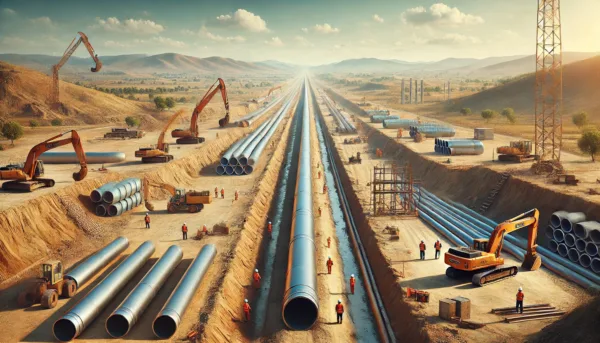
Naturgy Energy Group, S.A. (BME), through its international generation subsidiary Global Power Generation, has begun construction of the Fraser Coast Hybrid Project in Queensland, Australia, with planned investment exceeding €300 million. The development near Gigoomgan will combine roughly 330MW of solar capacity with a 180MW/360MWh battery energy storage system and is scheduled to begin operating in 2028. Electricity from the project is supported by a 10-year power purchase agreement with an unnamed major global company, while grid connection is planned through Powerlink’s 275kV Teebar Creek Substation. The construction start matters because it moves Naturgy’s largest renewable investment in Australia beyond permitting and development into a capital-intensive delivery phase where battery integration, grid readiness and contractor performance will determine commercial value. Naturgy shares traded around €28.98 during the July 20 session, up about 2.5% over five sessions and approximately 1% over one month, leaving the stock close to its 52-week high of €29.94.
Why does Naturgy’s Fraser Coast construction start matter for Queensland’s energy transition?
The construction start is strategically important because Fraser Coast has moved beyond the category of announced Australian renewable capacity. Global Power Generation now has a physical build programme involving solar equipment, battery systems, civil works, electrical infrastructure and grid integration. That transition reduces development uncertainty but creates a new set of construction, commissioning and operating risks that investors must evaluate differently.
Queensland needs more generation capacity as population, industrial consumption, mining activity, electrification and data infrastructure place additional pressure on the electricity system. Solar resources can supply relatively low-cost electricity during daylight hours, but the state also requires assets capable of supporting demand when solar output declines. Fraser Coast’s battery component gives the project a more useful operating profile than a conventional solar development that must sell nearly all its electricity when the sun is producing.
The battery is designed with 180MW of power and 360MWh of energy capacity, giving it an approximately two-hour duration at maximum rated output. This configuration can support evening demand, wholesale market trading and frequency-control services, although it cannot provide overnight or multi-day energy coverage. The project should therefore be viewed as a flexible short-duration asset rather than a substitute for long-duration storage, firm generation or transmission investment.
The project’s location also matters. It will occupy approximately 500 hectares of predominantly agricultural land around 50 kilometres southwest of Maryborough. Large renewable developments increasingly face scrutiny over land use, biodiversity, visual impact and community benefits. Naturgy must therefore deliver grid and electricity-market value while maintaining support among host landowners, First Nations communities and local residents.
How will the 330MW solar plant and 180MW/360MWh battery operate as one hybrid asset?
Global Power Generation’s current project information describes the solar component as approximately 333MW direct current and 290MW alternating current, supported by nearly 538,000 solar panels and 6,776 single-axis trackers. The wider announcement refers to the development as a roughly 330MW solar project, reflecting the common industry practice of discussing headline photovoltaic capacity using direct-current values.
The trackers will allow panels to follow the sun across the day, increasing energy production compared with fixed-tilt systems. The electricity will move through photovoltaic inverters before being exported to the grid or used to charge the battery. The battery system will include 84 storage units and 56 battery inverters, creating a separate but connected dispatchable asset within the hybrid facility.
The operating strategy will depend on market prices, contractual requirements and grid conditions. Global Power Generation can charge the battery during periods of strong solar production or lower wholesale prices and discharge it during more valuable demand periods. The system may also participate in frequency-control markets, where batteries can respond faster than most conventional generators when the grid requires rapid balancing.
The key commercial advantage is the ability to separate the timing of generation from the timing of delivery. A solar farm without storage is heavily exposed to daylight electricity prices, which can decline when several projects produce simultaneously. The Fraser Coast battery can retain part of that production and sell it later, potentially improving realised revenue and reducing exposure to solar-price cannibalisation.
The limitation is duration. A two-hour battery cannot shift the entire daily solar output into the evening, and it may fill before all surplus energy has been captured. Global Power Generation must optimise which electricity to export immediately, which electricity to store and which market services generate the best risk-adjusted returns. The panels produce the electrons, but the software increasingly decides whether those electrons are commercially useful.
Why does a 10-year PPA improve bankability without removing merchant and counterparty risk?
The 10-year power purchase agreement strengthens the project because it provides a contracted revenue foundation during the early operating period. Large renewable projects require significant upfront investment, and lenders and equity investors prefer predictable cash flows capable of supporting debt service and expected returns. A credible corporate offtaker can reduce exposure to volatile wholesale prices and make construction financing easier to secure.
Naturgy has not publicly identified the customer in the latest announcement, describing it only as a major global company. The unnamed status prevents a detailed assessment of the buyer’s credit quality, electricity requirements and contractual obligations. The existence of the agreement is positive, but the full value depends on pricing, volume commitments, settlement structure, performance conditions and termination protections.
The 10-year contract also does not cover the entire expected operating life of the project. Solar plants and battery facilities can operate for considerably longer, although battery cells will require augmentation or replacement over time. Naturgy will therefore retain exposure to electricity-market conditions after the initial PPA expires unless the contract is extended or replaced.
The project may also have merchant exposure during the PPA period. Many corporate renewable agreements settle financially rather than requiring every unit of electricity to be physically delivered to the customer. Revenue can still vary depending on generation, spot prices, battery dispatch and the exact structure of the agreement.
Counterparty concentration is another consideration. A single large customer can provide strong revenue visibility, but it also creates dependence on that customer’s financial health and long-term energy strategy. Naturgy must ensure that the agreement protects the project if the buyer changes its electricity demand, corporate structure or sustainability commitments.
How does the Teebar Creek grid connection shape project value and execution risk?
Fraser Coast is planned to connect through Powerlink’s 275kV Teebar Creek Substation, giving the project access to Queensland’s high-voltage transmission network and the wider National Electricity Market. That connection is essential because a large solar and battery facility has little commercial value if electricity cannot be exported reliably.
Transmission access is increasingly one of the biggest constraints facing Australian renewable developers. Projects can have strong resources, land agreements and customers yet remain delayed by network studies, congestion, system-strength requirements or expensive connection works. Grid access has become a competitive asset rather than an administrative step completed near the end of development.
The Teebar Creek connection could give Fraser Coast access to regional demand and allow the battery to respond to National Electricity Market price and frequency signals. The project may also complement other planned renewable and battery infrastructure around the same substation, potentially strengthening the region’s role as an energy hub.
However, multiple projects seeking access in the same area can create congestion and competition for transmission capacity. Network modelling must account for how solar output, battery charging and battery discharge affect power flows under different conditions. Global Power Generation may need to comply with operating limits or undertake additional technical work to satisfy Powerlink and the Australian Energy Market Operator.
Grid commissioning will remain a critical schedule risk. Solar panels and battery units can be installed before the network connection is ready, leaving completed equipment unable to generate full revenue. Naturgy’s 2028 operating target therefore depends on close coordination between project construction, substation work, transmission approvals and system testing.
What does Fraser Coast reveal about Naturgy’s current renewable expansion strategy in Australia?
Fraser Coast is Naturgy’s largest renewable investment in Australia and its second hybrid solar and battery project in the country. The project follows the Cunderdin hybrid facility in Western Australia, giving Global Power Generation operating experience with combining photovoltaic generation and storage under Australian market conditions.
Australia has become an important international renewable market for Naturgy because it offers strong wind and solar resources, transparent electricity trading and rising demand for storage. Global Power Generation currently operates or develops projects across Queensland, New South Wales, Victoria, Western Australia and the Australian Capital Territory.
The investment also fits Naturgy’s current group strategy. The company reports approximately 18.7GW of total installed generation capacity, including around 8GW of renewable power, and has allocated €6.4 billion of investment under its 2025 to 2027 Strategic Plan. Fraser Coast provides a sizeable international project capable of supporting renewable capacity growth beyond Naturgy’s core Spanish market.
Australia also offers useful diversification. Naturgy’s earnings remain exposed to European gas, electricity regulation and Iberian market conditions. International generation assets can broaden the revenue base and create exposure to markets with different demand, pricing and regulatory cycles.
The challenge is converting international growth into attractive returns. Australia’s renewable market is competitive, wholesale prices can be volatile and connection processes can be demanding. Global Power Generation must demonstrate that its operating and commercial expertise can produce stronger economics than simply accumulating megawatts across a map.
How should investors read Naturgy’s share-price strength before first-half results?
Naturgy shares traded around €28.98 on July 20, compared with the July 17 close of €28.84. The stock has gained approximately 2.5% over five sessions and around 1% over one month, while remaining within a 52-week range of €24.30 to €29.94. That places Naturgy near the upper end of its annual trading band.
The market reaction to Fraser Coast is unlikely to be dramatic because the project remains modest relative to Naturgy’s overall regulated networks, gas, electricity and generation portfolio. The construction start adds strategic value and supports the renewable investment narrative, but commercial operation is not expected until 2028.
Investor attention is also shifting toward Naturgy’s first-half 2026 results scheduled for July 22. The market will focus on earnings resilience, net debt, investment deployment, gas-market performance, regulated infrastructure and progress under the 2025 to 2027 Strategic Plan. Fraser Coast may feature as evidence of capital deployment, but it will not dominate the financial discussion.
The stock’s proximity to its 52-week high raises the execution standard. Investors appear to be assigning value to Naturgy’s defensive earnings, dividend profile, balance-sheet capacity and strategic investment programme. A company trading near annual highs must show that international renewable projects support returns rather than merely satisfy capacity targets.
Fraser Coast therefore adds to a constructive equity narrative without independently justifying a re-rating. The stronger market signal will come when Naturgy discloses whether renewable investment is translating into higher operating earnings and whether capital expenditure remains compatible with debt and shareholder remuneration.
What construction, equipment and commissioning risks could delay the 2028 operation target?
The most immediate risk is construction coordination across a large and technically mixed site. Global Power Generation must manage panel installation, tracker systems, battery units, inverters, transformers, internal roads, drainage, substation equipment and transmission connection work. Delays in one package can affect several later commissioning activities.
Equipment procurement remains another risk. Solar modules, battery cells, inverters, transformers and control systems are sourced through international supply chains exposed to shipping disruption, tariffs, commodity prices and currency movements. Naturgy must maintain cost control despite committing more than €300 million to the development.
Battery performance creates a longer-term challenge. The system must maintain power and usable energy capacity despite repeated charging and discharging. Degradation will gradually reduce available capacity, meaning the project may require battery augmentation or replacement to continue meeting commercial obligations.
Fire safety and emergency response will receive close attention. Utility-scale batteries require thermal monitoring, separation, detection systems, firefighting procedures and coordination with local emergency services. A serious incident would affect not only one asset but also community confidence in battery projects across Queensland.
Weather can influence construction and operations. Heavy rainfall may affect civil works and access, while high temperatures can reduce solar-module efficiency and place additional demands on battery cooling systems. The operating design must account for Queensland conditions rather than relying only on standard equipment assumptions.
The final risk is commissioning integration. Solar generation, storage controls and grid systems must respond as one coordinated facility. A battery can be physically complete while still unable to trade if control software, metering or network compliance tests remain unresolved.
How could the project affect local communities, landowners and Queensland’s supply chain?
The construction phase is expected to create up to 400 jobs at peak, providing demand for civil contractors, electrical workers, transport providers, accommodation and local services. The duration and quality of those benefits will depend on how much procurement is placed with Queensland and Fraser Coast businesses rather than imported through national contracting groups.
Long-term employment will be considerably lower because solar and battery facilities are less labour intensive after commissioning. The local economic case must therefore include rates, land payments, community programmes and contracting opportunities rather than relying only on permanent job numbers.
Naturgy has committed more than A$700,000 to community benefit initiatives during construction, with continuing support planned once the project becomes operational. The programme is expected to include engagement with First Nations communities and other regional organisations.
Host landowners gain lease income while retaining surrounding agricultural activity, but construction may alter access, drainage and land management. Global Power Generation will need to manage relationships across the operating life of the asset rather than treating engagement as a temporary approval exercise.
Biodiversity and vegetation management will also remain important. Renewable energy reduces operating emissions, but large projects still have physical impacts. The credibility of the energy-transition argument depends on how well the project protects waterways, habitats and culturally significant areas.
The project’s social licence will ultimately be measured by whether regional communities see durable benefits after the construction workforce leaves. Solar panels are excellent at remaining in one location for decades. Community trust requires a little more maintenance.
Could Fraser Coast become a template for Australian solar-and-storage investment?
Fraser Coast could become a useful template because it combines several elements increasingly required for successful Australian renewable development: solar generation, co-located storage, a corporate power purchase agreement, high-voltage grid access and a defined community benefit programme.
The hybrid structure addresses the declining value of unshifted daytime solar electricity. As Australia adds more photovoltaic capacity, projects increasingly need storage, flexible contracts or differentiated grid locations to protect revenue. Fraser Coast’s two-hour battery provides one response, even though longer-duration systems may eventually become more valuable as evening and overnight flexibility needs grow.
The project also demonstrates how international utilities are approaching Australia. Naturgy is using Global Power Generation as an operating platform capable of developing projects across several states rather than making a single opportunistic investment. That platform approach can spread procurement, technical and market expertise across multiple assets.
Competitors will watch whether the project reaches operation on schedule, manages connection risk and produces attractive returns under its PPA and merchant exposure. Strong performance could encourage more international investment in hybrid developments. Weak performance could reinforce concerns around Australian grid access and renewable-price cannibalisation.
The expert assessment is that Fraser Coast has a credible commercial foundation, but the construction start only changes the type of uncertainty. Naturgy has largely moved beyond development risk. It now faces the harder and more expensive questions of delivery, grid integration and long-term battery economics.
What are the key takeaways from Naturgy’s Fraser Coast Hybrid Project construction start?
- Naturgy has begun confirmed construction of the Fraser Coast Hybrid Project rather than announcing another early-stage Australian renewable proposal.
- The development involves more than €300 million of investment and is Naturgy’s largest renewable infrastructure project in Australia.
- The project combines approximately 333MWdc of solar capacity with a 180MW/360MWh battery energy storage system.
- The two-hour battery can shift solar production and provide fast grid services, but it cannot offer overnight or long-duration energy coverage.
- A 10-year PPA with an unnamed major global company provides revenue support, although pricing, volume and counterparty terms remain undisclosed.
- Connection through Powerlink’s 275kV Teebar Creek Substation gives the project high-voltage grid access but creates transmission and commissioning dependencies.
- Commercial operation is targeted for 2028, leaving Naturgy exposed to equipment, contractor, weather and grid-connection risks during construction.
- Naturgy shares are trading close to their 52-week high, suggesting investors already expect disciplined investment and resilient earnings.
- The project strengthens Global Power Generation’s Australian hybrid portfolio after the Cunderdin solar and battery development.
- Fraser Coast’s ultimate value will depend on whether storage, contracted revenue and grid access protect returns as daytime solar prices become more competitive.
Discover more from Business-News-Today.com
Subscribe to get the latest posts sent to your email.