Novo Nordisk A/S (NYSE: NVO; Nasdaq Copenhagen: NOVO-B) has entered a potential $1.4 billion drug-discovery and licensing partnership with Danish biotechnology company Orbis Medicines targeting oral treatments for cardiometabolic diseases. The multi-target collaboration will use Orbis’ artificial-intelligence-enabled nGen platform to design synthetic macrocycles capable of addressing biological targets that have traditionally required injectable medicines. Novo Nordisk will also make an undisclosed strategic investment in privately held Orbis.
The financial headline requires qualification. The companies did not disclose how much Novo Nordisk will pay upfront, how the $1.4 billion is divided among development and commercial milestones, or the size of Novo Nordisk’s equity investment. Orbis will additionally be eligible for tiered royalties on future product sales, meaning the maximum transaction value would depend on successful development and commercialisation rather than representing an immediate $1.4 billion payment.
What are macrocycles and why does Novo Nordisk want oral versions?
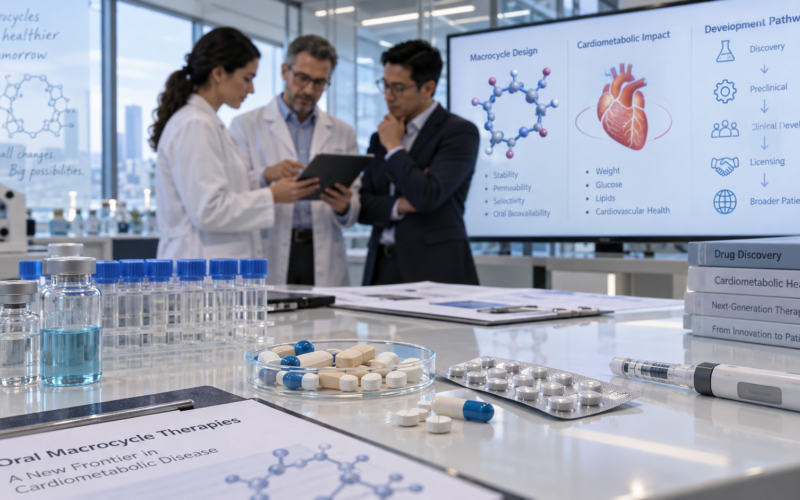
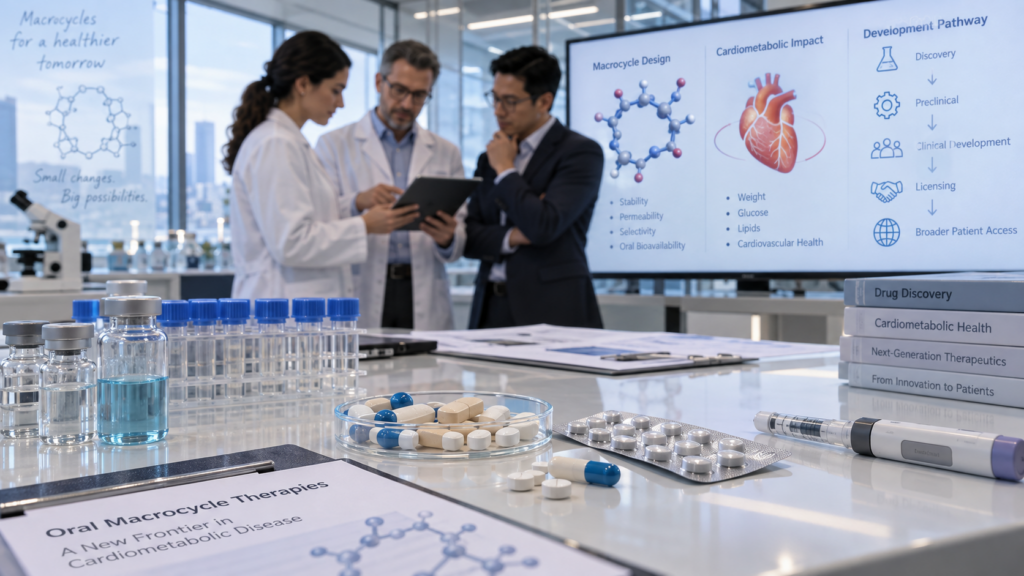
Macrocycles are ring-shaped molecules positioned between conventional small-molecule drugs and much larger biological medicines. Their structure can allow them to interact with biological targets that are difficult for traditional oral drugs to reach while potentially retaining enough stability to survive administration through the digestive system.
That combination is commercially attractive because many important peptide and protein targets currently require injections. Turning more of those treatments into tablets could make therapy easier for patients, broaden prescribing and reduce some of the manufacturing and distribution complexity associated with injectable products.
Orbis Chief Executive Morten Graugaard told Reuters that synthetic macrocycles developed using the company’s platform had achieved oral bioavailability of as much as 18% in preclinical testing. That result is preliminary and does not establish that future Novo Nordisk programmes will achieve similar performance in humans, but it helps explain why the technology attracted a transaction with milestone potential of $1.4 billion.
The collaboration will focus on multiple cardiometabolic targets rather than a single disclosed drug candidate. That gives Novo Nordisk the opportunity to apply the platform across a broader pipeline if early research proves productive.
Why is oral delivery becoming so important in the obesity drug market?
The obesity treatment market began its current expansion around weekly injections such as Novo Nordisk’s Wegovy and Eli Lilly and Company’s Zepbound. Injectable therapies can produce substantial weight loss, but needles remain a barrier for some patients and injectable manufacturing has historically created capacity constraints.
Oral medicines can potentially broaden the treatment population. Tablets are easier to store, distribute and administer, while manufacturing economics may eventually differ materially from those of injection pens.
Novo Nordisk already has an important position in this transition. Wegovy pill, based on oral semaglutide, has been expanding rapidly in the United States, and Novo Nordisk said weekly prescriptions exceeded 265,000 by the week ending July 17. The company has also launched the product in additional international markets after regulatory approvals.
The Orbis transaction addresses a different technological route. Novo Nordisk’s current oral peptide approach uses absorption-enhancing technology to help semaglutide survive and enter the bloodstream. Synthetic macrocycles could potentially create drug candidates inherently better suited to oral administration and capable of hitting targets beyond semaglutide.
That makes the partnership more strategically interesting than simply developing another formulation of an existing medicine.
How intense is the competition between Novo Nordisk and Eli Lilly becoming?
The obesity market has expanded dramatically while competitive pressure has intensified. Novo Nordisk pioneered the commercial category with Wegovy, but Eli Lilly gained substantial momentum through tirzepatide-based Mounjaro and Zepbound.
The battle is increasingly moving into oral treatments. Reuters reported earlier in September that Eli Lilly’s oral obesity drug Foundayo had already captured more than 30% of new US patients starting oral weight-loss medicines, although Novo Nordisk’s Wegovy pill remained the larger established product.
Novo Nordisk itself expects oral therapies to become a substantial portion of the long-term obesity market. The strategic logic is straightforward: patients have different preferences, and the company that offers effective injectable and oral options can address a larger population.
The Orbis agreement therefore should be viewed as pipeline insurance as much as an individual research partnership. Novo Nordisk does not know today which mechanisms or delivery technologies will define cardiometabolic medicine in the 2030s, so it is securing access to additional discovery platforms while its existing franchises remain commercially powerful.
Can Novo Nordisk afford another large pipeline partnership while its growth outlook remains under scrutiny?
Novo Nordisk generated DKK175.3 billion of reported sales during the first half of 2026 and DKK86.7 billion of reported operating profit. On an adjusted basis, first-half sales were DKK148.6 billion and adjusted operating profit was DKK66.2 billion.
Second-quarter adjusted sales increased 7% at constant exchange rates while adjusted operating profit rose 11%. Obesity-care adjusted sales increased 16% at constant exchange rates, confirming that the underlying market remains large even as competition intensifies.
The company nevertheless expects full-year adjusted sales and adjusted operating profit growth between 0% and negative 6% at constant exchange rates. That unusual guidance range reflects pricing pressure, changing rebate economics and a more competitive US market even while volumes increase.
Novo Nordisk therefore has considerable financial capacity but also strong incentive to replenish its pipeline. A company deriving such a large portion of earnings from diabetes and obesity cannot assume current GLP-1 products will maintain the same competitive position indefinitely.
Why is Novo Nordisk using external technology instead of relying entirely on internal research?
Large pharmaceutical companies routinely combine internal discovery with partnerships because no organisation can independently develop every promising technology. External deals allow them to access specialist platforms while delaying the largest payments until programmes achieve scientific or regulatory milestones.
The Orbis structure follows that logic. Novo Nordisk gains access to an AI-enabled macrocycle platform and can pursue selected cardiometabolic targets, while Orbis receives capital, validation and potentially large milestone and royalty economics if medicines succeed.
The collaboration also comes as Novo Nordisk broadens its use of artificial intelligence in drug development. The company has separately announced work with Anthropic around applying Claude models to research and development processes, illustrating that AI is being introduced both at the molecular-discovery level and across wider pharmaceutical workflows.
AI itself does not remove biological risk. Drug candidates still must demonstrate safety, efficacy, manufacturability and clinical value. The technology can potentially narrow the search space and improve molecule design, but clinical trials remain the ultimate test.
What does Novo Nordisk’s share performance say about investor expectations?
Novo Nordisk’s US-listed shares had fallen about 18% year to date in market data through September 17 and remained well below their 52-week high. The American depositary receipts were trading around $42 to $43 during the September 17 session, rising roughly 2.5% on the day after several weak sessions earlier in the week.
The broader decline reflects concerns about competition, pricing and the sustainability of the extraordinary growth investors once expected from the obesity franchise. That sentiment makes pipeline deals increasingly relevant because the market wants evidence that Novo Nordisk can create a second generation of differentiated medicines rather than relying indefinitely on semaglutide.
The company’s Capital Markets Day on September 21 becomes the next important catalyst. Novo Nordisk has said management will provide a comprehensive update covering strategy, research and development, operations and performance.
The Orbis deal arrives at an ideal moment for that discussion.
Novo Nordisk already helped turn injectable GLP-1 medicines into one of pharmaceuticals’ largest commercial categories. Its next challenge is ensuring that the shift toward oral treatment expands its opportunity rather than eroding the advantage it built with injections.
Discover more from Business-News-Today.com
Subscribe to get the latest posts sent to your email.