

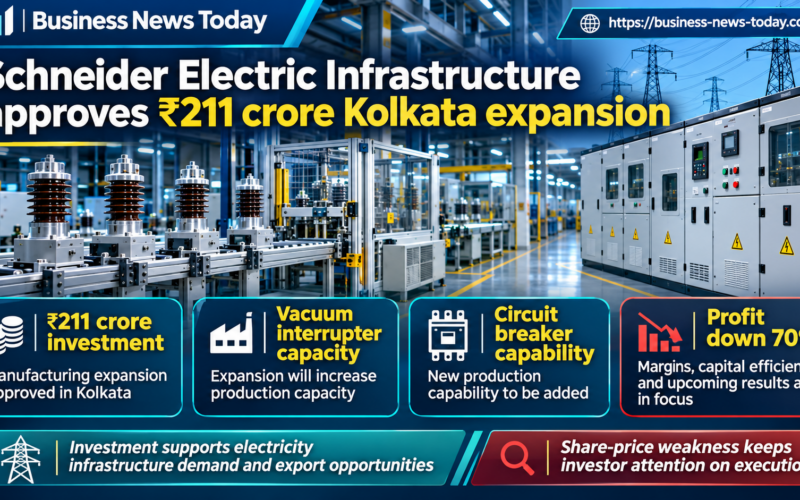
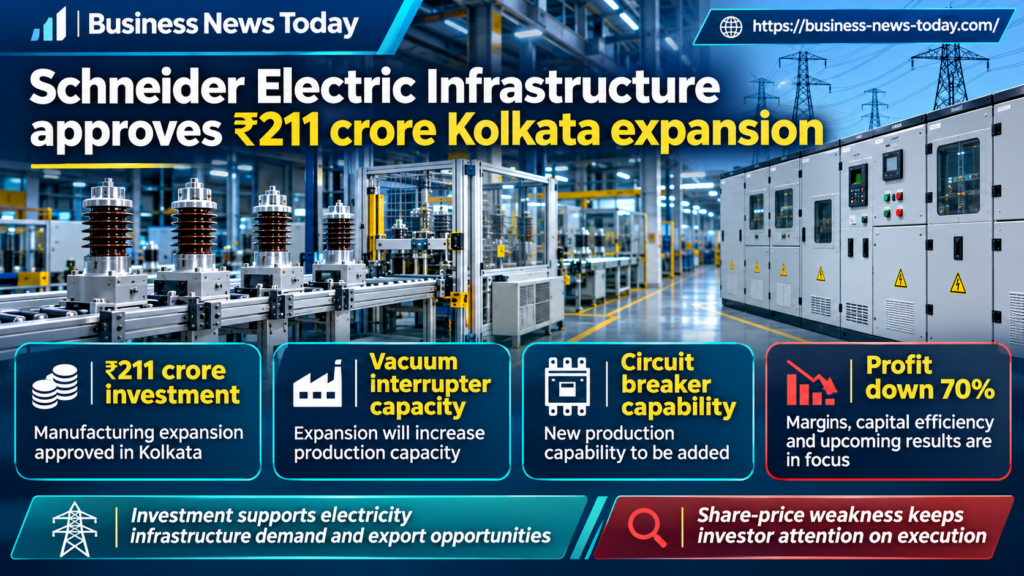
Schneider Electric Infrastructure Limited (NSE: SCHNEIDER, BSE: 534139) has approved a ₹211 crore expansion at its Kolkata Medium Voltage Components facility, increasing planned annual vacuum interrupter manufacturing capacity from 250,000 to 375,000 units and adding capacity for 18,000 circuit breakers. Announced on 29 October 2026, the investment is intended to support manufacturing localisation, export growth and technology upgrades, with completion targeted by the end of FY2028-29. The decision follows a period of substantial order-book expansion, with outstanding orders reaching ₹2,169 crore at 30 June 2026, approximately 33% higher than a year earlier. However, first-quarter profit fell nearly 70% as commodity costs and slower project execution affected profitability, exposing a gap between the company’s expanding manufacturing ambitions and its recent financial performance. The next challenge is converting growing demand for electrical equipment into stronger earnings while financing additional production capacity.
The Kolkata announcement also extends an investment programme that had already undergone revisions earlier in 2026. In July, Schneider Electric Infrastructure raised the planned expenditure for vacuum interrupter capacity expansion and separately revised investment in a mechanism assembly line. The latest approval therefore represents another stage in the facility’s development, rather than the creation of an entirely new manufacturing operation.
How will Schneider Electric Infrastructure’s ₹211 crore Kolkata investment increase vacuum interrupter and circuit breaker capacity?
The expansion focuses on the company’s Kolkata Medium Voltage Components facility, which manufactures components used in electrical switching and distribution equipment. Schneider Electric Infrastructure plans to increase annual vacuum interrupter capacity by 125,000 units, taking the proposed total from 250,000 to 375,000. The 50% increase is intended to support future manufacturing requirements as well as the company’s export ambitions.
The company has also approved capacity for an additional 18,000 circuit breakers annually. Vacuum interrupters and circuit breakers are closely related products, but they serve different positions within the manufacturing value chain. Vacuum interrupters are components used within switching devices to interrupt electrical current, whereas complete circuit breakers incorporate additional mechanisms, insulation, controls and assemblies.
The two capacity additions should consequently be evaluated separately. Increasing vacuum interrupter production can improve component availability for downstream electrical equipment manufacturing, while expanding breaker assembly capability may support a broader range of finished products and customer requirements. Their combined commercial contribution will depend on product specifications, internal consumption, external sales and manufacturing efficiency.
Schneider Electric Infrastructure expects the proposed additions to be completed by the end of FY2028-29, meaning March 2029. The company has identified internal accruals and external borrowings as potential funding sources, without disclosing a definitive split between them. The ₹211 crore approval establishes the planned expenditure but does not provide a detailed annual spending schedule or a quantified revenue contribution from the additional capacity.
The proposed investment is equivalent to approximately 7.3% of the company’s ₹2,891 crore revenue reported for FY26. While that comparison indicates the scale of the project relative to annual sales, it does not measure the expected return on capital. The financial outcome will depend on the timing of commissioning, utilisation of the additional production lines and the margins achieved on their output.
Why is the Kolkata expansion more complicated than a straightforward 50% manufacturing capacity increase?
The latest capacity announcement must be interpreted alongside Schneider Electric Infrastructure’s previous disclosures about the same facility. On 3 July 2026, the company approved an increase in planned capital expenditure for vacuum interrupter manufacturing from ₹138 crore to ₹184 crore. That earlier programme involved raising proposed annual capacity from 180,000 to 250,000 units.
At the time of the July disclosure, the company reported existing operational vacuum interrupter capacity of approximately 80,000 units annually, with utilisation of around 90%. The higher 250,000-unit capacity was still being developed, with completion targeted for the first quarter of FY2028-29, ending June 2028.
The October announcement explicitly states that the 250,000-unit capacity is being installed in phases. Consequently, the newly disclosed 375,000-unit target represents a 50% increase over the previously planned capacity, not a 50% increase over the manufacturing capability already fully operational in July.
Measured against the 80,000-unit operational reference disclosed in July, the eventual 375,000-unit target would represent a much larger expansion. However, that comparison spans multiple approved and ongoing investment phases and should not be treated as a single new project or an immediate increase in production.
The distinction is important when estimating future manufacturing output. Capacity additions that remain under installation cannot generate the same production volumes as commissioned and fully operational lines. Even after completion, manufacturing utilisation will depend on equipment qualification, operating schedules, product demand and supply-chain readiness.
The company has therefore established a multi-stage manufacturing development programme with different milestones. The near-term operational evidence will come from commissioning progress on previously approved lines, while the latest 125,000-unit increase represents a further expansion scheduled for completion by March 2029.
How does the October investment relate to Schneider Electric Infrastructure’s earlier ₹184 crore and ₹107.2 crore approvals?
The Kolkata facility has been the subject of several investment decisions covering vacuum interrupter manufacturing and associated assembly capabilities. In July 2026, the board revised expenditure on vacuum interrupter capacity from ₹138 crore to ₹184 crore, an increase of ₹46 crore. The company attributed the additional expenditure to further capacity enhancements and project execution requirements.
The same July announcement separately revised investment in a mechanism assembly line from ₹90.6 crore to ₹107.2 crore. That increase was intended to support the company’s manufacturing development, future growth and export opportunities. The revised amounts demonstrated that the capital requirements of the Kolkata programme were already evolving before the October decision.
The latest disclosure describes a ₹211 crore investment to further increase vacuum interrupter capacity and add breaker capacity. It refers to the earlier announcements but does not provide a comprehensive reconciliation of expenditure already approved, spent or superseded across the different project phases.
Accordingly, the ₹211 crore should not automatically be added to every previously announced investment figure to produce a definitive cumulative project cost. Such a calculation could overstate the total commitment if particular expenditure categories overlap or if the latest approval revises elements of the earlier programme.
The commercial significance extends beyond the accounting presentation of capital expenditure. Schneider Electric Infrastructure is expanding manufacturing capabilities over several years, meaning the financial return will be determined by the combined performance of successive production investments rather than the isolated economics of one approval.
Greater clarity on cumulative capital expenditure, completed capacity and expected manufacturing utilisation would help investors assess the programme more accurately. The company’s future disclosures will be particularly useful if they identify the expenditure incurred and the operational capacity commissioned under each development phase.
Why are vacuum interrupters and medium-voltage switchgear important to India’s electricity infrastructure expansion?
Vacuum interrupters are essential components in many medium-voltage switching applications. They enable electrical circuits to be interrupted safely by extinguishing the arc formed when contacts separate under load or fault conditions. The technology is widely used in circuit breakers and other switching equipment serving industrial facilities, electricity distribution networks and infrastructure installations.
India’s electricity infrastructure is undergoing substantial investment as generation capacity increases, industrial demand grows and power networks accommodate a changing energy mix. The Ministry of Power’s National Electricity Plan for transmission envisages expanding the country’s transmission network to approximately 6.48 lakh circuit kilometres by 2032, alongside significant additions to transformation capacity.
The expansion of national transmission infrastructure does not translate directly into demand for every medium-voltage component. High-voltage transmission lines and medium-voltage distribution equipment operate at different points in the electricity network. Nevertheless, investment in new substations, industrial connections, distribution infrastructure and downstream power systems can create demand for switching and protection equipment.
The government has also outlined substantial expansion requirements for distribution infrastructure, including substations, distribution transformers and feeder networks. These developments provide a broader industrial setting for manufacturers supplying electrical distribution and control equipment.
Schneider Electric Infrastructure’s product portfolio includes transformers, medium-voltage switchgear, circuit breakers, ring main units, protection relays, automation systems and related services. The Kolkata programme focuses on particular components within this wider business rather than the entire range of equipment used in electricity networks.
Demand is also emerging from commercial and industrial facilities with increasingly complex electricity requirements. Data centres, semiconductor manufacturing, renewable energy installations and other electricity-intensive industries require reliable power distribution and protection systems.
These sectors provide potential markets for Schneider Electric Infrastructure’s products, although the newly announced capacity should not be interpreted as evidence of specific contracts from those industries. The financial opportunity will depend on actual customer orders, the products required and the company’s ability to manufacture them competitively.
What does Schneider Electric Infrastructure’s ₹2,169 crore order backlog reveal about demand for its electrical equipment?
Schneider Electric Infrastructure reported its highest-ever quarterly order intake of ₹915 crore during the first quarter of FY27, covering April to June 2026. The figure represented a modest year-on-year increase of approximately 0.5%, but it supported an expansion in the company’s outstanding order backlog to ₹2,169 crore at the end of June.
The backlog was 32.7% higher than the corresponding figure a year earlier and had increased from ₹1,911 crore at 31 March 2026. The sequential rise of approximately ₹258 crore indicates that incoming orders exceeded the value of business converted into sales and other backlog movements during the quarter.
The relationship between orders and revenue provides an indication of the company’s future workload. The ₹2,169 crore backlog was equivalent to approximately 75% of FY26 annual revenue, suggesting meaningful business visibility based on the company’s latest disclosed operating performance.
However, order-book value is not equivalent to revenue already earned. Electrical infrastructure orders can involve different combinations of equipment manufacturing, engineering, installation, commissioning and services. Revenue recognition depends on the applicable contract terms and delivery or execution milestones.
Management has identified data centres and semiconductor manufacturing among the emerging areas supporting demand. These sectors can involve technically demanding electrical systems, potentially creating opportunities for higher-value equipment and integrated solutions.
The timing of order conversion remains important. A growing backlog can support manufacturing investment if demand is sustained, but longer execution cycles may delay the contribution to reported sales. The company’s first-quarter results demonstrated that strong new orders and immediate earnings growth do not necessarily occur together.
The planned Kolkata expansion is therefore more appropriately viewed as an investment in future manufacturing capability rather than a direct response to a disclosed order backlog for vacuum interrupters alone. The company has not provided a separate order-book figure specifically attributable to the proposed 375,000-unit production capacity.
Why did Schneider Electric Infrastructure’s Q1 FY27 profit fall nearly 70% despite revenue growth and record orders?
Schneider Electric Infrastructure’s latest reported quarterly financial results provide a contrasting picture to its manufacturing expansion plans. Revenue from operations increased 4.8% year on year to ₹651.4 crore during Q1 FY27, compared with approximately ₹621.6 crore in the corresponding quarter of FY26.
Net profit declined 69.8% to ₹12.4 crore from ₹41.2 crore, substantially underperforming revenue growth. Profit before tax fell to approximately ₹17 crore from ₹55.9 crore, reflecting the deterioration in earnings during the period.
The company’s reported earnings before interest and tax declined from approximately ₹66.7 crore to ₹32.1 crore. This represented a reduction of nearly 52%, despite the increase in sales. The decline points to operating cost pressures and weaker profitability on the business executed during the quarter.
Management attributed the deterioration partly to volatility in commodity prices and delays in passing higher input costs through to customers. Certain contracts had been secured at fixed prices before increases in material costs, creating pressure when they were subsequently executed.
Commodity movements can affect manufacturers of electrical equipment through changes in the cost of metals, components and imported materials. Where contracts contain fixed pricing arrangements, the ability to recover unexpected cost increases may be limited until newer orders with revised prices begin contributing to revenue.
The company also experienced relatively weak operating leverage. Revenue increased by less than 5%, leaving limited additional sales to absorb higher operating expenditure. When cost increases exceed the incremental revenue contribution, profit can deteriorate even as the order backlog expands.
Management has indicated that pricing and competitiveness initiatives are intended to address these pressures. Their effectiveness will depend on the proportion of existing contracts exposed to earlier input-cost assumptions and the timing at which newer orders enter execution.
For the Kolkata investment, the financial implication is that additional manufacturing capacity alone cannot guarantee stronger earnings. The company must achieve competitive production costs and sell the resulting output at prices that preserve adequate margins.
How has Schneider Electric Infrastructure’s profitability changed since FY25, and what does it mean for future investment?
The company’s financial performance had already moderated during FY26, before the sharp first-quarter FY27 decline. Annual revenue increased approximately 9.6% to ₹2,891 crore, demonstrating that underlying business activity continued growing.
However, annual EBITDA declined to approximately ₹388.8 crore from ₹407.3 crore in FY25. The reported EBITDA margin on total income fell from approximately 15.3% to 13.4%, indicating that higher sales were accompanied by weaker operating profitability.
Profit after tax declined from approximately ₹267.9 crore in FY25 to ₹212.6 crore in FY26, a reduction of about 20.7%. The decrease shows that profitability pressures were not confined to the June 2026 quarter, although their severity increased in that period.
The contrast between revenue growth and declining profit illustrates the importance of product mix, input-cost management and contract execution in the electrical equipment business. Equipment manufacturers may benefit from growing demand while still experiencing margin pressure when procurement costs or project-related expenditure increase faster than selling prices.
The expanding manufacturing programme introduces further financial considerations. New production assets can improve output and reduce certain manufacturing bottlenecks, but they also introduce depreciation, maintenance and other operating expenses after commissioning.
If higher capacity produces sufficient profitable sales, these costs can be absorbed across greater production volumes. If utilisation remains below commercial expectations, the new facilities may increase the fixed-cost burden without generating proportionate earnings.
The most useful financial measure will therefore be the incremental profit and cash flow produced by the investments after commissioning. A recovery in existing operating margins would strengthen the financial foundation for the expansion, while continued profitability pressure could reduce the returns generated by additional capital expenditure.
Can Schneider Electric Infrastructure use the Kolkata plant to expand exports and strengthen manufacturing localisation?
Export growth is one of the stated objectives of the ₹211 crore investment. The company intends to increase domestic manufacturing capability while upgrading technology and supporting production requirements beyond the Indian market.
Local manufacturing of vacuum interrupters and associated switching components could strengthen supply-chain flexibility where components would otherwise need to be sourced from external facilities. It may also support the broader Schneider Electric group’s manufacturing network, subject to product specifications, commercial arrangements and customer demand.
However, membership of a global industrial group does not automatically guarantee export orders or a particular volume of business for the listed Indian company. The actual commercial benefits will depend on the allocation of manufacturing programmes, product competitiveness and the terms under which equipment or components are supplied.
Schneider Electric Infrastructure has not provided a specific export revenue target associated with the Kolkata expansion. Management has previously indicated that the plant is expected to support increasing export value as capacity becomes available, but it has not quantified the eventual proportion of total revenue that exports might represent.
The technology upgrade element is also important because production efficiency and product specifications can influence market access. Higher automation, improved manufacturing processes and more consistent component quality could support competitiveness, although the company has not disclosed a project-specific estimate of cost savings.
Export opportunities may provide an additional route to capacity utilisation if domestic demand develops more slowly than expected. They also introduce exposure to international pricing, currency movements and customer qualification requirements.
The most convincing evidence of commercial success would be higher export sales accompanied by sustainable manufacturing margins. Capacity expansion and localisation can create the opportunity to compete for additional business, but actual contracts and profitable production will determine whether the strategy generates value.
How might Schneider Electric Infrastructure finance the ₹211 crore project while maintaining capital discipline?
Schneider Electric Infrastructure has indicated that the Kolkata expansion will be financed through internal accruals and/or external borrowings. The disclosure provides flexibility in funding the investment but does not establish a particular borrowing amount, repayment schedule or financing cost.
Internal funding would allow the company to deploy cash generated from its operations, potentially reducing the need for incremental debt. Such an approach would nevertheless require sufficient operating cash flow after working capital commitments and other investment expenditure.
Borrowing could spread the financing burden over the project’s development period, but it would introduce interest costs and future repayment obligations. The financial attractiveness of debt funding depends on borrowing terms, the timing of drawdowns and the returns generated by the commissioned assets.
The ₹211 crore project is relatively modest compared with FY26 revenue, but it forms part of a wider manufacturing investment programme. Management has previously discussed substantial spending across production facilities in Kolkata and Vadodara, reflecting the company’s broader strategy of increasing local manufacturing capability.
The company’s existing earnings profile makes the timing of expenditure relevant. FY26 EBITDA and net profit declined despite revenue growth, while Q1 FY27 profitability weakened further. A prolonged period of reduced operating margins could limit the amount of internally generated cash available to finance additional investment.
Nevertheless, lower reported profitability does not by itself establish financial distress or an inability to fund the project. A proper assessment requires current cash balances, operating cash-flow performance, available financing facilities and the schedule of capital commitments.
The next financial results will help clarify the funding position. Investors will need to distinguish expenditure already incurred from approved future spending and assess whether the company’s financing requirements are increasing faster than operating cash generation.
Why did Schneider Electric Infrastructure shares fall 3.5% after the Kolkata expansion announcement?
Schneider Electric Infrastructure shares closed at ₹1,091.10 on the National Stock Exchange of India on Friday, 30 October 2026, declining ₹39.60, or 3.5%, from the previous close of ₹1,130.70. The session followed the announcement of the ₹211 crore Kolkata investment on 29 October.
The stock traded between ₹1,072.30 and ₹1,131.20 during the session, with approximately 1.14 lakh shares changing hands. The decline extended recent weakness, bringing the one-month share-price fall to approximately 9.3%.
The company’s shares had reached a 52-week high of ₹1,548 in July 2026 and a low of ₹571.85 in January. At the 30 October close, the stock was approximately 29.5% below its annual high, although it remained around 27.8% higher than a year earlier.
The combination of a strong one-year return and a substantial decline from the July peak suggests that longer-term investor expectations and recent market sentiment have diverged. The share-price movement coincided with the capacity announcement but cannot be attributed conclusively to that announcement alone.
The company had an equity market capitalisation of approximately ₹26,100 crore at the 30 October NSE closing price. That valuation was substantial relative to FY26 revenue of ₹2,891 crore and annual profit after tax of approximately ₹212.6 crore.
The market capitalisation represented roughly nine times FY26 annual revenue. Such a comparison is not a standalone valuation measure, but it illustrates the extent to which future growth and profitability expectations can influence the company’s equity valuation.
The investment case is consequently sensitive to whether rising orders and additional manufacturing capacity produce stronger earnings. If profitability remains under pressure, the company’s ability to support an elevated valuation multiple through future operating performance may be challenged.
The Kolkata project provides a longer-term opportunity for manufacturing growth, but it is not expected to be fully completed until March 2029. Investors assessing near-term financial performance must therefore rely principally on the existing business, its order book and the earlier phases of manufacturing expansion.
What will Schneider Electric Infrastructure’s 5 November results reveal about its recovery prospects?
Schneider Electric Infrastructure has scheduled a board meeting for 5 November 2026 to consider unaudited financial results for the quarter and half-year ended 30 September. The announcement creates a near-term financial milestone for investors evaluating the company’s expanding order portfolio and recent margin deterioration.
The results will be particularly important because the first quarter showed strong order intake but relatively weak revenue growth and a sharp decline in profit. A recovery in quarterly sales would provide evidence that previously secured orders are beginning to convert into reported revenue at a faster pace.
Profitability will remain a separate measure of progress. Management has attributed the earlier deterioration partly to commodity prices and the delayed recovery of input-cost increases on legacy contracts. Evidence of improving margins could indicate that pricing initiatives and changes in contract mix are beginning to offset those pressures.
Order intake and the outstanding backlog will provide additional context. At the end of June, Schneider Electric Infrastructure reported ₹2,169 crore of outstanding orders. An updated figure will show how new business acquisition and execution progressed during the September quarter.
Investors will also be looking for evidence of commissioning progress across existing manufacturing investment programmes. Management has previously indicated that additional capacity from ongoing expansion projects is expected to become available in stages, providing an opportunity to increase sales and improve operational flexibility.
The October Kolkata approval is too recent to have contributed to the September-quarter results. Its relevance to the upcoming financial announcement will instead lie in management commentary about cumulative capital expenditure, project schedules, export opportunities and the financing approach.
A stronger recovery narrative would combine improving revenue conversion, stabilising margins and evidence that manufacturing investments are progressing without disproportionate increases in financial commitments. Such developments would offer a more direct assessment of the business than the latest capacity approval alone.
Can the Kolkata investment strengthen Schneider Electric Infrastructure’s long-term competitive position despite near-term earnings pressure?
Schneider Electric Infrastructure’s latest investment reflects a strategy centred on manufacturing localisation, technical capability and participation in growing electricity infrastructure markets. Expanding vacuum interrupter production from a previously planned 250,000 units to 375,000 units annually could increase the company’s capacity to support medium-voltage switching equipment manufacturing and export requirements.
The project also illustrates a longer-term industrial commitment. Rather than relying only on higher sales through existing facilities, Schneider Electric Infrastructure is investing in production assets that may improve manufacturing scale and product availability over several financial years.
However, the programme remains dependent on staged commissioning. The previously planned 250,000-unit capacity is still being installed in phases, while the additional 125,000-unit increase and 18,000-unit breaker capacity are targeted for completion by March 2029.
The company’s latest operating results also demonstrate that market demand does not automatically produce higher profitability. Revenue and orders increased during FY26, but margins declined, and the deterioration continued into Q1 FY27. That recent history provides a clear financial benchmark against which the next expansion phase should be assessed.
Schneider Electric Infrastructure has the advantage of participating in an established electrical equipment market with growing requirements from utilities, industry and emerging power-intensive sectors. Its global group affiliation, manufacturing experience and product portfolio provide commercial capabilities that could support additional business, although the financial benefits for the listed entity must be demonstrated through its own reported results.
The more immediate challenge is restoring operating profitability while translating the enlarged order backlog into revenue. A sustained improvement in earnings would strengthen the case for further manufacturing investment and provide greater flexibility in financing the Kolkata programme.
The ₹211 crore approval therefore represents a meaningful addition to Schneider Electric Infrastructure’s manufacturing roadmap, but not yet evidence of incremental revenue or shareholder returns. The next measurable proof point will arrive with the 5 November results, particularly changes in sales execution, margins and the outstanding order book.
Over the longer term, the commercial success of the Kolkata expansion will depend on commissioning the planned capacity, securing sufficient domestic and export demand and producing components at competitive costs. Stronger order conversion and margin recovery would support the investment rationale, while slower utilisation or persistent cost pressures would reduce the earnings contribution expected from the enlarged manufacturing base.
What should investors know about Schneider Electric Infrastructure’s ₹211 crore Kolkata expansion, falling profits and November earnings?
– Schneider Electric Infrastructure Limited approved a ₹211 crore expansion at its Kolkata Medium Voltage Components facility on 29 October 2026, targeting additional manufacturing capacity and technology upgrades.
– The company plans to raise vacuum interrupter capacity from a previously planned 250,000 to 375,000 units annually, a 50% increase, alongside 18,000 units of additional circuit breaker capacity.
– The earlier 250,000-unit vacuum interrupter capacity is still being installed in phases, meaning the October announcement does not represent an immediate 50% increase in fully operational production capability.
– The proposed expansion is targeted for completion by March 2029 and will be financed through internal accruals and/or external borrowings, with the precise funding mix not yet disclosed.
– Schneider Electric Infrastructure reported a ₹2,169 crore order backlog at 30 June 2026, up approximately 32.7% year on year, following record first-quarter order intake of ₹915 crore.
– Q1 FY27 revenue increased 4.8% to ₹651.4 crore, but profit after tax declined approximately 69.8% to ₹12.4 crore as commodity costs and weaker operating leverage affected earnings.
– The company’s annual profitability had already moderated in FY26, with profit after tax falling approximately 20.7% despite revenue growth of 9.6%.
– Schneider Electric Infrastructure shares closed 3.5% lower at ₹1,091.10 on 30 October, approximately 29.5% below their July 2026 52-week high.
– The next quarterly results are scheduled for 5 November 2026, providing a near-term test of order conversion, margin recovery and progress across existing manufacturing investments.
– The Kolkata project’s longer-term financial contribution will depend on phased commissioning, export and domestic demand, manufacturing costs and the returns generated from additional capital expenditure.
Discover more from Business-News-Today.com
Subscribe to get the latest posts sent to your email.