



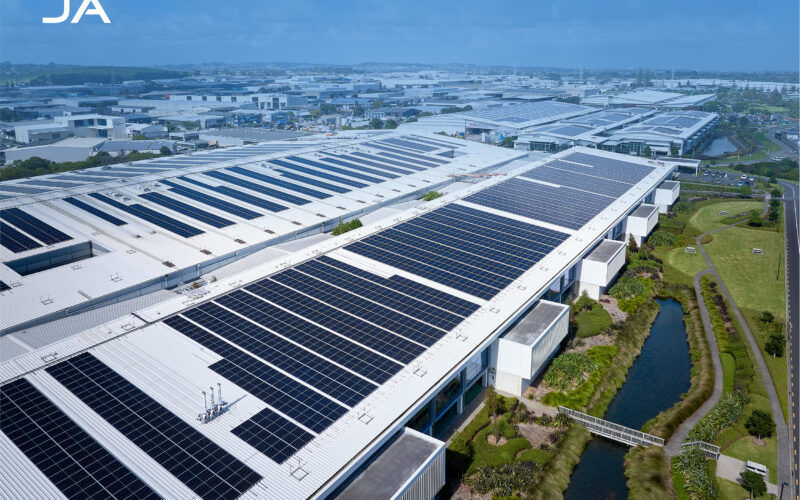
JA Solar Technology Co., Ltd. (SZSE: 002459) has supplied 8,273 DeepBlue modules for a 5.3 MWp rooftop solar system at Fisher & Paykel Healthcare Corporation Limited’s (NZX: FPH; ASX: FPH) Auckland campus, creating what the companies describe as New Zealand’s largest operating rooftop photovoltaic installation. The system is expected to generate about 6,600 MWh of electricity annually and avoid approximately 486 tonnes of carbon emissions a year, while Sunergise served as the engineering, procurement and construction provider. For Fisher & Paykel Healthcare, the installation adds substantial on-site generation to an East Tāmaki manufacturing campus that is itself expanding to accommodate further research, production and distribution capacity. For JA Solar Technology, however, the strategic value is less about 5.3 MW of module volume and more about establishing a highly visible commercial and industrial reference project in a market where solar generation is expanding quickly. The tension is that the New Zealand milestone arrives while JA Solar Technology is still navigating severe photovoltaic pricing pressure, falling revenue and continuing losses, making the commercial quality of future projects more important than headline shipment growth alone.
The Auckland project brings together two very different investment stories. Fisher & Paykel Healthcare enters the project from a position of strong operating growth, having reported a 14% increase in annual revenue and a 24% rise in net profit for the year ended March 2026. JA Solar Technology, by contrast, remains one of the world’s largest photovoltaic manufacturers but is operating through an industry downturn that pushed 2025 revenue down almost 30% and left the company with a RMB4.61 billion attributable net loss. That contrast makes the rooftop installation interesting beyond its environmental credentials: one company is using solar to support a growing industrial footprint, while the other is trying to demonstrate that scale, technology and global distribution can still translate into differentiated commercial demand during a punishing module-price cycle.
How significant is the 5.3MW Fisher & Paykel Healthcare rooftop system for New Zealand commercial solar?
The 5.3 MWp installation represents a considerable jump in the scale of New Zealand rooftop solar rather than an incremental record. Sunergise previously described the 2.3 MW system at Auckland Airport’s Mānawa Bay outlet centre as New Zealand’s largest rooftop solar power plant. On that comparison, Fisher & Paykel Healthcare’s new system is about 130% larger in installed capacity, effectively moving the country’s rooftop benchmark from the low single-megawatt range to above 5 MW in one step.
JA Solar Technology said the project contains 8,273 DeepBlue modules. Dividing the disclosed 5.3 MWp capacity by the module count implies an average nameplate rating of roughly 641 watts per module, which is consistent with the high-power commercial modules increasingly being deployed where roof space is valuable. The company expects the array to generate about 6,600 MWh annually, equivalent to approximately 1,245 kWh of annual electricity per installed kWp and an implied capacity factor of around 14.2%. Those calculations do not independently validate future output, which will depend on irradiation, temperature, degradation, maintenance and system availability, but they provide a useful benchmark against which operating performance can eventually be judged.
The scale also changes what rooftop solar can mean for major industrial consumers. Smaller systems can primarily function as sustainability projects or electricity-bill offsets, whereas a 5.3 MW plant becomes part of a site’s energy infrastructure and requires serious engineering, electrical integration, construction sequencing and long-term asset management. That distinction is particularly relevant because the Fisher & Paykel Healthcare installation was delivered within a large operating campus rather than on an isolated greenfield site, increasing the importance of coordinating construction without disrupting manufacturing and other activities.
Why does the rooftop solar project matter to Fisher & Paykel Healthcare beyond its carbon-reduction headline?
Fisher & Paykel Healthcare has considerably more at stake in East Tāmaki than the electricity produced by one solar system. The medical-device manufacturer reported NZ$2.31 billion of operating revenue for the 2026 financial year, up 14%, while net profit after tax rose 24% to NZ$468.5 million. Hospital product revenue increased 18% to NZ$1.51 billion, and the company invested NZ$235.5 million in research and development as it continued expanding its product pipeline and manufacturing capabilities.
Infrastructure spending is also continuing. Fisher & Paykel Healthcare is constructing a fifth building at East Tāmaki with approximately 28,000 square metres of gross floor area for research and development, manufacturing and distribution. The company estimated that building at about NZ$250 million when it signed the construction contract in March 2025, with operations expected to begin in 2027. Against that backdrop, large-scale on-site generation fits into a broader programme of preparing the Auckland operation for future capacity rather than functioning as a stand-alone environmental gesture.
The carbon numbers also deserve context. JA Solar Technology estimates that 6,600 MWh of annual generation will prevent approximately 486 tonnes of carbon emissions, implying about 74 kilograms of avoided carbon emissions for every MWh generated. That relatively modest carbon intensity is understandable because New Zealand already operates an unusually renewable electricity system: the Ministry of Business, Innovation and Employment reported that renewable sources supplied 94.5% of electricity during the March 2026 quarter, with solar generation reaching a record 373 GWh.
That means the business case for commercial rooftop solar in New Zealand should not be assessed purely through avoided emissions. Electricity-cost management, reduced exposure to grid-price volatility, matching daytime generation with industrial load, infrastructure resilience and the ability to support future electrification may ultimately be at least as important. The project cost and Fisher & Paykel Healthcare’s expected electricity savings have not been disclosed, so a credible payback period cannot currently be calculated; actual generation and future power costs will therefore matter more than the headline carbon figure when assessing the project’s economic contribution.

What does the Auckland reference project prove for JA Solar Technology in a brutally competitive module market?
For JA Solar Technology, the most important number in this project may actually be how small 5.3 MW is relative to the company’s overall scale. A 2026 credit-rating update reported that JA Solar Technology shipped approximately 69.563 GW of cells and modules during 2025. The entire Fisher & Paykel Healthcare installation therefore represents only about 0.008% of that annual shipment figure, making it commercially immaterial as a stand-alone volume contribution.
Its strategic usefulness is different. Commercial rooftop customers, engineering contractors and industrial asset owners are not selecting modules solely on headline price per watt; roof space, module efficiency, reliability, warranties, logistics and the consequences of installation problems can all become more important when thousands of modules are being fitted to occupied industrial buildings. Sunergise chief executive Paul Makumbe indicated that projects of this scale require suppliers capable of providing technical capability, reliability and an understanding of large-project execution challenges. JA Solar Technology’s ability to point to an operating 5.3 MW New Zealand rooftop installation therefore gives its sales organisation a reference asset that can potentially support future commercial and industrial bids.
That matters because the financial backdrop remains difficult. JA Solar Technology’s 2025 operating revenue fell 29.94% to RMB49.13 billion from RMB70.12 billion a year earlier, while the company recorded a RMB4.61 billion net loss attributable to shareholders. Management attributed the deterioration principally to excess photovoltaic manufacturing capacity, weaker product prices and intensifying competition across the industry.
There was some improvement in the first quarter of 2026, but not enough to suggest the downturn has ended. Revenue declined another 13.65% year on year to RMB9.22 billion, while the attributable net loss narrowed by approximately 35% to RMB1.07 billion from RMB1.64 billion. Operating cash flow also fell sharply to about RMB204 million from RMB787 million in the comparable period, indicating that lower losses have not removed pressure on the economics of the business.
The New Zealand installation should therefore be viewed as evidence of market reach and product deployment rather than evidence of a financial recovery. JA Solar Technology does not need a handful of prestigious rooftops to change its earnings trajectory; it needs repeated demand for differentiated products at pricing that allows revenue, gross profitability and cash generation to recover. Reference projects can help that process, but only if they convert into a broader pipeline rather than remaining isolated showcase installations.
Can New Zealand’s accelerating solar market become a meaningful commercial niche for global module suppliers?
New Zealand remains a relatively small photovoltaic market globally, but the direction of travel is becoming more significant. Ministry of Business, Innovation and Employment data showed solar generation reaching 373 GWh in the March 2026 quarter, 50.2% higher than the corresponding period a year earlier, as new projects entered operation. Renewable generation overall reached 94.5% of electricity supply, following a record 96.4% renewable share during the December 2025 quarter.
This creates an unusual solar market. In many countries, new photovoltaic capacity is primarily sold around replacing carbon-intensive power generation. New Zealand already obtains most of its electricity from hydro, geothermal, wind and other renewable sources, so the next wave of solar adoption may increasingly depend on complementary economics: generating electricity close to demand, diversifying energy supply, using industrial roof space that otherwise produces no economic return, supporting load growth and reducing exposure to periods when hydro or wind availability tightens. The record Fisher & Paykel Healthcare installation is therefore potentially more instructive as an industrial-energy project than as a conventional decarbonisation story.
JA Solar Technology said Chinese photovoltaic exports to New Zealand increased materially between early 2025 and a year later, citing Chinese customs data. That claim provides directional support for the company’s view that the local market is expanding, although the underlying customs dataset was not presented in the announcement and should not be treated as an independently verified market forecast. More persuasive evidence comes from New Zealand’s own electricity statistics, which show solar output continuing to rise rapidly from a small base.
The commercial opportunity will depend on whether installations such as Fisher & Paykel Healthcare’s become repeatable across warehouses, factories, distribution centres, retail facilities, airports and other large daytime power consumers. If they do, suppliers able to combine high-output modules with reliable local engineering and distribution partners could gain access to a commercially attractive niche even though New Zealand will never match the absolute installation volumes of China, the United States or major European markets.
What do JA Solar Technology and Fisher & Paykel Healthcare share prices say about the very different investor narratives?
The two listed companies enter the project with strikingly different market sentiment. Fisher & Paykel Healthcare shares were trading around NZ$42.50 on August 20, close to their 2026 high of NZ$43.19 and up approximately 12.4% from the beginning of the calendar year. The shares were also roughly 0.7% above their closing level seven days earlier, suggesting that investors continue to value the company near the upper end of its recent range following strong FY2026 revenue and profit growth.
JA Solar Technology presents almost the opposite picture. Its Shenzhen-listed shares were trading around RMB8.04 on August 20, with a 52-week range of approximately RMB7.92 to RMB15.54 and a one-year decline of about 14.7%. The stock had recovered by roughly 6% from its August 14 close of RMB7.56 and by around 14% from its July 20 close of RMB7.06, but it remained about 48% below the top of its reported 52-week range.
Neither movement should be attributed directly to the rooftop announcement. The release reached the market during the August 20 trading day in both China and New Zealand, and the 5.3 MW installation is far too small relative to either company’s financial scale to justify treating short-term share-price changes as a direct response. The useful comparison is instead one of investor expectations: Fisher & Paykel Healthcare is being valued against continued earnings growth and expansion, while JA Solar Technology remains tied much more closely to whether photovoltaic industry pricing, margins and capacity utilisation can normalise.
That difference also explains why the same project has different strategic meanings for each company. For Fisher & Paykel Healthcare, solar is an infrastructure-efficiency measure supporting a growing manufacturing operation. For JA Solar Technology, it is another piece of evidence that the company can continue winning internationally visible installations despite financial pressure across the module-manufacturing industry.
What would turn New Zealand’s largest rooftop solar project into a stronger strategic signal for both companies?
The first measurable test will be operating performance. JA Solar Technology has forecast about 6,600 MWh of annual production, so actual output, system availability and degradation will determine whether the project performs as designed. Reliable generation would strengthen the installation’s value as a reference asset, while persistent underperformance would reduce the importance of the headline 5.3 MW capacity.
For Fisher & Paykel Healthcare, the more important question is whether on-site solar translates into measurable improvements in energy economics as its Auckland campus grows. Without disclosure of project cost, avoided electricity purchases or expected payback, it is not yet possible to quantify the investment return. The strongest evidence would eventually be consistent generation, meaningful reductions in purchased daytime electricity and integration of renewable power into a larger strategy for the company’s expanding production footprint.
For JA Solar Technology, replication matters even more. A single 5.3 MW project represents only a fraction of one hundredth of one percent of its annual shipment volume, so the commercial thesis depends on using projects of this quality to secure more industrial customers, strengthen channel relationships and defend pricing in markets where customers value reliability as well as headline module cost. The company’s financial recovery will still depend primarily on industry supply discipline, module pricing, production economics and cash generation, not on one New Zealand rooftop.
The project is therefore strategically meaningful without being financially transformative. Fisher & Paykel Healthcare has created a new benchmark for New Zealand commercial rooftop solar at a time when its manufacturing operations are expanding, while JA Solar Technology has gained a visible international deployment during one of the most difficult pricing environments the photovoltaic manufacturing industry has experienced. The next proof point is not another record-setting press release; it is whether the system delivers its expected electricity output and whether JA Solar Technology can turn reference-project credibility into repeatable, economically stronger orders.
Key takeaways from JA Solar Technology’s 5.3MW Fisher & Paykel Healthcare rooftop solar project
- JA Solar Technology supplied 8,273 DeepBlue modules for a 5.3 MWp rooftop photovoltaic system at Fisher & Paykel Healthcare’s Auckland campus.
- The companies describe the installation as New Zealand’s largest operating rooftop photovoltaic system.
- The project is expected to generate approximately 6,600 MWh annually and avoid about 486 tonnes of carbon emissions each year.
- The disclosed capacity and module count imply an average module rating of roughly 641 watts and an estimated capacity factor near 14.2%.
- The 5.3 MW system is around 130% larger than the 2.3 MW Mānawa Bay installation previously described as New Zealand’s largest rooftop solar project.
- Fisher & Paykel Healthcare reported FY2026 revenue of NZ$2.31 billion and net profit after tax of NZ$468.5 million while continuing to expand its East Tāmaki manufacturing campus.
- JA Solar Technology reported 2025 revenue of RMB49.13 billion and a RMB4.61 billion attributable net loss as severe photovoltaic pricing pressure continued.
- At roughly 0.008% of JA Solar Technology’s reported 2025 cell and module shipment volume, the project’s strategic value is primarily as a reference installation rather than a material sales contribution.
- New Zealand renewable electricity generation reached 94.5% in the March 2026 quarter, making electricity economics, resilience and load management important components of the rooftop solar investment case.
- The next measurable tests are whether the system achieves its expected annual generation and whether JA Solar Technology converts the reference project into repeat commercial and industrial orders.
Discover more from Business-News-Today.com
Subscribe to get the latest posts sent to your email.