



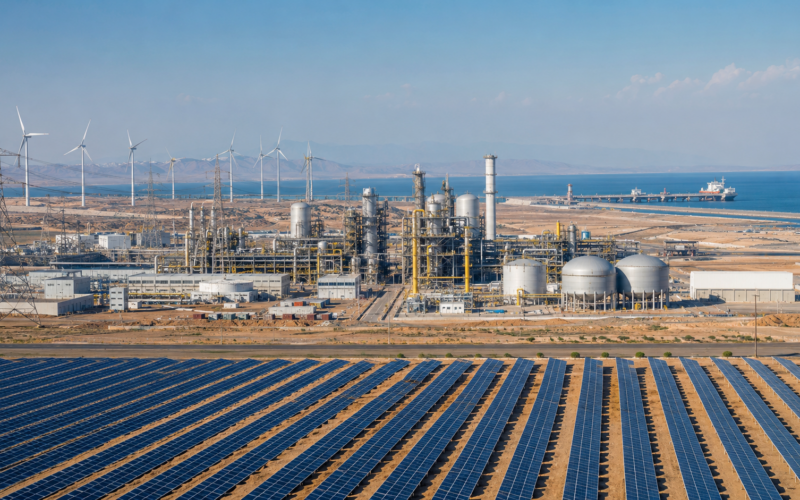
The NEOM Green Hydrogen Project is strategically important because it is one of the first global attempts to build an integrated green hydrogen and green ammonia export complex at true industrial scale. Located at Oxagon in Saudi Arabia’s NEOM region, the project combines dedicated solar power, wind power, transmission infrastructure, electrolysers, hydrogen processing, ammonia synthesis and export logistics in a single development.
The project is being developed by NEOM Green Hydrogen Company, an equal joint venture between ACWA Power, Air Products and NEOM. It has a total investment value of $8.4 billion and is intended to use around 4GW of renewable electricity from dedicated wind and solar assets. Once operational, the facility is designed to produce up to 600 tonnes per day of carbon-free hydrogen, which will be converted into green ammonia for global export.
The NEOM Green Hydrogen Project matters in 2026 because it is moving from construction toward commissioning. NEOM Green Hydrogen Company said in March 2026 that the overall project had reached 90% construction completion across all sites, while its renewable power generation assets, including the wind garden, solar farm and transmission grid, had reached approximately 95% completion.
As of that March 2026 update, the renewable power generation sites were targeted for completion by mid-2026, followed by electrolyser commissioning and first green ammonia product availability in 2027. A later official confirmation of full renewable-site completion was not available at the time of publication, so the safest current framing is that 2026 is the project’s final construction and commissioning-transition year.
This updated schedule is important because earlier project material referred to full operations or export start-up in 2026. The more current position is that first green ammonia product availability is planned for 2027. That distinction matters for investors, policymakers, engineers, contractors and hydrogen market watchers because the project’s biggest test is not only physical construction. It is whether a first-of-a-kind integrated green hydrogen export chain can move through energisation, electrolyser commissioning, ammonia conversion and shipping at commercial scale.
Where is the NEOM Green Hydrogen Project located and what is being built?
The NEOM Green Hydrogen Project is located at Oxagon in the NEOM region of northwest Saudi Arabia. Oxagon is being developed as an industrial and logistics hub on the Red Sea, making it a suitable location for a project that needs both renewable power resources and export access to global markets.
The project covers more than 300 square kilometres of land and includes solar, wind, power transmission, hydrogen production, ammonia production and marine export infrastructure. It is not simply a hydrogen plant in the narrow sense. It is a full renewable power-to-ammonia value chain designed to turn wind and solar electricity into a transportable export commodity.
The renewable power component includes more than 5.6 million solar panels with capacity of up to 2.2GW and more than 250 wind turbines that will generate around 1.6GW of renewable power. A dedicated transmission grid is being constructed to carry renewable electricity across the site and supply the green hydrogen facility.
The industrial core of the project uses electrolysis to split water into hydrogen and oxygen. The hydrogen is then converted into ammonia, creating a denser and more easily transportable hydrogen carrier. The green ammonia will be exported to global markets through a purpose-built jetty and associated logistics infrastructure.
The physical location gives the project two strategic advantages. First, northwest Saudi Arabia has strong solar and wind resources that can support high renewable-power generation. Second, the Red Sea location gives access to international shipping routes, which is essential because the project is designed around export rather than only domestic consumption.

Who owns and operates the NEOM Green Hydrogen Project?
The NEOM Green Hydrogen Project is owned by NEOM Green Hydrogen Company, an equal joint venture between ACWA Power, Air Products and NEOM. Each partner brings a different strategic role to the project.
ACWA Power contributes renewable power development and large-scale infrastructure experience. Air Products brings industrial gases, hydrogen, ammonia and engineering capability, while NEOM provides the location, industrial development platform and strategic alignment with Saudi Arabia’s Vision 2030 goals.
Air Products has a particularly important role because it is the primary engineering, procurement and construction contractor and system integrator for the project. It also holds the exclusive 30-year offtake agreement for all the green ammonia produced by the facility. That means Air Products is not only a shareholder. It is also central to project execution and future commercialisation.
The project reached financial close in May 2023 at a total investment value of $8.4 billion. The financing package included $6.1 billion of non-recourse financing from 23 local, regional and international banks and financial institutions. That financing structure helped turn the project from a headline ambition into a funded construction programme.
The equal ownership model is important because it spreads risk across a Saudi utility developer, a global industrial gases group and NEOM’s industrial platform. It also aligns the project with Saudi Arabia’s strategy to use its renewable resources, land availability and infrastructure ambitions to enter the global green hydrogen and ammonia market.
What is the capacity of the NEOM Green Hydrogen Project?
The NEOM Green Hydrogen Project is designed to operate on around 4GW of dedicated renewable electricity. The renewable generation system includes up to 2.2GW of solar power and around 1.6GW of wind power, supported by a dedicated transmission grid across the project area.
The project’s hydrogen production capacity is up to 600 tonnes per day. That hydrogen will be converted into green ammonia, with expected export volume of up to 1.2 million tonnes per year. The ammonia route is central because shipping pure hydrogen over long distances remains technically and commercially more difficult than shipping ammonia using established industrial logistics.
The electrolysis component is one of the largest in the world. thyssenkrupp nucera, formerly thyssenkrupp Uhde Chlorine Engineers, was awarded a contract to supply a more than 2GW electrolysis plant for Air Products at NEOM. The plant uses large-scale alkaline water electrolysis modules designed for industrial deployment.
The project’s capacity profile should be understood carefully. Its renewable power capacity, electrolyser capacity, hydrogen output and ammonia export volume are related but not identical measures. The renewable power assets supply electricity, the electrolysers produce hydrogen, and the ammonia plant converts that hydrogen into an exportable derivative.
This distinction matters because the project’s effective output will depend on the performance of the entire integrated chain. Solar and wind output, grid reliability, electrolyser efficiency, water treatment, ammonia synthesis, storage, shipping and market demand must all work together before the project can deliver steady export volumes.
Which companies won major contracts for the NEOM Green Hydrogen Project?
Air Products is the primary EPC contractor and system integrator for the NEOM Green Hydrogen Project. The company’s EPC agreements with NEOM Green Hydrogen Company were concluded at a value of $6.7 billion after the project reached financial close.
The Air Products role is significant because green hydrogen projects at this scale require integration across multiple systems that have traditionally been built as separate industrial assets. Renewable electricity generation, electrolysis, hydrogen handling, nitrogen supply, ammonia synthesis, storage, export loading and digital control systems must be coordinated under one operating model.
thyssenkrupp nucera is the electrolysis technology supplier. Air Products awarded the company a contract to engineer, procure and fabricate a more than 2GW electrolysis plant based on large-scale alkaline water electrolysis modules. The contract is one of the most important equipment awards in the global hydrogen sector because electrolyser performance will determine the project’s ability to convert renewable electricity into hydrogen at scale.
Envision Energy is supplying the wind turbines for the project as a supplier to Air Products. NEOM announced the first major delivery of wind turbines to the project site in 2023, with more than 250 turbines planned for the wind garden. Those wind assets are critical because the project’s power strategy relies on complementary wind and solar production.
The broader contractor ecosystem includes renewable power equipment suppliers, transmission contractors, ammonia plant contractors, port and jetty contractors, logistics providers, water treatment systems, storage suppliers and commissioning teams. While not all contract values and subcontractor names have been fully disclosed, the project’s execution model clearly depends on one of the most complex industrial supply chains in the green hydrogen sector.
The contract structure also illustrates why the NEOM Green Hydrogen Project is more than a demonstration plant. Its equipment orders, EPC commitments, non-recourse financing and 30-year offtake agreement place it in the category of large capital projects rather than experimental hydrogen pilots.
How did the NEOM Green Hydrogen Project reach financial close?
The modern development history of the NEOM Green Hydrogen Project began in July 2020, when Air Products, ACWA Power and NEOM announced plans for a world-scale green hydrogen-based ammonia production facility powered by renewable energy. The project was designed from the beginning as an export platform rather than only a domestic hydrogen supply asset.
In 2021, Air Products awarded thyssenkrupp nucera the contract for the more than 2GW electrolysis plant. That early technology selection was important because electrolysers are one of the longest-lead and most project-defining components of any green hydrogen development.
The project reached financial close in May 2023. NEOM Green Hydrogen Company secured $6.1 billion in non-recourse financing from 23 banks and financial institutions as part of the total $8.4 billion investment package. At the same time, the company secured the 30-year exclusive offtake agreement with Air Products for all green ammonia produced at the facility.
After financial close, the project moved through a series of equipment delivery and construction milestones. The first wind turbines arrived at the Port of NEOM in October 2023 and were transported to the wind garden site near the Gulf of Aqaba. Project execution then advanced across the wind garden, solar farm, transmission grid and hydrogen plant.
By June 2025, NEOM Green Hydrogen Company said the project had reached 80% construction completion across the green hydrogen facility, wind garden, solar farm and transmission grid. By March 2026, the completion figure had risen to 90% overall and approximately 95% for renewable power generation assets.
This trajectory shows that the project has moved beyond early works and procurement. It is now in the final construction and commissioning transition phase, where system integration becomes more important than individual equipment delivery.
What are the latest NEOM Green Hydrogen Project updates in 2026?
The latest official 2026 project update stated that the NEOM Green Hydrogen Project had reached 90% construction completion across all sites. NEOM Green Hydrogen Company said construction was continuing to advance and that renewable power generation assets had reached approximately 95% completion.
As of that March 2026 update, the 4GW solar and wind power generation sites were targeted for completion by mid-2026. The latest available official project wording still points to electrolyser commissioning as the next major stage and first green ammonia product availability in 2027.
A later official confirmation of full renewable-site completion was not available at the time of publication. For that reason, the project should be described as nearing the transition from renewable-power completion into electrolyser commissioning, rather than as already fully operational.
Air Products’ June 2026 portfolio update also increased the project’s relevance. The company said it would not proceed with its Louisiana Clean Energy Complex and would discontinue other smaller clean energy distribution projects, but separately confirmed that it was finalizing a marketing and distribution agreement with Yara International for renewable ammonia from the NEOM Green Hydrogen Project.
That distinction is important. Air Products has stepped back from some other clean energy investments because of commercial conditions and return criteria, but it continues to proceed with NEOM. This makes the Saudi project even more important as one of the few large green hydrogen export developments moving toward commercial availability.
How will green ammonia from NEOM reach global markets?
The NEOM Green Hydrogen Project will export hydrogen in the form of green ammonia. This strategy reflects the current state of global hydrogen logistics. Ammonia is easier to store and ship than pure hydrogen because existing industrial systems already move ammonia in large volumes for fertiliser and chemical markets.
Air Products holds the exclusive 30-year offtake agreement for the ammonia produced by the project. Under the model, NEOM Green Hydrogen Company produces the green ammonia, while Air Products takes the product and supplies global markets.
In June 2026, Air Products and Yara International said they were finalizing a marketing and distribution agreement for renewable ammonia from the NEOM Green Hydrogen Project. The agreement is intended to allow ammonia from the project to be sold and delivered worldwide through Yara’s global supply chain.
This is commercially significant because green ammonia needs credible distribution channels. A production plant alone does not create a market. Buyers must be able to receive, store, handle and use the ammonia, either directly or through conversion into hydrogen for end uses.
Potential end markets include fertilisers, shipping fuel, industrial chemicals, refining, power generation and heavy transport. However, the pace of market adoption will depend on regulation, certification, carbon pricing, customer willingness to pay and the availability of ammonia-handling infrastructure in importing regions.
What environmental and regulatory issues affect the NEOM Green Hydrogen Project?
The NEOM Green Hydrogen Project is designed as a renewable-power-based hydrogen and ammonia development. It uses wind and solar electricity to produce hydrogen through electrolysis, avoiding the direct carbon dioxide emissions associated with conventional grey hydrogen made from natural gas without carbon capture.
NEOM Green Hydrogen Company says the project could save up to 5 million tonnes of carbon dioxide per year once operational. That figure reflects the estimated avoided emissions from replacing higher-carbon fuels or conventional ammonia production routes.
The project’s environmental profile is still more complex than a simple zero-emissions label. The facility requires large land areas, extensive renewable generation, desalinated or treated water supply, transmission infrastructure, industrial equipment, ammonia handling, shipping and construction materials. Its net climate benefit depends on full lifecycle emissions, product use, certification, shipping emissions and whether the green ammonia displaces higher-carbon alternatives.
Water is also a key consideration because electrolysis requires purified water. In a desert region, water sourcing, desalination energy, brine management and industrial water efficiency are important environmental and operating issues. The project’s long-term credibility will depend partly on how transparently these water and lifecycle impacts are managed.
Safety is another major factor. Hydrogen and ammonia are both industrial chemicals requiring strict handling, storage and transport protocols. Ammonia is toxic and must be managed carefully across production, storage, shipping and end-use markets. A successful project must therefore prove not only low-carbon production, but also reliable industrial safety at scale.
How does the NEOM Green Hydrogen Project affect Saudi Arabia’s energy strategy?
The NEOM Green Hydrogen Project supports Saudi Arabia’s effort to diversify its energy economy beyond oil and conventional petrochemicals. It aligns with Saudi Vision 2030 by positioning the kingdom as an exporter of low-carbon fuels and industrial products, not only hydrocarbons.
Saudi Arabia has abundant solar resources, strong wind resources in selected regions, large land availability and experience in building export-oriented energy infrastructure. The NEOM Green Hydrogen Project attempts to combine those advantages into a new export industry.
The project also supports Oxagon’s industrial strategy. By anchoring a major green hydrogen and ammonia complex at Oxagon, NEOM is trying to position the city as a hub for advanced manufacturing, logistics and clean industrial development. The project’s renewable power, port access and export orientation are therefore linked to a wider regional development agenda.
For ACWA Power, the project extends its role as a global renewable energy and green hydrogen developer. For Air Products, it provides exposure to renewable ammonia at commercial scale. For NEOM, it demonstrates that the region’s industrial plans are moving beyond real-estate concepts into operating infrastructure.
The project also has strategic value for potential importers. Countries and companies trying to decarbonise fertilisers, shipping, chemicals and industrial fuel use need credible large-volume sources of green ammonia. NEOM is one of the earliest projects designed to supply that market at scale.
What could limit the NEOM Green Hydrogen Project’s future output?
The main risk for the NEOM Green Hydrogen Project is integration risk. Each component of the project is technically understood, but the challenge lies in combining them at an unprecedented scale under desert conditions and export-market requirements.
Renewable generation variability is one challenge. Solar and wind output fluctuate across the day and seasons. The project must manage that variability while operating electrolysers, ammonia synthesis systems and export logistics efficiently. Dedicated transmission and power-management systems are therefore central to performance.
Electrolyser commissioning is another major test. The more than 2GW electrolysis plant is far larger than most operating green hydrogen systems globally. Bringing the units online, managing efficiency, ensuring reliability and coordinating maintenance will be crucial to meeting output targets.
Ammonia synthesis and export systems must also perform consistently. Even if hydrogen production proceeds successfully, the project must convert hydrogen into ammonia, store it safely, load it onto ships and deliver it to customers able to receive and use the product.
Commercial risk remains relevant despite the 30-year offtake agreement. Green ammonia markets are still developing, and customers will compare it against conventional ammonia, low-carbon ammonia, direct hydrogen, biofuels and electrification alternatives. Certification standards, import policies and carbon-pricing systems will strongly influence demand.
Why does the NEOM Green Hydrogen Project matter for global hydrogen markets?
The NEOM Green Hydrogen Project matters because global hydrogen markets need reference projects that move beyond small pilots. For years, green hydrogen has been discussed as a solution for hard-to-abate sectors, but most projects have remained small, delayed or dependent on subsidies.
NEOM is different because it has secured financial close, reached advanced construction, ordered core equipment and built a commercial offtake structure. That does not guarantee success, but it gives the project a stronger foundation than many announced hydrogen schemes.
The project will test whether green hydrogen can be produced from dedicated renewables, converted into ammonia and exported at scale. If it works, it could become a template for other regions with abundant renewable resources, export infrastructure and industrial partners. If it struggles, it will show how difficult the hydrogen export model remains even with strong sponsors and financing.
The project also matters because several other hydrogen projects have faced delays, cancellations or commercial reassessments. Air Products’ decision not to proceed with the Louisiana Clean Energy Complex in 2026 highlights the pressure on hydrogen economics. Against that backdrop, NEOM’s continued progress makes it one of the most closely watched green hydrogen projects in the world.
The outcome will influence how developers, lenders, governments and customers think about green ammonia exports. A successful ramp-up would improve confidence in the sector. A difficult commissioning phase would make future lenders and buyers more cautious.
What is the future outlook for the NEOM Green Hydrogen Project?
The future outlook for the NEOM Green Hydrogen Project is constructive but execution-sensitive. The project has reached 90% construction completion, renewable power assets were about 95% complete in the latest official update, and the partners are moving toward energisation, commissioning and product availability.
The key near-term milestones are completion confirmation for the solar and wind power generation sites, commissioning of the electrolysers, integration of hydrogen systems with ammonia production, and readiness of export logistics. These steps will determine whether the project can move from construction completion to reliable product supply.
The first green ammonia product is expected in 2027. That will be a major milestone, but the more important long-term test will be sustained production and export reliability. Large industrial plants often face ramp-up issues after first output, and green hydrogen plants at this scale have limited operating history.
The project’s long-term relevance depends on whether it can deliver on three linked promises. It must produce hydrogen at scale from renewable electricity, convert that hydrogen into exportable ammonia, and find customers willing to use or distribute green ammonia at commercially viable prices.
If the NEOM Green Hydrogen Project succeeds, it will give Saudi Arabia an early position in global green ammonia exports and provide the wider hydrogen sector with a rare large-scale proof point. If the project faces delays, underperformance or commercial bottlenecks, it will still be valuable as infrastructure, but it may slow confidence in the broader hydrogen export model.
In 2026, the NEOM Green Hydrogen Project stands at the boundary between construction and proof. The site is largely built, the financing is closed, the offtake structure is in place and the market is watching. The next test is whether one of the world’s most ambitious green hydrogen projects can turn 4GW of desert renewable power into steady ammonia exports.
Discover more from Business-News-Today.com
Subscribe to get the latest posts sent to your email.