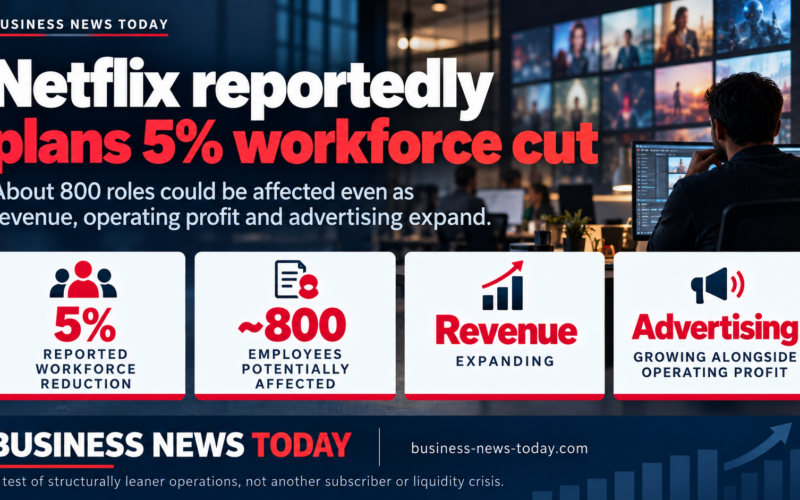
Netflix, Inc. (Nasdaq: NFLX), the Los Gatos-based global entertainment company, is reportedly preparing to reduce its workforce by approximately 5%, with an announcement potentially coming as early as next week. Netflix has not confirmed the plan and has declined to comment, so the size, affected functions, geographic distribution and timing remain unverified until the company makes a formal disclosure. Based on Netflix‘s latest reported year-end workforce of approximately 16,000 full-time employees, a 5% reduction would mathematically equate to about 800 positions, but that figure should be treated as an estimate rather than a confirmed layoff number. The report arrives less than two weeks before Netflix’s October 20 third-quarter results and at a time when the company is growing revenue, expanding margins and investing simultaneously in advertising, live programming, games and artificial intelligence.
The potential cuts would be strategically different from Netflix’s last major layoff period in 2022, when slowing subscriber growth triggered a much broader reassessment of spending and business priorities. Netflix’s latest reported quarter showed revenue increasing 13% year over year to $12.56 billion, operating income rising 11% to $4.19 billion and operating margin reaching 33.4%. Management also maintained its 2026 expectation for revenue of $51.0 billion to $51.4 billion and an operating margin of 31.5%, indicating that the reported workforce action is emerging from a position of substantial profitability rather than financial distress.
Netflix also ended the second quarter with $9.1 billion of cash and cash equivalents and expects approximately $12.5 billion of free cash flow for the full year. The board authorised an additional $25 billion of share repurchases in April, and Netflix bought back $4.7 billion of stock during the second quarter alone. Against that financial background, any confirmed workforce reduction would look primarily like an operating-model and capital-allocation decision, raising a more demanding question than whether Netflix can afford its current payroll: whether management believes the company can keep expanding entertainment output and monetisation with materially fewer employees.
Why would Netflix cut about 5% of its workforce while revenue and operating profit are still growing?
The most important distinction is that Netflix is not currently experiencing the combination of collapsing subscriber economics and slowing revenue that defined its 2022 restructuring. Second-quarter revenue grew by approximately $1.48 billion from the prior-year period, while first-half revenue reached $24.81 billion, up 15%. Membership growth, higher pricing and advertising contributed to the increase, suggesting the underlying business continues to expand even as management reportedly considers removing a meaningful portion of employees.
That changes the likely economic logic of the cuts. Netflix’s focus has increasingly shifted from proving streaming can become profitable toward sustaining double-digit revenue expansion while widening operating margins and generating large amounts of free cash flow. Once a company reaches that stage, workforce productivity becomes a capital-allocation question because each additional layer of administration, technology development, marketing or content support has to demonstrate that it contributes enough incremental growth to justify its cost.
The reported reduction could therefore reflect a reassessment of organisational complexity after years of expansion into new businesses. Netflix is no longer simply a subscription streaming platform. It is building a major advertising business, expanding live events, developing cloud games, adding creator and podcast-style programming and deploying AI across discovery, advertising and content-production workflows. The risk is that reducing staff while broadening strategic scope creates bottlenecks precisely when coordination across those businesses becomes more important.
How many Netflix employees could be affected if the reported 5% workforce reduction is confirmed?
Netflix disclosed approximately 16,000 full-time employees at December 31, 2025, including about 10,900 in the United States and Canada, 2,500 across Europe, the Middle East and Africa, 1,900 in Asia-Pacific and 700 in Latin America. The company also uses additional production personnel, including some temporary and part-time employees, whose numbers fluctuate with content activity and are not included in the full-time headcount in the same way.
Applying 5% to the disclosed 16,000 full-time workforce produces an indicative figure of approximately 800 positions. That calculation is useful for understanding potential scale, but it is not a confirmed layoff count because Netflix’s current October workforce may differ from its December 2025 level and the reported percentage could be applied to a different employment base. Netflix has also not disclosed which functions, levels or geographies would be affected.
A reduction of that magnitude would nevertheless represent one of Netflix’s most significant workforce actions in recent years. The company last undertook a large layoff round in 2022, when hundreds of positions were eliminated during a much weaker period for the streaming business. The strategic interpretation would be very different in 2026 if Netflix confirms comparable or larger cuts while operating income, free cash flow and advertising revenue are still expanding.
Could Netflix’s growing use of artificial intelligence be changing the economics of its workforce?
Netflix has made artificial intelligence increasingly visible across both the customer experience and internal production workflows. The company is using large language models to improve discovery and understand preferences, while search is being expanded through voice capabilities and AI-powered natural-language queries. Netflix also said generative AI workflows had been used in roughly 300 titles during 2026 by the end of the second quarter, with the greatest concentration in post-production.
That does not establish that AI is causing the reported job cuts. No confirmed Netflix disclosure has linked a 5% workforce reduction directly to automation, and the affected functions have not yet been identified. Treating the reported layoffs as 800 jobs replaced by AI would therefore go well beyond the available evidence.
The more defensible interpretation is that AI may be altering the productivity assumptions behind parts of Netflix’s operating model. Netflix says generative tools can produce some visual work faster and at lower cost than conventional workflows, while AI-powered advertising tools are reducing manual effort in areas such as planning, creative production, campaign management, optimisation and reporting. If similar productivity improvements spread across technology, marketing or operational functions, management may conclude that future growth requires fewer incremental employees even when AI does not directly eliminate a specific existing position.
Why does Netflix’s $3 billion advertising ambition make the reported workforce reset more complicated?
Advertising has become one of Netflix’s clearest diversification opportunities. Management expects advertising revenue to approximately double to around $3 billion in 2026 and has continued investing in its own advertising technology, programmatic capabilities and AI-powered tools. The opportunity is strategically important because advertising allows Netflix to monetise viewing beyond monthly subscription fees while supporting a lower-priced membership option.
Building that business requires capabilities that differ substantially from the original subscription model. Advertiser relationships, measurement, campaign optimisation, sales infrastructure, programmatic technology and brand-safety systems all increase organisational requirements. Netflix therefore needs to reduce employment selectively rather than assume every function can become smaller without affecting the growth areas management itself has prioritised.
The strongest version of a workforce reset would move resources away from mature or duplicated activities and toward advertising, AI, live programming and other businesses with higher incremental growth potential. The weaker outcome would be a broad cost reduction that improves margins temporarily but constrains the teams responsible for creating new revenue streams. Until Netflix identifies the affected functions, that distinction remains one of the most important unanswered questions.
How do live events and games change the organisational demands facing a leaner Netflix?
Netflix has expanded materially beyond on-demand films and television series. Management expects live programming to account for just over 5% of 2026 content spending while representing only about 1% of viewing hours, yet live events have produced six of Netflix’s 10 strongest new-member sign-up days over the previous five years. That makes live content strategically valuable even when raw viewing-hour economics look less impressive than traditional programming.
The company is also pursuing cloud-based television games and reported strong early engagement from selected launches during the second quarter. These initiatives create new technical, production, rights-management and operational requirements that traditional streaming did not demand to the same extent. Reducing overall staffing while expanding into these categories therefore requires meaningful productivity gains elsewhere if Netflix wants to avoid overstretching the organisation.
This is one reason a potential 5% reduction should not automatically be interpreted as simple cost cutting. The more strategically important issue is where Netflix chooses to preserve or increase employment after the restructuring. Workforce composition may matter more than aggregate headcount if management is simultaneously reducing mature functions and adding specialist roles around advertising technology, machine learning, live production or interactive entertainment.
What does Netflix’s 31.5% operating margin target reveal about the pressure for greater efficiency?
Netflix expects a 31.5% operating margin for 2026, up from 29.5% in 2025, while annual operating income is forecast to grow by more than 20%. That level of profitability places Netflix in a fundamentally different financial position from many traditional media groups, where declining linear television economics and restructuring charges continue to weigh heavily on returns.
High margins, however, can create their own expectations. Investors increasingly evaluate Netflix not only on membership and revenue growth but also on its ability to convert scale into expanding operating income and free cash flow. A smaller workforce can support that equation if labour reductions occur without materially weakening content quality, technology reliability or monetisation initiatives.
There is also a limit to how far efficiency can substitute for growth. Netflix’s valuation ultimately depends on maintaining a combination of revenue expansion, strong engagement and rising profitability, not on repeatedly reducing costs. If layoffs become the primary source of future margin expansion while revenue growth slows, the market could interpret higher margins as evidence of maturation rather than improving competitive economics.
Why does YouTube and media consolidation increase the strategic risk around Netflix’s reported layoffs?
Netflix competes not only with subscription streaming services but with the entire range of entertainment options consuming audience attention. YouTube continues to capture substantial viewing time and advertising spending, while major media groups are reorganising portfolios and pursuing combinations intended to improve scale and economics. The competitive landscape therefore rewards companies that can produce content efficiently while maintaining enough technological and creative capacity to respond quickly to shifting viewer behaviour.
Netflix’s advantage remains its global distribution, large audience, recommendation technology and ability to spread content investment across many markets. Its first-half 2026 members watched more than 97 billion hours, with non-English programming again accounting for more than one-third of viewing. That scale can support higher productivity than smaller streaming rivals because technology, content and advertising infrastructure can be amortised across a massive global audience.
The danger is that scale can encourage management to remove too much organisational capacity when financial performance is strong. Entertainment remains difficult to industrialise because creative success is unpredictable, local markets require specialist understanding and emerging formats can demand new expertise. Netflix must therefore distinguish between genuine organisational excess and capabilities whose value becomes visible only when competitive conditions change.
How did NFLX shares trade after the 5% workforce reduction report emerged before Friday’s market open?
Netflix shares closed at $70.30 on October 9, down 1.77% for the session, after the workforce report surfaced before the US market opened. The broader S&P 500 gained approximately 0.6% that day, meaning Netflix underperformed the overall market, although a single session cannot establish that the reported workforce plan caused the decline. NFLX had gained during each of the preceding four trading sessions and remained up roughly 4.8% compared with its October 2 close.
The longer-term stock picture is more challenging. Netflix was down about 7.5% over the preceding month and traded within a 52-week range of approximately $65.08 to $124.86, leaving the October 9 close roughly 44% below the 52-week high. The shares were only about 8% above the 52-week low, showing that the market has already substantially compressed Netflix’s valuation despite strong current operating performance.
That disconnect places additional significance on the reported workforce action. Investors may welcome greater efficiency, but the share price suggests concerns already extend beyond near-term expenses to questions about future growth, competition and the valuation appropriate for a maturing streaming leader. Cutting employees cannot answer those questions unless the savings improve Netflix’s ability to fund businesses capable of extending its growth runway.
Why will Netflix’s October 20 earnings report be more important than the initial layoff headline?
Netflix is scheduled to report third-quarter results on October 20, giving management an opportunity to clarify both operating performance and potentially the workforce situation. The company’s prior forecast called for third-quarter revenue of approximately $12.86 billion, representing year-over-year growth of around 12%, with operating income of about $4.27 billion and operating margin of 33.2%.
If Netflix confirms a restructuring before earnings, investors will be able to compare the savings logic with updated revenue, margin and cash-flow expectations. A workforce reduction accompanied by intact or improving guidance would support the interpretation that Netflix is proactively redesigning its cost structure. Cuts paired with weaker guidance would suggest a more defensive response to changing business conditions.
The earnings call may also reveal whether management’s 2026 advertising forecast, content investment assumptions and free-cash-flow expectations remain intact. Those metrics matter more strategically than the initial number of jobs because they indicate whether Netflix is cutting expenditure to protect weakening economics or reallocating resources within a still-growing business.
What are the main execution risks if Netflix confirms a workforce reduction of roughly 5%?
The first risk is organisational disruption across a company that is expanding into multiple adjacent markets simultaneously. Removing approximately one employee in 20 would be substantial enough to alter reporting lines, project ownership and workloads even if the cuts are distributed globally. Netflix would need to ensure that critical product development, content operations and advertising capabilities are not weakened as positions disappear.
The second risk is morale and retention. Netflix has historically promoted a distinctive performance-oriented corporate culture in which employees receive considerable responsibility and compensation but are expected to maintain a high performance threshold. Another sizeable layoff round during a period of strong profitability could cause remaining employees to reassess the relationship between company performance and employment stability.
The third risk is the possibility of optimising too aggressively around current technology. AI can lower production and workflow costs, but the long-term economics of generative systems remain uncertain and the human expertise required for creative development, engineering and commercial decision-making is difficult to quantify. Cutting too early on the assumption that emerging tools will deliver permanent productivity gains could create expensive rehiring requirements later.
What are the key takeaways from Netflix’s reported 5% workforce reduction plan?
- Netflix is reportedly considering a workforce reduction of approximately 5%, but the company has not confirmed the plan and has declined to comment.
- Applying 5% to Netflix’s year-end 2025 full-time workforce of approximately 16,000 implies roughly 800 positions, although that is an estimate rather than a confirmed layoff count.
- The reported cuts would arrive while Netflix remains financially strong, with second-quarter revenue up 13% to $12.56 billion and operating income up 11% to $4.19 billion.
- Netflix continues to forecast a 31.5% full-year 2026 operating margin and revenue of $51.0 billion to $51.4 billion.
- Free cash flow is expected to reach approximately $12.5 billion in 2026, making the potential restructuring primarily an efficiency and capital-allocation question rather than a liquidity response.
- Netflix expects advertising revenue to approximately double to $3 billion this year while it expands AI tools, live programming and cloud gaming.
- Generative AI is already being used in hundreds of Netflix productions and across advertising workflows, but there is no verified evidence that AI directly accounts for the reported job cuts.
- NFLX closed at $70.30 on October 9, down 1.77% for the session and roughly 44% below its 52-week high.
- Third-quarter results on October 20 should provide a more important test of whether any workforce action is proactive efficiency or a response to deteriorating growth expectations.
- The central strategic question is whether Netflix can run a leaner organisation without weakening the content, technology and monetisation capabilities required to sustain double-digit growth.
Discover more from Business-News-Today.com
Subscribe to get the latest posts sent to your email.