


The Global Combat Air Programme, known as GCAP, is a trilateral defence aerospace programme between the United Kingdom, Japan and Italy to develop a next-generation combat aircraft system targeted for service from 2035. The programme is governed through the GCAP International Government Organisation, or GIGO, headquartered in Reading in the UK, with the GCAP Agency managing execution on behalf of the three partner governments.
The industrial delivery structure is led by Edgewing, the joint venture formed by BAE Systems of the UK, Leonardo of Italy and Japan Aircraft Industrial Enhancement Co. Ltd. Edgewing acts as the trinational prime contractor and design authority for the aircraft, while wider national industry teams support the programme through aircraft engineering, electronics, propulsion, weapons integration, manufacturing and testing.
GCAP is not a conventional fighter purchase where one country buys an aircraft already designed elsewhere. It is a shared development programme intended to create a sixth-generation combat aircraft that can operate within a wider combat air system, alongside aircraft such as the F-35 and Typhoon, future autonomous systems, advanced sensors, secure data networks and next-generation weapons.
The programme moved into a more advanced 2026 phase after the GCAP Agency awarded Edgewing an 18-month £4.6 billion contract in July 2026. That contract followed an initial £686 million international contract placed in April 2026 and is intended to complete advanced concept and assessment activity while pushing the aircraft into further detailed design and development. The UK Defence Investment Plan also committed £8.6 billion to GCAP over four years, while Italy has approved €8.77 billion for its initial programme phases through 2037.
GCAP matters because it is one of the most ambitious defence industrial programmes now underway outside the United States. It is also a test of whether three advanced aerospace nations can jointly design, fund and deliver a sixth-generation combat aircraft within a compressed timeline while preserving sovereign industrial capability, export potential and interoperability with allied forces.
Where is the Global Combat Air Programme based and which countries are involved?
The Global Combat Air Programme is built around three founding countries: the United Kingdom, Japan and Italy. The partnership connects European and Indo-Pacific defence aerospace priorities in one next-generation fighter programme.
The GCAP International Government Organisation provides the government-level structure. Its headquarters are in Reading in the UK, where GIGO and Edgewing are intended to work under a streamlined governance model alongside teams from the three partner nations. That structure is designed to avoid the fragmentation that can affect multinational defence programmes when requirements, budgets and workshare are managed through separate national tracks.
The industrial delivery structure is centred on Edgewing. BAE Systems represents the UK industrial side, Leonardo represents Italy, and Japan Aircraft Industrial Enhancement Co. Ltd. represents Japan’s aerospace industry. Mitsubishi Heavy Industries remains central to Japan’s combat-air industrial base and is one of the key national champions supporting Edgewing’s programme delivery.
The programme’s geography is important because GCAP is not being concentrated in one country. Design, engineering, supplier activity, electronics, propulsion, weapons integration, software, simulation and manufacturing preparation are expected to be distributed across the UK, Japan and Italy.
This structure gives GCAP strategic value beyond the aircraft itself. For the UK, it supports the future of sovereign combat-air design after Typhoon. For Italy, it preserves a high-end military aerospace and electronics role through Leonardo and its wider defence supply chain. For Japan, it creates a pathway to replace the Mitsubishi F-2 while deepening defence industrial cooperation with European partners.

Who governs and delivers the GCAP fighter programme?
GCAP is governed through GIGO, which was created to oversee delivery on behalf of the UK, Japan and Italy. Within that structure, the GCAP Agency manages, coordinates and executes programme activity for the three governments.
Edgewing is the main industrial joint venture responsible for the aircraft. The company was launched by BAE Systems, Leonardo and Japan Aircraft Industrial Enhancement Co. Ltd. to provide a single industrial interface for the programme. Each partner holds an equal 33.3% shareholding in Edgewing.
The relationship between the GCAP Agency and Edgewing is central to the execution model. The GCAP Agency represents the customer side across the three governments, while Edgewing consolidates aircraft-level industrial design and development leadership. That structure is intended to create clearer accountability than a loose coalition of national contractors.
BAE Systems brings the UK’s combat-aircraft design, integration and manufacturing experience. Leonardo brings Italian combat-air systems, avionics, sensors, electronics and integration capability. JAIEC connects the programme to Japan’s aerospace industrial base, with Mitsubishi Heavy Industries and other Japanese defence firms supporting the national industrial contribution.
This model is ambitious because multinational fighter programmes are difficult to manage. Requirements, budgets, export rules, workshare, industrial priorities, national security restrictions and technology-transfer boundaries can all create friction. GCAP’s governance structure is designed to manage those pressures before they become programme-breaking disputes.
What aircraft and combat system is GCAP trying to build?
GCAP is intended to deliver a sixth-generation combat aircraft system by 2035. The phrase “combat aircraft system” is important because the programme is not only about building one airframe. It is intended to create a connected platform that can operate within a wider digital battlespace.
The core aircraft is expected to include stealth features, advanced sensors, open-system architecture, high levels of data fusion, electronic warfare capability, secure communications and the ability to work with uncrewed systems. Public descriptions have also emphasised advanced autonomy, artificial intelligence, next-generation sensors and integration with future combat networks.
The aircraft is expected to sit above current fourth-generation fighters and complement or succeed roles now performed by platforms such as the Eurofighter Typhoon and Mitsubishi F-2. It is also expected to operate alongside fifth-generation aircraft such as the F-35 rather than immediately replacing them.
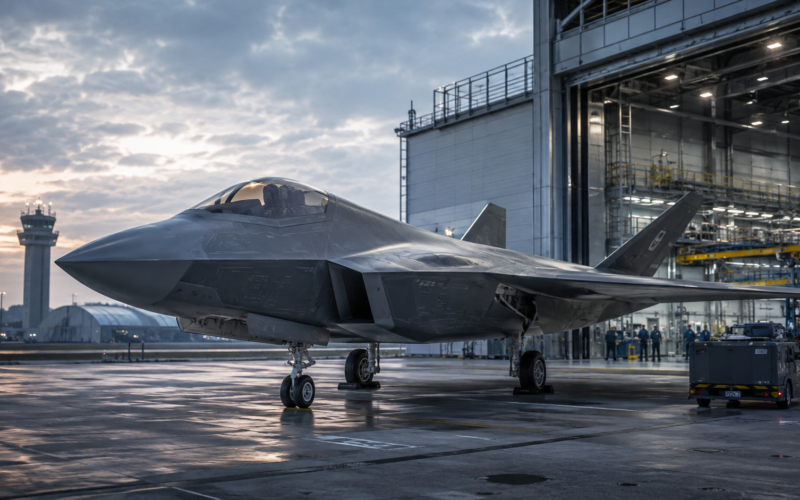
GCAP’s final specifications are still being defined, so exact capability claims should be treated carefully. Public concept models and full-scale replicas show design direction, but they are not final production configuration. The programme is now in the phase where requirements, testing, engineering, digital design and industrial architecture need to mature before prototype and production decisions.
The weapons-system angle matters because future air combat is no longer judged only by speed, manoeuvrability or payload. A sixth-generation platform must connect sensors, electronic warfare, data links, long-range weapons, uncrewed teaming and command-and-control functions into one combat network. GCAP’s success will depend on that system integration as much as on the aircraft’s aerodynamic design.
What are the latest GCAP updates in 2026?
The most important 2026 development is the £4.6 billion international contract awarded to Edgewing in July 2026. The 18-month contract runs through the end of 2027 and is designed to complete the advanced concept and assessment phase while supporting further detailed design and development.
That July contract followed an initial £686 million contract placed in April 2026. Together, the two contracts show that GCAP has moved beyond diplomatic statements, treaty structures and early industrial alignment into funded international programme execution.
The UK Defence Investment Plan added another major milestone by confirming £8.6 billion for GCAP over four years. That gives the UK side a clearer near-term funding envelope and signals that the sixth-generation fighter remains central to Britain’s combat-air modernisation plan.
Canada also joined GCAP as the first observer nation in July 2026. Observer status does not give Canada a decision-making role, but it provides direct insight into capability development, industrial collaboration and long-term delivery planning. The move also keeps open the possibility of deeper future participation if the partner governments choose to expand the programme.
Japan’s industrial base is also moving from programme alignment toward investment. Mitsubishi Electric, a key Japanese defence electronics participant, plans to build three facilities to produce electronic systems for the fighter. That matters because GCAP’s delivery depends not only on aircraft prime contractors, but also on sensors, radar, electronic warfare, secure communications, software and advanced manufacturing capacity.
How did GCAP develop from national fighter plans into a trilateral programme?
GCAP was launched in December 2022, when the UK, Japan and Italy agreed to combine their future combat-air ambitions into one programme. The move brought together the UK-Italy Tempest and future combat air workstream with Japan’s F-X fighter ambitions.
That merger was strategically significant. Developing a sixth-generation combat aircraft is too expensive and technically demanding for many countries to manage alone. By pooling investment and industrial capability, the three countries aimed to reduce cost pressure, strengthen interoperability and preserve sovereign combat-air design expertise.
The governments signed a convention in December 2023 to establish the GCAP International Government Organisation. That treaty framework enabled the creation of a formal multinational structure to manage the programme, rather than relying only on national ministries and separate company arrangements.
The industrial side also evolved. BAE Systems, Leonardo and Japanese industry moved toward a more unified delivery structure, resulting in the launch of Edgewing as the joint venture responsible for leading aircraft design and development.
By 2026, the programme had moved from political launch and organisational formation into contract-backed execution. That transition is important because many defence programmes look strong at announcement stage but struggle when requirements, cost, design choices and industrial workshare need to become real delivery plans.
Which companies and industrial partners are central to GCAP?
BAE Systems is the UK’s principal industrial participant in GCAP. Its role builds on the UK’s long combat-air history, including Tornado, Typhoon and the national Future Combat Air System and Tempest work that preceded GCAP.
Leonardo is Italy’s main industrial participant and also has a major UK role in defence electronics. The company’s role spans aircraft systems, sensors, avionics, mission systems, electronics and integration work.
Japan Aircraft Industrial Enhancement Co. Ltd. represents the Japanese industrial side within Edgewing. Mitsubishi Heavy Industries is central to Japan’s fighter-aircraft capability and is one of the lead systems integrators supporting Edgewing’s delivery role.
The electronics layer is being developed through GCAP Electronics Evolution, or G2E. This consortium brings together Leonardo in the UK and Italy, Mitsubishi Electric in Japan and ELT Group in Italy to work on integrated sensing, non-kinetic effects and integrated communications systems.
The propulsion layer is also organised through a trinational consortium. Rolls-Royce in the UK, IHI in Japan and Avio Aero in Italy are working on the power and propulsion system, which will need to provide both thrust and the electrical power required by high-demand onboard systems.
The weapons and effects integration layer is also taking shape. MBDA UK, MBDA Italia, Mitsubishi Electric and Mitsubishi Heavy Industries have formed the Sovereign Effects Partners collaboration to support digital integration of effectors with the GCAP platform. That agreement does not mean a single joint missile is being developed under that framework, but it does show how weapons integration is being organised around national capabilities.
What role does Edgewing play in the GCAP programme?
Edgewing is the industrial joint venture created to lead delivery of the GCAP aircraft. It brings together BAE Systems, Leonardo and Japan Aircraft Industrial Enhancement Co. Ltd. under one company structure.
The purpose of Edgewing is to create a unified delivery interface for the three governments. Instead of each nation managing separate prime contractor structures, Edgewing is intended to coordinate aircraft-level design, development and integration.
The joint venture also gives GCAP a clearer industrial accountability model. Multinational defence programmes often struggle when no single body has enough authority to resolve technical, workshare or schedule conflicts. Edgewing is designed to reduce that risk by creating one aircraft-delivery organisation.
The 2026 contracts with the GCAP Agency are central to Edgewing’s role. The initial £686 million contract in April 2026 and the larger £4.6 billion contract in July 2026 give Edgewing funded responsibility for the next stages of work.
Edgewing’s success will be measured by whether it can convert national ambitions into a coherent aircraft design. That includes requirements alignment, systems architecture, digital design, supplier coordination, engineering maturity and preparation for later manufacturing and flight-test activity.
How is GCAP being funded by the partner countries?
GCAP is funded through commitments from the partner governments, with each country supporting its national contribution and industrial base within the trilateral programme.
The UK’s Defence Investment Plan confirmed £8.6 billion for GCAP over four years. This gives the UK programme a clearer near-term funding envelope and signals that the sixth-generation fighter remains a core part of Britain’s defence-modernisation plan.
Italy has also committed major early funding. In February 2026, Italy’s lower-house defence committee approved €8.77 billion for GCAP’s initial phases, to be spent through 2037. That approval was final at committee level and did not require a full chamber vote.
Japan’s contribution is embedded in its national fighter replacement and defence industrial strategy. Japan’s role is especially important because the Mitsubishi F-2 replacement requirement gives the programme a strong operational driver in the Indo-Pacific.
The July 2026 £4.6 billion contract shows that the three countries are beginning to convert national funding into joint programme execution. That is important because a multinational fighter cannot succeed if each country funds only its own domestic activity without supporting integrated design and delivery.
Funding will remain a long-term issue. A sixth-generation fighter programme will require spending across design, prototyping, testing, production engineering, manufacturing infrastructure, weapons integration, training and sustainment. The 2026 commitments are major milestones, but they are not the full lifetime cost of GCAP.
Why does GCAP matter for the UK, Japan and Italy?
GCAP matters to the UK because it supports the future of sovereign combat-air design and manufacturing. Without a next-generation programme, the UK could eventually lose the ability to design and integrate advanced fighter aircraft at national level.
For Japan, GCAP matters because it provides a pathway to replace the Mitsubishi F-2 and strengthen air-power capability in a deteriorating Indo-Pacific security environment. The programme also gives Japan deeper defence industrial cooperation with European partners at a time when Tokyo is expanding security ties beyond its traditional U.S. alliance framework.
For Italy, GCAP preserves a major role in advanced aerospace and defence electronics. Leonardo’s participation gives Italy influence in one of the world’s most important future combat-air programmes and helps sustain domestic high-value defence engineering work.
For all three countries, the programme supports interoperability. A shared aircraft and combat system can improve coalition operations, common upgrades, training compatibility and weapons integration across allied air forces.
The programme also gives the three partners export potential. A successful GCAP aircraft could attract interest from countries seeking a future alternative or complement to U.S. platforms, although export policy, cost and operational requirements will determine future sales prospects.
How could GCAP affect global fighter-aircraft competition?
GCAP is one of the leading non-U.S. next-generation combat aircraft programmes. Its main significance is that it creates a credible allied alternative in a market where the United States has dominated high-end fighter exports through the F-35.
The programme will compete for relevance against U.S. next-generation air dominance efforts, Chinese fighter development and other national or multinational combat-air programmes. Its success depends on whether it can deliver operational capability on time and at a cost that customers and governments can sustain.
GCAP’s 2035 target is aggressive but strategically important. If the aircraft enters service around that timeframe, it would arrive as current fourth-generation fighters age and as air forces reassess the balance between crewed jets, drones, missiles, electronic warfare and space-enabled targeting.
The difficulties facing rival European fighter-development efforts may also increase GCAP’s strategic importance. Industrial friction in other collaborative programmes can make GCAP look more attractive to countries that want a structured future combat-air pathway, but expansion must not slow the core UK-Japan-Italy delivery schedule.
That is why Canada’s observer status matters. It gives GCAP wider allied visibility without immediately changing the programme’s decision-making structure. Further participation from any new country would need to be managed carefully so it supports cost sharing and industrial depth without creating fresh delays.
What technical and programme risks could limit GCAP?
The first major risk is schedule. Delivering a sixth-generation combat aircraft by 2035 gives the programme a tight development window. Aircraft design, systems architecture, prototyping, flight testing, software validation, weapons integration and certification all take time.
The second risk is requirements alignment. The UK, Japan and Italy have different geographies, threat perceptions, basing needs, industrial priorities and air-force structures. GCAP must meet enough national requirements to satisfy all three countries without becoming overloaded by conflicting demands.
Technology integration is another major challenge. A sixth-generation aircraft is expected to combine stealth, advanced sensors, data fusion, electronic warfare, secure networking and uncrewed teaming. The hard part is not listing those capabilities. It is making them work reliably inside a combat aircraft system that can be produced, maintained and upgraded.
Cost control will remain central. Even with shared funding, advanced fighter programmes can become politically vulnerable if costs rise faster than defence budgets. The UK, Japan and Italy will all need to maintain commitment through future governments and spending cycles.
Export and security rules could also create complexity. A fighter jointly developed by three countries will need clear rules for technology protection, export approvals, third-country participation and upgrades. Canada’s observer role shows that wider engagement is possible, but expansion must be managed without slowing the core programme.
What is the future outlook for the Global Combat Air Programme?
The future outlook for GCAP is positive but highly execution-sensitive. The programme has three committed founding countries, a formal government organisation, an industrial joint venture, major 2026 funding decisions and a clear 2035 in-service target.
The next major test is the period through the end of 2027. The £4.6 billion contract gives Edgewing a funded runway to mature design, refine requirements, complete advanced concept and assessment work, deepen engineering activity and prepare for later development milestones.
The programme’s strength lies in its combination of operational need and industrial urgency. The UK, Japan and Italy all need a future combat-air pathway, and all three have strong reasons to avoid losing sovereign aerospace capability.
The programme’s weakness is complexity. A sixth-generation fighter is difficult enough for one country. A trilateral programme must also manage politics, workshare, technology transfer, export policy, national requirements and industrial accountability.
In 2026, GCAP is past the symbolic-launch stage. GIGO exists, Edgewing has been launched, contracts have been signed, funding has been allocated, Canada has joined as an observer and supplier investment is beginning to move. The question now is whether the programme can turn that structure into a real combat aircraft system by 2035.
Discover more from Business-News-Today.com
Subscribe to get the latest posts sent to your email.