


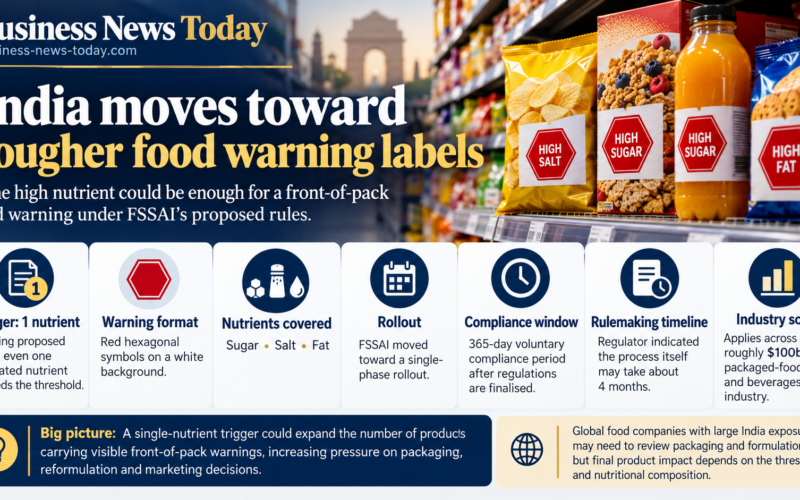
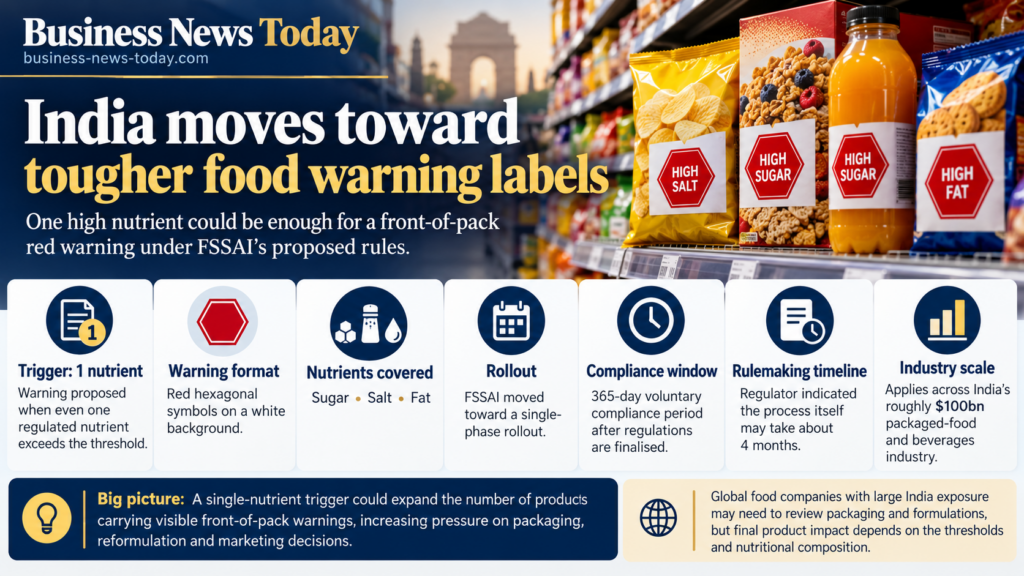
India’s Food Safety and Standards Authority of India (FSSAI) has toughened its proposed front-of-pack nutrition-labelling regime, telling the Supreme Court that packaged foods could carry a red warning symbol when even one regulated nutrient exceeds the prescribed threshold. The shift abandons an earlier plan under which the first phase would have required at least two nutrient thresholds to be breached before the warning appeared, potentially expanding the number of products exposed to visible labels across India’s approximately $100bn packaged-food and beverages industry.
The proposed warnings cover sugar, salt and fat and would be displayed through red hexagonal symbols against a white background. FSSAI has also moved toward a single-phase rollout rather than introducing the requirements gradually. Food businesses are expected to receive a 365-day voluntary compliance window after regulations are finalised, with the regulator indicating that it expects the rulemaking process itself to take about four months.
The change has direct relevance for multinational consumer companies including Nestlé S.A., Unilever PLC, Mondelez International, Inc., Mars Incorporated, PepsiCo, Inc. and The Coca-Cola Company, although whether an individual product receives a warning will depend on the final thresholds and its nutritional composition. It would therefore be inaccurate to assume that every snack, beverage, confectionery product or instant-food brand sold by those companies will automatically carry a red symbol.
How did India’s proposed food warning-label rules become stricter?
FSSAI’s earlier framework envisaged an initial warning when a product exceeded limits in at least two of three nutrient categories, followed by a later stage covering a single nutrient. Health organisations and nutrition experts argued that the approach could allow products with a high level of one nutrient to avoid a warning during the first phase.
The Supreme Court scrutinised that distinction and asked the government to provide a clearer implementation pathway. Reuters subsequently reported that FSSAI told the court it was prepared to adopt a single-phase model under which one nutrient exceeding the threshold would be enough for the corresponding red warning.
The change materially alters potential product exposure. A food that is high in sugar but remains below the limits for salt and saturated fat would no longer escape a front-panel warning simply because two thresholds were not crossed. The same principle applies to foods particularly high in salt or fat.
The final commercial impact will depend on the numerical thresholds and how serving size, product categories and exemptions are treated in the regulations. Those details determine whether reformulation becomes necessary for a narrow group of products or a much larger portion of supermarket shelves.
What could the red warning labels mean for Nestlé, Unilever, Mondelez and PepsiCo?
The immediate cost is packaging compliance. Companies may need to redesign labels, adjust manufacturing and inventory transitions and ensure that every stock-keeping unit is correctly classified before mandatory implementation. A one-year transition period can reduce packaging waste by allowing companies to run down older printed material, but large portfolios still create substantial operational work.
The more consequential issue is consumer behaviour. A prominent warning on the front of a package changes the information visible before a shopper reads a detailed nutrition panel. That may affect brand choice in categories where competing products carry different numbers of warnings.
Companies consequently have three broad commercial responses even though the final strategy will vary by brand. They can retain formulations and carry the required warning, reformulate products to fall below thresholds where technically and commercially feasible, or alter product mix and marketing toward categories with fewer warning triggers.
Reformulation is not costless. Reducing sugar, salt or fat can change flavour, texture, preservation, ingredient costs and consumer acceptance. A formulation that passes a regulatory threshold but disappoints existing customers can destroy more value than the warning it was designed to avoid.
Why is the India market important enough for global food companies to respond?
India combines a large population, rising packaged-food consumption and growing modern retail and quick-commerce distribution. Reuters described the food-and-drinks sector as approximately $100bn and one of the faster-growing markets for foreign participants including Nestlé, Unilever, Mondelez and Mars.
That scale makes India-specific nutrition rules economically meaningful even for enormous multinational groups. Companies cannot simply treat compliance as an issue affecting a marginal export market. Domestic manufacturing, local product formulations and substantial brand portfolios mean regulatory changes can influence capital spending, packaging, research and development, advertising and supply chains.
The change also arrives amid a broader Indian food-safety enforcement push. Reuters has reported increased inspections and enforcement activity alongside the front-of-pack debate, creating a regulatory environment in which labelling is one part of wider scrutiny of food standards and consumer information.
For multinational companies, that raises the value of local regulatory expertise. Products developed for global portfolios may need India-specific nutritional, packaging or compliance decisions rather than a single worldwide formula.
What role did food-industry lobbying play in the warning-label debate?
Reuters previously reported that Coca-Cola and groups representing or backing companies including Nestlé and PepsiCo had advocated against stricter warning approaches, arguing among other things that warning labels could be ineffective or that alternative frameworks would be more appropriate. Health advocates took the opposite position, arguing that the earlier two-nutrient threshold weakened the usefulness of the labels.
Those are competing stakeholder positions rather than established conclusions about which design produces the best public-health outcome. The Supreme Court’s scrutiny and FSSAI’s subsequent shift have moved the proposal toward a stricter single-nutrient trigger, but the regulatory process is still being finalised.
Industry concerns about implementation costs and product classification remain relevant, while health organisations continue to focus on whether warnings are sufficiently prominent and whether thresholds correctly identify products with elevated nutrient levels. The final rule will need to translate those competing considerations into an enforceable national standard.
Artificial sweeteners add another layer. Existing Indian rules already require declarations for specified non-caloric sweeteners, and the evolving front-of-pack framework increases the visibility of the wider debate over how such ingredients should be communicated to consumers.
Are food-company shares already pricing in the tougher India rules?
The market signal is mixed rather than clean. Nestlé India shares were around ₹1,354.90 on September 25, up approximately 0.3% in the latest session captured, after falling 2.42% to ₹1,365.10 on September 22. The company has also been dealing with a separate FSSAI matter involving infant-nutrition products, making it impossible to attribute recent share moves solely to the front-of-pack proposal.
In the United States, PepsiCo closed September 24 at $128.15, down 1.56%, while Mondelez International closed at $60.86, down 0.94%. Both companies are affected by far more than India regulation, including global input costs, currencies, category demand and investor expectations.
The absence of a clean share-price reaction does not make the regulation commercially unimportant. The real financial consequences will emerge only when the final nutrient thresholds identify how much of each company’s portfolio is affected and management teams disclose reformulation, packaging or marketing costs.
That makes the next four months particularly important. The current development establishes the direction of regulation: India is moving toward a single-phase warning regime in which one high nutrient can be enough to produce a visible red label. The next stage will determine which products actually cross the line.
Discover more from Business-News-Today.com
Subscribe to get the latest posts sent to your email.