


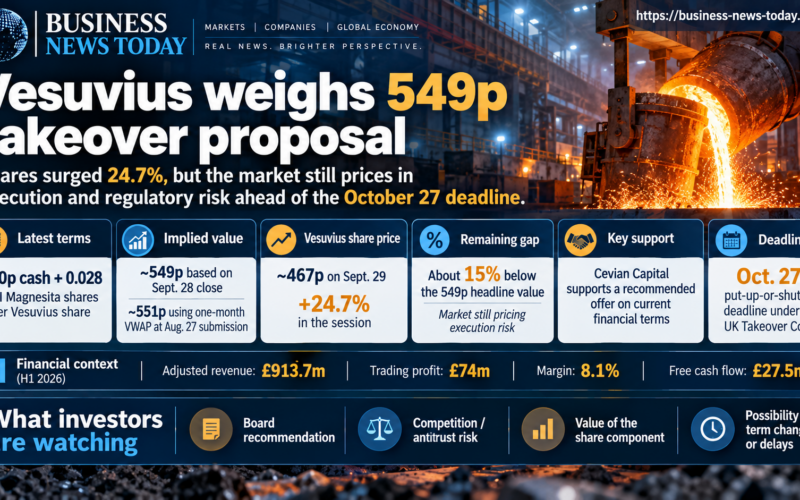
Vesuvius plc (LSE: VSVS) finished September 29 around 467p, up approximately 24.7%, after confirming that it is carefully evaluating the latest takeover proposal from RHI Magnesita N.V. The current terms comprise 470p in cash plus 0.028 RHI Magnesita shares for each Vesuvius share, equivalent to approximately 549p based on RHI Magnesita’s September 28 closing price and 551p using the one-month volume-weighted average when the proposal was submitted on August 27.
That distinction immediately creates the September 30 investor question. Even after the enormous rally, Vesuvius remained roughly 15% below the 549p latest mark-to-market headline value. Some discount is reasonable because the proposal is not yet a firm offer, includes a variable share component and faces execution risk. The scale of the remaining gap nevertheless shows that investors are still assigning meaningful probability to either negotiations failing, transaction terms changing or regulatory complications emerging.
Why has RHI Magnesita been pursuing Vesuvius for almost a year?
The September disclosure revealed a much longer courtship than shareholders previously knew. RHI Magnesita first approached Vesuvius in September 2025 with a proposal worth 448p per share and subsequently returned with multiple revised approaches.
By March 2026, RHI Magnesita had offered an all-cash 550p proposal, after which Vesuvius granted access for confirmatory due diligence. Another proposal worth around 550p arrived in June and was rejected. The latest August approach changes the structure by combining 470p of cash with RHI Magnesita shares.
Persistence on that scale suggests RHI Magnesita sees strategic value beyond a conventional short-term acquisition opportunity.
Both businesses manufacture refractory and molten-metal-flow products used in extremely high-temperature industrial processes including steelmaking and foundries. Combining them could create procurement, manufacturing, commercial and research efficiencies while broadening geographic reach.
The industrial logic also creates the principal execution risk. Significant overlap between two major suppliers can attract competition scrutiny and may ultimately require disposals or behavioural remedies before regulators approve a transaction.
How much upside is actually left between Vesuvius shares and the proposed deal value?
At approximately 467p, the September 29 market price sat about 82p below the 549p value implied by RHI Magnesita’s September 28 share price.
That represents roughly 17.6% potential appreciation from 467p to 549p if a firm offer were eventually made on identical terms and the RHI Magnesita share component retained the same value. It is not a guaranteed arbitrage return.
The 470p cash component is already very close to the latest Vesuvius share price. Most of the remaining theoretical upside therefore comes from the RHI Magnesita shares Vesuvius investors would receive.
Those shares create market exposure before and after completion. If RHI Magnesita falls substantially, the economic value of the proposal declines. If RHI Magnesita rises, the implied value increases.
Vesuvius shareholders would own approximately 13% of the enlarged RHI Magnesita after completion. This means the proposed transaction is not simply an exit at a fixed price; existing Vesuvius investors would retain a meaningful interest in the combined refractory group.
Why does Cevian Capital’s support matter to the takeover process?
Cevian Capital, Vesuvius’ largest shareholder, has provided an irrevocable undertaking supporting a recommended offer on the latest proposed financial terms.
That substantially strengthens RHI Magnesita’s negotiating position because it demonstrates that an influential long-term shareholder is prepared to support the economics if the board recommends the deal.
It does not force the Vesuvius board to accept. Directors have said they are evaluating both the financial terms and execution risk with advisers.
This distinction matters because a 549p or 551p headline can look attractive against the pre-announcement share price, but directors also need to assess the probability and timing of regulatory approvals and the standalone value shareholders give up.
RHI Magnesita has until October 27 under the UK Takeover Code to announce a firm intention to make an offer or state that it does not intend to proceed, unless the deadline is extended with Takeover Panel consent.
Do Vesuvius’ own earnings support holding out for a higher valuation?
First-half 2026 adjusted revenue was £913.7 million, up 1.5% at constant currency, while trading profit declined slightly to £74 million and trading margin slipped to 8.1%.
Free cash flow improved strongly to £27.5 million from a negative figure a year earlier, but statutory operating profit fell to £47.4 million. Vesuvius has also been dealing with operational and supply-chain challenges, particularly in North America.
Those results do not suggest a company at peak earnings. That can work both ways in takeover negotiations.
RHI Magnesita can argue that its proposal offers Vesuvius shareholders a substantial premium while execution challenges remain unresolved. Vesuvius can argue that selling during an operationally depressed period transfers future recovery upside to the acquirer.
The latest proposal also preserves Vesuvius’ declared 7.1p interim dividend without reducing the takeover consideration, adding modest additional value to the package.
Why could competition risk explain much of the remaining takeover discount?
Vesuvius and RHI Magnesita sell products into overlapping steel and industrial customer bases. A transaction combining major refractory suppliers may therefore receive detailed antitrust scrutiny across multiple jurisdictions.
Regulators can approve transactions subject to asset disposals, but divestitures can reduce the synergies that originally justified the acquisition price. The possibility of remedies also adds time and uncertainty.
This explains why the market does not simply price Vesuvius immediately at 549p.
Another risk is financing and RHI Magnesita’s share-price performance. Because the transaction includes equity, Vesuvius shareholders are partly exposed to how the market judges the acquisition from the buyer’s perspective.
The nearly 25% September 29 rally captured the probability of a real transaction. The remaining valuation gap captures everything that still needs to happen before shareholders can treat 549p as money in the bank.
What should Vesuvius investors watch before the October 27 deadline?
The first milestone is whether Vesuvius recommends the proposal. A recommendation would materially increase completion expectations and could narrow the spread.
Investors should then look for firm-offer documentation detailing conditions, regulatory approvals, financing and any expected combination benefits. Movement in RHI Magnesita shares will continue changing the proposal’s value while the equity component remains part of the terms.
A rival bidder would radically alter the setup, although there is currently no evidence that another party will emerge.
For September 30, the useful number is therefore not the 25% one-day gain. It is the continuing gap between approximately 467p and a proposal currently worth around 549p. That gap is effectively the market price of execution risk.
Discover more from Business-News-Today.com
Subscribe to get the latest posts sent to your email.