

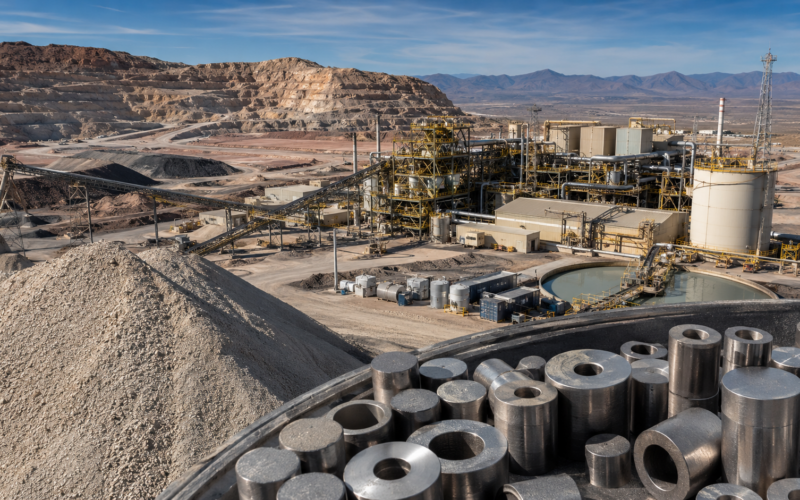
MP Materials Corp. (NYSE: MP) has evolved from the operator of California’s Mountain Pass mine into one of the most strategically important companies in the United States critical-minerals industry. The Las Vegas-headquartered company now combines rare earth mining and separation at Mountain Pass with metal, alloy and magnet manufacturing at its Independence facility in Fort Worth, Texas, while constructing a second magnet campus known as 10X in Northlake. Its commercial relationships include the United States defence establishment, Apple Inc. and General Motors Company, placing MP Materials at the intersection of national security, electric vehicles, consumer electronics, robotics and advanced manufacturing.
The strategic case has strengthened faster than the company’s reported profitability. MP Materials generated $90.6 million of revenue during the first quarter of 2026 and separately recognised $42.3 million of price-protection agreement income, while adjusted EBITDA improved to $36.6 million. However, the company still reported a net loss of approximately $8 million, remained in the early stages of commercial magnet production and faced a large multiyear construction and commissioning programme.
That tension defines the MP Materials company profile. The company has secured government support, customer commitments, financing capacity and an operating mineral resource that would be difficult to replicate. It must now prove that it can convert those advantages into consistent volumes, acceptable manufacturing yields and durable cash flow without becoming dependent on perpetual policy support.
What does MP Materials do and how does its rare earth business model operate?
MP Materials operates through two connected businesses: Materials and Magnetics. The Materials segment covers mining, beneficiation, separation and refining at Mountain Pass, while the Magnetics segment converts refined rare earth materials into metals, alloys and neodymium-iron-boron permanent magnets at the Independence facility. This structure is designed to keep more of the rare earth value chain within the United States rather than exporting concentrate for overseas processing.
Mountain Pass mines bastnaesite ore containing several rare earth elements. The ore is crushed, ground and processed into a concentrate before undergoing roasting, leaching, separation and finishing to produce refined products. Neodymium and praseodymium, commonly grouped as NdPr, are particularly valuable because they are used in high-performance permanent magnets found in electric motors, wind turbines, drones, robots, defence equipment and consumer electronics.
The Independence facility takes NdPr oxide produced at Mountain Pass and converts it into NdPr metal, alloy flake and ultimately finished magnets. The plant began generating revenue from magnetic precursor products supplied to General Motors during the first quarter of 2025 and commenced manufacturing finished NdFeB magnets on commercial equipment in December 2025. MP Materials expects Independence to reach projected annual magnet capacity of approximately 3,000 metric tons as the facility is expanded and commissioned.
The business model is therefore changing from commodity-linked concentrate sales toward higher-value refined products and magnets. That transition could improve customer visibility and capture more margin, but it also introduces manufacturing complexity, product qualification requirements and significantly higher capital needs.
How did MP Materials revive Mountain Pass and become a publicly traded company?
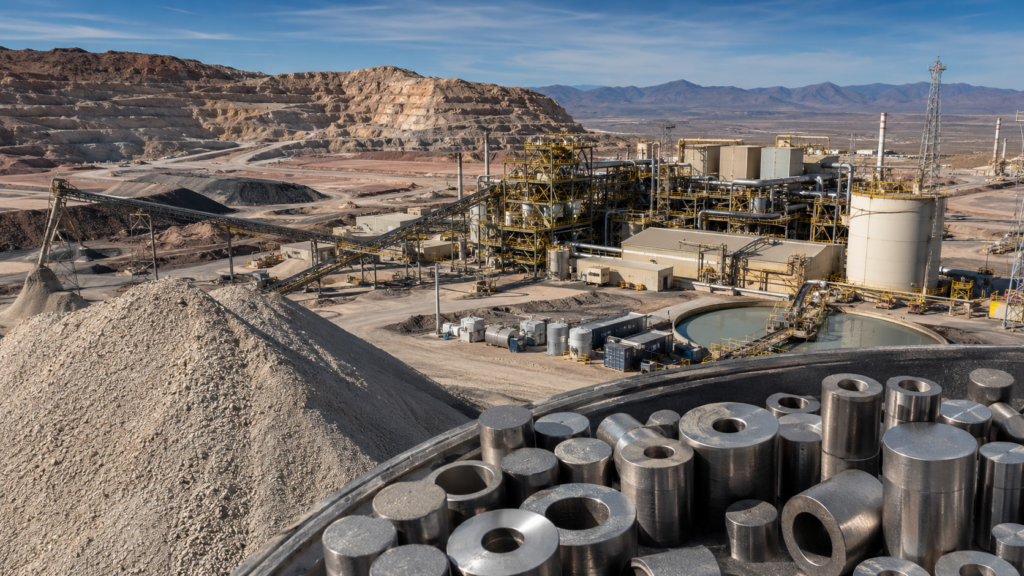
Mountain Pass has played a central role in the global rare earth industry since mining began there in 1952. Operations passed through several owners, including Molybdenum Corporation of America, Unocal Corporation, Chevron Corporation and Molycorp, before Molycorp placed the operation into a cold-idle state in 2015. MP Materials acquired the asset from the Molycorp bankruptcy estate in July 2017 and restarted concentrate production later that year.
The new owners initially focused on stabilising and increasing mine and concentrator output using existing infrastructure. First concentrate sales resumed in 2018, while separated rare earth production began during the second half of 2023 after the company recommissioned and upgraded Mountain Pass processing equipment.
MP Materials entered the public markets in November 2020 through a combination with Fortress Value Acquisition Corp., a special-purpose acquisition company. Founder James H. Litinsky became chairman and chief executive officer, while co-founder Michael Rosenthal continued overseeing operations as chief operating officer. The transaction gave the company access to public-market capital for the costly transition from mining into separation and magnet manufacturing.
The strategic evolution can be viewed in three stages. The first restored large-scale concentrate output, the second brought separated rare earth refining back to Mountain Pass, and the third is intended to establish domestic magnet production at Independence and 10X.
How important is Mountain Pass to MP Materials’ competitive position?
Mountain Pass is the only rare earth mining and processing site operating at scale in North America and represents the largest commercial rare earth source in the Western Hemisphere. MP Materials reported proven and probable reserves containing approximately 1.96 million short tons of rare earth oxide within 28.96 million short tons of ore at an average grade of 5.89% as of December 31, 2025. Based on the company’s expected production profile, the reported reserves supported an estimated mine life of approximately 28 years.
The scale and grade of the deposit are central to MP Materials’ cost argument. Mining companies seeking to enter the rare earth sector must not only identify a suitable resource but also build beneficiation, chemical separation and waste-handling systems, secure permits and develop specialised technical expertise. Mountain Pass already possesses much of that infrastructure, although portions required major recommissioning and optimisation.
MP Materials produced a record 50,692 metric tons of rare earth oxide in concentrate during 2025, up approximately 12% from the previous year. It also produced 2,599 metric tons of NdPr oxide, representing growth of 101%, and sold 1,994 metric tons of NdPr oxide-equivalent products. Those numbers show that upstream mining is established while separated-product output remains in a comparatively earlier ramp-up phase.
The company is pursuing an Upstream 60K programme intended to raise annual concentrate production toward approximately 60,000 metric tons of rare earth oxide. It is also commissioning heavy rare earth separation capabilities for elements such as dysprosium and terbium, which can improve magnet performance at high temperatures and are particularly important for automotive and defence applications.
What did MP Materials’ 2025 financial results reveal about its transformation?
MP Materials generated $224.4 million of revenue during 2025, an increase of approximately 10% from $203.9 million in 2024. Materials segment external revenue was $157.6 million, while the emerging Magnetics segment contributed $66.9 million from sales of magnetic precursor products.
The revenue mix changed substantially. MP Materials historically depended on sales of rare earth concentrate that was ultimately processed in China. During 2025, it reduced concentrate shipments, expanded sales of separated NdPr products and began recognising revenue connected with General Motors. The company stopped selling products to China in July 2025 and allowed its principal Shenghe Resources offtake agreement to expire in January 2026.
MP Materials reported a 2025 net loss of $85.9 million, compared with a loss of $65.4 million in 2024. Adjusted EBITDA improved to $11.4 million from an adjusted EBITDA loss of $50.2 million, reflecting the contribution from Magnetics, higher separated-product activity and price-protection income.
Price-protection agreement income totalled $51 million during 2025 and was recorded separately from revenue. The distinction is important because combining ordinary customer revenue with government-linked support could give readers an exaggerated impression of the company’s commercial sales. MP Materials’ reported revenue measures customer activity, while price-protection income reflects the financial benefit of its strategic agreement with the United States government.
Operating cash flow was negative $155.8 million during 2025, compared with positive operating cash flow of $13.3 million a year earlier. Management attributed the deterioration partly to higher inventories, stockpiled concentrate, the ramp-up of separated materials and the timing of customer cash received under earlier prepayment arrangements.
What do the first-quarter 2026 results say about current operating momentum?
MP Materials produced a record 12,983 metric tons of rare earth oxide in concentrate during the first quarter of 2026, representing year-over-year growth of 6%. NdPr oxide production increased 63% to a record 917 metric tons, while NdPr sales more than doubled to 1,006 metric tons.
Revenue increased 49% to $90.6 million from $60.8 million. The company also recognised $42.3 million of price-protection agreement income, taking the combined total of revenue and that separate support income to $132.9 million. The Materials segment generated $72.2 million of revenue and $36.7 million of adjusted EBITDA, while the Magnetics segment produced $21.1 million of revenue and $9.6 million of adjusted EBITDA.
The consolidated net loss narrowed to $8 million from $22.6 million, while adjusted net income improved to $6.7 million from an adjusted loss of $19.9 million. Adjusted diluted earnings were $0.03 per share compared with an adjusted loss of $0.12 a year earlier.
These results suggest that government price support and rising NdPr volumes are improving near-term economics before full magnet production has scaled. They also underline the importance of separating underlying production improvements from the contractual support mechanism. The quality of future earnings will increasingly depend on how much profit comes from customer magnet sales rather than price-floor income alone.
How did the Pentagon partnership change MP Materials’ financial outlook?
MP Materials entered a multibillion-dollar public-private partnership with the United States Department of Defense, now referred to in recent company filings as the Department of War, in July 2025. The arrangement includes equity investment, debt financing, price protection and a long-term magnet-purchase commitment intended to establish a full domestic rare earth supply chain.
The government agreed to a ten-year price floor of $110 per kilogram for qualifying MP Materials NdPr products. When applicable market pricing falls below that threshold, the arrangement can support company economics, while the government shares in upside under the contractual formula. The mechanism addresses one of the biggest obstacles facing non-Chinese rare earth projects: competing against prices that may not reflect fully commercial market economics.
The agreement also provides demand support for the planned 10X facility. For ten years after construction, the government committed to ensure that the facility’s magnet output is purchased by defence or commercial customers. That significantly reduces offtake uncertainty, although MP Materials must still build the plant, meet specifications and deliver magnets at commercially viable costs.
The government purchased $400 million of newly created convertible preferred stock and received a warrant to acquire additional common shares. On an as-converted and as-exercised basis when announced, the instruments represented approximately 15% of MP Materials’ outstanding common stock, positioning the government to become the company’s largest shareholder.
The partnership reduces commodity-price and demand risk, but it introduces policy, appropriations and regulatory risk. MP Materials’ filings acknowledge that changes in government support, legal challenges or limitations on the department’s authority could affect the expected benefits of the transaction.
How are Apple and General Motors shaping MP Materials’ magnet business?
General Motors is the foundational commercial customer for MP Materials’ Independence facility. Sales of magnetic precursor products began during the first quarter of 2025, and MP Materials recognised $66.9 million of Magnetics revenue during the full year. The supply relationship is expected to progress from precursor materials toward finished magnets as production equipment is commissioned and automotive qualification requirements are completed.
Apple entered a $500 million long-term partnership with MP Materials in July 2025. Under the agreement, MP Materials plans to manufacture magnets at Independence using 100% recycled rare earth feedstock processed through a dedicated recycling line at Mountain Pass. Magnet shipments are expected to begin in 2027 and eventually support hundreds of millions of Apple devices.
The Apple agreement adds a different dimension to the business. General Motors validates the automotive pathway, while Apple provides exposure to consumer electronics and closed-loop recycling. This diversification matters because magnet demand can vary significantly across vehicles, smartphones, robotics, industrial motors and defence systems.
Apple and MP Materials had worked on recycling technology for nearly five years before announcing the commercial agreement. Moving from pilot work to scaled production will require MP Materials to collect and process post-industrial scrap and end-of-life magnets while achieving the consistency expected from a global consumer-electronics customer.
What is the 10X facility and why does it matter to MP Materials’ growth strategy?
MP Materials selected a 120-acre site in Northlake, Texas, for the 10X magnet manufacturing campus in February 2026. The project is located fewer than ten miles from Independence and is expected to begin commissioning in 2028. Once scaled, 10X is designed to produce approximately 7,000 metric tons of magnets annually.
Together with the planned expansion of Independence to approximately 3,000 metric tons, the company is targeting total United States magnet manufacturing capacity of about 10,000 metric tons per year. The project is supported by a proposed $1 billion construction-financing package, government offtake commitments and a $200 million Texas incentive package.
The 10X strategy is not simply about manufacturing more of the same product. MP Materials intends to incorporate processes that reduce or eliminate the need for certain heavy rare earth inputs while maintaining magnet performance. Lower heavy rare earth intensity could improve supply security and costs because dysprosium and terbium remain among the most difficult elements to source outside China.
Construction is only the first hurdle. Rare earth magnet production requires exact control over alloy composition, powder handling, pressing, sintering, machining, coating and finishing. The investment case ultimately depends on manufacturing yield, product qualification and repeatable commercial output rather than headline nameplate capacity.
How strong is MP Materials’ balance sheet as capital spending increases?
MP Materials ended March 2026 with approximately $886.3 million of cash and $852.1 million of short-term investments, giving it total cash and investments of about $1.74 billion. Long-term debt, including the current portion, was approximately $1 billion, while the government-linked redeemable preferred stock carried a liquidation preference of roughly $420.7 million.
The balance sheet therefore provides meaningful liquidity for the current buildout. MP Materials used only $1.9 million of operating cash during the first quarter, a substantial improvement from the $63.2 million used in the prior-year period. Additions to property, plant and equipment increased to $77.4 million from $30.5 million as work advanced at Independence, Mountain Pass and 10X.
The financial position is stronger than that of a typical early-stage mining developer because Mountain Pass is already operating and the company has raised substantial government and equity funding. However, the balance sheet should not be viewed as permanently overcapitalised. Magnet facilities, separation plants, recycling lines and production ramp-ups can absorb significant cash before customer receipts scale.
Convertible notes, preferred stock and government warrants also create potential dilution. The government partnership may reduce operating risk while simultaneously increasing the future common-share count if securities are converted or exercised.
How does MP Materials compete with China and other rare earth producers?
China remains the dominant force in rare earth separation and NdFeB magnet manufacturing. MP Materials said two consolidated Chinese groups and their affiliates controlled substantially all of China’s quotas for concentrate production and refining, while Chinese producers retained substantial cost, infrastructure and policy advantages in magnets.
Outside China, the most established integrated competitor operates across Australia and Malaysia, a description that points to Lynas Rare Earths Limited. Other companies, including Energy Fuels Inc., USA Rare Earth, Inc., Neo Performance Materials Inc. and a growing group of government-supported developers, are pursuing parts of the Western rare earth and magnet supply chain. Few possess MP Materials’ combination of an operating mine, existing separation infrastructure and downstream facilities under construction.
MP Materials’ advantage is vertical integration. It can potentially mine ore in California, separate NdPr and selected heavy rare earths, manufacture alloys and magnets in Texas, and recycle production scrap and end-of-life material through its own system. This traceability may be particularly valuable to defence, automotive and technology customers concerned about supply security.
Its disadvantage is that the downstream platform is still ramping. Chinese competitors have decades of manufacturing experience, established customer relationships, large supplier networks and cost structures supported by industrial scale. Government support narrows the economic gap, but it does not automatically create comparable technical efficiency.
How has the MP Materials share price performed in 2026?
MP Materials shares closed at $41.30 on July 24, 2026, compared with $54.97 on January 2. The stock was therefore down approximately 24.9% for the year to date. It had also fallen about 26.9% from its June 24 close of $56.51 and approximately 8.7% over the five trading days beginning July 17.
The July 24 price sat close to the bottom of the reported 52-week range of $41.12 to $100.25. Shares were approximately 58.8% below the 52-week high, reflecting a substantial reversal after the optimism generated by government backing, Apple demand and higher rare earth prices.
Using the 177.7 million common shares outstanding reported at March 31, the July 24 closing price implied an indicative market capitalisation of approximately $7.34 billion. That calculation excludes the full dilutive effect of preferred stock, warrants, employee awards and convertible notes.
The decline appears to reflect a reassessment of the wider rare earth sector rather than a collapse in MP Materials’ operating results. Investors have become more cautious about planned mining capacity, the time required to scale Western refining and magnet production, and whether policy-supported valuations moved too far ahead of near-term earnings.
Analyst sentiment remained strongly positive despite the correction. One current compilation placed the average 12-month price target near $78.72, with estimates ranging from $61 to $100. The wide spread shows that valuation depends heavily on assumptions about 10X, magnet margins, government support and the timing of commercial production.
What does institutional and founder ownership reveal about MP Materials?
James Litinsky remained MP Materials’ largest disclosed individual shareholder, beneficially owning approximately 12.81 million shares, or 7.2%, according to the 2026 proxy statement. Hancock Prospecting Pty Limited held approximately 7.8%, while BlackRock, Inc. was listed with about 6.7%.
Litinsky combines the roles of founder, chairman and chief executive officer. That structure provides continuity during an unusually complex industrial expansion but concentrates leadership authority in one individual. The board includes independent directors with backgrounds spanning defence, aerospace, technology, law and industrial management.
The government’s preferred stock and warrant position is structurally different from conventional common ownership. It potentially gives the Pentagon substantial economic exposure while tying shareholder outcomes more closely to national industrial policy.
What are the biggest risks facing MP Materials through 2028?
Manufacturing execution is the most important company-specific risk. MP Materials has experience in mining and concentration, but high-volume automotive and electronics magnets require different production disciplines. Delays in qualification, lower yields or quality problems could postpone revenue while labour, depreciation and plant costs continue.
Government dependence is another material issue. The $110-per-kilogram price floor, equity investment, loans and magnet offtake support significantly improve the project’s economic foundation. They also mean that changes in political priorities, appropriations, contract interpretation or legal authority could affect expected cash flows.
Customer concentration could remain elevated as General Motors and Apple become major downstream buyers. Large anchor customers help finance and validate new capacity, but production problems involving a single contract could have a disproportionate effect on revenue and reputation.
Rare earth prices remain relevant even with price protection. The government agreement covers specific NdPr products and contains shared-upside provisions, but it does not eliminate all exposure to market prices, product mix, customer demand or production costs.
Technical competition is also likely to intensify. Manufacturers may reduce magnet sizes, use lower quantities of heavy rare earths, redesign motors or develop substitutes. MP Materials is pursuing technologies intended to lower heavy rare earth content, but the long-term demand profile will depend on how end-market technologies evolve.
Environmental, permitting and operational risks remain inherent in mining and chemical processing. Mountain Pass uses extensive water recycling and dry-tailings systems, but the company must continue managing waste, chemical reagents, energy use, worker safety and regulatory compliance across an expanding footprint.
What is the growth outlook for MP Materials through 2028?
MP Materials has moved beyond the conventional mining-company model. It now controls an operating rare earth deposit, commercial separation infrastructure, a growing magnet plant, a second manufacturing campus under development and a recycling strategy supported by a major technology customer.
The near-term financial outlook should benefit from higher NdPr volumes, price-protection income and rising Magnetics revenue. The more consequential milestones will be the sustained production of qualified finished magnets at Independence, commencement of Apple shipments in 2027 and commissioning of 10X from 2028.
The Pentagon partnership addresses two structural weaknesses that have historically undermined Western rare earth projects: volatile pricing and uncertain demand. The $110 price floor improves visibility for separated materials, while the 10X offtake mechanism reduces the risk that new magnet capacity will lack buyers.
Those protections do not remove execution risk. MP Materials must still deliver competitive production costs, meet exacting customer specifications and manage a simultaneous expansion across mining, separation, recycling and magnets. Government support can protect revenue economics, but it cannot manufacture products on the company’s behalf.
Markets are likely to assess MP Materials through two increasingly separate lenses. The Materials segment will be judged on production volumes, recovery rates, unit costs and price-protection income. The Magnetics segment will be judged on commercial magnet shipments, customer qualification, margins and the timing of Independence and 10X capacity.
MP Materials possesses a strategic position that few publicly traded mining companies can match. Its assets matter to national security, industrial policy and several high-growth technologies, while Apple and General Motors provide commercial validation beyond defence procurement. The central question is whether the company can turn strategic scarcity into repeatable manufacturing economics. If Independence and 10X scale as planned, MP Materials could become a durable non-Chinese magnet supplier. If execution slips, the gap between its policy-backed valuation and current earnings may remain difficult for investors to ignore.
Discover more from Business-News-Today.com
Subscribe to get the latest posts sent to your email.