




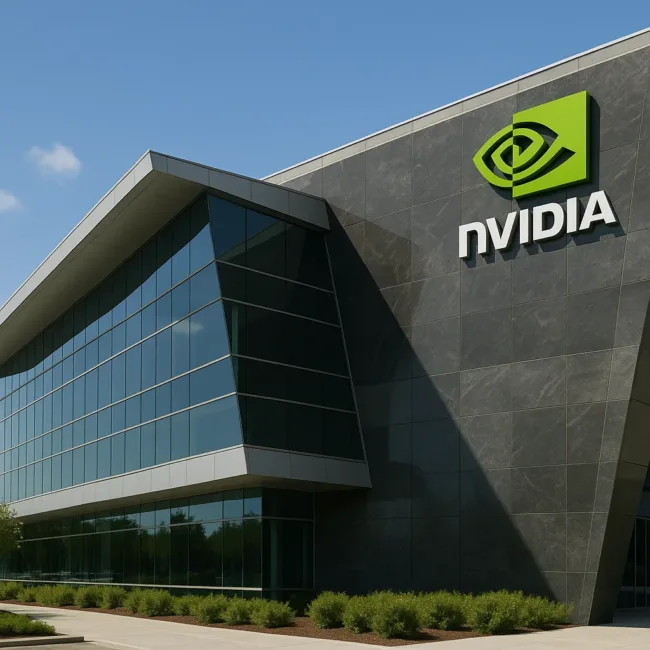
What Does NVIDIA Corporation Do? Business Overview
NVIDIA Corporation is a leading global semiconductor and AI computing company based in Santa Clara, California. Initially established in 1993 to enhance computer graphics through advanced GPUs, the company has since expanded into a dominant force in artificial intelligence, data center computing, and enterprise acceleration. Today, the NVIDIA Corporation company profile is defined by its role in powering generative AI models, autonomous systems, robotics, and next-generation computing infrastructures.
At the heart of its offering is the CUDA parallel computing platform, which, together with its AI-optimized GPUs like the H100 and Grace Hopper Superchip, enables developers and enterprises to train large language models and deploy AI at scale. NVIDIA’s customer base includes hyperscalers, automotive manufacturers, healthcare firms, and national governments—all integrating NVIDIA’s software and silicon for real-time inference, simulation, and digital transformation.

Sector Presence and Core Business Segments
NVIDIA operates through four main business segments: Data Center, Gaming, Professional Visualization, and Automotive. Among these, the Data Center segment has emerged as the company’s largest growth engine, representing nearly 88% of total revenue in FY2025, driven by explosive demand for AI chips across global cloud service providers and enterprise AI workloads.
The Gaming segment remains a foundational business unit, contributing through GeForce GPUs and the NVIDIA RTX platform, which continue to drive demand among PC gamers, content creators, and streamers. Professional Visualization serves industries like engineering and media production, while the Automotive segment focuses on AI-based autonomous driving and digital cockpit solutions.
The expansion of NVIDIA’s networking capabilities through the integration of Mellanox Technologies further strengthens its AI infrastructure proposition. This convergence of GPUs, high-speed interconnects, and AI frameworks positions the company as a full-stack AI platform provider, rather than just a chipmaker.
Revenue Breakdown and Key Financial Metrics
NVIDIA Corporation reported a record $130.5 billion in revenue for fiscal year 2025, more than doubling its FY2024 revenue of $60.9 billion. This growth was primarily led by the Data Center segment, which contributed $115.2 billion, marking a 142% year-over-year increase. Gaming revenue came in at $11.4 billion, up 9% from the previous year. Professional Visualization revenue rose to $1.9 billion, while the Automotive business generated $1.8 billion.
GAAP gross margin for FY2025 reached 74.2%, reflecting robust pricing power amid heightened demand for NVIDIA’s AI and HPC offerings. Operating income for the year stood at $65.9 billion, while net income surged to $59.7 billion, translating to GAAP earnings per diluted share of $2.94. These figures underscore NVIDIA’s transformation into a high-margin, high-growth enterprise at the center of the global AI value chain.
With free cash flow exceeding $27 billion and over $31 billion in cash and marketable securities, the company is strategically positioned to reinvest in R&D, pursue acquisitions, and support shareholder returns through stock repurchases and dividends.
Latest Quarterly Results and Earnings Highlights (Q4 FY25)
For Q4 FY2025, NVIDIA reported $39.3 billion in revenue, a 22% sequential increase and a 78% year-on-year rise. The Data Center segment alone contributed $35.6 billion, fueled by demand for AI training infrastructure from hyperscalers and enterprises deploying generative AI across domains. Gaming revenues came in at $3.1 billion, while Professional Visualization and Automotive contributed $0.5 billion and $0.1 billion respectively.
GAAP gross margin for the quarter was 76.0%, with operating income reaching $25.1 billion. Net income stood at $22.1 billion, and diluted earnings per share were reported at $0.89. The company’s CEO Jensen Huang stated that generative AI has triggered a new industrial revolution and emphasized that NVIDIA is supplying “the engines of the modern AI factories.”
These earnings affirm NVIDIA’s accelerating dominance in the AI compute market, bolstered by both strong customer adoption and innovation cycles across its full-stack platform.
Strategic Initiatives and Growth Drivers
Globally, NVIDIA’s growth trajectory is rooted in three strategic pillars: AI infrastructure leadership, software ecosystem expansion, and ecosystem partnerships. Its CUDA platform has become an indispensable tool for over four million developers globally. The company’s close collaboration with Microsoft, Google Cloud, AWS, and Oracle Cloud ensures widespread distribution and adoption of its AI hardware and frameworks across public and private cloud deployments.
In India, NVIDIA has announced strategic partnerships with Reliance Industries and the Tata Group, targeting the development of India-specific large language models and sovereign AI infrastructure. These alliances aim to support India’s ambitions in digital public infrastructure (DPI) and AI-enabled services across government and enterprise sectors.
Further investments in the Omniverse platform for industrial simulation, NVIDIA Clara for healthcare AI, and autonomous vehicle systems reflect the company’s long-term diversification strategy. These initiatives expand NVIDIA’s addressable market across edge computing, robotics, and enterprise software—a multi-decade growth opportunity.
NVIDIA Corporation Stock Performance and Valuation Ratios
NVIDIA Corporation share price today reflects investor enthusiasm for its role as the AI backbone of the digital economy. As of May 16, 2025, NVIDIA stock traded at $135.40 post-stock-split adjustment, following a massive rally driven by AI chip demand and record earnings.
The company briefly surpassed a $3 trillion market cap, positioning it as one of the most valuable public companies in the world, alongside Apple and Microsoft. The current P/E ratio hovers around 46x forward earnings, a premium valuation justified by NVIDIA’s dominant market share, exceptional earnings growth, and visibility into multi-year demand cycles.
Despite the high valuation, many institutional investors view the stock as a cornerstone of long-term AI exposure. The share price trajectory, which has nearly tripled since early 2023, reflects strong earnings visibility, robust free cash flow generation, and ecosystem stickiness.
Institutional Holdings and Investor Sentiment (FII/DII Analysis)
As of Q2 2025, institutional investors held approximately 64.39% of NVIDIA’s outstanding shares, underscoring high confidence in the company’s fundamentals. Leading asset managers including Vanguard, BlackRock, and State Street remain among the top shareholders, with significant exposure across global ETFs and AI-themed funds.
Options volume and ETF inflows suggest sustained bullish sentiment, with strong participation from both retail and institutional investors. While Domestic Institutional Investors (DIIs) in India have limited direct exposure, several Indian mutual funds and pension funds have increased their indirect allocations through global feeder funds.
The broader sentiment surrounding the NVIDIA Corporation stock outlook remains decisively positive, driven by the company’s unparalleled leadership in AI, superior unit economics, and mission-critical role in enterprise transformation.
ESG Ratings, Board, and Corporate Governance
NVIDIA Corporation has made measurable progress on its ESG commitments, earning an “AA” ESG rating from MSCI and ranking among the top semiconductor companies for sustainability disclosures. The firm targets net-zero emissions by 2040, with active efforts to reduce power usage, water consumption, and waste across its global operations.
The company’s governance structure includes a balanced board composed of experienced executives from technology, academia, and finance. Jensen Huang, who co-founded the company, continues to serve as President and CEO. NVIDIA has implemented robust policies around executive compensation, shareholder rights, and cybersecurity governance, contributing to strong institutional trust.
ESG-focused funds have increased their weighting toward NVIDIA, citing its responsible AI development principles, ethical sourcing programs, and stakeholder transparency as key differentiators in the tech sector.
Analyst Consensus and Future Outlook
The analyst community remains overwhelmingly bullish on NVIDIA. Over 90% of analysts covering the stock have a “Buy” or “Overweight” rating, with an average 12-month price target above $160. Bullish scenarios cite continued strength in AI hardware demand, software monetisation opportunities, and full-stack differentiation.
Key risks include regulatory scrutiny over AI chip exports, particularly to China, as well as intensifying competition from AMD, Intel, and new entrants in the AI accelerator market. However, analysts broadly agree that NVIDIA’s scale, intellectual property leadership, and developer loyalty give it a defensible moat for years to come.
For investors evaluating the NVIDIA Corporation company profile, the firm’s transformation from GPU manufacturer to AI superpower marks one of the most consequential pivots in modern tech history. With unmatched positioning across the AI stack—from silicon and systems to platforms and partnerships—NVIDIA is likely to remain at the epicenter of global computing innovation for the foreseeable future.
Discover more from Business-News-Today.com
Subscribe to get the latest posts sent to your email.

