Rheinmetall AG (Frankfurt Stock Exchange: RHM) has transformed from a diversified German automotive and defence group into a defence-focused systems company spanning land, air, sea, cyber and space. The Düsseldorf-based manufacturer produced €9.94 billion in continuing-operations revenue during 2025, generated a record €1.84 billion operating result and increased its backlog to €63.8 billion before the addition of Naval Vessels Lürssen helped lift that figure to €73 billion by March 2026. Rheinmetall now supplies military trucks, armoured vehicles, artillery systems, ammunition, air-defence platforms, digital battlefield technology, drones, satellites and naval vessels to Germany, Ukraine and other European and NATO customers.
The company’s industrial transformation is occurring at a pace rarely seen in established European manufacturing. Rheinmetall is expanding production facilities, acquiring businesses, integrating shipyards, building ammunition plants and entering new technologies while governments simultaneously demand faster deliveries. That opportunity has produced exceptional revenue visibility, but it has also increased execution risk, working-capital requirements and investor expectations.
What does Rheinmetall AG do and how does its defence business model operate?
Rheinmetall designs, manufactures and supports military systems rather than relying on a single product category. Its business model combines large equipment programmes, ammunition supply, recurring maintenance, modernisation, training, spare parts, digital integration and long-term framework agreements. Customers are primarily governments, armed forces, procurement agencies and defence alliances, making revenue heavily dependent on public budgets, contract timing and regulatory approvals.
Military vehicle programmes can generate revenue over many years as Rheinmetall delivers platforms, provides upgrades and maintains fleets. Ammunition contracts may involve high-volume recurring orders, while air-defence and digital programmes combine hardware, software, sensors and ongoing support. The acquisition of Naval Vessels Lürssen extended this structure into ship construction, repair and maritime systems.
Rheinmetall uses a measure called “Rheinmetall Nomination” to represent conventional order intake together with the expected value of newly signed framework agreements. “Rheinmetall Backlog” includes binding orders and anticipated call-offs under existing frameworks. The backlog therefore provides strong visibility but should not be interpreted as revenue that will automatically be recognised within a fixed short period.

How did Rheinmetall develop from a nineteenth-century manufacturer into a defence group?
Rheinmetall traces its history to April 1889, when Rheinische Metallwaaren- und Maschinenfabrik Actiengesellschaft was established in Germany. The company entered the stock market in 1894 and subsequently expanded across armaments, mechanical engineering, automotive components and industrial technology.
For decades, Rheinmetall operated as a mixed defence and automotive group. Its civilian activities supplied components and systems used in internal-combustion engines, emissions reduction and industrial applications. That diversification once reduced dependence on government defence budgets, but the automotive division became increasingly exposed to weak demand, technological disruption and restructuring pressures.
The strategic direction changed decisively after Russia’s invasion of Ukraine accelerated German and European military spending. Rheinmetall expanded ammunition, vehicle and air-defence capacity while gradually selling or separating civilian operations. The company classified its remaining Power Systems automotive business as discontinued in late 2025 and signed an agreement in June 2026 to sell it to AEQUITA for a provisional €350 million, subject to regulatory approval and completion expected in the fourth quarter.
The divestment means future Rheinmetall financial performance will be determined almost entirely by defence. That makes the business strategically clearer, but it also removes the diversification that previously softened fluctuations in government procurement.
Which divisions and military products define Rheinmetall’s operations in 2026?
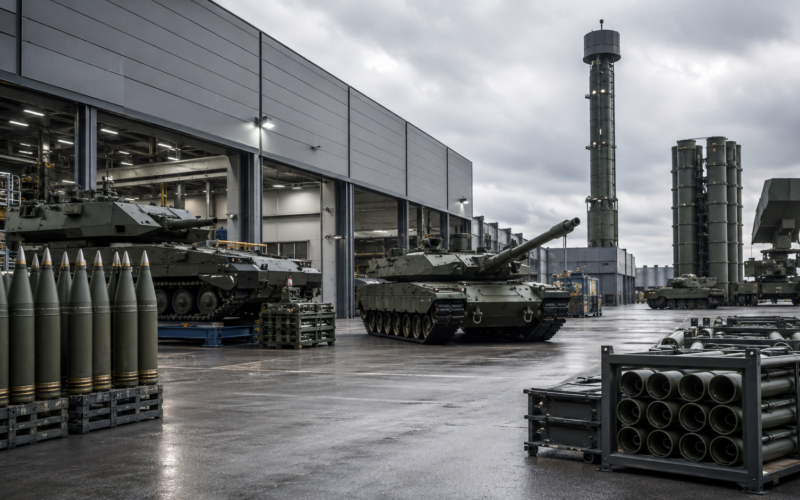
Rheinmetall reorganised its defence activities into five principal divisions from the beginning of 2026: Vehicle Systems, Weapon and Ammunition, Air Defence, Digital Systems and Naval Systems. The structure reflects the company’s ambition to become a cross-domain defence supplier capable of connecting platforms, sensors, weapons and command networks.
Vehicle Systems manufactures wheeled and tracked military platforms, including Boxer armoured vehicles, Lynx infantry fighting vehicles, Puma-related systems, HX military trucks and support vehicles. The business also provides services, maintenance and fleet support, creating revenue beyond original equipment deliveries.
Weapon and Ammunition includes artillery, tank ammunition, medium-calibre systems, propellants, protection technology, mortars, weapon stations and military medical facilities. This division produced the highest margin among Rheinmetall’s major businesses during 2025 and is central to efforts to replenish European ammunition inventories.
Air Defence supplies systems such as Skynex and Skyranger, combining radar, fire-control technology, cannons, missiles and programmable ammunition. Demand has increased as governments respond to drones, missiles and low-flying threats demonstrated in recent conflicts.
Digital Systems covers battlefield networking, soldier systems, simulation, aviation technology, sensors, cyber capabilities, drones and space-related products. The division is intended to connect reconnaissance information with decision-making and weapon systems, giving Rheinmetall exposure to software-defined and networked defence.
Naval Systems was created after Rheinmetall completed its takeover of Naval Vessels Lürssen on March 1, 2026. The acquisition added corvettes, patrol vessels, support ships, repair operations and autonomous maritime systems, making Rheinmetall a supplier across all major military domains.
What did Rheinmetall’s 2025 financial results reveal about its growth and profitability?
Rheinmetall generated €9.94 billion of continuing-operations sales in 2025, an increase of 29% from €7.72 billion in 2024. The operating result rose 33% to €1.84 billion, while the operating margin improved to 18.5% from 18%. Operating free cash flow increased 15% to €1.22 billion, helped by customer payments received during the year.
Earnings after tax reached €835 million, compared with €808 million in the previous year. Earnings attributable to Rheinmetall shareholders were €696 million, while earnings per share from continuing operations increased to €22.73 from €17.19. The company proposed an €11.50 dividend per share, up from €8.10.
Vehicle Systems generated €4.99 billion in sales, up 32%, and an operating result of €583 million. The division’s 11.7% margin reflected deliveries of trucks and armoured vehicles, including Boxer programmes in Germany and the United Kingdom.
Weapon and Ammunition generated €3.53 billion in sales, an increase of 27%. Its operating result rose 31% to €1.04 billion, producing an operating margin of approximately 29%. The division benefited from ammunition demand across Germany, Ukraine and other NATO countries.
The former Electronic Solutions division generated €2.50 billion of sales, up 45%, before being separated into Air Defence and Digital Systems for 2026. Its operating result increased 68% to €366 million, supported by digitalisation programmes, soldier systems and air-defence deliveries.
The financial figures show that Rheinmetall’s expansion is not merely backlog growth without operating leverage. Revenue and operating earnings are rising together, while the highest-margin ammunition business is becoming increasingly important. The main financial question is whether these margins can be sustained as the company recruits staff, opens plants and absorbs acquired businesses.
What do Rheinmetall’s first-quarter 2026 results say about current momentum?
Rheinmetall generated €1.94 billion in first-quarter 2026 sales, an increase of 8% from the prior-year period. The operating result rose 17% to €224 million, lifting the operating margin to 11.6% from 10.6%. Earnings per share from continuing operations increased to €2.18 from €1.78.
The relatively modest sales growth disappointed investors expecting a faster start, but management said the previous year contained customer pull-forward effects and that growth was expected to accelerate during the second quarter. Rheinmetall retained its full-year 2026 guidance.
Vehicle Systems generated €985 million of sales, up 3%, and improved its operating margin to 9.6%. Weapon and Ammunition sales were broadly flat at €601 million, while its operating margin remained approximately 19%. Air Defence revenue increased 43% to €192 million, and Digital Systems sales rose 16% to €349 million.
Naval Systems contributed €77 million for March, its first month under Rheinmetall ownership, and added €5.5 billion to backlog. The newly consolidated business included naval construction and repair programmes for Germany and Bulgaria.
Operating free cash flow was negative €285 million, compared with positive €243 million a year earlier. Rheinmetall attributed the decline to fewer customer advances and higher inventories built to support planned growth. The cash outflow illustrates a recurring defence-industry tension: companies must purchase materials and increase production before completed systems can be delivered and invoiced.
Why is Rheinmetall’s €73 billion backlog strategically important?
Rheinmetall’s backlog reached €73 billion at March 31, 2026, up from €56 billion a year earlier. Vehicle Systems represented approximately €25.85 billion, Weapon and Ammunition €25.76 billion, Digital Systems €17.22 billion, Air Defence €3.14 billion and Naval Systems €5.5 billion, before eliminations and other adjustments.
The size of the backlog provides multiyear visibility and supports investments in factories, machinery and employees. It also allows suppliers to plan capacity around government demand rather than relying only on annual spot orders.
However, framework agreements may not be called off at their maximum value, and defence programmes can be delayed by elections, budget negotiations, technical changes or procurement disputes. Backlog quality therefore matters as much as headline size.
This distinction became visible in June 2026 when Germany abandoned plans involving six F126 frigates after delays and cost overruns. Rheinmetall shares suffered their largest recorded one-day decline because investors had expected the company’s newly acquired naval business to benefit from the programme.
The episode showed that government demand can remain structurally strong while individual programmes still fail. Rheinmetall’s €73 billion backlog reduces dependence on one contract, but expectations for future unbooked projects are already embedded in the valuation.
Which contracts and investments could drive Rheinmetall’s next growth phase?
Romania awarded Rheinmetall a €5.7 billion contract package in May 2026 covering 298 Lynx vehicles, Skyranger air-defence systems, ammunition and four naval vessels. Deliveries are expected between 2028 and 2030, with a significant portion of production and supplier activity located in Romania.
The package demonstrates the benefit of Rheinmetall’s cross-domain strategy. A single national customer can purchase vehicles, air defence, ammunition and ships while the company coordinates local production and technology transfer.
Rheinmetall is also expanding ammunition and propellant capacity across Germany, Spain, Lithuania, Latvia and other markets. A new powder facility in Aschau is intended to support production of more than one million propellant charge modules, reflecting Europe’s effort to reduce dependence on constrained external supply chains.
The acquisition of a 51% stake in Croatian unmanned-systems specialist DOK-ING added remotely operated and autonomous platforms used for mine clearance, engineering and high-risk missions. Rheinmetall plans to combine those systems with its own weapons, reconnaissance equipment and military vehicles.
Additional partnerships involving drones, missiles, satellites and digital command systems show that Rheinmetall is trying to participate in future military technology rather than relying exclusively on conventional ammunition and armoured vehicles.
How does Rheinmetall compare with Europe’s other defence contractors?
Rheinmetall competes with companies including BAE Systems plc, Leonardo S.p.A., Thales S.A., Saab AB, KNDS, General Dynamics Corporation and Lockheed Martin Corporation, although the overlap differs by product.
Its strongest positions lie in land vehicles, artillery ammunition, cannon-based air defence and military logistics. The company’s ability to combine weapons, ammunition, sensors and platforms may make it more attractive for governments seeking integrated systems rather than separate components.
BAE Systems and Leonardo have broader exposure to aerospace, while Thales has deeper positions in electronics and avionics. Saab is strong in combat aircraft, radar and missile systems, and KNDS is a major competitor in European armoured vehicles and artillery.
Rheinmetall’s acquisition of Naval Vessels Lürssen gives it a broader product range, but the company is less established in naval shipbuilding than long-standing competitors. The potential acquisition of German Naval Yards Kiel would further expand this capability, although Rheinmetall had made only a non-binding offer as of July 22 and had not reached a final decision.
How has the Rheinmetall share price performed in 2026?
Rheinmetall shares traded around €1,034 on July 24, 2026, compared with a €1,602 closing price on January 2. That represents a year-to-date decline of approximately 35.5%, despite rising revenue, backlog and defence spending.
The stock had recovered approximately 9% from its June 24 closing price near €947 and gained roughly 5.5% from the July 17 close of €980. It nevertheless remained approximately 48.5% below its reported 52-week high of about €2,008 and only around 15% above the €900.20 low.
The July price implied a market capitalisation of roughly €47 billion. Based on 2025 continuing-operations earnings per share of €22.73, the shares traded at about 45 times trailing earnings, while the proposed €11.50 dividend represented a yield of approximately 1.1%. Those ratios indicate that investors still assign substantial value to future earnings growth even after the correction.
The share-price decline reflects several factors. Expectations had risen extremely quickly, individual contract setbacks exposed procurement risk, and investors became more cautious about the time required for European governments to convert defence promises into funded orders and deliveries.
The cancellation of the expected F126 frigate opportunity was particularly damaging because it challenged assumptions about Rheinmetall’s naval expansion. Analysts subsequently reduced some price targets, although the broader consensus continued to assume significant long-term earnings growth.
What does Rheinmetall’s ownership and governance structure reveal?
Rheinmetall has a widely distributed shareholder base dominated by institutional investors. BlackRock, Inc. reported voting rights of approximately 7.33% in March 2026, making it one of the largest disclosed shareholders.
Armin Papperger has led the company as chief executive officer since 2013 and received a five-year contract extension beginning in January 2025. His tenure has covered Rheinmetall’s shift toward defence, the rapid expansion after 2022 and the move into naval systems, drones and space.
Ulrich Grillo chairs the supervisory board. Rheinmetall follows Germany’s co-determination model, with its 16-member supervisory board divided equally between shareholder and employee representatives. This structure gives labour representatives a formal role in oversight as the company expands production and employment.
Papperger’s leadership has been central to the company’s re-rating, but the scale of the current acquisition and construction programme increases dependence on management execution. The concentration is operational rather than voting-based because Rheinmetall does not have a founder-controlled dual-class structure.
What are the biggest financial, operational and political risks facing Rheinmetall?
Programme execution is the most immediate risk. Rheinmetall must deliver complex vehicles, ships, ammunition systems and digital networks according to technical specifications and government schedules. Delays can postpone revenue, increase costs and damage customer confidence.
Working-capital pressure is likely to remain elevated as inventories and production capacity rise. Customer advances can make operating cash flow volatile from quarter to quarter, while new factories require spending before revenue begins.
Political risk is unavoidable. Defence budgets depend on elections, coalition agreements, fiscal constraints and public acceptance. Europe’s security environment currently supports higher spending, but the exact allocation and timing of procurement can change.
Naval expansion introduces integration risk. NVL brought a €5.5 billion backlog and established shipbuilding capabilities, but warship programmes are notorious for cost inflation, design changes and schedule overruns. The F126 cancellation demonstrated how quickly anticipated value can disappear.
Supply chains are another constraint. Ammunition production depends on explosives, propellants, metals and specialised machinery. Rapid industry-wide expansion may push up labour, material and construction costs, reducing the benefit of higher volumes.
Rheinmetall also faces ethical, legal and reputational scrutiny because its products are used in armed conflicts. Export approvals, sanctions, human-rights debates and rules governing controversial weapons can restrict customers and influence whether institutional investors hold the shares.
Valuation remains a material risk despite the decline. A trailing earnings multiple near 45 assumes that Rheinmetall will deliver strong earnings growth. Delays in large programmes or lower margins could therefore produce further volatility even if underlying defence demand remains historically high.
What is the growth outlook for Rheinmetall AG through 2027?
Rheinmetall expects 2026 sales of €14 billion to €14.5 billion, representing growth of 40% to 45% from 2025, including acquisitions and structural changes. Management also expects an operating margin of approximately 19%, compared with 18.5% in 2025.
The guidance implies that the second half of 2026 will require a significant acceleration from the first-quarter sales pace. Vehicle deliveries, ammunition production, new air-defence programmes and the full consolidation of Naval Systems will be important contributors.
Beyond 2026, Rheinmetall is positioned to benefit from European requirements to rebuild ammunition inventories, modernise ground forces, strengthen air defence and develop sovereign digital and naval capabilities. Greater preference for locally produced European equipment may also improve its competitive position against United States suppliers in selected programmes.
The company’s principal advantage is no longer only the existence of military demand. It is the breadth of its industrial system, spanning ammunition, vehicles, electronics, air defence and ships. Governments seeking rapid procurement may prefer contractors capable of coordinating multiple technologies and local production arrangements.
The decisive question is whether Rheinmetall can convert backlog and political urgency into reliable cash flow without sacrificing quality or margins. The first-quarter working-capital outflow, naval programme setback and sharp stock correction show that markets are no longer rewarding expansion plans without examining delivery risk.
Rheinmetall has become one of Europe’s most strategically relevant listed manufacturers, supported by record orders and a defence-spending cycle likely to extend for years. However, the share price already demonstrated that geopolitical demand does not remove commercial discipline. Through 2027, markets are likely to judge Rheinmetall less by government spending announcements and more by actual sales growth, operating margins, cash conversion and the successful integration of its naval and autonomous-systems acquisitions.
Discover more from Business-News-Today.com
Subscribe to get the latest posts sent to your email.