

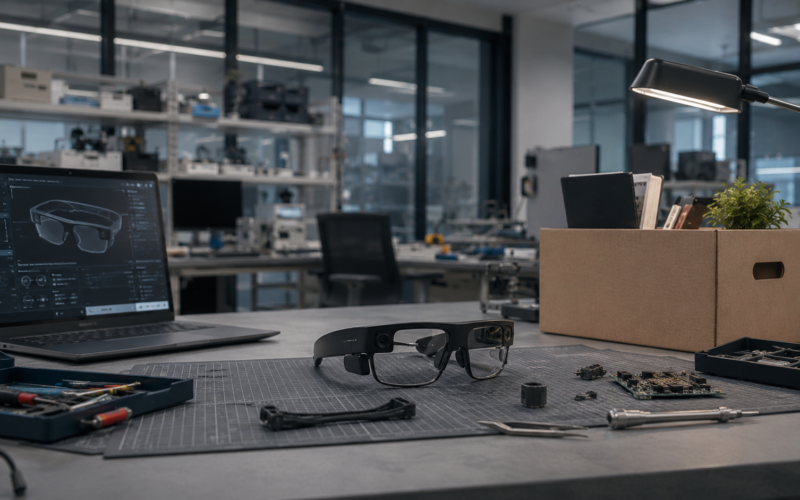
Magic Leap is preparing to eliminate at least 269 positions across its operations in Florida and California as the augmented reality pioneer replaces its first-party device strategy with a partner-led business focused on optical waveguides, display systems and smart-glasses integration. Public workforce notices show that 193 employees at the company’s Plantation, Florida headquarters and another 76 employees at its Sunnyvale, California site are affected, with the reductions scheduled to take effect around October 1, 2026. The expanded layoff total reaches deeply into engineering, product development, manufacturing and design functions that previously supported Magic Leap’s own augmented reality hardware. The restructuring follows the company’s July 9 announcement that it would stop positioning itself primarily as a device manufacturer and instead become a component and engineering partner to companies developing artificial intelligence-enabled display glasses.
The Magic Leap layoffs represent one of the clearest acknowledgements yet that the company’s original ambition to build a mass-market spatial-computing platform has not produced a sustainable independent hardware business. Magic Leap is not leaving augmented reality entirely. It is attempting to monetise the optical technology, manufacturing processes and engineering knowledge developed during more than a decade of expensive headset development.
The new strategy could give Magic Leap a commercially realistic role within the emerging artificial intelligence glasses market. It also leaves the privately held company dependent on larger technology partners choosing its waveguides and integration services rather than developing competing optical systems internally.
How did Magic Leap’s known workforce reduction increase from 193 to 269 positions?
The first major workforce notice covered 193 employees at Magic Leap’s headquarters in Plantation, Florida. Those reductions are expected to occur on October 1 and October 2 and encompass a broad range of hardware, software, product, quality, manufacturing-engineering and management positions.
A separate California filing subsequently disclosed 76 permanent layoffs at Magic Leap’s Sunnyvale operation. The California notice was dated July 17 and lists October 1 as the effective date, bringing the publicly identified United States total to 269 positions.
Magic Leap has not disclosed its current global workforce or stated what percentage of employees the reductions represent. It would therefore be inaccurate to describe the cuts as a precise proportion of the company without additional confirmation.
The functions affected are nevertheless revealing. These are not isolated administrative reductions affecting a peripheral office. The Florida notice reportedly includes technical programme management, user experience, design, product management, software, hardware and manufacturing-related roles.
That distribution is consistent with the company’s decision to stop carrying the entire organisational structure required to develop, market and support its own complete augmented reality devices. A component supplier still needs optical scientists, manufacturing engineers and partner-development specialists, but it does not require the same breadth of consumer-product, platform and device-management capabilities.
Why is Magic Leap moving away from building its own augmented reality headsets?
Magic Leap said on July 9 that it was adopting a partner-first model centred on waveguide technology, device prototyping and integration services for companies building artificial intelligence display glasses. Rather than attempting to place its own branded headset at the centre of the market, it wants to provide the difficult optical layer that allows digital information to appear within a lightweight transparent lens.
Waveguides are thin optical structures that direct light from a display engine into the wearer’s eyes while preserving the ability to see the physical environment. Producing a wide, bright and stable field of view within glasses that remain comfortable enough for extended use is one of the industry’s most persistent technical challenges.

Magic Leap has spent more than a decade developing proprietary optical designs, materials, manufacturing equipment and production processes. The company now argues that this accumulated expertise can help other manufacturers bring artificial intelligence glasses to market without independently recreating the entire display stack.
The strategic logic is considerably narrower than Magic Leap’s original mission, but it may be more economically defensible. Selling completed headsets requires hardware design, software platforms, application ecosystems, sales channels, customer support and continuous device investment. Supplying a specialised component allows Magic Leap to concentrate capital on an area where it believes it retains differentiated intellectual property.
The danger is that waveguide production can also become competitive and commoditised. Large technology companies may prefer to own strategically important display technologies, while specialist optical manufacturers are pursuing similar opportunities. Magic Leap must show that its waveguides offer a meaningful advantage in visual clarity, manufacturability, power consumption or cost.
Do the layoffs mark the final collapse of Magic Leap’s original consumer vision?
Magic Leap was once among the world’s most highly funded technology startups. It attracted billions of dollars from investors including Alphabet Inc.’s Google, Alibaba Group Holding Limited, Qualcomm Incorporated, Temasek Holdings and Saudi Arabia’s Public Investment Fund. Saudi Arabia’s sovereign wealth fund first invested $400 million in the company’s 2018 financing round and later became its controlling investor.
The company’s early narrative promised a new computing platform in which digital objects would appear naturally within the physical world. That vision generated intense investor enthusiasm, but the first Magic Leap device was expensive, unfamiliar to mainstream consumers and unable to establish the application ecosystem required for mass adoption.
Magic Leap responded in 2020 by reducing its workforce and retreating from the consumer market. Contemporary reports indicated that approximately 1,000 positions, or about half the workforce at that time, were affected.
The company then repositioned itself around enterprise augmented reality. Magic Leap 2 targeted organisations using spatial computing for healthcare, industrial training, collaboration, defence and other specialist applications. A 2023 leadership announcement described Magic Leap as having completed its move towards the enterprise market.
The 2026 partner-first strategy represents another step away from owning the complete customer relationship. Magic Leap is no longer primarily arguing that enterprises or consumers should purchase a Magic Leap device. It is arguing that companies building their own artificial intelligence and augmented reality glasses should use Magic Leap technology inside them.
The original vision of Magic Leap as an independent computing-platform leader has therefore largely ended. What remains is a potentially valuable optical-technology business extracted from that much broader ambition.
Can the Google partnership turn Magic Leap’s optical technology into a viable business?
Magic Leap’s relationship with Google provides the clearest evidence that its component strategy can attract major technology customers. The companies initially announced a strategic technology partnership in 2024 and later extended the collaboration through a three-year agreement.
The collaboration has combined Magic Leap’s waveguides and optical expertise with Google’s Raxium microLED light engine in an augmented reality glasses prototype associated with the Android XR ecosystem. Magic Leap has positioned the prototype as evidence that it can help technology companies balance visual quality, comfort and manufacturability.
This partnership is strategically important because Google brings software, artificial intelligence, developer tools and consumer reach that Magic Leap could never reproduce independently. Magic Leap can instead focus on the optical and hardware-integration capabilities that remain difficult even for the largest technology companies.
However, a development partnership is not the same as a high-volume supply contract. Magic Leap has not publicly disclosed the commercial value of the Google agreement, expected component volumes or whether a consumer product based on the reference design will enter mass production.
The workforce restructuring may therefore be intended to align operating costs with the current stage of the relationship. Maintaining hundreds of employees in anticipation of uncertain future volumes would create substantial financial risk.
Magic Leap must now convert technical collaboration into repeatable revenue. The crucial milestones will include production contracts, customer commitments, component volumes and evidence that its optical manufacturing can achieve competitive yields at scale.
Why does the Pegatron agreement matter to Magic Leap’s waveguide supplier strategy?
Magic Leap announced an agreement with Pegatron Corporation in December 2025 to collaborate on the production of augmented reality glasses components, including waveguides. Pegatron brings high-volume electronics manufacturing capabilities, while Magic Leap contributes optical design and proprietary production expertise.
The partnership addresses one of the central weaknesses of advanced augmented reality hardware. A prototype can demonstrate impressive optical performance, but commercial success requires those components to be produced consistently, economically and in very large quantities.
Waveguides must meet tight tolerances. Small manufacturing variations can affect brightness, colour consistency, image alignment and visual comfort. Scaling production without damaging quality has delayed or increased the cost of numerous augmented reality projects.
Pegatron could give Magic Leap a route from specialist development to broader production without requiring the company to fund every element of manufacturing expansion itself. That is particularly valuable for a business whose access to capital has repeatedly depended on major investors.
The agreement also supports the logic behind reducing Magic Leap’s product-development workforce. If the company is transferring part of its manufacturing scale-up to an external partner and no longer building complete first-party devices, it can operate with a smaller internal organisation.
The commercial question is whether Pegatron and Magic Leap have sufficient customer demand to justify scaled production. Manufacturing readiness is valuable only when technology companies commit to shipping products containing the components.
Are artificial intelligence glasses creating a second opportunity for augmented reality suppliers?
The market surrounding wearable technology has changed as artificial intelligence models have become capable of understanding images, speech and real-world context. Smart glasses can now be positioned as interfaces for artificial intelligence assistants rather than merely miniature screens for conventional applications.
That shift may improve the commercial prospects of augmented reality components. Consumers may see greater value in glasses that can identify objects, translate text, provide navigation, record information and answer contextual questions. The artificial intelligence assistant becomes the product experience, while optical displays provide information without forcing users to look at a phone.
Technology companies including Alphabet Inc., Meta Platforms Inc. and Samsung Electronics Co., Ltd. are investing in extended-reality and wearable artificial intelligence platforms. Magic Leap’s partner-first model allows it to participate in that competition without directly challenging those companies for consumers.
The company’s opportunity is to become an enabling supplier similar to a specialist semiconductor, camera-module or display manufacturer. Multiple consumer brands could theoretically use Magic Leap waveguides while differentiating their glasses through software, design and artificial intelligence services.
This model reduces brand and distribution risk, but it also reduces Magic Leap’s control over product economics. Component suppliers generally receive only part of the final device’s value and can face intense pressure on pricing.
Magic Leap must therefore protect its intellectual property and demonstrate technical advantages that customers cannot easily obtain elsewhere. Otherwise, the company could exchange the risk of selling headsets for the lower-margin risk of supplying an increasingly standardised component.
What do the Magic Leap layoffs mean for Florida and California technology employment?
The Plantation reductions are particularly significant because Magic Leap has been one of South Florida’s most prominent technology companies. The loss of 193 positions affects specialised workers across engineering, design, software and advanced manufacturing rather than only general corporate functions.
These employees possess skills relevant to optics, augmented reality, embedded systems and precision manufacturing. Some may find opportunities across defence, aerospace, medical technology and other industries using advanced displays, but South Florida does not have the same concentration of augmented reality employers as Silicon Valley.
The 76 Sunnyvale cuts occur within a deeper technology labour market, although competition for roles remains intense after repeated workforce reductions across software, semiconductor and artificial intelligence companies.
The delayed October effective dates provide a transition period under federal and state workforce-notification requirements. California’s Worker Adjustment and Retraining Notification rules generally require advance notice for qualifying mass layoffs and establish processes intended to connect affected employees with employment and retraining services.
The human impact extends beyond the final number. Magic Leap employees have repeatedly experienced strategic resets as the company moved from consumer hardware to enterprise devices and now to component supply. Each pivot can remove expertise that was essential to the previous strategy but no longer fits the next one.
Is Magic Leap’s partner-first model a disciplined reset or another temporary pivot?
The optimistic interpretation is that Magic Leap has finally identified the part of its business that creates defensible value. Its waveguides, optical manufacturing and device-integration expertise may be more valuable to larger technology companies than Magic Leap’s own branded headsets were to customers.
Under this interpretation, the layoffs are painful but strategically coherent. The company is removing the product and organisational infrastructure associated with a business model it no longer intends to pursue.
The less favourable interpretation is that Magic Leap remains dependent on periodic investor support and strategic partnerships without demonstrating a durable commercial engine. The company has moved from consumer devices to enterprise headsets and from enterprise headsets to component supply. Another pivot could follow if waveguide orders do not materialise at sufficient scale.
Because Magic Leap is privately held, there is no public share price that can indicate investor sentiment towards the layoffs. The most meaningful market signals will instead come from customer contracts, production announcements, additional financing and the future scope of its Google and Pegatron relationships.
The company’s strategy is now easier to understand than it was during the height of its consumer ambitions. Magic Leap does not need to win the entire augmented reality market. It needs to persuade the companies that may win that market to use its technology.
That is a more achievable objective, but it is not a modest one. The company must retain enough optical and manufacturing talent after cutting 269 positions to support partners, protect intellectual property and deliver production-quality components.
What are the key takeaways from Magic Leap’s 269 planned job cuts?
- Magic Leap’s known United States workforce reduction has increased to 269 positions, comprising 193 roles in Plantation, Florida and 76 roles in Sunnyvale, California. The layoffs are expected to take effect around October 1 and affect functions associated with hardware, software, product development, design and manufacturing.
- The restructuring follows Magic Leap’s decision to stop prioritising first-party augmented reality devices and become a partner supplying waveguides, optical systems and integration expertise to other artificial intelligence glasses companies.
- Partnerships with Google and Pegatron Corporation provide strategic credibility, but Magic Leap has not disclosed the commercial value or production volumes associated with those relationships.
- The company’s latest shift may represent a more disciplined and sustainable use of its optical technology. It also confirms that the original vision of Magic Leap as an independent mass-market spatial-computing platform has largely been abandoned.
Discover more from Business-News-Today.com
Subscribe to get the latest posts sent to your email.