




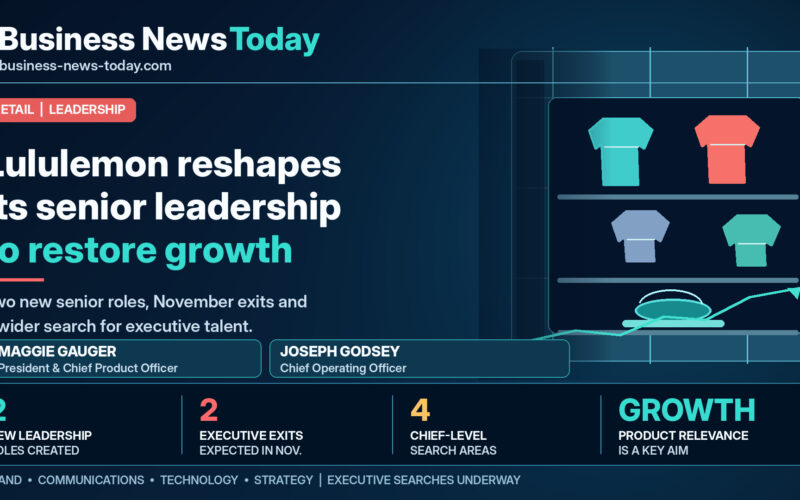
Lululemon Athletica Inc. (NASDAQ: LULU) is carrying out a sweeping leadership redesign that places product development, supply-chain execution and brand relevance at the centre of its attempt to recover from declining sales. Maggie Gauger will join as President and Chief Product Officer and Joseph Godsey as Chief Operating Officer on October 26, with both positions newly created.
The reorganisation also removes parts of the previous management structure. Chief Brand and Product Activation Officer Nikki Neuburger and Chief Supply Chain Officer Ted Dagnese will leave on November 6, with the company’s regulatory filing stating that both departures will be treated as terminations without cause under their employment agreements. Lululemon is separately searching for a Chief Brand Officer, Chief Communications Officer, Chief Technology Officer and Chief Strategy Officer.
The breadth of those changes shows that this is not an ordinary round of executive appointments. Chief Executive Officer Heidi O’Neill is effectively redrawing responsibility across product, operations, brand, technology and corporate strategy at a time when Lululemon’s financial performance has deteriorated and its once formidable growth narrative has come under pressure.
Why is Lululemon putting product at the centre of the new structure?
Lululemon’s core challenge is increasingly one of product excitement rather than brand awareness. The company remains globally recognised, particularly in premium athletic apparel, but consumers have become more selective while competitors have expanded aggressively across performance wear, running, lifestyle footwear and women’s apparel.
The newly created President and Chief Product Officer position will consolidate design, merchandising, footwear, product innovation and materials science under Gauger. That is significant because the company is trying to reduce fragmentation between the teams that identify consumer trends, design products and decide what eventually reaches stores.
Gauger brings more than 28 years of apparel and footwear experience and most recently served as President and Chief Executive Officer of Athleta. She previously spent more than two decades at Nike, including leadership positions in the North American women’s business and global direct strategy.
Her mandate therefore extends beyond producing another successful leggings franchise. Lululemon needs a broader flow of differentiated products capable of creating reasons for existing customers to return while attracting consumers who have increasingly large wardrobes of premium activewear from competing brands.
What does Joseph Godsey’s appointment reveal about Lululemon’s operational problems?
The Chief Operating Officer position is equally revealing. Godsey joins from Walmart Canada, where he served as Chief Growth Officer and oversaw businesses including e-commerce, advertising, financial services, membership, analytics and digital products. He previously led supply-chain transformation at Sam’s Club and spent 15 years at adidas.
Lululemon is grouping sourcing, production, commercialisation, go-to-market execution, fulfilment, planning, allocation and sustainability under Godsey. The objective is to connect product decisions more directly with how quickly those products can be manufactured, distributed and replenished.
That matters because even an attractive product loses economic value if it reaches stores too slowly, arrives in the wrong quantities or creates excess inventory. Modern apparel retailers increasingly compete on supply-chain responsiveness as much as design.
By placing a dedicated Chief Operating Officer between product vision and execution, Lululemon appears to be trying to increase speed while creating clearer accountability. The move also reduces the likelihood that individual functional leaders optimise their own departments without considering the full product cycle.
How weak has Lululemon’s financial performance become?
Second-quarter fiscal 2026 revenue declined 4% to approximately $2.4 billion, while comparable sales fell 9%. Those numbers represent a substantial reversal for a company accustomed to delivering consistent growth and premium margins.
Management lowered its full-year 2026 revenue outlook to between $10.35 billion and $10.50 billion, implying a decline of approximately 5% to 7%. Full-year diluted earnings per share are expected between $9.48 and $9.73.
The third-quarter outlook is even more challenging, with revenue expected between $2.29 billion and $2.32 billion, representing a projected decline of roughly 10% to 11%. That means the leadership restructuring is occurring before the company’s top line has stabilised rather than after a recovery is already underway.
The strategic pressure is therefore straightforward. Lululemon needs to improve product relevance and execution quickly enough to prevent weakening sales from becoming a longer-term loss of market position.
Why are more executive searches still underway?
The creation of two roles is only the first phase of the leadership reset. Lululemon is looking for a Chief Brand Officer who will oversee global brand marketing, creative, store experience, sports marketing, partnerships and community initiatives. It is also searching for a Chief Technology Officer responsible for product and supply-chain systems, digital and omnichannel technology, enterprise data, artificial intelligence and cybersecurity.
A separate Chief Communications Officer will report directly to the Chief Executive Officer, while a Chief Strategy Officer is expected to report to Chief Financial Officer Meghan Frank. Frank will temporarily oversee global brand and technology responsibilities until permanent appointments are made.
That leaves Lululemon in a potentially awkward transition period. A company seeking greater execution speed is simultaneously filling several of its most important strategic positions, which means O’Neill must manage the turnaround while parts of the final leadership architecture remain incomplete.
The potential upside is that the company can recruit executives specifically suited to the new structure rather than forcing existing jobs into a strategy they were not designed to execute. The risk is that too much organisational change at once creates uncertainty lower in the organisation precisely when teams need to move faster.
What does Lululemon stock tell us about investor confidence?
Lululemon shares closed at $94.50 on October 9 after gaining 1.96% during the session. Despite the rebound, the stock remains around 58% below its 52-week high of $225.98.
That collapse captures how dramatically investor expectations have changed. The market previously valued Lululemon as a premium global growth company capable of expanding stores, categories and international revenue while maintaining unusually strong customer loyalty. Investors are now questioning whether slowing demand is cyclical or whether the company has lost some of the product differentiation that justified its premium valuation.
The leadership announcement produced no immediate dramatic reversal in sentiment. That is understandable because management changes are inputs into a turnaround rather than proof that the turnaround will succeed.
Investors will need to see evidence in new product launches, comparable sales, markdown rates, inventory productivity and margins before assigning substantial value to the new organisational design.
Can the new structure actually repair Lululemon’s growth problem?
The strategic logic is credible. Product, brand and operations need to work together more tightly when a retailer is trying to restore relevance. Lululemon’s decision to recruit leaders with experience at Nike, Athleta, Walmart Canada, Sam’s Club and adidas gives the company deep outside expertise rather than relying only on internal succession.
The challenge is execution speed. Apparel development cycles mean changes made at the leadership level may take several seasons to become fully visible in stores, while competitors will continue launching products and spending on marketing during that period.
O’Neill therefore needs to stabilise the existing business while rebuilding future pipelines. That requires careful inventory management, strong employee retention and clear communication because major executive changes can otherwise create paralysis throughout design, merchandising and supply-chain teams.
Lululemon’s restructuring is ultimately a bet that organisational design has become part of the company’s competitive problem. If the new structure creates sharper product decisions and faster execution, the changes could mark the beginning of a credible recovery. If sales continue falling despite the leadership overhaul, investors may begin asking whether the challenges are deeper than management structure alone.
Discover more from Business-News-Today.com
Subscribe to get the latest posts sent to your email.


