



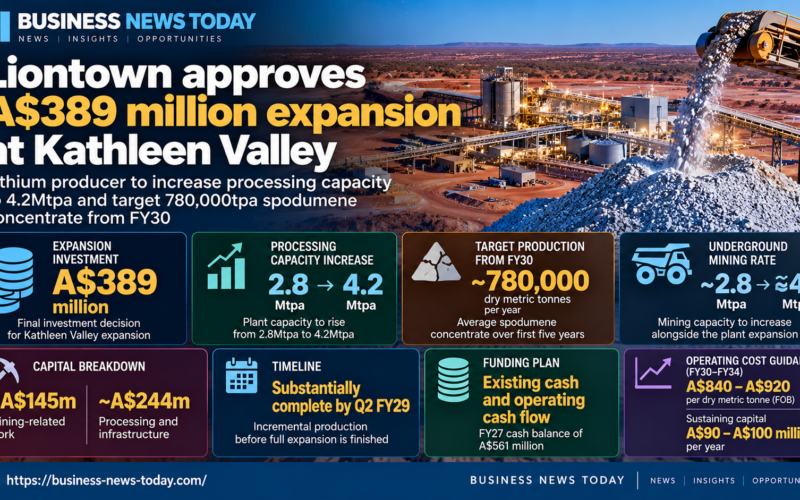
Liontown Limited (ASX: LTR) has made the final investment decision on a A$389 million expansion of the Kathleen Valley Lithium Operation in Western Australia, moving the lithium producer from its current ramp-up programme into a larger brownfield growth phase. The expansion is designed to increase processing capacity from 2.8 million tonnes per annum to 4.2 million tonnes per annum and support average spodumene concentrate production of approximately 780,000 dry metric tonnes annually over the first five years from FY30.
The decision is significant because Liontown Limited is committing new capital after emerging from one of the lithium sector’s most difficult pricing cycles. Kathleen Valley only entered production in 2024 and is still ramping toward its existing 2.8 million-tonne annualised operating target, yet improving operating performance, stronger lithium pricing and a strengthened balance sheet have allowed Liontown to sanction another major stage of growth before the original ramp-up is fully complete.
What exactly has Liontown Limited approved at Kathleen Valley?
The A$389 million approved capital programme covers both underground mining expansion and additional processing and non-process infrastructure. Liontown has allocated approximately A$145 million to mining-related work and about A$244 million to processing and associated infrastructure as it prepares the underground operation and plant for materially higher throughput. Construction is expected to be substantially completed by the end of the second quarter of FY29, with incremental production beginning before the full expansion is finished.
The project is not starting from a blank sheet. Liontown began early works and long-lead procurement in April, including ordering a 5.5-megawatt ball mill, advancing underground development and progressing mine-services infrastructure. That approach allowed the company to start working on critical-path items ahead of the formal final investment decision and reduce some schedule risk associated with equipment delivery.
Kathleen Valley’s existing design also creates brownfield advantages. Management had previously highlighted that parts of the processing infrastructure were built with expansion in mind, allowing higher capacity to be developed without recreating an entire greenfield mine, plant and logistics system. That does not eliminate construction risk, but it helps explain why Liontown believes a relatively concentrated capital programme can produce a large increase in saleable concentrate volumes.
How much more lithium could Kathleen Valley produce after the expansion?
Liontown is targeting average spodumene concentrate output of roughly 780,000 dry metric tonnes per year over five years beginning in FY30. That would represent a substantially larger operating base than the company is building toward under its current ramp-up and would position Kathleen Valley as a more significant long-life supplier into global lithium conversion and battery supply chains.
Mining capacity is planned to rise alongside the plant. The expansion plan increases the underground mining rate from roughly 2.8 million tonnes per annum toward approximately 4.1 million tonnes per annum, while processing capacity increases to 4.2 million tonnes. Liontown expects the expanded operation to benefit from higher fixed-cost absorption, although actual unit costs will still depend on mining productivity, grades, recoveries, energy, labour and sustaining capital.
The company has guided to steady-state unit operating costs of approximately A$840 to A$920 per dry metric tonne on a free-on-board basis and sustaining capital of around A$90 million to A$100 million annually between FY30 and FY34. Those numbers will become important benchmarks because the investment case depends not simply on producing more lithium but on moving Kathleen Valley down the cost curve as throughput grows.
Can Liontown fund the A$389m expansion without another major capital raising?
Liontown Limited said it expects to fund the expansion from existing cash and operating cash flow. The company entered FY27 with A$561 million of cash after Kathleen Valley generated positive operating cash flow during FY26, giving it a much stronger starting position than when lithium prices were under greater pressure. FY26 revenue reached A$639 million, operating cash flow was A$182 million and statutory net profit after tax was A$93 million, although underlying profit was lower at A$14 million after adjusting for one-off items.
That funding capacity is one of the most important differences between the current expansion and the original mine-development period. Liontown is no longer financing an asset that has yet to generate product revenue. It is reinvesting cash into an operating mine that already has customers, infrastructure, production history and an established resource base.
There is still a near-term capital-intensity trade-off. Following the final investment decision, Liontown lifted FY27 total capital-expenditure guidance to approximately A$435 million to A$495 million from the previous A$320 million to A$370 million range. Existing FY27 production and unit-cost guidance was left unchanged, meaning investors will now be watching whether operating cash generation remains strong enough to absorb the heavier investment period without materially weakening financial flexibility.
Why is Liontown expanding while lithium markets remain volatile?
Lithium markets have recovered from their earlier downturn, but the commodity remains cyclical and capable of large price movements. Liontown’s decision indicates that the board sees sufficient long-term demand and project economics to justify investing through that volatility rather than waiting for an unequivocally high-price environment. The company’s expansion modelling uses a long-term SC6 spodumene price assumption of US$1,495 per tonne and an Australian dollar-US dollar exchange rate assumption of 0.73.
On those assumptions, Liontown estimates a payback period of approximately 2.5 years from completion of construction. That is an attractive headline metric for a brownfield mining project, but it remains sensitive to lithium prices, realised product quality, recoveries, foreign exchange rates and the timing of production ramp-up.
Liontown also retains marketing flexibility because incremental tonnes from the expansion are currently largely uncommitted. Existing offtake relationships provide a demand foundation, while uncontracted expansion production potentially allows the company to capture spot or new-contract opportunities if lithium markets strengthen further. The reverse is also true: leaving tonnes uncommitted exposes Liontown more directly to future market conditions.
How did Liontown shares respond to the Kathleen Valley expansion decision?
Liontown shares traded around A$0.99 during the September 30 session, up roughly 4.4% on the day at the delayed reading available during Australian trading. The positive reaction suggests investors broadly welcomed the decision to commit capital to expansion, although the share price remains tied heavily to lithium-market expectations and the operational performance of Kathleen Valley.
The market response also reflects the change in Liontown’s financial position. FY26 marked a transition from construction and early ramp-up toward meaningful operating cash generation, with revenue more than doubling to A$639 million and year-end cash reaching A$561 million. Investors are effectively being asked to decide whether reinvesting that balance-sheet strength into a higher-capacity Kathleen Valley creates more value than preserving cash through another lithium cycle.
The answer will depend increasingly on execution rather than project concept. Kathleen Valley already exists, the underground mine is operating and the processing plant is producing concentrate. The expansion therefore carries less binary development risk than a greenfield mine, but construction interfaces with a live operation can create their own challenges, including shutdown coordination, labour requirements and disruption to the existing ramp-up.
What are the biggest risks to Liontown’s Kathleen Valley expansion?
Lithium price risk remains the obvious one. A 4.2 million-tonne processing operation delivers considerable operating leverage when spodumene prices are strong, but the same additional volume can pressure returns if global supply growth pushes prices materially below Liontown’s long-term assumptions. The company’s decision to sanction the project therefore embeds a long-duration view of lithium demand.
Operational execution is equally important. Liontown needs to complete the existing journey to a 2.8 million-tonne annualised rate while simultaneously expanding underground development, building additional infrastructure and modifying processing capacity. Running those programmes together can accelerate growth but increases management complexity.
The third issue is capital discipline. A$389 million is manageable relative to Liontown’s stronger cash position, but cost overruns, slower operating cash generation or renewed lithium weakness could change that equation. The updated FY27 capital guidance makes the coming 12 months particularly important for demonstrating that Kathleen Valley can fund growth while maintaining balance-sheet resilience.
What should investors watch next at Liontown Limited?
The key milestones are the progression of underground mining toward the existing 2.8 million-tonne annualised target, installation of expansion equipment, construction progress through FY28 and FY29, and the first incremental tonnes generated by the programme. Investors should also monitor whether unit costs begin trending toward the expanded-operation targets as throughput rises.
Commercially, attention will turn to what Liontown does with the additional uncommitted spodumene. New long-term offtake agreements could improve revenue visibility, while retaining some spot exposure could preserve upside if lithium prices strengthen. The optimum balance will depend on market conditions closer to ramp-up.
Liontown Limited has therefore moved beyond merely discussing a larger Kathleen Valley. The A$389 million final investment decision converts expansion into a committed capital programme, making delivery, cost control and lithium-price resilience the next tests of whether Kathleen Valley can translate geological scale into sustained shareholder returns.
Discover more from Business-News-Today.com
Subscribe to get the latest posts sent to your email.