


The global electricity investment boom is creating a less visible industrial constraint beneath the race to build more generation. Utilities can approve transmission projects, data-center developers can secure long-term power agreements and manufacturers can announce new factories, but those investments cannot operate without transformers, switchgear, insulation systems and other electrical equipment capable of safely connecting new loads and generation to the grid. Increasingly, manufacturing capacity for that equipment appears to be becoming as strategically important as electricity generation itself.
Recent investment decisions from Hitachi Energy, Hammond Power Solutions Inc. (TSX: HPS.A), Siemens Energy AG, GE Vernova Inc. (NYSE: GEV) and Schneider Electric SE point in the same direction. Hitachi Energy is investing hundreds of millions of dollars not only in finished transformers but in specialised insulation materials, Hammond Power Solutions is creating additional U.S. transformer capacity, Siemens Energy is expanding transformer production and building a new switchgear factory, and GE Vernova is adding large-power-transformer capacity across several regions.
Schneider Electric is attacking the same problem from another direction by redesigning medium-voltage switchgear around standardised hardware and software-defined functionality intended to shorten manufacturing and commissioning schedules. The common mechanism is increasingly clear: electricity demand is growing faster than portions of the industrial system required to physically deliver that electricity.
The developing Signal is therefore not simply that transformer demand is strong. It is that electrical equipment manufacturing may increasingly determine how quickly new generation, data centers, factories and other large loads can actually become operational.
Why can more power generation fail to solve the electricity-capacity problem?
Power systems require far more than generating plants. Electricity has to be transformed between voltage levels, routed through transmission and distribution networks, protected against faults and safely switched before it reaches a data center, industrial site, commercial building or household.
Transformers perform one of the most fundamental functions in that chain by stepping voltage upward for efficient transmission and downward again as electricity approaches the end user. Switchgear performs another essential function by controlling, isolating and protecting electrical circuits.
Those components traditionally attracted less public attention than power plants because they were viewed as mature industrial equipment. That assumption becomes harder to sustain when new generation and unusually large electricity loads are being developed faster than manufacturers can expand specialised production capacity.
A data center can secure land, computing equipment and even a power-purchase arrangement yet still face delays if transformers, medium-voltage equipment or grid-interconnection infrastructure are unavailable. Electricity capacity on paper is therefore not the same as electricity capacity that can be energised.
That distinction is becoming increasingly relevant as artificial intelligence, manufacturing reshoring, transport electrification, renewable generation and conventional power investment all compete for parts of the same grid-equipment supply chain.
Why is Hitachi Energy investing deeper inside the transformer supply chain?
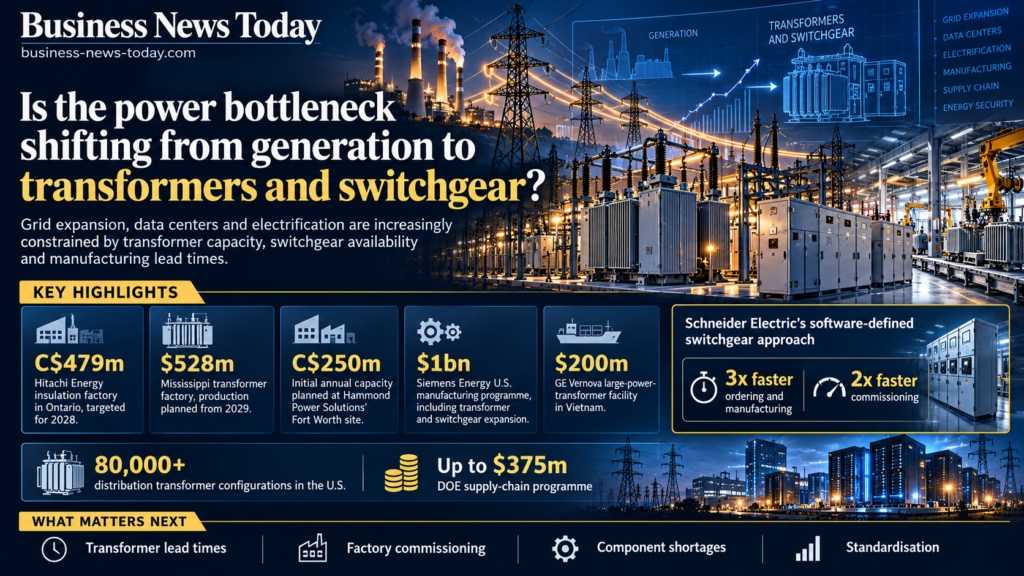
Hitachi Energy’s October 16 announcement illustrates how the constraint can move several layers below final transformer assembly. The company plans to invest C$479 million, equivalent to more than US$330 million, in a new transformer-insulation factory in London, Ontario.
The 21,000-square-metre facility is expected to be completed in 2028 and will produce electrical insulation pressboard and laminates used inside transformers. It will establish Canada’s first pressboard manufacturing line and Hitachi Energy’s first such production line in the Americas.
Pressboard may sound like a relatively ordinary industrial input compared with a large transformer, but the material performs critical electrical-insulation and cooling functions. Hitachi Energy specifically identified limited availability of specialised insulation materials as one of the bottlenecks affecting transformer manufacturing.
That investment is important because it suggests the supply constraint cannot necessarily be solved by adding final-assembly lines alone. Transformer manufacturers also need greater availability of upstream materials and components that meet exacting performance and reliability requirements.
Hitachi Energy is simultaneously expanding downstream manufacturing. In September it announced a $528 million transformer plant in Gallman, Mississippi, designed to more than double its local production capacity and create more than 700 jobs. Transformer production at the new site is expected to begin in 2029.
The company says the Mississippi investment forms the cornerstone of roughly $1.5 billion of U.S. manufacturing expansion and that it is investing more than $2 billion to strengthen its North American supply chain through 2027. In Canada, Hitachi Energy is also expanding its Varennes, Quebec operation in a C$270 million programme intended to nearly triple large-power-transformer capacity.
The timelines reveal both the opportunity and the problem. Manufacturers are responding aggressively, but much of the new capacity does not become available immediately.
Is Hammond Power Solutions seeing the same demand from data centers and electrification?
Hammond Power Solutions provides independent evidence from a smaller transformer manufacturer. In September, the Canadian company signed a long-term lease for a new manufacturing facility in Fort Worth, Texas, intended to support larger standard and custom-engineered transformers for U.S. customers.
The company directly linked rising demand to data centers, electrification and power infrastructure. Production is expected to start in stages during the fourth quarter of 2027, with full initial production anticipated in the first quarter of 2028.
Once fully operational, Hammond Power Solutions expects the initial phase to add approximately C$250 million of annual manufacturing capacity based on normal operating assumptions and anticipated demand. The company expects to invest around C$50 million to equip and commission that first phase.
The site has room to expand further. Subject to demand and additional investment, Hammond Power Solutions estimates that Fort Worth could eventually support around C$400 million of annual manufacturing capacity.
That expansion matters because it is occurring independently of the much larger programmes at Hitachi Energy, Siemens Energy and GE Vernova. Multiple manufacturers are reaching the same conclusion: North American transformer demand justifies substantial new capacity even though those investments take several years to translate into finished equipment.
Why are Siemens Energy and GE Vernova investing across transformers and switchgear?
Siemens Energy announced a $1 billion U.S. manufacturing programme in February covering both electricity generation and grid equipment. The company is expanding transformer production in North Carolina and building a new high-voltage switchgear factory in Mississippi as part of a broader programme expected to create more than 1,500 jobs.
The investment reflects a crucial feature of the current electricity cycle. Growth is occurring simultaneously on both sides of the grid. Additional turbines and generation equipment increase potential electricity supply, while transformers and switchgear determine whether that supply can be delivered to new loads.
GE Vernova is also adding transformer capacity internationally. In March, it announced approximately $200 million for a new facility in Hai Phong, Vietnam, primarily dedicated to large power transformers used in high-voltage direct-current transmission projects.
That investment sits inside a much larger electrification strategy. GE Vernova has planned approximately $1 billion of investment in Prolec GE between 2026 and 2028 after completing its $5.3 billion acquisition of the transformer business, while also investing in grid facilities in the United States and Europe.
The geographic spread is significant. Transformer manufacturing constraints are not merely a local response to U.S. data-center development. Transmission expansion, renewable integration, conventional generation, industrialisation and aging-grid replacement are increasing demand for high-voltage electrical equipment across multiple regions.
Could standardisation solve part of the transformer shortage without building as many factories?
Manufacturing capacity is only one side of the constraint. Product complexity also influences how efficiently factories can operate.
The U.S. Department of Energy has identified more than 80,000 possible distribution-transformer varieties or configurations across the country. Different utility specifications, accessories, voltage requirements and legacy preferences can limit interchangeability and make manufacturing more fragmented than it might otherwise be.
A Department of Energy working group has therefore been examining common configurations and opportunities for greater standardisation. The objective is not to create one transformer for every application, but to reduce unnecessary variation that lengthens production schedules and makes it harder for utilities to share equipment during emergencies.
This represents an important counterargument to the idea that shortages can only be solved through enormous factory investment. If manufacturers can build larger runs of more standardised equipment, existing factories may generate greater effective capacity.
The federal government is also preparing additional support. The Department of Energy’s Office of Electricity plans a supply-chain programme worth up to $375 million aimed at transformer manufacturing, components, materials and other grid hardware.
The combination of industrial investment and specification reform suggests that the transformer problem increasingly resembles a manufacturing-productivity challenge rather than merely a temporary shortage.
Can software-defined switchgear reduce another bottleneck in power deployment?
Schneider Electric is testing whether redesigning electrical equipment can shorten deployment timelines in the same way that standardisation could improve transformer production.
Its software-defined medium-voltage architecture, unveiled in September, moves protection, metering, automation, monitoring and control functions away from heavily customised hardware arrangements toward a more standardised equipment platform configured through software.
Schneider Electric estimates that the approach can enable up to three times faster ordering and manufacturing and up to two times faster commissioning. Its own analysis of data-center deployment suggests the architecture could reduce the end-to-end electrical deployment schedule by as much as 64%, although those figures are company estimates rather than guaranteed outcomes across every project.
The technology has already been piloted in a live Equinix colocation data-center environment. Additional pilots are planned through 2027, with broader availability expected from 2028.
The significance extends beyond one switchgear product. Traditional electrical infrastructure often relies on project-specific engineering, large amounts of control wiring and considerable onsite commissioning. If more functionality can move into configurable software while hardware becomes more standardised, manufacturers could increase throughput without expanding physical production capacity proportionately.
That would represent a structural change in an industry historically dominated by highly engineered hardware. Electrical equipment would become partly a software and configuration problem.
Are transformer lead times long enough to become a strategic constraint?
Evidence from grid-reliability organisations suggests this is more than a theoretical concern. The North American Electric Reliability Corporation has repeatedly identified transformers and other critical electrical equipment as supply-chain risks for system development.
Its 2025 Summer Reliability Assessment reported that transformer lead times averaged roughly 120 weeks during 2024, while large transformers could require around 80 to 210 weeks. Those figures should not be treated as exact October 2026 market quotations, but they illustrate how prolonged the constraint had already become.
More recent actions suggest the issue has not simply disappeared. The Department of Energy continues to describe distribution transformers as constrained by long production times and component shortages, while manufacturers continue announcing factories whose output will not arrive until 2027, 2028 or 2029.
That timing mismatch is economically significant. Electricity demand and data-center projects can move faster than heavy electrical-equipment factories, creating periods in which the limiting factor is not capital or even generation capacity but the manufacturing queue.
For large projects, equipment procurement may consequently move earlier in the development process. Developers that once ordered transformers after other project milestones may increasingly need to reserve manufacturing capacity years before energisation.
What are stock markets saying about the grid-equipment investment cycle?
Public markets have already recognised the structural demand for electrification equipment, although recent performance shows that strong industry fundamentals do not eliminate valuation and execution risk.
Hammond Power Solutions Class A shares were at C$245.75 on October 16 after falling 4.39% during that session, even as analysts continued highlighting data-center and transformer demand and the company’s Texas expansion. The stock has experienced substantial longer-term appreciation, leaving investors increasingly sensitive to expectations embedded in valuation.
Siemens Energy shares were also under pressure on October 20, trading around €128 to €130 during the European session after a decline of roughly 3%. That short-term weakness follows a powerful multiyear rerating supported by recovering profitability, large order books and expectations around electricity infrastructure.
GE Vernova closed October 19 at $908.44, down 1.39% in its fourth consecutive declining session and roughly 24% below its July high. The pullback demonstrates that investors are becoming more selective after an extraordinary run across AI-power and electrification stocks.
Schneider Electric presents an even clearer example of competing narratives. Its third-quarter revenue reached €11.46 billion with organic growth of about 17%, and the company again increased its 2026 outlook as data-center demand surged. Yet its shares have remained affected by investor concerns about the price and strategic implications of its proposed PTC acquisition.
The broader sentiment remains constructive toward grid and electrical infrastructure demand, but increasingly discriminating about valuation, capital allocation and execution. That is consistent with a maturing investment theme rather than indiscriminate enthusiasm.
Could the transformer and switchgear bottleneck disappear before it becomes structural?
That possibility should not be dismissed. Hitachi Energy, Siemens Energy, GE Vernova, Hammond Power Solutions and numerous other manufacturers are already expanding production, while government programmes are attempting to strengthen supply chains.
Greater standardisation could improve utilisation of existing factories. Alternative materials, equipment refurbishment and component interchangeability could also ease shortages without requiring every unit to come from newly constructed capacity.
Demand could moderate as well. Data-center development forecasts remain unusually large, and any meaningful slowdown in artificial-intelligence investment, industrial construction or electrification could release manufacturing capacity faster than expected.
The timing of new factories creates another potential reversal. Capacity scheduled for 2027 through 2029 could eventually arrive just as demand growth slows, turning today’s shortage into tomorrow’s overcapacity in particular product segments.
That is why the Signal should not be framed as an inevitable permanent shortage. The stronger conclusion is that electrical-equipment availability has become strategically important enough to influence project timelines and justify billions of dollars of manufacturing investment.
What would confirm that grid equipment has become the next major electricity bottleneck?
Transformer lead times remain the most direct indicator. Persistent multi-year delivery schedules despite the first wave of manufacturing expansions would strengthen the argument that demand continues to outrun industrial capacity.
Factory commissioning will provide another test. Hammond Power Solutions’ Fort Worth operation, Hitachi Energy’s Ontario insulation plant, its Mississippi transformer facility and Siemens Energy’s switchgear investments will need to move from announcements into equipment output on schedule.
Upstream component availability matters just as much. Hitachi Energy’s decision to build pressboard capacity suggests that expanding final assembly without securing insulation, electrical steel and other specialised inputs may simply move the bottleneck deeper into the supply chain.
Project behaviour should also change if the Signal is becoming structural. Data-center developers, utilities and power producers would increasingly reserve transformer and switchgear manufacturing slots years in advance, include electrical equipment availability in site-selection decisions and favour standardised designs that reduce procurement risk.
Schneider Electric’s software-defined switchgear will provide a different test. If wider commercial deployment demonstrates materially shorter manufacturing and commissioning schedules across multiple customers, product redesign could become an important source of effective grid capacity.
The larger electricity story is therefore becoming an industrial-manufacturing story. Generating more power remains essential, but electricity cannot reach a new data center, factory or community without an entire chain of heavy equipment between the generating source and the customer.
That chain has traditionally been treated as supporting infrastructure. The scale of current investment suggests that assumption is changing.
The next constraint on the electricity boom may not be whether enough megawatts can be built. It may be whether enough transformers, switchgear and specialised components can be manufactured quickly enough to make those megawatts usable.
Discover more from Business-News-Today.com
Subscribe to get the latest posts sent to your email.