

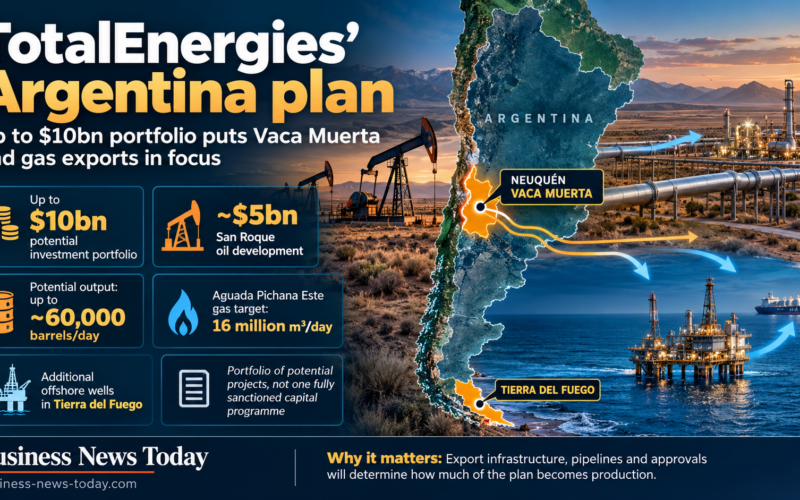
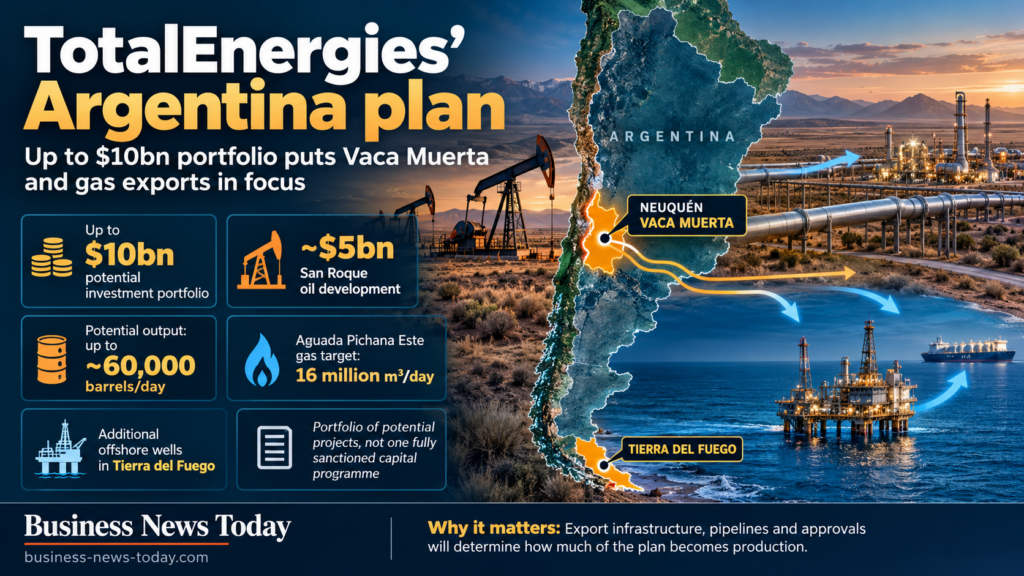
TotalEnergies SE (Euronext Paris: TTE; NYSE: TTE) has outlined an investment portfolio approaching $10 billion across Argentina, potentially expanding oil and gas production in both the Vaca Muerta shale formation and offshore Tierra del Fuego as the country attempts to convert its rapidly growing hydrocarbon resources into a much larger export industry.
Chairman and Chief Executive Officer Patrick Pouyanné disclosed the investment ambition during Argentina Week in Paris on October 1, saying TotalEnergies plans new wells in Tierra del Fuego and additional gas production in Neuquén. Pouyanné said the company wants to increase gas output at its Neuquén operations to 16 million cubic metres per day and indicated that several billion dollars of investment could be deployed over the coming decade.
The headline $10 billion should not be interpreted as a single project that has already received final investment approval. Neuquén provincial authorities subsequently described TotalEnergies’ plans as a portfolio approaching $10 billion and said the most consequential component could be an approximately $5 billion unconventional oil development at San Roque. That project has passed technical evaluation but still requires further commercial, transportation and provincial administrative work before full development can proceed.
Industry reporting has separately indicated that TotalEnergies could invest roughly $4 billion expanding gas production at Aguada Pichana Este, while additional spending is being considered for new offshore wells linked to existing infrastructure in Tierra del Fuego. The strategic opportunity is therefore substantial, but the pace of expenditure will depend on permits, evacuation infrastructure, project economics and Argentina maintaining the investment conditions required to convert technically attractive resources into commercial production.
What could TotalEnergies actually build with nearly $10 billion in Argentina?
The investment portfolio spans two very different hydrocarbon provinces.
In Neuquén, TotalEnergies operates Aguada Pichana Este, San Roque and Pampa de Las Yeguas, giving it exposure to the Vaca Muerta formation. The company is already one of Argentina’s most important gas producers, with Aguada Pichana Este among the country’s largest producing gas areas.
The largest new opportunity is San Roque. Neuquén’s government says TotalEnergies has completed the technical evaluation of a potential unconventional oil development carrying an estimated investment of approximately $5 billion. Provincial Energy Minister Gustavo Medele said the company has established sufficient geological and production potential to advance toward development, while work remains on commercial arrangements, evacuation capacity and the formal concession process.
The project could eventually support production of as much as roughly 60,000 barrels per day, according to remarks from Pouyanné reported during the Paris conference. That would transform San Roque from an area historically associated heavily with gas into a more important source of Vaca Muerta oil.
Aguada Pichana Este provides the second major leg. TotalEnergies has been producing around 14 million cubic metres of gas per day from the area and is targeting an increase toward 16 million cubic metres per day. Industry reporting indicates the wider expansion could require approximately $4 billion.
The third leg is offshore Tierra del Fuego, where TotalEnergies operates the Cuenca Marina Austral 1 concession and is examining additional wells that could connect into infrastructure already built around fields including Fénix.
Combined, the projects show that the $10 billion ambition is not one giant bet on a single asset. It represents an attempt to extract more value from an existing operating system spanning shale oil, shale gas and offshore conventional gas.
Why is the proposed $5 billion San Roque project so important?
San Roque could change the composition of TotalEnergies’ Argentine portfolio.
The company has historically been identified primarily with natural gas in Argentina. TotalEnergies says it operates approximately 25% of the country’s gas production, making its Total Austral subsidiary the leading international gas producer in the country.
San Roque potentially adds a much larger oil-growth component.
Neuquén officials say one advantage is existing infrastructure. The area already has processing facilities, gas pipelines and oil pipelines, while transport capacity is available through the Oldelval system. That could shorten the distance between drilling additional wells and actually moving production toward domestic refineries or export terminals.
Infrastructure matters because Vaca Muerta’s geological productivity is no longer the only constraint on growth. Producers increasingly need pipelines, storage and marine export capacity capable of carrying rising volumes away from Neuquén.
The province has also made clear that technical readiness does not equal final approval. TotalEnergies still needs to resolve how incremental production will be evacuated, complete commercial arrangements and finalise the necessary concession process.
That makes San Roque an execution story rather than simply an investment announcement. The difference between a technically attractive $5 billion development and a producing 60,000-barrel-per-day asset will depend on infrastructure, permits, capital discipline and access to export markets.
Why did TotalEnergies sell two Vaca Muerta blocks before planning billions more investment?
The apparent contradiction is one of the most interesting parts of the strategy.
In August 2025, TotalEnergies agreed to sell its 45% operated interests in Rincón La Ceniza and La Escalonada to YPF for $500 million. Those two blocks represented approximately 20% of TotalEnergies’ net Vaca Muerta acreage at the time.
Rather than signalling a retreat from Argentina, TotalEnergies described the sale as portfolio management intended to concentrate capital on its core Neuquén and Tierra del Fuego assets.
After the divestment, the company said it retained approximately 183,000 net acres in Vaca Muerta and was producing gas and condensate from Aguada Pichana Este and San Roque. Those two areas generated approximately 50,000 barrels of oil equivalent per day attributable to TotalEnergies in 2024.
The new investment programme makes that portfolio logic clearer. TotalEnergies appears willing to monetise acreage it considers less central while placing substantially greater capital behind assets where it sees scale, infrastructure advantages and stronger development economics.
That is consistent with the company’s broader investment discipline. TotalEnergies plans annual net investments of roughly $14 billion to $16 billion over much of the second half of the decade and says about 35% of spending is expected to support new low-cost, lower-emission oil and gas projects.
Argentina therefore has to compete for capital with TotalEnergies projects around the world. A $10 billion Argentine portfolio would represent a meaningful share of the company’s global investment capacity if it is progressively sanctioned.
How important is Aguada Pichana Este to Argentina’s gas growth?
Aguada Pichana Este is already one of the most important gas-producing areas in the Neuquén Basin.
TotalEnergies’ local operations show the company remains Argentina’s leading private gas producer and operates approximately one-quarter of national gas production across its portfolio. In the Neuquén Basin alone, Aguada Pichana Este has recently produced roughly 13 million to 14 million cubic metres per day.
TotalEnergies wants to move that figure toward 16 million cubic metres per day.
The longer-term opportunity could be substantially larger. Company representatives have previously indicated that Aguada Pichana Este may eventually have the resource potential to support considerably higher production if markets and infrastructure allow it.
This is where Argentina’s energy strategy is changing. For many years, additional gas production primarily helped reduce expensive winter imports and secure domestic supply. Increasingly, producers are looking beyond the local market toward Chile, Brazil and eventually large-scale liquefied natural gas exports.
That changes investment economics because resource development is no longer constrained solely by Argentine demand.
If new pipelines and LNG export projects create durable international outlets, gas fields that once faced limited domestic growth opportunities can support much larger drilling programmes.
What role does Tierra del Fuego play after the Fénix gas project?
TotalEnergies has already demonstrated that offshore southern Argentina can support commercially significant investment.
The Fénix gas field began production in September 2024 approximately 60 kilometres off Tierra del Fuego. TotalEnergies operates the Cuenca Marina Austral 1 concession with a 37.5% interest alongside Harbour Energy, which also holds 37.5%, and Pan American Energy with 25%.
Fénix has maximum production capacity of 10 million cubic metres of gas per day, equivalent to approximately 70,000 barrels of oil equivalent per day. More than $700 million was invested in the project.
A critical element of the development was its use of existing infrastructure. Fénix consists of an unmanned platform and horizontal wells connected to the existing Véga Pléyade platform, with gas subsequently processed through established onshore facilities.
That model helps explain why TotalEnergies is considering additional offshore drilling.
Instead of constructing an entirely independent production system for every new discovery or reservoir, additional subsea wells could potentially be connected into infrastructure whose large upfront costs have already been incurred. That can materially improve the economics of incremental reserves.
The company’s October investment plan includes new drilling in Tierra del Fuego, although the final number of wells, capital commitments and development schedule have not been formally sanctioned in a comprehensive company announcement.
The opportunity is therefore real but should still be viewed as part of a developing portfolio rather than guaranteed expenditure.
Can Argentina actually export enough oil to justify another major Vaca Muerta development?
The physical evidence is becoming stronger.
Argentina said crude exports reached a record 2.01 million cubic metres in September 2026, equivalent to approximately 421,000 barrels per day. That demonstrates that Vaca Muerta is already changing the country’s trade balance rather than remaining a future-resource story.
Production has also accelerated. Reuters reported that Vaca Muerta produced approximately 670,000 barrels of oil per day in August, accounting for roughly 72% of Argentina’s national oil output.
Infrastructure is expanding to accommodate further growth. The Vaca Muerta Oil Sur pipeline project is designed to create a major new export corridor toward Punta Colorada on Argentina’s Atlantic coast. President Javier Milei has described the project as involving around $3 billion of investment and potentially supporting about $15 billion of annual oil exports when fully developed.
For TotalEnergies, that infrastructure is critical to the San Roque equation.
An additional 60,000 barrels per day has much more commercial value if Argentina can reliably move the crude into international markets rather than allowing pipeline congestion to discount production or constrain drilling.
The provincial government has indicated that new San Roque oil would likely be oriented primarily toward exports because additional Argentine supply increasingly exceeds incremental domestic requirements.
That makes transport capacity almost as important as geology.
Could Argentina’s LNG ambitions create a second growth engine for TotalEnergies?
Argentina’s natural-gas strategy is following a similar path, although large-scale LNG exports require much more infrastructure.
The country is advancing projects intended to monetise Vaca Muerta gas beyond South American pipeline markets. YPF and international partners are pursuing large LNG developments that could ultimately move Argentine gas into global markets, while regional exports to Chile, Brazil and Uruguay are already expanding.
President Milei said in October that Argentine gas exports averaged around 8 million cubic metres per day over the preceding year, with peaks above 10 million cubic metres per day. He also highlighted much larger LNG projects being advanced by YPF and international partners.
TotalEnergies has not announced that its proposed $10 billion investment portfolio is directly tied to a specific Argentine LNG project.
That distinction matters. Additional production at Aguada Pichana Este can serve domestic demand or regional pipeline exports without requiring TotalEnergies itself to invest in LNG infrastructure.
Nevertheless, LNG expansion could transform the long-term value of Vaca Muerta gas by providing another large source of demand.
A field capable of producing more gas than the domestic and neighbouring markets can absorb becomes significantly more attractive when liquefaction capacity provides access to Europe and Asia.
For TotalEnergies, one of the world’s largest LNG players, that broader transformation is strategically relevant even without a currently announced direct equity role in Argentina’s flagship LNG developments.
How much does Argentina matter inside TotalEnergies’ global strategy?
Argentina is already material, but the proposed investment programme could make it more important.
TotalEnergies has operated in the country since 1978 and employs more than 1,100 people there. Its equity production in Argentina averaged approximately 95,000 barrels of oil equivalent per day in 2024, while its operated production footprint is considerably larger.
The company also operates renewable assets, including wind and solar projects with combined capacity of roughly 300 MW.
Globally, TotalEnergies expects energy production to grow around 4% annually through 2030. Its updated strategy also targets oil and gas production growth of roughly 2% to 3% annually between 2030 and 2035.
Argentina offers assets capable of contributing to that growth without requiring TotalEnergies to establish an entirely new operating platform.
The company already has personnel, technical expertise, acreage, processing infrastructure and decades of experience in the country. Incremental investment can therefore build on an existing position rather than carrying all the costs and uncertainties associated with entering a new market.
The challenge is political and macroeconomic durability.
Pouyanné emphasised during the Paris event that investment requires predictable rules. Argentina has experienced repeated policy swings affecting currencies, prices, exports and capital controls, meaning project economics depend partly on confidence that reforms encouraging investment remain durable over the life of assets that may produce for decades.
What does TotalEnergies’ recent share performance say about investor sentiment?
TotalEnergies shares have performed strongly during October, although the movement cannot reasonably be attributed to the Argentina announcement alone.
The company’s New York-listed shares closed at $84.51 on October 1, the day the investment plan was reported, and at $92.78 on October 23. That represents an increase of approximately 9.8%.
On Euronext Paris, TotalEnergies closed at €83.45 on October 23 and was up more than 10% for the month at that point.
Energy prices, geopolitical developments, TotalEnergies’ broader portfolio and its September strategy update all influence the stock, making it inappropriate to treat the rally as investor endorsement of Argentina specifically.
The broader sentiment backdrop is nevertheless supportive.
TotalEnergies said in September that it expects approximately $10 billion of additional free cash flow between 2025 and 2030 at constant price assumptions, while targeting a gearing ratio below 10% by the end of 2026. It also committed to increasing its dividend by more than 5% annually through 2030 and maintaining shareholder distributions of at least 40% of cash flow while deleveraging.
That financial framework matters to Argentina because shareholders are likely to judge new projects against alternative uses of capital.
The proposed San Roque, Aguada Pichana and Tierra del Fuego investments will ultimately need to compete not only with other upstream developments but with dividends, share buybacks and projects across TotalEnergies’ global portfolio.
What could stop the $10 billion Argentina investment from becoming reality?
The first risk is that headline potential does not translate into final investment decisions.
Neuquén officials have explicitly said San Roque still needs commercial and administrative work despite having completed technical evaluation. The company must finalise how production is transported, establish the required concession framework and determine whether export economics support the investment.
Gas projects face similar constraints. Producing another cubic metre has limited value without enough pipeline, processing or export capacity to monetise it.
Macroeconomic policy remains another major variable. TotalEnergies has operated through repeated Argentine crises, but multibillion-dollar projects require confidence around currency convertibility, taxation, export rights and capital repatriation.
Commodity prices also matter. Vaca Muerta has become increasingly competitive, but a $5 billion oil development must still earn an acceptable return through multiple price cycles.
Finally, execution will occur over years rather than months. Inflation, drilling costs, labour availability and infrastructure schedules can materially change project economics before the final wells enter production.
The $10 billion figure should therefore be read as a statement of opportunity rather than guaranteed spending.
What should investors watch next in TotalEnergies’ Argentina strategy?
San Roque is the most important near-term milestone.
A formal unconventional exploitation concession, clearer transport arrangements and an eventual final investment decision would turn the roughly $5 billion concept into a much more concrete project. Production guidance would then allow investors to assess how quickly the targeted capacity could contribute to TotalEnergies’ upstream growth.
At Aguada Pichana Este, the key metric is whether production actually rises toward 16 million cubic metres per day and whether further gas infrastructure opens a path beyond that level.
Tierra del Fuego should be watched for new offshore well approvals and details on how TotalEnergies plans to reuse the Fénix and wider Cuenca Marina Austral infrastructure.
Argentina itself has to deliver the other half of the equation. Vaca Muerta Oil Sur, regional gas pipelines and LNG export projects must move forward quickly enough to prevent infrastructure from becoming the new bottleneck after years in which subsurface development was the main challenge.
That is why TotalEnergies’ $10 billion ambition matters even before every dollar is sanctioned.
The company is effectively betting that Argentina is crossing a threshold from a hydrocarbon-rich country repeatedly constrained by domestic policy and infrastructure into a durable export producer capable of attracting long-lived international capital.
If that transition holds, TotalEnergies already has the acreage, infrastructure and operating position to participate at scale. If policy reverses or export infrastructure lags, a significant portion of the announced investment portfolio could remain potential rather than production.
The opportunity is therefore enormous, but so is the execution test.
Discover more from Business-News-Today.com
Subscribe to get the latest posts sent to your email.