

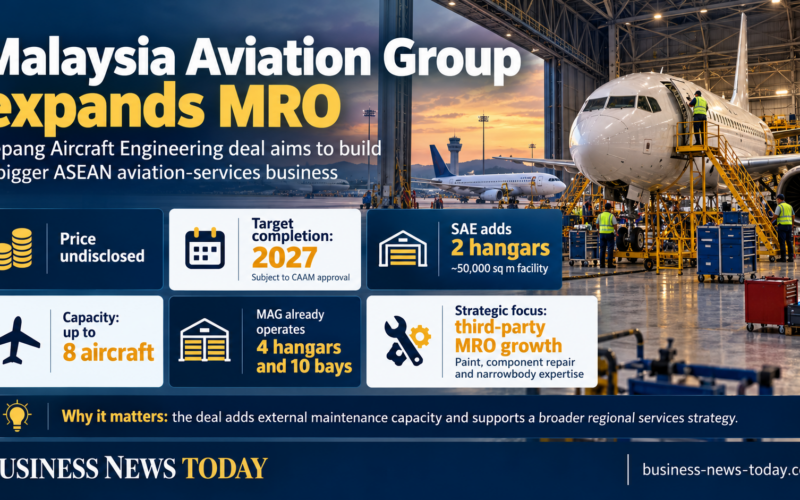
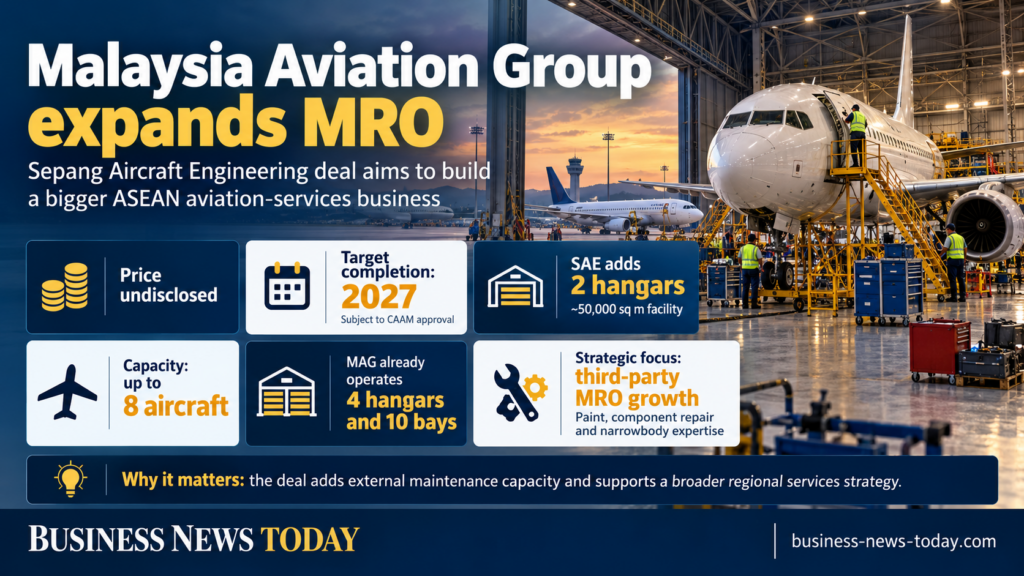
Malaysia Aviation Group has agreed to acquire Sepang Aircraft Engineering from Airbus SE, bringing one of Malaysia’s established aircraft maintenance businesses into the same aviation group that owns Malaysia Airlines and operates MAB Engineering. The transaction could significantly expand the group’s maintenance, repair and overhaul footprint while giving it additional capabilities aimed at external airline customers rather than merely supporting its own fleet. The companies signed a sale and purchase agreement on October 1, but neither Malaysia Aviation Group nor Airbus disclosed the transaction value, while completion is targeted for 2027 and remains subject to customary conditions, including approval from the Civil Aviation Authority of Malaysia.
The absence of a disclosed price makes it impossible to determine whether Malaysia Aviation Group is acquiring Sepang Aircraft Engineering cheaply or paying a strategic premium. What can be assessed more clearly is the industrial logic, because Sepang Aircraft Engineering adds approximately 50,000 square metres of hangar space, Airbus A320-family expertise, aircraft-painting capacity and specialised component-repair capabilities to a group that already operates a substantial engineering business. Those assets broaden the range of maintenance services Malaysia Aviation Group can sell to third-party airlines and create the possibility of building a larger regional aviation-services platform alongside its passenger business.
The most revealing feature of the transaction is that Malaysia Aviation Group itself does not operate Airbus A320-family aircraft. Buying an A320-focused maintenance provider therefore cannot be explained simply as bringing maintenance for Malaysia Airlines’ own narrowbody fleet in-house. Instead, the acquisition points more directly toward Malaysia Aviation Group’s ambition to expand third-party engineering revenue and develop maintenance as a larger independent business serving carriers across ASEAN.
What exactly is Malaysia Aviation Group buying from Airbus?
Sepang Aircraft Engineering is an established maintenance, repair and overhaul business located near Kuala Lumpur International Airport. Airbus first invested in the company in 2011 before acquiring the remaining shares in 2017, making the operation a wholly owned Airbus subsidiary. Since then, the business has developed capabilities spanning line and base maintenance, lease-return checks, aircraft painting, cabin work and specialised component repairs.
The facility has two hangars covering approximately 50,000 square metres and can accommodate as many as eight aircraft at one time for major maintenance work. It has particular expertise in Airbus A320-family aircraft, which remain widely used across Southeast Asia, while its component capabilities extend beyond narrowbody work and include specialised repairs such as radome maintenance for multiple Airbus aircraft types. Malaysia Aviation Group specifically highlighted A320 expertise, the dedicated paint hangar and component-repair capabilities when explaining why the acquisition complements MAB Engineering rather than simply duplicating existing functions.
That combination creates a broader commercial proposition than adding hangar space alone. Malaysia Aviation Group would gain a business already accustomed to serving external airline customers, with technical capabilities that can be sold independently of the group’s own fleet requirements. The strategic value therefore lies in both physical capacity and an established third-party maintenance franchise.
How much MRO capacity could Malaysia Aviation Group control after the acquisition?
Malaysia Aviation Group already has significant engineering infrastructure before Sepang Aircraft Engineering is added. MAB Engineering operates facilities at Sepang and Subang with four hangars and 10 aircraft bays capable of supporting both narrowbody and widebody aircraft. Its existing capabilities cover aircraft including the Boeing 737 family, Airbus A330, Airbus A330neo and Airbus A350, reflecting both Malaysia Aviation Group’s own fleet and third-party customer demand.
Sepang Aircraft Engineering adds another two hangars and space for as many as eight aircraft during major checks. It would be misleading to state that the combined business simply has 18 interchangeable maintenance positions, because hangars differ in size, certification, equipment and aircraft-type capability, while utilisation varies depending on the work being performed. The more useful conclusion is that Malaysia Aviation Group would control a considerably broader collection of MRO assets clustered around one of Southeast Asia’s important aviation hubs.
That expanded footprint could support both Malaysia Aviation Group’s internal maintenance requirements and a much larger external business. The addition of aircraft painting, component repair and deeper A320-family expertise also gives the group more ways to monetise engineering capacity beyond conventional heavy maintenance checks.
Why buy an A320 maintenance company when Malaysia Airlines does not fly A320s?
Malaysia Airlines’ own fleet strategy makes the third-party rationale particularly clear. The carrier’s narrowbody operation is centred on Boeing 737-family aircraft, while the group is also expanding its Airbus widebody fleet through a commitment for 40 A330neo aircraft. Malaysia Aviation Group has additionally ordered Boeing 737-8 and 737-10 aircraft as it works toward a modernised narrowbody fleet of 55 Boeing 737 MAX-family aircraft by 2030.
An A320-focused MRO business therefore does not primarily solve a fleet-support problem created by Malaysia Airlines itself. It gives Malaysia Aviation Group exposure to aircraft operated by other carriers across the region, where the A320 family remains a major part of low-cost and full-service airline fleets. That makes Sepang Aircraft Engineering commercially valuable even if Malaysia Aviation Group’s own aircraft mix continues moving in a different direction.
Recent Sepang Aircraft Engineering customers have included airlines such as Air India Express, Cebu Pacific Air, VietJet Air and Aircalin, demonstrating that its customer base already extends well beyond Malaysia. By acquiring the business, Malaysia Aviation Group is effectively buying access to a third-party maintenance franchise whose revenue can grow independently of passenger traffic on Malaysia Airlines, Firefly or other group carriers.
Why is third-party maintenance becoming more strategically important?
Airlines operate in a volatile industry where profitability can change rapidly because of fuel prices, currencies, aircraft shortages, economic conditions and geopolitical disruption. Maintenance demand has different characteristics because aircraft must continue meeting regulatory and safety requirements as long as they remain in service, creating recurring expenditure even when passenger economics become difficult. That can make engineering services an attractive source of more diversified revenue for an airline group.
Malaysia Aviation Group has explicitly said it wants the Sepang Aircraft Engineering acquisition to accelerate third-party revenue growth. That objective became even clearer on October 9, when the group announced seven engineering and MRO partnerships spanning component support, engineering, materials management and aviation logistics. Partners included Thales, Airbus Flight Hour Services, Air France Industries KLM Engineering & Maintenance, Boeing, Collins Aerospace and CEVA Logistics, while MAB Engineering Services also expanded its relationship with Batik Air Malaysia.
The timing suggests a coordinated strategy rather than an isolated acquisition. Modern aircraft maintenance depends not only on hangar space but also on component access, technical data, repair networks, specialist skills and logistics, which means adding physical capacity without strengthening the surrounding ecosystem would limit commercial upside. Malaysia Aviation Group appears to be trying to build those supporting capabilities at the same time it enlarges the infrastructure base.
Could Malaysia Aviation Group become a larger ASEAN MRO competitor?
The regional demand backdrop is favourable because Asia-Pacific aircraft fleets are expected to continue expanding as passenger volumes rise and airlines replace ageing equipment. At the same time, delays in new-aircraft deliveries have forced many carriers to keep existing aircraft in service for longer, increasing demand for inspections, repairs, modifications and life-extension work. Those conditions can support MRO growth even when aircraft manufacturers struggle to deliver new capacity quickly.
Malaysia already occupies a meaningful position in this market. Under the Malaysian Aerospace Industry Blueprint 2030, the country is targeting a 5% share of the global MRO market by the end of the decade, compared with around 4% in 2025, while national aerospace revenue is targeted at approximately RM55.2 billion annually by 2030. Industry data indicate that MRO already accounts for a substantial share of Malaysia’s aerospace activity.
Competition, however, remains intense. Singapore has one of the world’s most developed aviation-maintenance ecosystems, while capacity is expanding in Indonesia, Thailand, the Philippines and India, and established providers such as SIA Engineering continue investing across the region. Malaysia Aviation Group will therefore need to compete on turnaround time, engineering quality, certifications, component availability and customer trust rather than relying solely on cost advantages.
How does Sepang Aircraft Engineering complement MAB Engineering?
The acquisition provides both greater breadth and greater specialisation. MAB Engineering already has a long history of maintaining Malaysia Airlines aircraft and serving external carriers from Sepang and Subang, with capabilities covering several narrowbody and widebody types. Sepang Aircraft Engineering adds deeper A320-family expertise together with facilities such as a dedicated paint hangar and specialised component-repair operations.
Aircraft painting may appear secondary compared with heavy maintenance, but it is commercially valuable because airlines repaint aircraft during rebranding, fleet transitions, lease returns and ownership changes. Lease-return work can combine inspection, repairs, cabin modifications, documentation, component replacement and painting into a single complex service package, creating higher-value maintenance opportunities. Component repair also allows Malaysia Aviation Group to earn revenue without requiring an entire aircraft to be physically present at one of its hangars.
That gives the enlarged platform several independent revenue channels. Instead of depending only on scheduled base maintenance, Malaysia Aviation Group could pursue aircraft checks, painting, lease-return services, technical work and component repair across a wider customer base.
Could owning more maintenance capacity also help Malaysia Airlines?
A larger engineering platform could also improve Malaysia Aviation Group’s own operational resilience, even though external customers appear to be the primary strategic rationale for buying Sepang Aircraft Engineering. Airlines globally have faced persistent aircraft-availability problems caused by engine issues, spare-parts shortages and stretched maintenance networks, while experienced engineers and hangar slots have become increasingly scarce.
Malaysia Aviation Group is modernising its fleet during this period of industry constraint. It has doubled its A330neo commitment to 40 aircraft and is adding Boeing 737-8 and 737-10 aircraft while continuing to operate a mixed fleet that requires multiple maintenance capabilities. Greater engineering scale can potentially improve planning, parts access and technical flexibility as those aircraft enter service.
The challenge will be balancing internal and external demand. Third-party MRO customers can improve utilisation and generate attractive revenue, but Malaysia Aviation Group must ensure that commercial work does not reduce maintenance availability for its own airlines. The value of the acquisition will therefore depend partly on how effectively it allocates capacity between the two groups of customers.
Why is Airbus selling Sepang Aircraft Engineering?
Airbus has not publicly provided a detailed strategic explanation for selling the business, so the transaction should not be interpreted as evidence that the aircraft manufacturer is withdrawing from maintenance services in Asia-Pacific. Airbus continues to operate extensive aftermarket, support, training and flight-hour-services businesses globally, and Malaysia Aviation Group itself expanded its relationship with Airbus Flight Hour Services shortly after announcing the Sepang acquisition.
The transaction instead changes ownership of one local MRO asset. Airbus first became a shareholder in Sepang Aircraft Engineering in 2011 and bought the remaining ownership in 2017, describing the business at the time as part of its regional services-growth strategy. Under Malaysia Aviation Group, the same infrastructure could become more closely integrated with a Malaysian aviation-services platform focused on third-party revenue.
The undisclosed transaction price prevents a meaningful financial assessment from Airbus’s perspective. Investors cannot determine whether Airbus is crystallising a gain, accepting a loss or simply reallocating capital because neither party has published sufficient financial information about Sepang Aircraft Engineering.
What could prevent the acquisition from delivering the expected benefits?
The first hurdle is completion. The transaction remains subject to customary conditions, including approval from the Civil Aviation Authority of Malaysia, and Malaysia Aviation Group is targeting completion during 2027 rather than treating the acquisition as already closed. Regulatory timing and closing conditions therefore remain relevant execution variables.
Integration could become more difficult after completion. Sepang Aircraft Engineering has developed systems, technical processes and customer relationships under Airbus ownership, and Malaysia Aviation Group will need to preserve those strengths while aligning the business with MAB Engineering and its broader aviation-services organisation. Retaining experienced engineers and licensed technicians will be particularly important because hangars have little commercial value without qualified people able to perform and certify maintenance work.
Customer retention will also matter because some external airlines that selected Sepang Aircraft Engineering while it was owned by Airbus may compete directly or indirectly with Malaysia Aviation Group carriers. The group will need to convince those customers that the engineering operation remains commercially neutral and focused on service quality rather than functioning primarily as an internal airline maintenance arm.
What should investors and the aviation industry watch next?
Regulatory approval is the first milestone, followed by confirmation that the transaction completes during 2027. After that, one of the most important questions will be how Malaysia Aviation Group organises the combined engineering platform, including whether Sepang Aircraft Engineering remains a distinct operation or becomes more closely integrated with MAB Engineering Services.
Third-party customer growth will provide the clearest evidence of strategic success. Malaysia Aviation Group has repeatedly emphasised external MRO revenue, while the October partnerships reinforce its ambition to build a wider commercial maintenance business. New contracts from airlines outside the group would therefore provide stronger evidence of value creation than simply shifting existing Malaysia Airlines maintenance among group facilities.
Capacity utilisation will be equally important because owning six hangars across MAB Engineering and Sepang Aircraft Engineering creates substantial infrastructure but does not guarantee attractive returns. Profitability will depend on keeping those assets productively occupied while controlling labour, material and component costs.
The acquisition ultimately points to a broader change in Malaysia Aviation Group’s business model. The group will remain fundamentally dependent on Malaysia Airlines and its other carriers, but it is increasingly building businesses capable of generating revenue even when the customer is not flying under a Malaysia Aviation Group brand. Cargo, ground handling, training, catering and maintenance all extend the group’s commercial reach beyond passenger tickets.
Buying an Airbus-owned maintenance business whose strongest aircraft speciality is a type Malaysia Airlines itself does not operate makes that ambition particularly clear. If Malaysia Aviation Group can retain Sepang Aircraft Engineering’s external customers, combine its specialist capabilities with MAB Engineering and use Malaysia’s broader aerospace ecosystem to attract more ASEAN maintenance work, engineering could become a materially larger independent revenue engine. If utilisation and third-party growth disappoint, the group will simply own more maintenance capacity without fully monetising it.
Discover more from Business-News-Today.com
Subscribe to get the latest posts sent to your email.