
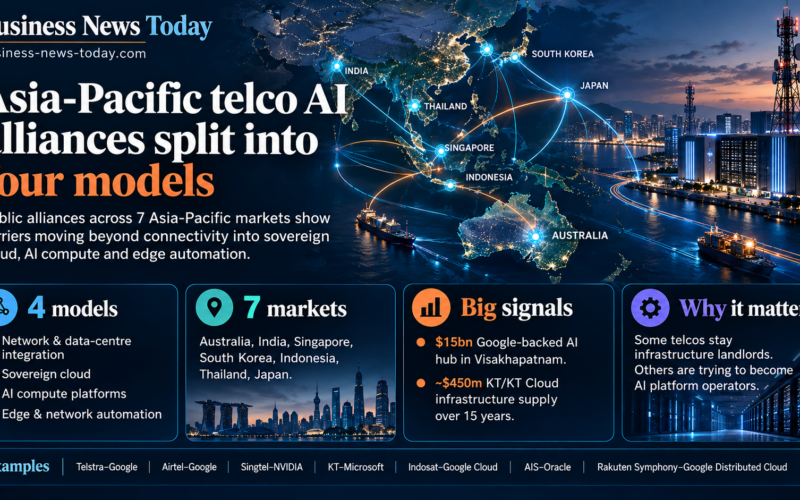
Asia-Pacific telecommunications groups are not following a single playbook as artificial intelligence reshapes digital infrastructure. A review of publicly disclosed partnerships across Australia, India, Singapore, South Korea, Indonesia, Thailand and Japan shows four distinct commercial models emerging: physical network and data-centre integration, sovereign cloud delivery, carrier-operated AI compute platforms, and edge or network automation. The distinction is commercially important because merely carrying hyperscaler traffic can leave a telecom operator with infrastructure-style returns, while controlling AI compute, orchestration or sovereign-cloud services potentially moves the carrier further up the value chain. The emerging divide is therefore not between telcos participating in AI and those sitting it out, but between companies becoming indispensable infrastructure landlords and those attempting to become AI platform operators.
The alliances include Telstra Group Limited exchanging terrestrial and subsea fibre access with Google, Bharti Airtel Limited supporting Google’s $15 billion Visakhapatnam AI hub through Nxtra and its fibre network, Singapore Telecommunications Limited building sovereign AI capabilities around NVIDIA infrastructure, KT Corporation developing Korean cloud and AI services with Microsoft Corporation, Indosat Ooredoo Hutchison working with Google Cloud on sovereign infrastructure, Advanced Info Service Public Company Limited operating an Oracle-powered Thai hyperscale cloud, and Rakuten Symphony embedding its storage technology inside Google Distributed Cloud. These arrangements look superficially similar because all combine telecom assets with hyperscaler technology. Economically, however, they place the carrier in very different positions.
What four commercial models are emerging from Asia-Pacific telco AI partnerships?
The first model is straightforward physical infrastructure integration. Telstra’s agreement with Google gives Google dark-fibre capacity on Telstra’s Aura terrestrial network while allowing Telstra to access fibre pairs on Google’s Tabua, Proa and Bulikula subsea systems. Neither company is simply buying bandwidth from the other. They are exchanging access to complementary infrastructure that would be expensive and time-consuming to duplicate.
Bharti Airtel’s relationship with Google follows a related but more capital-intensive version of this model. Google’s approximately $15 billion investment in its Visakhapatnam AI hub over 2026 to 2030 includes gigawatt-scale compute and a new international subsea gateway, while Airtel and Nxtra participate in the connectivity and data-centre layer. Google has described Airtel and AdaniConnex as major local infrastructure partners in the project.
The second model is sovereign cloud, where the telco’s competitive advantage comes from jurisdiction rather than merely bandwidth. Indosat Ooredoo Hutchison is working with Google Cloud to deliver Google Distributed Cloud infrastructure for Indonesian public-sector agencies and regulated industries. Advanced Info Service has taken the concept further in Thailand by operating a locally controlled cloud powered by Oracle Cloud Infrastructure while keeping systems, data residency and operations inside Thailand.
The third model involves the carrier attempting to become an AI compute and orchestration platform itself. Singapore Telecommunications’ RE:AI combines sovereign AI cloud capacity, Nxera AI-ready data centres, its Paragon multi-cloud and network orchestration technology and NVIDIA infrastructure. Rather than supplying connectivity underneath somebody else’s AI service, Singtel is trying to package compute, models, networking, governance and deployment into one enterprise platform.
The fourth model pushes cloud capability outward toward the network edge or uses hyperscaler AI internally to automate telecom operations. Rakuten Symphony has integrated its Cloud-Native Storage technology directly into Google Distributed Cloud Connected Servers, while Australian operators including TPG Telecom have been using Amazon Web Services technology and AI agents to automate increasingly complex network-operation processes. In these cases, the telco network itself becomes part of the computing architecture.
Why do hyperscalers still need telecom operators if they can build their own data centres?
Artificial intelligence has made the physical limitations of cloud computing harder to ignore. Hyperscalers can own the chips, software and cloud platforms, but they cannot instantly reproduce nationwide fibre routes, cable landing stations, radio networks, local licences, rights-of-way, enterprise relationships and decades of operating history in every country where they want to expand.
Telstra and Google’s Australian arrangement demonstrates the infrastructure logic clearly. Google gains access to terrestrial dark fibre without building another nationwide backbone, while Telstra gains access to subsea capacity linking Australia with Japan, Pacific markets and the United States. Each company effectively acquires a network extension that would otherwise require enormous capital and lengthy permitting.
India provides an even larger example. Google’s Visakhapatnam investment includes not only computing infrastructure but new international subsea connectivity and inland fibre routes. Airtel’s existing national network and Nxtra data-centre capability give the project a local physical layer that Google would have to create or contract anyway.
That makes telecom assets valuable in a way that is not always captured by traditional mobile-service valuations. Fibre routes, cable landing capability and data-centre interconnection are increasingly inputs into AI production rather than merely utilities supporting consumer broadband. The strategic question is whether carriers can price those assets accordingly or whether hyperscalers ultimately capture most of the economic upside.
Which partnerships risk leaving telecom companies as infrastructure landlords?
Bharti Airtel offers one of the clearest examples of the distinction between participating in AI infrastructure and actually capturing AI compute economics. Airtel management has described the Google Visakhapatnam arrangement as a colocation-led project through Nxtra and has explicitly said the group is not currently operating a GPU-as-a-Service model for that partnership.
That matters because colocation and GPU cloud services have very different economics. A colocation provider earns revenue for supplying reliable space, power, cooling and connectivity. A GPU cloud operator takes substantially more technology, utilisation and depreciation risk but can potentially capture much more revenue per unit of installed capacity.
Airtel’s model may be entirely rational. AI accelerators are expensive, product cycles are rapid and utilisation risk can destroy returns if computing capacity is purchased ahead of demand. By allowing Google to own more of the technology layer, Airtel can monetise infrastructure while limiting exposure to rapidly depreciating hardware.
Telstra’s Google partnership similarly looks more like infrastructure monetisation than an attempt to become an independent AI cloud provider. The value lies in network reach, resilience and interconnection rather than ownership of foundation models or GPU fleets. This may produce steadier returns, but it also means hyperscalers remain closer to the highest-growth AI software and compute revenue pools.
Which Asia-Pacific telcos are trying to capture more of the AI stack?
Singapore Telecommunications appears considerably more ambitious about moving beyond connectivity. Its RE:AI platform combines locally controlled AI computing with data centres, network orchestration and technology partners including NVIDIA, Mistral AI, Scale AI and Nscale. Singtel’s recent collaboration with the Singapore Institute of Technology also adds a testing environment where enterprises can move AI applications from experimentation toward production.
The strategic advantage is integration. A company deploying AI may otherwise need separate agreements for GPU infrastructure, cloud software, networking, security, governance and application development. Singtel is attempting to bundle those layers through a platform controlled by a domestic telecommunications group.
KT Corporation is pursuing a comparable transformation in South Korea through its Microsoft alliance. The five-year partnership covers Korean-language AI models, a Korean secure public cloud, enterprise AI transformation services, research and startup development. A regulatory filing also shows that KT and KT Cloud agreed to supply approximately $450 million of network and data-centre infrastructure over a 15-year period under the broader partnership.
If the $450 million infrastructure figure were distributed evenly across 15 years, it would correspond to roughly $30 million annually, although actual revenue recognition will depend on individual contracts and deployment schedules. More important is the direction of travel: KT is simultaneously supplying physical infrastructure to Microsoft and using Microsoft technology to build its own Korean AI and cloud businesses.
That two-way exchange may become one of the more attractive telco-hyperscaler structures. Instead of functioning only as Microsoft’s local network provider, KT is attempting to turn access to Microsoft’s technology into enterprise services it can sell under its own commercial relationships.
Why is sovereign AI strengthening the bargaining position of local telecom operators?
Artificial intelligence has intensified concerns around where sensitive information is stored, who can access it and which country’s laws ultimately govern the infrastructure. Those concerns are particularly important for government agencies, banks, healthcare systems, defence organisations and critical infrastructure operators.
Global hyperscalers possess sophisticated technology but can face limitations when customers require systems operated within national jurisdictions or under local governance. Telecom groups frequently possess the opposite characteristics: strong domestic regulatory relationships and local infrastructure but less advanced cloud and AI technology.
Sovereign-cloud partnerships combine the two.
Indosat’s Google Cloud arrangement allows Indonesian organisations to run AI and data-intensive workloads through Google Distributed Cloud while maintaining strict controls over data location and security. The target sectors include defence, healthcare, financial services, energy and manufacturing, areas where data governance can materially influence purchasing decisions.
Thailand’s Advanced Info Service has gone further by positioning AIS Cloud as a locally owned and operated hyperscale platform powered by Oracle technology. Customers receive access to more than 100 Oracle Cloud Infrastructure services, including AI capabilities, while the cloud operates from Thai data centres under Thai jurisdiction.
The distinction may seem technical, but commercially it is significant. Sovereignty requirements give local operators something hyperscalers cannot manufacture with software alone: trusted domestic control.
Could edge AI make telecom networks more valuable than centralised cloud capacity alone?
The architecture of AI workloads may also strengthen telecom operators if more inference happens closer to users, factories and machines. Training large foundation models remains concentrated in enormous data centres, but inference applications can require low latency, local processing and continued operation even when external connectivity is constrained.
Rakuten Symphony’s relationship with Google illustrates this shift. Rakuten Cloud-Native Storage is now built directly into Google Distributed Cloud Connected Server deployments, creating an integrated compute and storage product for distributed environments. In this arrangement, technology originating from a telecom ecosystem becomes part of the hyperscaler’s edge offering rather than the telco merely reselling Google’s cloud.
The opportunity expands further when edge computing combines with 5G or private networks. Manufacturing, autonomous equipment, video analytics and industrial control systems may require AI processing close to the source of the data. Telcos already operate distributed networks capable of connecting those locations.
Network operations themselves are also becoming AI workloads. Amazon Web Services has been developing agent-based systems capable of analysing telecom alarms, technical standards, performance indicators and operating procedures. TPG Telecom has publicly discussed automating large numbers of network procedures using Amazon Bedrock, illustrating how carriers can first use hyperscaler AI internally before selling similar capabilities externally.
This creates a potential flywheel. Operators use AI to make their own networks more autonomous, package those network capabilities with cloud services, and then sell low-latency AI infrastructure to enterprise customers.
What could stop telcos from capturing the economics of the AI infrastructure boom?
The largest risk is that partnerships make telecom operators more dependent on hyperscalers rather than less dependent on them. A carrier may provide fibre, data centres, spectrum and customers while the hyperscaler retains control over the AI models, developer ecosystem, cloud platform and most valuable software interfaces.
Capital intensity presents another problem. S&P Global Ratings expects hyperscaler AI investment to remain enormous, but telecommunications groups generally do not possess hyperscaler balance sheets. Operators already spend heavily on spectrum, 5G, fibre and network maintenance. Competing directly in GPU infrastructure could increase leverage while exposing carriers to short hardware replacement cycles.
There is also no guarantee that sovereign cloud remains permanently differentiated. If several domestic operators offer similarly compliant infrastructure using the same underlying hyperscaler technology, competition could eventually push margins back toward ordinary infrastructure economics.
Customer concentration creates a further tension. A multi-billion-dollar hyperscaler project can provide a long-duration anchor customer for a carrier’s data-centre or fibre assets, but losing or renegotiating that customer can have an outsized financial effect. Operators will need to balance strategic partnerships with maintaining enough neutrality to serve competing clouds and enterprise platforms.
The strongest telco position may therefore be neither complete dependence nor complete vertical integration. It may be controlling scarce domestic infrastructure and customer access while remaining capable of working across multiple clouds.
Have investors started valuing Asia-Pacific telcos as AI infrastructure companies?
Public-market evidence suggests not yet, at least not consistently. Bharti Airtel closed October 16 at ₹1,905, up about 2.8% for the session and roughly 5.5% over the week, but the immediate catalyst was renewed Indian telecom valuation interest ahead of the Jio Platforms initial public offering rather than Google’s AI infrastructure project.
Telstra closed the same day at A$4.74, down 1.0%, after falling sharply earlier in the week when investors reacted to the potential competitive implications of SpaceX acquiring low-band spectrum in the United States. The response demonstrates that markets still view traditional network competition as more immediately relevant to Telstra’s valuation than its developing role in hyperscaler infrastructure.
KT Corporation’s New York-listed depositary receipts closed October 16 at $18.47, considerably below their 52-week high despite the company’s multi-year Microsoft strategy. Again, that does not disprove the AI thesis. It shows that investors have not yet awarded a universal AI premium simply because a telecom company has signed a major hyperscaler partnership.
The distinction is healthy. The value of these alliances should eventually be measured through enterprise revenue growth, data-centre utilisation, cloud margins, incremental return on invested capital and customer adoption, not the number of AI announcements issued.
Which partnership model is most likely to create durable value for Asia-Pacific carriers?
The emerging partnership map suggests that telecom companies possess three assets hyperscalers increasingly need: physical network infrastructure, domestic regulatory standing and established enterprise distribution. Those advantages are particularly valuable in Asia-Pacific because the region consists of many separate regulatory jurisdictions rather than one homogeneous digital market.
What differs is how aggressively operators monetise those assets.
Telstra’s infrastructure exchange with Google and Airtel’s colocation role in Visakhapatnam can generate value without requiring the carriers to take the full technology risk of AI compute. Singtel and KT are pursuing a more ambitious path by combining infrastructure with cloud, orchestration and enterprise AI services. Indosat and Advanced Info Service are using sovereignty as a route into regulated workloads, while Rakuten Symphony is attempting to place telecom-origin technology directly inside the distributed cloud stack.
None is inherently the correct strategy. Returns will depend on capital costs, local competition, regulatory requirements, utilisation and whether customers actually pay premiums for locally integrated AI services.
But the public agreements already reveal a structural change in the role of the telecommunications industry. The network is no longer merely the pipe connecting users to hyperscaler data centres. In parts of Asia-Pacific, it is becoming part of the AI platform itself.
The operators most likely to benefit will be those that can convert that indispensability into something more valuable than wholesale bandwidth. If they succeed, the AI infrastructure cycle could finally give some carriers a credible route beyond the slow-growth economics that have defined traditional telecommunications for much of the past decade.
Discover more from Business-News-Today.com
Subscribe to get the latest posts sent to your email.