




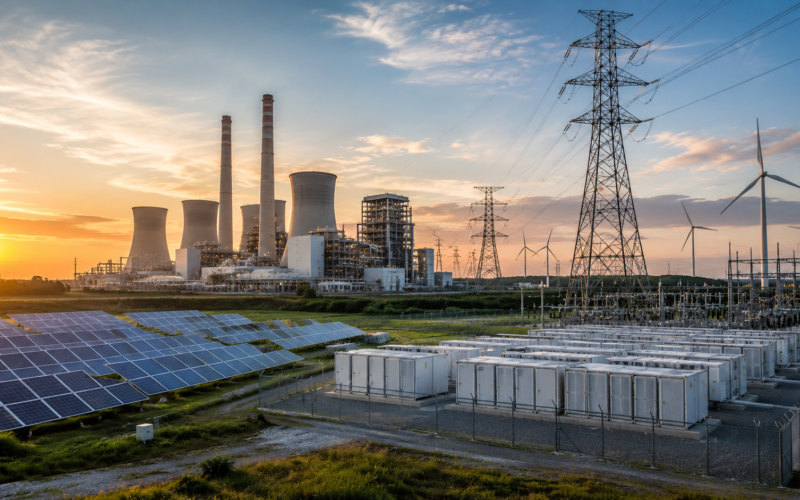
JSW Energy Limited, listed on the National Stock Exchange of India under the ticker JSWENERGY, has reaffirmed capital expenditure guidance of approximately ₹20,000 crore for FY27 as it advances its Strategy 3.0 growth programme. The investment is intended to support new power generation capacity, energy storage, equipment manufacturing and the infrastructure required to move toward 30 GW of generation capacity and 40 GWh of storage by 2030. JSW Energy had already incurred ₹4,076 crore of capital expenditure during the first quarter, demonstrating that the programme has moved beyond long-range planning into active deployment. The opportunity is substantial because India’s electricity demand is rising, but the financial test will be whether the company can commission assets on schedule without allowing interest costs and leverage to consume the resulting operating growth.
How will JSW Energy fund its ₹20,000 crore FY27 capital expenditure without another immediate fundraising?
JSW Energy’s funding structure indicates that management does not expect the entire ₹20,000 crore investment programme to translate directly into additional borrowing. During its July 22 earnings call, management said recently raised capital and operating cash flow could together provide approximately ₹12,000 crore to ₹12,500 crore, leaving the remaining requirement to be met through incremental financing and other available resources. Based on that indication, the potential residual requirement could be approximately ₹7,500 crore to ₹8,000 crore, although the final number will depend on cash generation, project expenditure timing and working-capital movements.
The company recently assembled a ₹10,150 crore growth-capital package through three separate transactions. These comprised a ₹3,000 crore preferential allotment to promoters, a ₹3,150 crore partial monetisation of JSW Steel Limited shares and a ₹4,000 crore qualified institutions placement. Of the promoter allotment, ₹1,125 crore had been received by the end of the first quarter, with the remaining ₹1,875 crore available to be received before June 2027.
Cash and cash equivalents stood at ₹12,881 crore at the end of June 2026, giving JSW Energy a substantial liquidity buffer as construction activity accelerates. Management has characterised the balance sheet as capable of funding the equity portion of its planned investments through a combination of existing liquidity and future internal accruals. That liquidity reduces the likelihood of an immediate large equity raise, but it does not eliminate the financial consequences of an investment cycle that is expected to continue through the end of the decade.
The more important capital-allocation question is therefore not whether money is available. It is whether JSW Energy can deploy that money into projects producing returns above the company’s weighted financing and execution costs. A well-funded project can still weaken shareholder returns when commissioning is delayed, tariffs prove insufficient or depreciation and interest expenses rise before utilisation reaches an efficient level.
Where will the ₹20,000 crore investment go as JSW Energy targets 3 GW of new capacity in FY27?
JSW Energy had installed generation capacity of 14,535 MW as of July 8, 2026, compared with 12,768 MW at the end of the corresponding period a year earlier. The portfolio comprised 5,658 MW of thermal capacity, 3,125 MW of wind, 2,275 MW of solar, 1,781 MW of hydro and 1,696 MW of hybrid capacity. The company had added 1,081 MW since the beginning of FY27, including 442 MW of solar, 381 MW of hybrid capacity, 150 MW of hydro and 108 MW of wind capacity.
That means JSW Energy had already completed more than one-third of its approximately 3 GW FY27 capacity-addition target by early July. Management is targeting around 1.5 GW of cumulative additions by the end of the first half, followed by further commissioning during the remainder of the financial year. The early progress is encouraging because it reduces the amount of capacity that must be compressed into the final quarters, when permitting, equipment delivery and grid-connection delays can become more disruptive.

The company’s broader development portfolio includes 13,567 MW of capacity under construction with signed power purchase agreements, excluding the first 600 MW expansion unit at the Mahanadi thermal project. Including additional projects under acquisition and pipeline opportunities, JSW Energy has described approximately 32.4 GW of generation capacity as locked in, exceeding its formal 30 GW target for 2030. The development mix includes 3,800 MW of thermal capacity, 3,105 MW of solar, 2,245 MW of wind and 4,417 MW of hybrid projects under construction.
This pipeline provides greater visibility than an aspirational capacity target unsupported by awarded projects. However, “locked in” does not mean fully commissioned, cash-generating or free from execution risk. JSW Energy must still manage land access, transmission infrastructure, equipment supply, financing drawdowns, construction schedules and power purchase agreement obligations across several technologies and jurisdictions.
Why is JSW Energy expanding thermal generation while investing heavily in renewable power and storage?
JSW Energy’s growth strategy is not a simple transition from conventional generation to renewable energy. It is becoming a diversified electricity platform that combines thermal generation for dependable supply, renewable capacity for lower-variable-cost energy and storage assets capable of shifting electricity to periods of higher system demand.
The company plans to expand the Mahanadi thermal power plant from 1.8 GW to 3.6 GW. The next 600 MW unit is targeted for commissioning in FY28, while the strategy for the additional fifth and sixth units is intended to take the site to its expanded capacity. Management has said that existing balance-of-plant infrastructure, including coal handling, ash handling, railway and transmission facilities, should allow the Mahanadi expansion to be completed at a lower capital cost than an equivalent greenfield development.
JSW Energy is also developing the Salboni thermal power project in West Bengal. The company’s under-construction portfolio identifies two planned 1,600 MW phases at Salboni, creating 3.2 GW of potential capacity. Turbine-generator equipment has been linked to Toshiba JSW Power Systems, while JSW Energy is progressing with the acquisition of GE Power India Limited’s boiler manufacturing facility in Durgapur to strengthen equipment availability and internal execution capabilities.
The thermal expansion reflects the continuing need for dispatchable power as India adds intermittent renewable capacity. India’s total electricity demand rose 8.5% year on year to 483 billion units during Q1 FY27, while peak demand reached a record 271 GW in May 2026. Demand growth accelerated to 11.5% in June, supported by heatwaves, delayed monsoon conditions and increased cooling requirements.
Thermal assets can therefore provide contracted availability and grid stability while renewable and storage investments expand. The risk is that long-lived coal assets will face increasing environmental, financing and policy scrutiny over time. JSW Energy must consequently demonstrate that new thermal projects are backed by durable power purchase agreements, reliable fuel arrangements and competitive generation costs rather than relying excessively on volatile merchant electricity prices.
How important are pumped hydro and battery storage to JSW Energy’s plan for 40 GWh by 2030?
Energy storage is emerging as the connective tissue between JSW Energy’s renewable portfolio and its ambition to supply more dependable electricity. The company has set a target of 40 GWh of storage capacity by 2030 and had identified approximately 29.6 GWh of contracted or pipeline capacity by July 2026.
Pumped hydro accounts for the largest portion of the programme. JSW Energy has 24 GWh of pumped-storage capacity under construction through projects linked to Maharashtra State Electricity Distribution Company Limited and Uttar Pradesh Power Corporation Limited. An additional 2.4 GWh associated with Power Company of Karnataka Limited takes the pumped-storage portfolio, including pipeline projects, to 26.4 GWh.
Battery energy storage provides a shorter-duration and potentially faster-to-commission complement. JSW Energy reported 1.7 GWh of battery projects under construction and 3.2 GWh when pipeline opportunities were included. Contracted commissioning schedules range from September and December 2026 for some initial projects to later dates for projects bundled with solar or firm renewable energy supply.
Storage can create value by absorbing renewable electricity when generation exceeds immediate demand and supplying it during peak periods. It can also support utilities seeking firm renewable power without developing storage systems independently. Management has indicated that contracted storage projects are expected to generate better than mid-teen returns, although those returns remain company projections that will need to be demonstrated through completed projects, reliable availability and disciplined construction costs.
Why did JSW Energy’s quarterly profit fall even as operating earnings and capacity increased?
JSW Energy’s Q1 FY27 performance illustrates the temporary earnings tension created by aggressive expansion. Consolidated revenue remained broadly flat at ₹5,437 crore, compared with ₹5,411 crore a year earlier, while earnings before interest, taxes, depreciation and amortisation increased 2% to ₹3,103 crore. The EBITDA margin improved to 57% from 56%, supported partly by the contribution from additional renewable capacity.
Reported profit after tax, however, fell to ₹533 crore from ₹836 crore. Profit attributable to shareholders declined to ₹471 crore from ₹743 crore, while diluted earnings per share dropped to ₹2.57 from ₹4.25. Cash profit after tax was more resilient but still decreased 7% to ₹1,464 crore.
Depreciation increased to ₹890 crore from ₹739 crore, while finance costs rose to ₹1,519 crore from ₹1,306 crore. These increases are consistent with an expanding asset base in which newly commissioned capacity begins contributing depreciation and interest expenses before utilisation and operating efficiencies fully mature.
Generation also declined 5% to 12.9 billion units. Hydro production was affected by weak hydrology, while the Mahanadi plant experienced a temporary power-evacuation constraint that management said had normalised during June. Renewable wind and solar generation increased, but weaker hydro and thermal output prevented the larger installed base from translating into equivalent total-generation growth during the quarter.
This does not necessarily indicate that the expansion strategy is underperforming. It does show that capacity additions alone are an incomplete measure of progress. The stronger evidence will come from plant load factors, contracted generation, cash collections, operating cash flow and the speed at which new projects begin contributing earnings above their financing costs.
Can JSW Energy keep leverage within its financial guardrails during the expansion cycle?
JSW Energy reported total net debt of ₹61,322 crore at June 30, 2026. This comprised approximately ₹54,885 crore of operational net debt and ₹6,437 crore associated with capital work in progress. Net debt to equity improved to 1.70 times, while operational net debt to trailing EBITDA declined to 4.95 times from approximately 5.2 times at the end of FY26.
The improvement was supported by the qualified institutions placement, the partial JSW Steel stake monetisation and higher cash balances. Management has committed to keeping operational leverage below five times by 2030, even while implementing a wider capital programme estimated at approximately ₹1.1 trillion through FY30.
Maintaining leverage near the stated threshold will require operating EBITDA to expand alongside debt. This is where commissioning discipline becomes financially important. A delayed project continues absorbing construction expenditure and interest while contributing limited operating earnings, which can weaken leverage even when the underlying asset remains strategically attractive.
Receivable management also warrants attention. Days sales outstanding increased to 65 days from 58 days, while trade receivables rose to ₹4,151 crore from ₹3,696 crore. The increase is not yet inconsistent with a growing portfolio of long-term contracts, but sustained deterioration could reduce the internal cash generation available to fund construction.
What does the recent JSW Energy share-price performance reveal about investor sentiment?
JSW Energy shares closed at ₹544.25 on July 28, 2026, giving the company a market capitalisation of approximately ₹99,787 crore. The stock had declined about 3.9% over the preceding week and approximately 6.2% over one month. It remained around 11.8% below its 52-week high of ₹617.35, although it was still approximately 27.2% above its 52-week low of ₹427.75.
The stock’s performance suggests cautious rather than uniformly negative sentiment. Investors appear to recognise the value of JSW Energy’s contracted generation and storage pipeline, while placing greater emphasis on near-term profit conversion, leverage and valuation.
Broker assessments illustrate the divide. Jefferies maintained a Buy rating after the Q1 results but reduced its target price to ₹720 from ₹745. Motilal Oswal downgraded JSW Energy to Neutral and revised its target to ₹550, indicating a more conservative view of the balance between growth and valuation.
This divergence is rational given the company’s position. The bullish interpretation is that JSW Energy has secured sufficient projects, capital and execution capability to create a substantially larger earnings base by FY28 and FY29. The cautious interpretation is that the current valuation already reflects considerable future capacity growth, leaving limited tolerance for delays, cost overruns or weaker-than-expected returns.
JSW Energy’s ₹20,000 crore FY27 capital expenditure plan strengthens the credibility of its 30 GW generation and 40 GWh storage ambitions. The company has secured liquidity, expanded its project pipeline and demonstrated rapid early-year commissioning. What remains unresolved is how quickly that expansion will translate into profit, cash flow and improved returns on capital. The next measurable test will be whether JSW Energy reaches its first-half commissioning target while keeping operational leverage near five times and preventing finance costs from outpacing EBITDA growth.
What are the key takeaways from JSW Energy’s ₹20,000 crore FY27 expansion programme?
- JSW Energy has retained FY27 capital expenditure guidance of approximately ₹20,000 crore.
- The company is targeting around 3 GW of capacity additions during FY27.
- Approximately 1,081 MW had been added by July 8, representing more than one-third of the annual target.
- JSW Energy held ₹12,881 crore of cash and cash equivalents at the end of June 2026.
- Recent capital initiatives included a qualified institutions placement, promoter funding and a partial JSW Steel stake sale.
- The company is building toward 30 GW of generation capacity and 40 GWh of storage by 2030.
- Q1 FY27 EBITDA increased, but higher depreciation and finance costs contributed to a sharp fall in reported profit.
- Operational net debt to EBITDA improved to 4.95 times, close to management’s long-term ceiling.
- The primary execution test is whether new projects can generate operating cash flow faster than debt and capital charges increase.
- Investor sentiment remains divided between confidence in the contracted pipeline and concern about valuation, leverage and profit conversion.
Discover more from Business-News-Today.com
Subscribe to get the latest posts sent to your email.


