



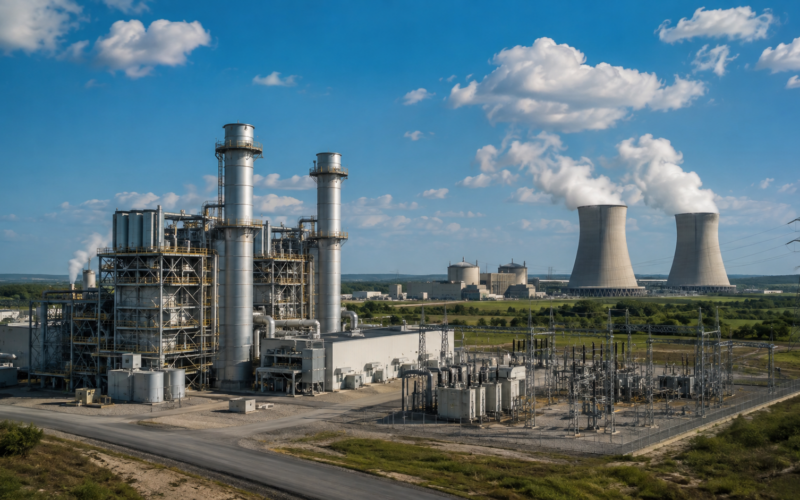
Vistra Corp. (NYSE: VST) reported second-quarter 2026 Ongoing Operations Adjusted EBITDA of $1.767 billion, up approximately 31% from $1.349 billion a year earlier, as higher realised energy prices, stronger capacity revenue and a full quarter of contribution from the natural gas plants acquired from Lotus Infrastructure Partners lifted performance. The company reaffirmed 2026 Ongoing Operations Adjusted EBITDA guidance of $6.8 billion to $7.6 billion and Adjusted Free Cash Flow before Growth of $3.925 billion to $4.725 billion. Vistra also confirmed Federal Energy Regulatory Commission approval for its pending Cogentrix Energy acquisition, while its 20-year Meta Platforms nuclear agreements and two new Permian Basin gas units continue advancing. The important point is that Vistra’s existing 2027 Adjusted EBITDA midpoint opportunity of $7.4 billion to $7.8 billion excludes both Cogentrix and the Meta agreements, creating a potentially meaningful earnings layer outside the published base case. The tension for shareholders is whether that upside can justify further acquisitions and project spending when VST closed August 7 at $140.59, roughly 36% below its 52-week high.
Why did Vistra’s second-quarter adjusted EBITDA rise more than 30% despite lower reported revenue?
Vistra’s second-quarter operating revenue declined to $4.017 billion from $4.250 billion a year earlier, yet Ongoing Operations Adjusted EBITDA increased by $418 million. The divergence reflects the economics of an integrated generation and retail company, where revenue alone does not reveal the value captured from power prices, hedges, capacity payments and generation margins. Vistra attributed the EBITDA improvement primarily to higher realised energy and capacity prices and three months of contribution from the Lotus plants acquired in 2025.
The strongest regional improvements came from the generation businesses. Texas Adjusted EBITDA increased to $311 million from $142 million, while the East segment rose to $642 million from $418 million. Retail remained comparatively stable at $773 million versus $756 million. Across the first six months, Texas Adjusted EBITDA reached $897 million, up from $632 million, while East increased to $1.443 billion from $932 million. Those figures show that the current earnings improvement is being driven heavily by generation economics rather than an unusually strong retail quarter.
GAAP net income tells a more complicated story. Vistra reported $305 million of net income, slightly below $327 million a year earlier, largely because an increase in unrealised mark-to-market losses on derivatives offset much of the improvement in realised operating performance. The company recorded a $472 million unrealised hedge loss expected to settle in future years during the quarter. This makes Adjusted EBITDA more useful for understanding the underlying operational change, although it remains a non-GAAP measure and should not be treated as a substitute for cash flow or net income.

How much earnings visibility does Vistra already have before Cogentrix and Meta begin contributing?
Vistra’s hedging position provides unusually high near-term visibility for a merchant power producer. As of August 3, the company had hedged approximately 100% of expected 2026 generation volumes, around 94% for 2027 and about 72% for 2028. Management said that portfolio supports both the current 2026 guidance and the previously disclosed 2027 Ongoing Operations Adjusted EBITDA midpoint opportunity range of $7.4 billion to $7.8 billion.
That 2027 figure requires careful wording because Vistra does not classify it as formal guidance. It is a midpoint opportunity based on market curves and assumptions, meaning actual results can move with power prices, hedging outcomes, generation availability and other variables. More importantly, Vistra explicitly excludes the pending Cogentrix acquisition and the announced Meta nuclear agreements from both its 2026 guidance and the 2027 midpoint opportunity.
This exclusion creates the most interesting analytical layer in the current results. Investors are not merely deciding whether Vistra can achieve a $7.6 billion midpoint in its existing 2027 opportunity range. They must assess how much incremental earnings Cogentrix can add after closing and how quickly the Meta contracts begin contributing, while avoiding the temptation to count every future contribution as guaranteed before regulatory, integration and project milestones are completed.
Why could the 5.5GW Cogentrix acquisition materially change Vistra’s generation portfolio?
Cogentrix Energy would add approximately 5,496MW of natural gas generation across ten facilities in PJM, ISO New England and ERCOT. The portfolio includes modern combined-cycle plants such as the 881MW Patriot and Hamilton-Liberty facilities in Pennsylvania, together with combustion turbines and the 583MW Altura cogeneration plant in Texas. Vistra expects its total United States generation portfolio to reach approximately 50GW after the acquisition.
Vistra agreed to an approximately $4 billion net purchase price after expected tax benefits. The transaction includes roughly $2.3 billion of cash consideration, around $0.9 billion of Vistra stock, assumption of approximately $1.5 billion of Cogentrix debt and an estimated $0.7 billion net present value of transaction-related tax benefits. On Vistra’s assumptions, the net price equates to approximately $730 per kilowatt and about 7.25 times expected 2027 Adjusted EBITDA contribution.
The acquisition was originally expected to deliver mid-single-digit accretion to Ongoing Operations Adjusted Free Cash Flow before Growth per share in 2027 and high-single-digit average accretion from 2027 through 2029. Vistra also said the transaction should exceed its mid-teens levered return target. Those are management expectations rather than realised results, and the deal still requires the remaining applicable closing conditions even after receiving Federal Energy Regulatory Commission approval.
Cogentrix matters strategically because Vistra is acquiring efficient dispatchable capacity in power markets where new generation is not simple to build. Interconnection queues, turbine availability, permitting, transmission constraints and construction timelines can make existing plants increasingly valuable when electricity demand is rising. The transaction effectively allows Vistra to purchase operating megawatts rather than wait several years for an equivalent greenfield fleet.
How could Meta’s 20-year nuclear agreements add a second earnings layer from 2027 onward?
Vistra’s agreement with Meta Platforms covers more than 2,600MW of nuclear energy and capacity from the Perry, Davis-Besse and Beaver Valley plants in PJM. The 20-year agreements include 2,176MW from existing generation and another 433MW expected from uprates across the three nuclear sites. Meta’s purchases begin in late 2026, while the additional uprated capacity will be added progressively through 2034.
The structure is strategically different from acquiring another power plant. Meta is providing long-term demand certainty around nuclear assets Vistra already owns, while the uprates allow additional generation to be created through improvements at existing facilities. The electricity will continue flowing into the grid rather than being physically isolated for Meta, while the commercial agreements provide greater certainty for Vistra to invest in the plants and pursue subsequent licence extensions.
This may create attractive capital efficiency if the uprates produce new megawatts at a lower cost than building equivalent greenfield generation. However, the full 433MW does not arrive immediately. Engineering, outage schedules, regulatory work and equipment installation extend through several years, meaning the economic contribution should build gradually rather than appear as one large 2027 step-up.
For shareholders, the important feature is that some Meta-related contribution is expected to begin in 2027 while remaining excluded from Vistra’s current 2027 midpoint opportunity. That creates upside outside the base framework, but the amount has not been separately quantified by the company.
Why is Vistra still constructing new gas plants when it is already acquiring thousands of megawatts?
Vistra is also building two advanced natural gas units at its Permian Basin Power Plant in West Texas. The units will add 860MW, more than tripling the site’s existing capacity from 325MW to 1,185MW. The investment forms part of Vistra’s plan to add more than 2,000MW of new ERCOT capacity between 2024 and 2028 as electricity demand expands across Texas.
The project illustrates why acquisition and construction are not necessarily competing strategies. Cogentrix gives Vistra immediate exposure to existing generation in several eastern markets, while Permian construction addresses a specific regional reliability need where oil and natural gas activity, population growth and industrial expansion are increasing electricity demand.
Vistra has already added more than 400MW through upgrades to existing Texas gas plants and expects those improvement projects ultimately to contribute roughly 500MW. It is also repowering the former Coleto Creek coal site with gas-fired generation expected to restore approximately 630MW. Including these investments, Vistra previously estimated it would have spent nearly $2 billion to add around 3,100MW of Texas generation since 2020.
The risk is capital concentration around the same broad thesis. If electricity demand accelerates as expected, existing and new dispatchable plants can capture greater value. If large-load projects are delayed or new generation enters more quickly than expected, scarcity economics could weaken. Vistra therefore needs construction costs and acquired-asset valuations to work under more than the most bullish power-demand scenario.
What does 97% fleet availability during extreme heat tell investors about the scarcity value of Vistra’s assets?
Vistra said its fleet achieved commercial availability of at least 97% during recent periods of extreme heat in Texas and PJM. This is strategically important because power plants create the greatest economic and system value when they are available during periods of high demand and tighter reserve margins. A nominal megawatt that is unavailable during peak conditions has far less value than dependable capacity capable of responding when the system needs it.
High availability also strengthens the logic behind Vistra’s acquisition strategy. Cogentrix’s modern gas portfolio is not valuable merely because it adds 5.5GW to a presentation. Vistra must integrate those plants, preserve maintenance discipline and operate them reliably across changing market conditions. The same applies to the Lotus assets that already contributed to the second-quarter EBITDA increase.
This creates an operating benchmark investors can follow after Cogentrix closes. If Vistra can extend its existing fleet-management performance across another ten facilities while maintaining cost control, the acquired EBITDA should become more credible. A rise in outages, maintenance expense or integration disruption would weaken the per-share accretion case even if power prices remain supportive.
Can Vistra continue buying plants and building capacity while still returning capital to shareholders?
Vistra has made share repurchases one of the defining features of its capital allocation. By August 3, it had executed approximately $6.5 billion of buybacks since November 2021 and reduced shares outstanding by about 30% to roughly 336 million. Approximately $1.2 billion of existing repurchase authorisation remained, which management expects to complete no later than the end of 2027.
The company also entered the second half with approximately $6.3 billion of available liquidity, including $435 million of cash and substantial capacity under corporate and commodity-linked revolving facilities. Cash provided by operating activities reached $2.22 billion during the second quarter, compared with $1.17 billion a year earlier, while first-half capital expenditure including nuclear fuel purchases and long-term service agreement prepayments reached $1.57 billion.
Cogentrix makes the allocation equation more complicated. Vistra is spending cash, issuing equity and assuming debt for the acquisition while simultaneously funding Permian construction, nuclear uprates, renewable projects and shareholder returns. Management has maintained a long-term net leverage target below three times and has said it intends to continue at least $1 billion of annual share repurchases alongside approximately $300 million of annual dividends.
The standard for new investment therefore needs to remain high. Every dollar committed to generation capacity competes with reducing the share count. Cogentrix creates value only if the cash flow acquired per share exceeds the opportunity cost of using the same capital for repurchases, debt reduction or other growth projects.
What does VST stock performance through August 7 say about investor confidence after Q2 results?
Vistra closed Friday, August 7 at $140.59 with a market capitalisation of approximately $48.1 billion. The shares had closed at $155.94 on August 3, meaning the stock declined approximately 9.8% across the five-day reference period. Compared with the July 7 close of $155.73, the shares were down roughly 9.7% over one month.
The wider valuation reset is more striking. VST’s 52-week range stood at approximately $132.66 to $219.82, placing the August 7 close about 36% below the high and only around 6% above the low. The stock had therefore given back a meaningful part of the rerating that accompanied enthusiasm around nuclear generation, artificial-intelligence electricity demand and power-market scarcity.
The decline does not demonstrate that investors have rejected Vistra’s strategy. The company continues to report rising adjusted EBITDA and has substantial potential earnings catalysts outside current guidance. However, the share-price behaviour suggests expectations have become more demanding. Power-demand growth alone is no longer enough. Investors increasingly need evidence that acquisitions, nuclear contracts and new generation translate into growing free cash flow per share without leverage or capital spending expanding faster than earnings.
At approximately $140.59, Vistra traded at roughly 23.5 times trailing reported earnings based on current market data. That conventional multiple does not capture the company’s hedge accounting, non-GAAP earnings framework or pending Cogentrix contribution cleanly, but it reinforces the broader point that the market is still assigning significant value to future generation economics rather than treating Vistra as a low-growth utility.
What are the key takeaways from Vistra’s Q2 2026 results, Cogentrix deal and Meta nuclear agreements?
- Vistra reported second-quarter Ongoing Operations Adjusted EBITDA of $1.767 billion, up more than 30% year on year.
- Texas Adjusted EBITDA increased to $311 million from $142 million, while East rose to $642 million from $418 million.
- Vistra reaffirmed 2026 Adjusted EBITDA guidance of $6.8 billion to $7.6 billion and Adjusted Free Cash Flow before Growth of $3.925 billion to $4.725 billion.
- The 2027 Adjusted EBITDA midpoint opportunity remains $7.4 billion to $7.8 billion and excludes Cogentrix and the Meta nuclear agreements.
- Cogentrix would add approximately 5.5GW of natural gas capacity at a net purchase price of about $4 billion after expected tax benefits.
- Vistra expects Cogentrix to provide mid-single-digit Adjusted Free Cash Flow before Growth per-share accretion in 2027, although the outcome remains a management forecast.
- Meta’s 20-year agreements cover more than 2.6GW of nuclear power, including 433MW of planned uprates.
- Two new Permian Basin gas units will add another 860MW of ERCOT generation capacity.
- Vistra has repurchased approximately $6.5 billion of shares since November 2021 and reduced its share count by roughly 30%.
- VST closed August 7 at $140.59, approximately 36% below its 52-week high, leaving execution on Cogentrix, Meta and new generation central to the next valuation test.
Can Vistra turn scarce dispatchable power into another earnings step-up without overpaying for growth?
Vistra’s operating position has improved. Second-quarter Adjusted EBITDA is substantially higher, its near-term generation is heavily hedged, fleet availability remained strong during periods of extreme heat, and the pending Cogentrix acquisition has moved through Federal Energy Regulatory Commission approval. The company also has a credible path to additional earnings through existing nuclear assets rather than relying entirely on expensive greenfield construction.
What remains unresolved is the amount of incremental value that reaches each existing share. Cogentrix must close and deliver the accretion Vistra forecast, the Meta nuclear agreements must translate into profitable uprates and licence extensions, and Permian construction must stay within investment thresholds. At the same time, management must preserve the buyback discipline that has reduced the share count by roughly 30% since 2021.
The strongest part of the thesis is that Vistra does not need every future power-demand prediction to materialise immediately. Much of its 2026 and 2027 generation is already hedged, while the existing 2027 earnings opportunity excludes two significant announced catalysts. The weakness is that expectations around artificial intelligence, nuclear scarcity and dispatchable generation have already proved capable of producing large valuation swings.
The next measurable proof point is therefore not another headline about electricity demand. It is closing Cogentrix, integrating 5.5GW without weakening fleet availability and showing how much combined Cogentrix and Meta contribution lifts 2027 and 2028 cash flow above the current base. If that incremental cash generation arrives while leverage remains controlled and repurchases continue, Vistra can demonstrate that power scarcity is creating per-share value rather than simply encouraging a larger asset base.
Discover more from Business-News-Today.com
Subscribe to get the latest posts sent to your email.