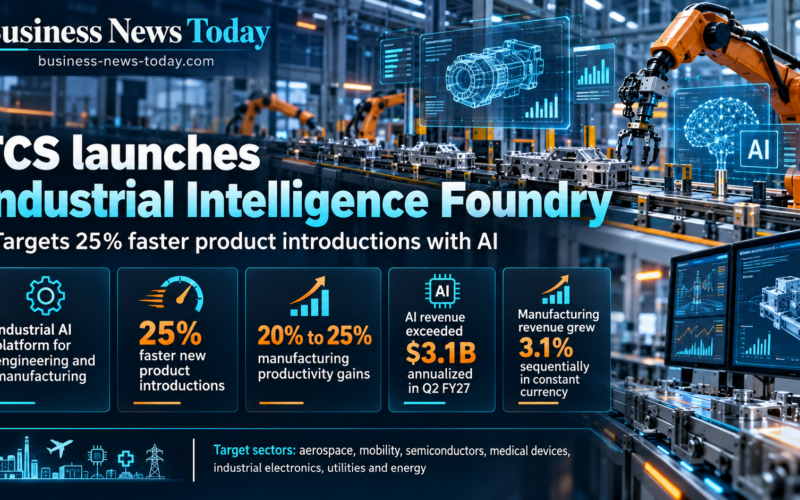
Tata Consultancy Services Limited (NSE: TCS, BSE: 532540) has launched its Industrial Intelligence Foundry, an artificial intelligence offering designed to help industrial enterprises automate engineering, manufacturing and operational workflows using domain-specific AI agents. Announced on October 15, 2026, the platform targets aerospace, mobility, semiconductors, medical devices, industrial electronics, utilities and energy companies, with TCS estimating that its capabilities could reduce new product introduction timelines by 25% and improve manufacturing productivity by 20% to 25%. The launch follows the company’s latest quarterly results, which showed annualized AI revenue exceeding $3.1 billion and manufacturing revenue growth of 3.1% sequentially in constant currency. The Foundry combines configurable applications, multi-agent orchestration and governance controls intended to move industrial AI projects beyond isolated experimentation into operational deployment. Its commercial significance will depend on whether manufacturers can achieve the proposed efficiency improvements in complex production environments while maintaining safety, quality and compliance.
How does TCS Industrial Intelligence Foundry differ from general-purpose enterprise AI platforms?
TCS Industrial Intelligence Foundry is designed around the requirements of industrial engineering and manufacturing rather than providing a generic conversational assistant for employees. The offering contains configurable AI agents, predefined workflows and governance capabilities intended to connect with existing enterprise systems. This approach allows manufacturers to adapt applications for specific operating processes without developing every AI agent from the beginning. TCS is positioning the platform as a reusable foundation for industrial transformation projects rather than a standalone productivity tool.
The Foundry addresses a challenge encountered when organizations attempt to scale AI beyond demonstrations and narrowly defined pilots. Industrial businesses operate across engineering design applications, manufacturing execution systems, enterprise resource planning platforms, asset management software and quality databases. Information frequently moves between these systems through workflows that also require human approvals and engineering judgment. An AI assistant that can summarize documents may offer limited benefits if it cannot securely interpret production information or coordinate actions across the applications used to run a factory.
TCS has adopted a domain-specific model in which AI agents can incorporate engineering context, operating constraints, industry standards and lifecycle information. The objective is to make recommendations and workflow actions more relevant to the industrial processes they support. For example, an engineering application may need to account for design specifications, testing requirements and documentation dependencies before recommending changes to a product development process. Similarly, a manufacturing application must consider production schedules, equipment availability and quality requirements rather than optimizing an isolated metric.
The Foundry also uses a model-agnostic architecture, allowing applications to work across different AI ecosystems rather than being restricted to a single underlying model provider. Such flexibility could appeal to large manufacturers managing multiple cloud environments, technology suppliers and existing software investments. However, model flexibility does not automatically guarantee interoperability, because individual applications and industrial systems may still require specialized integrations. The company has not disclosed a universal compatibility list or a standardized implementation cost for the new offering.
Can TCS deliver 25% faster product introductions and 20% to 25% manufacturing productivity gains?
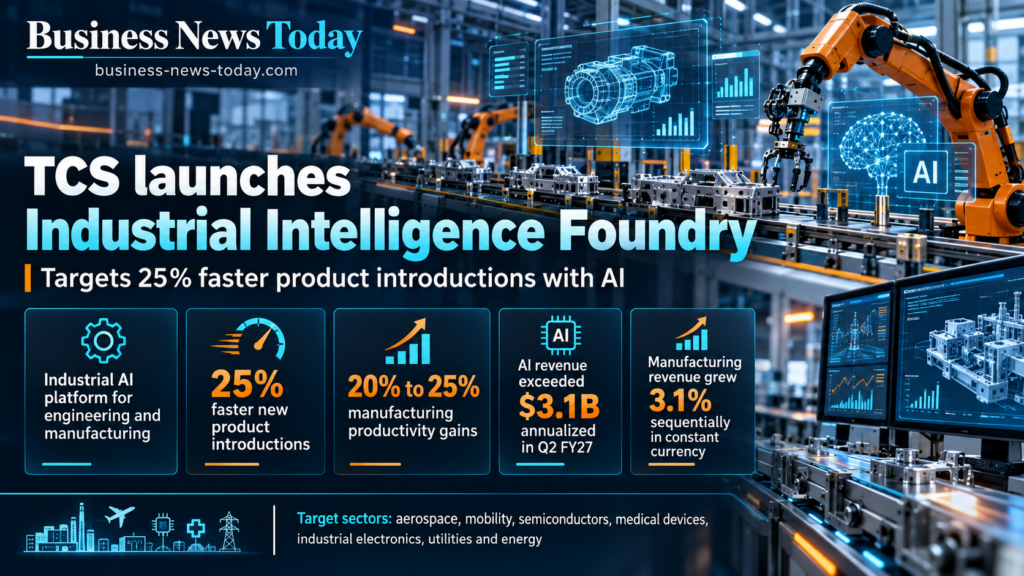
TCS has identified two principal operating benefits for the Industrial Intelligence Foundry: reducing new product introduction timelines by approximately 25% and improving manufacturing productivity by 20% to 25%. The company also believes productivity gains could exceed 40% as customers develop more mature data foundations and operating ecosystems. These figures describe potential improvements associated with the offering, not independently verified average results across deployed customer sites. The announcement does not identify the number of industrial implementations underlying those estimates or provide a standardized methodology for measuring the projected gains.
The product introduction target is especially relevant for manufacturers whose development schedules involve repeated design reviews, engineering validation, documentation and production readiness checks. A 25% reduction in the time required for an illustrative 12-month introduction programme would shorten that process to nine months. Such an improvement could allow a business to respond faster to market demand, reduce development overhead and potentially begin generating product revenue earlier. However, actual savings would depend on which activities AI can accelerate and whether physical testing, certification or supplier constraints remain on the critical path.
The productivity target raises a different measurement issue. Manufacturing productivity can refer to output per employee, production volume per operating hour, equipment effectiveness or another operational measure. A 20% improvement in output per labour hour does not necessarily mean a factory’s total production will increase by 20%, particularly if material shortages, equipment capacity or demand restrict output. Likewise, improvements in one production line cannot be assumed to apply uniformly across an entire manufacturing network.
TCS will therefore need to demonstrate results against clearly defined customer baselines. Manufacturers assessing the offering would benefit from evidence involving engineering cycle times, equipment downtime, first-pass quality, production throughput and the cost of implementation. Results should also account for software integration, employee training and ongoing AI infrastructure expenditure. Commercially persuasive case studies would show not only higher productivity but also whether the financial benefits exceed the total cost of deployment.
Which aerospace, semiconductor, medical device and energy workflows could benefit from TCS industrial AI?
The Industrial Intelligence Foundry covers five broad areas: engineering and product development, manufacturing operations, asset performance, quality and compliance, and service lifecycle management. These capabilities are intended to support industries with complex engineering requirements, expensive physical assets and extensive documentation. TCS has identified aerospace, mobility, semiconductors, medical devices, industrial electronics, utilities and energy as target markets. Each presents a different commercial opportunity because the value of automation depends on the operating problems being addressed.
Aerospace manufacturers require extensive coordination across design engineering, testing, certification and production documentation. AI agents could assist engineers by identifying inconsistencies between design requirements, supporting documentation reviews and coordinating information across systems. In automotive and mobility operations, comparable capabilities could help manage design changes, engineering validation and the transition from product development into manufacturing. However, final engineering approvals and safety-critical decisions require appropriate human oversight and established verification procedures.
Semiconductor manufacturers present a different set of challenges involving highly specialized design workflows, manufacturing process complexity and quality requirements. Industrial AI applications could help engineering teams analyze production information, identify recurring process issues and streamline technical documentation. TCS has separately expanded its semiconductor engineering activities, including a September 2026 announcement introducing next-generation system-on-chip design services for automotive and semiconductor companies. The Foundry could complement that engineering work, although the company has not disclosed any specific semiconductor customer deploying the new platform.
Medical device companies could use AI-assisted workflows to support design documentation, engineering change management, quality investigations and the preparation of information needed for regulated product development. These activities often involve traceability between product requirements, testing results and documented design changes. Automation may reduce administrative effort, but incorrect or incomplete outputs could create compliance problems. Manufacturers would therefore need validated workflows, controlled access to regulated information and auditable records before allowing AI systems to perform consequential activities.
For utilities and energy companies, the strongest applications may involve equipment reliability, maintenance planning and operational intelligence. An AI agent could combine asset histories, inspection findings and operating information to help maintenance teams prioritize interventions. Improved decision-making could potentially reduce unplanned outages and increase asset utilization, although the commercial benefit would depend on the accuracy of underlying data and the reliability of recommendations. The new offering does not establish that TCS has introduced fully autonomous control of power plants, energy infrastructure or other safety-critical assets.
How will TCS manage AI agents across industrial systems without compromising safety and governance?
The Foundry uses multi-agent orchestration, allowing specialized AI applications to coordinate work across different stages of an industrial process. One agent might analyze engineering requirements, another review associated documentation and a third evaluate whether the proposed workflow satisfies defined constraints. This structure could reduce the amount of manual coordination required across complex engineering processes. However, orchestrating several agents also introduces the possibility that an incorrect intermediate result affects subsequent tasks.
TCS has incorporated its Human+AI Service Autonomy Model into the offering to provide a framework for combining automated execution with human judgment. The model is intended to preserve oversight and business alignment while organizations increase their use of AI-driven workflows. Sreenivasa Chakravarti, the company’s Global Head and Vice President of Industrial Autonomy and Engineering, has emphasized context-aware deployment rather than applying generic AI tools without accounting for industrial requirements. The approach reflects the need to distinguish tasks suitable for autonomous execution from those requiring engineering authorization.
Governance will have practical financial consequences for customers. A manufacturer might use an AI agent to identify a probable quality defect, but automatically modifying production parameters could create unacceptable risks if the recommendation is incorrect. The value of automation may therefore come initially from faster investigation, better decision support and the preparation of actions for human approval. More autonomous operating models would require stronger safeguards, validation and evidence of dependable performance.
Industrial customers will also need to establish responsibility for AI-generated decisions. Engineering teams must know which information informed a recommendation, which systems an agent accessed and whether the output complied with operational requirements. Data security becomes particularly important when engineering records contain proprietary designs or sensitive information about production systems. TCS’s governance capabilities address these requirements conceptually, but their effectiveness will depend on implementation within individual customer environments.
How does the new Industrial Intelligence Foundry build on TCS’s NVIDIA engineering lab and factory automation investments?
The October launch builds on physical AI and engineering infrastructure that TCS established earlier in 2026. In July, the company launched an Autonomous Engineering Lab powered by NVIDIA at its Global Axis campus in Bengaluru. The facility is intended to help enterprises develop, simulate, validate and deploy AI-enabled applications across mobility and manufacturing. Its use of NVIDIA AI infrastructure provides a technology environment for engineering solutions that can be tested before customers introduce them into operational settings.
TCS also announced an Industrial Autonomy and Engineering Lab with a lights-out factory concept at its Sahyadri Park campus in Pune. The facility brings together digital twins, robotics, factory control systems and real-time operational intelligence to demonstrate how increasingly automated manufacturing environments could operate. These capabilities provide a practical complement to the Industrial Intelligence Foundry’s software-oriented approach. However, a demonstration facility is different from a production plant operating commercially without human intervention.
The company’s recent commercial developments also demonstrate its interest in engineering-led transformation. During its September-quarter earnings announcement, TCS disclosed a proposed five-year strategic partnership with Porsche AG involving an AI Mobility Centre of Excellence. The arrangement also includes a proposed acquisition of MHP, Porsche’s Germany-based management and technology consulting subsidiary, subject to regulatory approvals. These initiatives could strengthen TCS’s automotive and industrial consulting capabilities, but the October Foundry announcement does not identify Porsche or MHP as customers of the newly launched offering.
Another relevant customer relationship involves Honeywell Technologies, which selected TCS for a global SAP S/4HANA transformation programme. The engagement is intended to modernize enterprise processes and improve operational visibility, creating a foundation for further automation and AI applications. Such programmes illustrate the relationship between modern enterprise data systems and industrial intelligence. Nevertheless, conventional ERP modernization contracts should not automatically be classified as Foundry revenue merely because they may support future AI adoption.
Together, the laboratories, engineering services and enterprise transformation engagements provide infrastructure and expertise that could support the new offering. TCS can potentially combine design-stage simulation, engineering integration and AI-assisted operational workflows within longer customer programmes. The commercial advantage will be strongest where customers can move from a laboratory demonstration into production without rebuilding the underlying solution. Evidence of repeatable deployments across different manufacturing environments will be more persuasive than the number of related initiatives launched.
What does TCS’s $3.1 billion annualized AI revenue reveal about the new Foundry’s commercial opportunity?
TCS launched the Industrial Intelligence Foundry shortly after reporting that annualized AI revenue had exceeded $3.1 billion in the September quarter of FY27. The figure represents more than 10% of the company’s revenue on an annualized basis, providing evidence that AI-related services have become a material part of its business. Total quarterly revenue reached $7.642 billion, equivalent to approximately ₹73,188 crore, while company-wide constant currency revenue increased 0.5% sequentially. The contrast between expanding AI activity and relatively modest overall growth makes new revenue opportunities particularly important.
The manufacturing segment provides a relevant commercial base for the Foundry. It accounted for 9.0% of TCS revenue during the September quarter, increasing 3.1% sequentially and 4.2% year over year in constant currency terms. Manufacturing was among the strongest major segments in the latest reporting period, alongside banking and financial services and technology services. This suggests that industrial customers are continuing to invest in technology despite uneven spending across the wider enterprise market.
The Foundry could generate commercial opportunities through engineering consulting, system integration, application configuration and continuing operational support. Reusable AI agents may also help TCS reduce development time and replicate successful applications across multiple customers. That could improve delivery productivity if the company can implement common components without extensive customization for every industrial site. However, TCS has not disclosed Foundry-specific revenue, recurring subscription income or the pricing model for the new offering.
The financial implications also depend on how AI changes technology services contracts. Customers seeking measurable productivity gains may increasingly prefer agreements tied to completed engineering tasks, operational outcomes or managed services rather than the number of personnel assigned to a project. Such arrangements could create higher-value opportunities for providers with specialized industrial knowledge. They could also pressure traditional labour-based revenue if automation reduces the work required to complete existing engagements.
TCS reported an operating margin of 24.0% in the September quarter, while total contract value reached $9.6 billion. The company generated $1.48 billion in operating cash flow, equivalent to 102.2% of net income, providing resources to support additional technology and workforce investment. Nevertheless, the latest Foundry announcement contains no separately identified contract value or revenue forecast. The offering’s effect on company-wide growth and profitability cannot yet be quantified from the disclosed information.
How does TCS Industrial Intelligence Foundry compete with Siemens and other industrial AI providers?
Industrial AI is becoming increasingly competitive as established automation, enterprise software and engineering technology companies introduce specialized intelligent applications. Siemens expanded its industrial AI portfolio during 2026, including the Eigen Engineering Agent, designed to execute automation engineering tasks using integration with its TIA Portal software. The company said the application had been piloted with more than 100 customers across 19 countries before becoming generally available in April. Siemens has also been developing industrial copilots and AI agents across its engineering and manufacturing software portfolio.
IBM is pursuing a related opportunity through Maximo Application Suite, which incorporates AI into asset management, maintenance and reliability workflows. Its June 2026 Maximo 9.2 release expanded AI capabilities within applications already used by industrial maintenance and operations teams. These developments demonstrate that TCS is entering a market where competing vendors possess established relationships with manufacturers and direct integration into operational software. Industrial customers may prefer solutions that work within existing platforms rather than adopting additional systems.
TCS’s competitive proposition is based on combining domain engineering expertise with a model-flexible, multi-agent architecture. The company can potentially develop applications across different technologies and customer environments rather than concentrating on a single automation platform. This may be attractive to multinational manufacturers operating equipment and software from several suppliers. However, implementation complexity could offset that flexibility if substantial customization remains necessary for each plant.
The strongest competitive differentiation would come from demonstrated industrial outcomes rather than the availability of AI agents alone. Siemens has disclosed a customer pilot footprint for a specific engineering agent, while TCS has not announced equivalent adoption figures for the newly launched Foundry. TCS may benefit from its established industrial consulting relationships and engineering laboratories, but those advantages still need to translate into deployments of the specific offering. Customer references and measurable implementation results will provide a stronger basis for evaluating its market position.
What must industrial customers achieve before TCS’s AI autonomy platform delivers measurable returns?
Industrial enterprises evaluating the Foundry will need to establish which workflows can be automated safely and which require extensive redesign before AI can contribute. A manufacturer with fragmented engineering documentation or inconsistent production data may need significant preparatory work before deploying specialized agents. Integration with manufacturing execution systems, quality management platforms and existing engineering tools can also increase project complexity. These costs must be included when calculating the potential financial return.
The most practical starting point may involve processes with high administrative effort and clearly measurable outputs. Engineering document preparation, production reporting, maintenance prioritization and quality investigations could provide opportunities to compare AI-assisted performance against established procedures. Customers can then evaluate time savings, accuracy, employee intervention rates and implementation expenditure. More autonomous production decisions would require additional evidence of reliability and appropriate operational safeguards.
Pricing and deployment structure will also influence adoption. TCS has not disclosed whether the Foundry will be sold through subscriptions, project-based consulting contracts, managed services or a combination of commercial models. It has not identified named initial customers, signed contract values or a timetable for publishing deployment results. Consequently, the launch establishes the availability of a new industrial AI offering without demonstrating its immediate contribution to revenue.
For TCS, the most valuable customer engagements would likely involve repeatable deployments across multiple production facilities or engineering teams. A successful implementation at one factory may create an opportunity to expand the solution across additional sites, provided local equipment, data and processes can be accommodated. That could support longer-term services relationships and additional revenue beyond the initial implementation. Conversely, projects requiring extensive one-off customization may limit the delivery efficiencies expected from reusable AI components.
TCS has introduced the Industrial Intelligence Foundry at a time when its AI business has reached substantial scale and manufacturing has become one of its stronger growth segments. The offering brings together industrial engineering, workflow automation and governance capabilities, supported by investments in physical AI laboratories and enterprise technology partnerships. Its proposed productivity benefits are potentially significant, but the public evidence does not yet establish customer-wide results or a direct financial contribution from the platform. The next measurable test will be whether TCS can disclose production deployments that achieve sustained reductions in engineering cycle times or manufacturing costs while generating profitable, repeatable services revenue.
What are the key takeaways from TCS Industrial Intelligence Foundry and its manufacturing AI strategy?
- Tata Consultancy Services launched the Industrial Intelligence Foundry on October 15, 2026, targeting enterprise engineering and manufacturing operations.
- The offering combines configurable AI agents, specialized industrial applications, workflow orchestration and governance capabilities.
- TCS estimates that the Foundry could reduce new product introduction timelines by 25% and improve manufacturing productivity by 20% to 25%.
- Potential productivity improvements exceeding 40% depend on more mature customer data and operating environments and have not been established as standard deployment results.
- Target industries include aerospace, automotive and mobility, semiconductors, medical devices, industrial electronics, utilities and energy.
- The offering builds on TCS’s investments in autonomous engineering laboratories in Bengaluru and industrial automation infrastructure in Pune.
- TCS reported annualized AI revenue exceeding $3.1 billion in Q2 FY27, although no Foundry-specific revenue has been disclosed.
- Manufacturing revenue grew 3.1% sequentially in constant currency, providing an established industrial customer base for potential adoption.
- Competition from Siemens, IBM and other industrial technology companies increases the importance of interoperability and measurable customer results.
- Named deployments, verified efficiency gains, commercial pricing and recurring revenue will provide the strongest evidence of the Foundry’s success.
Discover more from Business-News-Today.com
Subscribe to get the latest posts sent to your email.