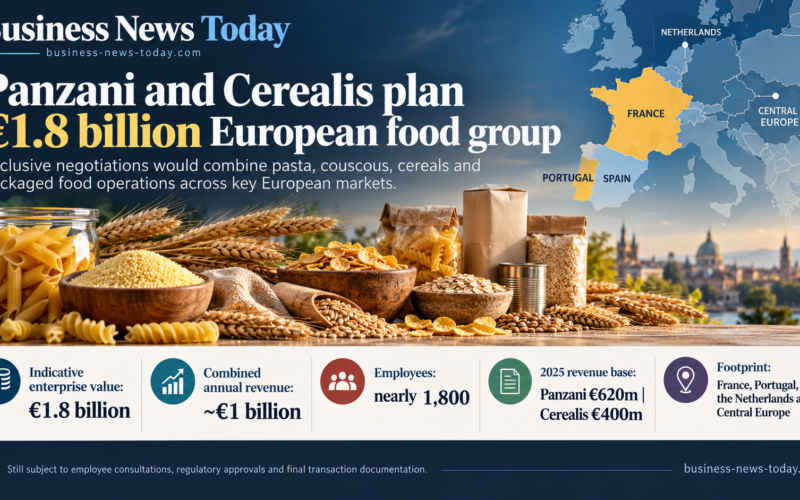
Panzani Group, the French manufacturer of pasta, couscous and sauces, and Cerealis, the Portuguese cereal and packaged food producer, have entered exclusive negotiations to establish a European food group with an indicative enterprise value of approximately €1.8 billion. Announced on October 16, 2026, the proposed combination would unite businesses reporting approximately €1 billion in combined annual revenue and nearly 1,800 employees, bringing together manufacturing operations and consumer brands across France, Portugal, Spain, the Netherlands and Central Europe. The transaction would be backed by Cerealis’ founding shareholders, Belgian investment company Sofina and private equity firm CVC Capital Partners, which would retain a minority interest in the combined business. Panzani would remain headquartered in Lyon, while Cerealis would continue operating from Porto under a decentralized management structure. The proposed integration offers opportunities to expand distribution, strengthen procurement and diversify product categories, but its financial value will depend on the final ownership structure, regulatory approvals and the ability to generate profitable growth without weakening the companies’ established brand positions.
How would the Panzani and Cerealis combination create a €1.8 billion European food business?
The proposed group would combine two food manufacturers with overlapping expertise in pasta but different geographic and product strengths. Panzani generated €620 million in revenue during 2025, according to the transaction announcement, and operates principally across France, the Netherlands and Central Europe. Cerealis reported €400 million in revenue for the same year, with operations extending across Portugal, Spain, the Czech Republic and Poland. Together, the stated figures produce €1.02 billion in annual revenue, broadly consistent with the rounded €1 billion figure used by the companies.
Based on those figures, Panzani would account for approximately 60.8% of the combined historical revenue base, with Cerealis contributing 39.2%. That calculation indicates the relative operating scale of the businesses but does not establish their future equity ownership or profitability. The merger structure involves a separate negotiation among existing shareholders and new capital contributions, meaning revenue proportions cannot be used to infer voting rights or financial consideration. The proposed €1.8 billion enterprise value also includes the economic valuation of the combined business rather than representing cash payable to one party.
The indicated valuation equates to approximately 1.76 times the €1.02 billion revenue total stated in the transaction announcement. Using the companies’ rounded €1 billion figure produces a multiple of approximately 1.8 times annual sales. These calculations offer a broad reference for the valuation but are not an earnings multiple or an indication of the combined group’s net equity value. The companies have not disclosed consolidated EBITDA, operating profit, net debt or the final consideration structure.
There is also a financial reporting distinction requiring care. Panzani’s corporate facts page separately presents a 2025 revenue figure of €549 million, below the €620 million attributed to Panzani in the combination announcement. The companies have not publicly reconciled those two figures or explained whether different reporting boundaries or accounting measures account for the variation. Consequently, the transaction’s announced revenue base is useful for understanding its proposed scale, but more detailed financial disclosures would be required before establishing an independently reconciled valuation multiple.
The combined business would remain privately controlled, with no direct public listing announced for the new company. Sofina is publicly traded in Brussels, but the transaction’s financial impact on its shareholders cannot be quantified from the available disclosure because the investment amount and final ownership percentage remain undisclosed. CVC Capital Partners would retain minority exposure following the combination, while Cerealis’ founding families would remain involved in ownership and governance. The precise capital structure will become clearer only if the negotiations proceed to a definitive agreement.
Why are Sofina and CVC Capital Partners supporting a combination of Panzani and Cerealis?
The shareholder structure brings together two forms of food industry investment. CVC Capital Partners acquired Panzani’s dry pasta, semolina, couscous and sauce operations from Spain’s Ebro Foods in December 2021 through a transaction initially valued at €550 million, subject to adjustments for debt and working capital. The acquisition established Panzani as a standalone business under private equity ownership. The latest proposal would move CVC from its current controlling position towards a minority role within a broader food group.
Sofina entered Cerealis’ shareholder base during the first quarter of 2026 as a long-term minority investor alongside the company’s founding families. Its involvement provided additional institutional capital before the proposed merger was announced. Sofina Chief Executive Officer Harold Boël has indicated that the investment company intends to provide additional capital to help finance the combination. The amount, instrument and conditions of that additional commitment have not been disclosed.
Cerealis is controlled by the Moreira da Silva and Silva Domingues families alongside Sofina, while CVC currently controls Panzani. Under the proposed arrangement, all four shareholder groups would receive representation on the new board of directors. This structure would retain significant family involvement while introducing the scale and investment resources of institutional shareholders. It could support a longer-term strategy emphasizing brand development, manufacturing investment and expansion into additional European markets.
The 2021 acquisition price and the latest €1.8 billion enterprise valuation describe different business perimeters and should not be compared as though they represented successive valuations of Panzani alone. The current proposal also incorporates Cerealis, which contributes substantial revenue, factories and established brands. Without details of the proposed transaction consideration and the respective enterprise values assigned to each business, the announcement does not establish CVC’s investment return. Its decision to retain a minority interest nevertheless indicates that the investor intends to maintain exposure to the combined group’s future performance.

How could Panzani and Cerealis expand pasta, couscous, breakfast cereals and packaged food sales?
The companies’ product portfolios create opportunities to expand beyond their existing markets without developing entirely new categories. Panzani operates established consumer brands in pasta, sauces and couscous, including Panzani, Ferrero, Zakia and Le Renard. Cerealis brings expertise in pasta, breakfast cereals, cereal bars, biscuits and flour, with brands including Milaneza, Nacional, Del Mondo and Amiga. The proposed group could use these complementary ranges to broaden its offering to supermarket chains, wholesalers and other food distributors.
The geographic fit is equally relevant. Panzani has established distribution in France and neighbouring European markets, while Cerealis has developed a stronger position in Portugal and Spain, alongside operations in the Czech Republic and Poland. Combining commercial networks could allow established products to enter markets where the other business already maintains customer relationships. Such expansion may involve less upfront investment than building a new distribution operation, although gaining shelf space and establishing consumer demand would still require pricing, promotions and marketing expenditure.
For Cerealis, the proposed combination would provide a broader platform for brands such as Milaneza and Nacional to expand beyond their existing customer bases. Panzani could potentially use Cerealis’ Iberian distribution channels to introduce selected French products, while Cerealis’ cereal and biscuit offerings could benefit from opportunities within Panzani’s commercial network. However, not every brand will necessarily transfer successfully across borders. Consumer preferences, product formats, packaging requirements and competition differ between European grocery markets.
The combination also creates an opportunity to increase the breadth of the group’s relationship with major retailers. A manufacturer offering several food categories may be able to coordinate promotional campaigns, distribution and commercial planning across a larger portfolio. However, supermarket customers retain significant bargaining power and can use competing branded products or private-label suppliers to negotiate prices. Broader product coverage is commercially valuable only if it produces profitable sales rather than additional volumes obtained through lower margins.
How would the combined manufacturing network support food production across France, Portugal and Central Europe?
The proposed group would bring together industrial operations serving different parts of Europe. Panzani operates three industrial facilities and three semolina mills in France, providing capabilities across durum wheat processing, pasta production and related food categories. Cerealis has four industrial sites in Portugal, one in Spain and one in the Czech Republic. These assets provide a physical production base for the expanded business, although the companies have not announced factory closures, site transfers or specific capacity changes.
Cerealis has already been expanding its international manufacturing presence. In April 2026, the company acquired the pasta manufacturing operations of Spanish food producer Cerealto in Castilla y León, extending its position in the Spanish market. That investment followed its acquisition of a controlling interest in Czech pasta company Europasta in March 2023. The proposed Panzani combination would therefore continue a pattern of geographic expansion rather than represent Cerealis’ first move beyond Portugal.
A larger manufacturing network may provide opportunities to allocate production according to demand, factory specialization and distribution costs. Certain products could potentially be manufactured closer to their destination markets, reducing transport requirements or improving delivery times. Shared technical knowledge could also support manufacturing improvements in areas such as product quality, energy consumption, packaging and equipment maintenance. However, the companies have not quantified potential cost savings or announced an integrated production plan.
Durum wheat procurement represents another potential area of cooperation, particularly because pasta production is exposed to agricultural commodity prices and crop availability. Panzani has developed an established French durum wheat supply chain, including relationships with domestic agricultural producers. Cerealis brings its own procurement and cereal processing capabilities across several European markets. Combining purchasing expertise may improve supply planning, but sourcing commitments, grain specifications and national agricultural conditions could limit the extent to which procurement can be centralized.
The industrial rationale is therefore broader than simply buying larger volumes of wheat. A resilient production network requires appropriate grain quality, reliable energy supplies, suitable manufacturing capacity and efficient distribution. The proposed group could potentially move certain products or raw materials between facilities when commercially justified. However, any operational changes would need to account for the costs of transportation, production conversion and maintaining established product standards.
Can Panzani and Cerealis compete more effectively with Barilla, Ebro Foods and supermarket private labels?
The proposed transaction would strengthen a European food producer operating in categories characterized by established brands and substantial retailer competition. In France, Panzani is a major national brand in pasta and sauces, competing with Italian producers including Barilla, De Cecco and Rummo, alongside supermarket private-label products. Spain’s Ebro Foods remains an important competitor in European pasta through businesses including Garofalo and Lustucru Premium Groupe. Cerealis’ additional presence in Portugal, Spain and Central Europe could give the combined group a wider geographic platform from which to compete.
Private-label manufacturing introduces a particularly relevant commercial opportunity. Cerealis operates both branded and retailer-label businesses, allowing it to serve customers seeking their own products rather than exclusively promoting manufacturer-owned brands. Its existing manufacturing capabilities could potentially support additional retailer contracts as the group expands. However, private-label volumes often involve different pricing and margin characteristics from branded products, making revenue growth an incomplete measure of value creation.
Panzani has continued investing in product differentiation, including its Fermes & Généreuses premium pasta range introduced in 2025. The range competes in a market where consumers have shown interest in higher-quality formats, bronze-die production techniques and differentiated ingredients. Such products may provide opportunities to improve product mix, although premium positioning can also require additional production and marketing expenditure. The proposed group could apply similar product development expertise across Cerealis’ pasta portfolio where consumer demand supports it.
Competition in breakfast cereals, biscuits and cereal bars would introduce additional category dynamics. Those markets involve different brand preferences, manufacturing technologies and retail purchasing patterns from conventional dry pasta. Cerealis’ established expertise offers an entry point for the broader group, but Panzani’s strength in pasta does not automatically establish an advantage in breakfast foods. Management will need to decide where cross-border expansion has a realistic route to profitability rather than attempting to extend every brand into every market.
The resulting portfolio could become more diversified, reducing reliance on the performance of any single product category or national market. However, the proposed group would remain significantly exposed to European grocery demand, retailer negotiations and agricultural commodity costs. Its competitive position would depend on category-level performance, branded product strength and the ability to convert manufacturing scale into attractive operating margins. The announcement does not provide sufficient financial information to establish that the combined group would already be more profitable than its major competitors.
Why will Panzani remain in Lyon and Cerealis in Porto under a decentralized management structure?
The shareholders intend to preserve the operating identities of both companies rather than establish a fully centralized management organization immediately. Panzani would remain a French company headquartered in Lyon, while Cerealis would retain its headquarters in Porto. Each business would continue operating with significant industrial and commercial autonomy, allowing management teams to maintain established relationships with employees, agricultural suppliers, customers and retail partners. This approach could limit disruption during the initial combination.
Panzani Chief Executive Officer Albert Mathieu would continue leading the French business while assuming additional responsibilities for the group’s Central European operations. Cerealis Chief Executive Officer Paula Meireles would retain leadership of the Portuguese company and oversee the Iberian and international private-label businesses. Pedro Moreira da Silva, currently Executive Vice-Chairman of Cerealis, would provide overall leadership for the combined group and coordinate initiatives involving both operations. The proposed arrangement establishes a regional division of responsibilities alongside central strategic oversight.
Decentralization can be useful when combining businesses with established national brands and distinct operating cultures. Manufacturing decisions, customer relationships and marketing strategies may require local expertise that could be weakened by excessive centralization. However, retaining separate operating structures can also limit cost reductions if procurement, administration and technology systems remain fragmented. The companies will need to determine which functions can create additional value through cooperation without undermining operational effectiveness.
The board structure would bring together the Moreira da Silva and Silva Domingues families, Sofina and CVC Capital Partners. Representation for each shareholder group could support continuity and provide access to different forms of expertise. Nevertheless, the arrangement will require clear decision-making procedures concerning investment budgets, acquisitions, dividends and future financing. The companies have not disclosed their proposed voting arrangements or the final shareholder percentages, preventing a detailed assessment of governance control.
What regulatory approvals and employee consultations must Panzani and Cerealis complete before combining?
The proposed transaction remains at the exclusive negotiation stage, meaning the companies have not announced completion of a binding final combination agreement. The parties must consult the relevant employee representative bodies and obtain required regulatory approvals before implementation. The announcement does not identify a closing date, transaction financing timetable or the authorities that will review the combination. As a result, the €1.8 billion enterprise valuation describes the proposed group rather than an already completed transaction.
Competition review could be relevant because both businesses manufacture pasta and operate in overlapping European markets. Regulators may examine individual national product categories and distribution channels rather than treating the European dry grocery industry as one uniform market. The existence of overlapping activities does not establish that the transaction will encounter competition objections, and no regulatory concerns have been announced. The specific review requirements will depend on the final transaction structure and applicable notification thresholds.
Employee consultation is also commercially relevant because the proposed group would employ approximately 1,800 people. Management has emphasized preserving the companies’ operating identities, but the announcement does not provide commitments concerning every manufacturing site, employment level or administrative function. Any operational restructuring would need to be assessed against applicable labour requirements and the group’s industrial strategy. The consultation process therefore represents a substantive transaction condition rather than a completed formality.
What financial evidence will determine whether the €1.8 billion Panzani and Cerealis combination creates value?
The proposed merger offers three identifiable routes to commercial growth: extending brands into additional markets, broadening relationships with retailers and improving the efficiency of manufacturing and procurement operations. The companies have established revenue bases and physical assets, reducing the need to develop a new business from the beginning. However, the announcement contains no quantified synergy target, consolidated profitability forecast or commitment to a specified level of investment. The prospective benefits therefore remain strategic opportunities rather than measurable financial outcomes.
The first important development will be a definitive transaction agreement clarifying ownership, financing and the treatment of existing liabilities. Subsequent disclosures could establish whether Sofina’s additional capital will fund shareholder consideration, industrial investment or other corporate purposes. Financial information covering EBITDA, cash generation and debt would also permit a more meaningful assessment of the enterprise valuation. Without those details, the proposed group’s revenue scale provides only a partial picture of its economic value.
If completed, the combination would bring together two established European food businesses with complementary brands, regional markets and industrial capabilities. Panzani would contribute scale in French pasta, sauces and couscous, while Cerealis would add Iberian and Central European operations alongside breakfast foods and private-label manufacturing. The proposed governance structure could preserve local commercial strengths while supporting coordinated investment, although the practical benefits will depend on how the companies allocate capital and expand distribution. A completed agreement followed by profitable cross-border revenue growth and sustained manufacturing investment would provide stronger evidence of value creation than the headline €1.8 billion valuation alone.
What are the key takeaways from the proposed Panzani and Cerealis European food group combination?
- Panzani and Cerealis announced exclusive negotiations on October 16, 2026, to establish a larger European food group.
- The proposed business would have an indicative enterprise value of approximately €1.8 billion and combined historical annual revenue of about €1 billion.
- The transaction announcement attributes €620 million in 2025 revenue to Panzani and €400 million to Cerealis.
- The indicated enterprise valuation represents approximately 1.8 times the companies’ combined announced annual sales, rather than an earnings multiple.
- Sofina and Cerealis’ founding families would participate in ownership alongside CVC Capital Partners, which would retain a minority stake.
- The businesses would preserve their respective French and Portuguese headquarters under a decentralized management structure.
- Product expansion opportunities span pasta, couscous, sauces, breakfast cereals, biscuits, cereal bars and retailer-owned brands.
- Their manufacturing operations across France, Portugal, Spain and the Czech Republic could support distribution expansion and industrial cooperation.
- Employee consultations, regulatory approvals and final transaction documentation remain outstanding.
- Financial benefits will depend on confirmed ownership terms, profitable expansion, operating performance and the ability to generate returns on future investment.
Discover more from Business-News-Today.com
Subscribe to get the latest posts sent to your email.