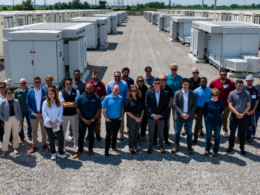
EDF power solutions North America has signed two 25-year power purchase agreements with NV Energy covering the Winston Energy Project in Lyon County, Nevada, giving the planned 400 MW solar and 400 MW/1,600 MWh battery development long-duration revenue visibility before electricity deliveries are expected to begin in October 2029. The four-hour battery will allow a substantial portion of Winston’s daytime solar generation to be shifted toward evening or other higher-demand periods, making the project considerably more useful to NV Energy than an equivalent solar facility without storage. The agreements also arrive as Nevada expands high-voltage transmission through Greenlink North and as KKR & Co. Inc. moves toward its proposed $4.2 billion acquisition of EDF power solutions’ North American operations. The commercial foundations are therefore becoming stronger, but Winston still faces the more difficult phase in which contracted revenue, storage capability and new transmission infrastructure must be converted into an operating project delivered on schedule.
The August 19 announcement is significant because it aligns three pieces of infrastructure that increasingly need to develop together in power markets with rapidly changing demand: generation, storage and transmission. Winston is expected to produce around 1.11 million MWh of electricity annually, while its 1.6 GWh battery can absorb solar output and return it to the grid when electricity is more valuable. Meanwhile, the broader Greenlink programme is intended to create additional transmission capacity across Nevada, including the 235-mile, 525 kV Greenlink North corridor between Ely and Yerington. The result is a project whose economics depend not simply on producing inexpensive solar electricity, but on ensuring that electricity can be stored, dispatched and transported when the grid actually requires it.
Why do Winston Energy’s 25-year NV Energy contracts materially change the project’s risk profile?
A 25-year power purchase agreement does not eliminate development risk, but it removes one of the largest uncertainties facing a utility-scale renewable project: who will buy the electricity once the asset is built. Winston now has NV Energy committed as the long-duration offtaker for the solar generation and associated storage capability, creating contractual visibility that could extend well into the 2050s if the agreements commence with commercial operation as planned.
That visibility is particularly important for a capital-intensive project combining two large assets. EDF power solutions must construct 400 MW of solar generation while also installing a battery capable of delivering 400 MW for four hours. Financing a project of that size becomes easier when lenders and investors can evaluate contracted revenue rather than assuming future merchant electricity prices will support debt repayment and equity returns.
The structure also helps align the project with NV Energy’s system requirements. A conventional solar PPA primarily commits a utility to purchasing generation when sunlight is available, which can create a mismatch if the system’s highest-value hours occur later in the day. Pairing the solar facility with storage changes the product being contracted because NV Energy gains access to electricity that can be moved across time rather than simply consumed when produced.
That feature becomes increasingly valuable as Nevada adds more solar capacity. The marginal value of another megawatt of midday solar can decline when multiple projects are producing simultaneously, while electricity can become much more valuable during the evening ramp after solar production falls. Winston’s four-hour storage duration is designed directly around that challenge.
How much dispatch flexibility does a 400 MW and 1.6 GWh battery actually give NV Energy?
The battery component is large enough to discharge at its full 400 MW rating for approximately four hours, meaning Winston could theoretically deliver the equivalent of its entire solar nameplate capacity well after peak solar production has passed. That does not transform the project into round-the-clock generation, but it gives NV Energy considerably more control over when a portion of the solar energy enters the system.
The scale becomes clearer when compared with Winston’s expected annual production. At approximately 1.11 million MWh of solar generation each year, a 400 MWac facility would operate at an implied annual capacity factor of roughly 31.7%, based on its alternating-current nameplate capacity. That is a strong utilisation profile for utility-scale solar and reflects Nevada’s favourable solar resource, although actual annual performance will depend on weather, degradation, curtailment and plant availability.
There is another useful way to examine the battery. If the 1.6 GWh system completed one full equivalent charge-and-discharge cycle every day, it could theoretically shift around 584 GWh of electricity annually before accounting for efficiency losses. That would equal approximately 53% of Winston’s expected annual solar production, illustrating how significant the storage system could be in shaping the timing of project output even though not every day will necessarily involve a complete cycle.
The battery therefore changes Winston from a project primarily exposed to daytime solar conditions into a more flexible power asset. The commercial value will depend on how NV Energy dispatches it, how battery degradation is managed across a 25-year contractual period and whether replacement or augmentation costs are adequately reflected in the project’s long-term economics.
Why does Greenlink North matter to Winston Energy almost as much as the solar panels and batteries?
Generation capacity has little strategic value if transmission constraints prevent electricity from reaching customers. Winston’s location in Lyon County places the project close to a major area of Nevada’s expanding high-voltage network, with EDF power solutions previously highlighting proximity to Greenlink infrastructure as an advantage of the site.
Greenlink North is planned as an approximately 235-mile, 525 kV transmission corridor connecting Ely with Yerington and is expected to enter service in December 2028. Winston’s latest commercial schedule calls for deliveries to NV Energy beginning in October 2029, creating a roughly ten-month interval between the currently planned Greenlink North in-service date and Winston’s commercial power deliveries.
That sequencing is strategically favourable if both programmes remain on schedule. New transmission capacity would be available before Winston needs to deliver contracted electricity, reducing the risk that generation is completed before the surrounding grid is sufficiently developed to accommodate it.
The broader lesson extends beyond one Nevada project. The United States has a large pipeline of renewable generation and battery projects, but many proposed assets face delays because transmission infrastructure takes longer to permit and build than solar arrays or storage facilities. When generation, storage and network expansion move on compatible schedules, developers have a clearer route from project approval to actual electricity delivery.
Winston therefore illustrates why power-sector investment is increasingly becoming a system-level exercise rather than a race to build generation alone. Adding solar without storage can intensify midday oversupply, while adding both solar and storage without transmission can leave valuable capacity stranded behind network constraints. Coordinating all three improves the probability that investment creates usable system capacity rather than merely another nameplate megawatt.
Does Winston Energy’s expected 1.11 million MWh output justify such a large storage component?
EDF power solutions expects Winston to generate approximately 1.11 million MWh annually, which indicates that the 400 MWac solar facility should operate at a comparatively high annual utilisation rate. The battery does not create additional primary solar energy, however, and its economic contribution must instead come from improving the timing and reliability of delivery.
That distinction matters because storage introduces substantial additional capital expenditure and operating complexity. Battery systems degrade with cycling and calendar age, thermal management consumes electricity, power is lost during charging and discharging, and long-duration PPAs may require augmentation or equipment replacement to maintain contractual performance over decades.
The benefit is that a stored megawatt-hour can be considerably more valuable than the same megawatt-hour delivered during a period of abundant solar production. If NV Energy can use Winston’s battery to reduce evening peak exposure, manage renewable variability or lower dependence on more expensive marginal generation, the storage system can create system value that is not visible from annual MWh production alone.
Winston is therefore best understood as a dispatchable solar platform rather than simply a solar farm accompanied by a large battery. The project’s commercial proposition rests on using storage to reshape the generation profile in a way that better matches Nevada’s load curve.
What does Winston Energy add to the $4.2 billion KKR acquisition of EDF power solutions North America?
Winston is advancing while ownership of EDF power solutions’ North American platform itself is expected to change. KKR & Co. Inc. (NYSE: KKR) agreed in June to acquire EDF power solutions’ operations and assets in the United States and Canada for approximately $4.2 billion, with potential additional payments of as much as $390 million. The transaction remains subject to customary closing conditions and regulatory approvals, so Winston continues to sit within EDF’s portfolio until the acquisition is completed.
The timing makes the 25-year NV Energy agreements strategically relevant to KKR even though Winston represents only one project inside a much larger renewable-energy platform. Development pipelines contain assets at widely different stages, and a project with a signed long-duration utility offtake contract is materially different from an early-stage site that still requires a customer, interconnection solution or major permits.
Winston therefore improves the quality of the development pipeline KKR has agreed to acquire by moving another large project further along the path toward construction and cash generation. The project combines 400 MW of generation, an equally large power-rated battery and a utility counterparty committed for 25 years, which is precisely the type of infrastructure profile that can support long-duration institutional capital once development risks are progressively reduced.
KKR described the proposed EDF power solutions acquisition as its largest individual renewables investment, making project-level execution increasingly important to the economics of the broader transaction. A $4.2 billion acquisition cannot be justified by one Nevada development, but repeatedly converting projects such as Winston from development inventory into contracted operating assets is how the North American platform can ultimately generate returns on KKR’s investment.
How significant is Winston Energy for EDF power solutions’ existing Nevada portfolio?
Winston is not EDF power solutions’ first Nevada project, which reduces some of the market-entry risk surrounding development. The company already has experience supplying NV Energy through projects including Arrow Canyon Solar+Storage, where solar generation was paired with battery capacity to provide greater dispatch flexibility.
The new project substantially increases the scale of that relationship. Winston’s 400 MW solar capacity is twice the solar capacity of the 200 MW Arrow Canyon project, while its 400 MW battery power rating is more than five times Arrow Canyon’s 75 MW storage rating. Winston’s 1.6 GWh storage capacity also places it firmly within the utility-scale battery category rather than treating storage as a secondary project component.
EDF power solutions is additionally developing other solar-plus-storage capacity in Nevada, including the Bonanza project. The emerging pattern suggests the company increasingly views paired assets as a core development model in a state where strong solar resources make daytime generation attractive but also increase the value of technologies capable of moving that electricity into later hours.
The commercial question is consequently shifting from whether large batteries belong beside utility-scale solar to how much storage duration and power capacity produce the best combination of revenue, grid value and lifecycle economics. Winston’s four-hour configuration represents the current mainstream answer for many U.S. utility projects because it is long enough to cover much of the evening peak without moving into the substantially more expensive territory of multi-day storage.
What could still delay Winston Energy despite having NV Energy contracted for 25 years?
Long-term PPAs materially improve revenue visibility, but they do not guarantee that Winston will reach commercial operation in October 2029. The project must still progress through detailed engineering, procurement, construction, grid integration and commissioning, while equipment supply and battery procurement will need to align with an industry in which technology and trade conditions can change considerably over a multi-year development period.
Transmission timing also remains important. Greenlink North is currently expected to enter service before Winston begins contracted deliveries, but large transmission projects carry their own permitting, construction and equipment risks. Any material delay affecting the network infrastructure relevant to Winston could complicate project commissioning even if EDF power solutions completes the generating asset itself on schedule.
Battery execution introduces a different set of uncertainties. A 1.6 GWh system requires a large quantity of cells, inverters, transformers, controls and fire-safety infrastructure, while the project’s 25-year commercial life is much longer than the expected useful life of many initial battery components. EDF power solutions will therefore need an augmentation and replacement strategy capable of preserving contracted performance as batteries degrade.
The 2029 timetable gives the developer time to manage those requirements, but it also means the project is exposed to several years of potential changes in equipment costs, trade policy, financing conditions and tax treatment before operations begin. The long-duration offtake reduces electricity-price uncertainty without removing construction and policy risk.
Why could Winston become a blueprint for Nevada’s next generation of renewable projects?
The strategic appeal of Winston is that its main components solve different parts of the same electricity-system problem. Solar creates large quantities of comparatively low-cost daytime electricity, the battery moves part of that electricity toward periods when it is more valuable, and Nevada’s expanding transmission system provides the network capacity required to connect geographically dispersed generation with growing demand centres.
The 25-year NV Energy contracts then add the financial layer required to support long-lived infrastructure. Rather than depending principally on merchant electricity prices, Winston can be financed around contracted offtake while retaining the operational value created by a large battery.
That combination is increasingly relevant as U.S. electricity demand begins growing more rapidly after years of relatively modest expansion. Data centres, manufacturing investments, electrification and population growth are increasing pressure on utilities to add generation without creating reliability problems during periods when renewable production falls.
Winston does not solve the firm-power challenge by itself because a four-hour battery cannot transform intermittent solar into continuous generation. What it can do is make a large solar resource substantially more responsive to daily demand patterns, reducing the gap between when renewable electricity is produced and when customers need it.
For EDF power solutions, the August agreement moves Winston materially closer to becoming a financeable operating asset. For NV Energy, it secures a large block of solar generation together with storage capable of reshaping that generation. For KKR, assuming its acquisition closes, the project provides another example of how the development pipeline it is buying could mature into long-duration contracted infrastructure.
The remaining test is execution rather than commercial intent. Winston now has the customer, storage architecture and a clearer transmission backdrop, but its value will ultimately be determined by whether those pieces arrive together in October 2029 at a cost that supports attractive long-term economics.
Key takeaways from Winston Energy’s 25-year NV Energy solar and battery contracts
- EDF power solutions North America has signed two 25-year PPAs with NV Energy covering the Winston Energy Project in Lyon County, Nevada.
- Winston will combine 400 MWac of solar generation with a 400 MW/1,600 MWh battery energy storage system.
- The battery provides four hours of discharge at its full 400 MW rating, allowing substantial solar output to be shifted away from midday periods.
- EDF power solutions expects Winston to generate approximately 1.11 million MWh annually, implying a simple solar capacity factor of roughly 31.7%.
- One theoretical full battery cycle per day could shift approximately 584 GWh annually before efficiency losses, equivalent to around 53% of expected solar generation.
- Electricity deliveries to NV Energy are currently expected to begin in October 2029.
- Greenlink North is planned as a 235-mile, 525 kV corridor between Ely and Yerington with a December 2028 in-service target, giving Nevada additional transmission capacity ahead of Winston’s planned delivery date.
- The project is expected to support more than 400 workers during peak construction and generate around $100 million in local tax revenue over its operating life.
- KKR has agreed to acquire EDF power solutions’ U.S. and Canadian operations for approximately $4.2 billion, with potential additional consideration of up to $390 million, making Winston part of a development platform expected to change ownership if the transaction closes.
- Winston’s main remaining tests are construction execution, battery lifecycle management, transmission coordination and delivery against the October 2029 commercial timetable.
Discover more from Business-News-Today.com
Subscribe to get the latest posts sent to your email.