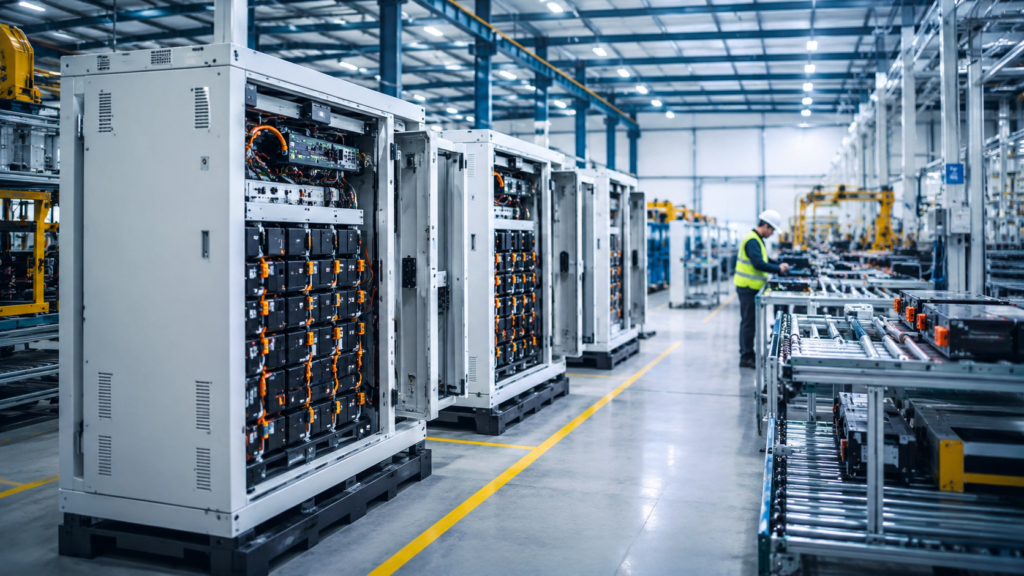
iNVERGY India Private Limited has inaugurated a 3 GWh battery energy storage system factory in Dasna, Uttar Pradesh, giving parent company GP Eco Solutions India Limited (NSE: GPECO) a larger manufacturing foothold in India’s clean energy supply chain. The facility has been set up with an investment of more than Rs 200 crore and is designed to produce battery energy storage systems, lithium iron phosphate battery packs, solar inverters, and integrated energy storage solutions. The move matters because India’s renewable power buildout is moving from generation capacity to grid stability, storage economics, and domestic manufacturing depth. GP Eco Solutions India Limited shares were trading around Rs 445 on June 4, 2026, still below the reported 52-week high of Rs 616.50 but well above the 52-week low of Rs 264.05, suggesting investors are watching the growth story but not pricing it without risk.
Why does iNVERGY India’s 3 GWh Dasna BESS factory matter for India’s energy storage supply chain?
The Dasna factory gives iNVERGY India Private Limited a declared annual manufacturing capacity of 3 GWh across a 217,000 square foot automated production footprint. For India’s clean energy sector, that is more than another factory opening. It points to the next phase of the renewables market, where solar modules and inverters are no longer enough and storage becomes the hard infrastructure that determines whether intermittent power can behave like dependable power.
India’s renewable energy growth has created an unavoidable system problem. More solar and wind capacity improves the country’s generation mix, but without storage, grid operators still face volatility during peak demand, cloudy generation periods, and evening load ramps. Battery energy storage systems address that gap by allowing surplus renewable energy to be stored and released when power demand and grid conditions require it. That makes BESS manufacturing a strategic layer within India’s power transition rather than a nice accessory hanging off the solar story like a shiny but optional side mirror.
For GP Eco Solutions India Limited, the importance lies in vertical positioning. The company has been associated with solar energy solutions and distribution-led growth, but the iNVERGY India factory moves the group closer to manufacturing-led value creation. That can potentially improve control over product availability, margins, technology integration, and customer stickiness across residential, commercial, industrial, and utility-scale segments. The challenge is that battery storage manufacturing is a tougher business than headline capacity suggests, because safety standards, cell sourcing, working capital, warranty management, and after-sales reliability can determine whether factory scale turns into durable earnings.
How could the Dasna facility change GP Eco Solutions India’s clean energy growth strategy?
The new facility allows GP Eco Solutions India Limited to participate more directly in the storage-linked phase of India’s renewable energy market. iNVERGY India Private Limited’s product scope includes battery energy storage systems, lithium iron phosphate battery packs, solar inverters, and integrated energy storage solutions, which means the company is not limiting itself to one narrow product line. That matters because customers increasingly want bundled systems that combine generation, conversion, storage, monitoring, and performance management rather than fragmented procurement from multiple vendors.
For commercial and industrial customers, the value proposition can be especially relevant. Factories, warehouses, data centres, hospitals, campuses, and retail estates are increasingly exposed to power cost volatility and reliability concerns. Battery storage can support peak shaving, backup power, renewable self-consumption, and load management. If iNVERGY India Private Limited can combine storage hardware with inverters, battery management systems, and remote monitoring, GP Eco Solutions India Limited may have a stronger route into higher-value energy infrastructure contracts.
The strategic question is execution. A 3 GWh facility creates capacity, but not guaranteed demand conversion. GP Eco Solutions India Limited will need to turn manufacturing capability into order visibility, customer financing options, installation partnerships, service networks, and warranty discipline. Battery systems are capital-intensive assets with long operating lives, so buyers will look beyond price and ask whether the manufacturer can support performance over years. That is where smaller listed clean energy players often face the real test: growth is exciting, but maintenance obligations do not care about investor presentations.
Why is lithium iron phosphate battery manufacturing becoming strategically important for Indian renewables?
The facility’s focus on lithium iron phosphate battery packs is important because LFP chemistry has become one of the preferred options for stationary energy storage. LFP batteries are widely used in storage applications because they are associated with relatively strong thermal stability, longer cycle life, and suitability for high-volume deployment. For grid-scale, commercial, and industrial customers, those attributes can matter as much as headline energy density, because stationary storage systems need predictable performance, safety confidence, and lower lifecycle risk.
India’s storage manufacturing push also has a policy logic. The country has spent years building solar generation capacity while depending heavily on imported upstream components across parts of the clean energy value chain. A stronger domestic BESS manufacturing base can reduce exposure to supply chain disruptions, currency movements, freight bottlenecks, and policy uncertainty in global battery markets. It does not eliminate import dependence overnight, especially where cells and critical minerals are concerned, but it does create domestic assembly, systems integration, testing, and deployment capability.
The competitive backdrop is becoming sharper. Battery storage is no longer only a utility-scale topic. It is moving into rooftop solar, electric vehicle charging infrastructure, commercial campuses, telecom sites, industrial backup systems, and renewable hybrid projects. That creates room for specialised players, but it also invites competition from large electrical equipment manufacturers, solar developers, engineering procurement and construction firms, and global storage technology providers. GP Eco Solutions India Limited therefore needs to treat iNVERGY India’s factory as a platform, not a one-time announcement.
What does GP Eco Solutions India’s stock performance suggest about investor sentiment after the BESS expansion?
GP Eco Solutions India Limited shares traded around Rs 445 on June 4, 2026, compared with a previous close near Rs 440.30, while the 52-week range stood at Rs 264.05 to Rs 616.50. That places the stock meaningfully above its yearly low but still below its peak, a useful signal that the market recognises the clean energy growth angle but is not treating the BESS factory as a risk-free rerating trigger. For a small-cap or SME clean energy-linked company, that is probably healthier than instant euphoria.
The latest share price context suggests investors may be balancing two competing narratives. On one side, GP Eco Solutions India Limited is tied to a fast-growing sector, has reported strong revenue growth, and now has a manufacturing asset aligned with India’s storage requirements. On the other side, clean energy equipment stocks can be volatile because capacity expansion often increases working capital needs before earnings visibility fully catches up. Investors are not wrong to ask whether the Rs 200 crore-plus investment can translate into recurring orders, margin expansion, and cash conversion.
The valuation story will likely depend on evidence rather than enthusiasm. Market watchers will look for utilisation levels at the Dasna factory, customer mix, order book quality, receivable cycles, debt levels, and management commentary on capacity ramp-up. If GP Eco Solutions India Limited can show that the factory supports profitable growth rather than just bigger scale, sentiment could strengthen. If utilisation is slow or margins are pressured by competition, the market may treat the BESS expansion as another case of clean energy ambition meeting the wonderful sport known as execution risk.
How could the iNVERGY BESS factory affect competition in India’s renewable energy equipment market?
iNVERGY India Private Limited’s entry into larger-scale BESS manufacturing adds another domestic player to a market that is likely to become crowded, fragmented, and strategically important. The facility’s product mix puts the company across several demand pools, including residential backup, commercial and industrial storage, utility-scale renewable projects, and integrated solar-plus-storage systems. That breadth gives the company flexibility, but it also exposes it to different procurement cycles and price pressures across each segment.
For established renewable energy equipment players, the Dasna facility is another sign that storage is becoming an adjacency they cannot ignore. Solar inverter suppliers, engineering procurement and construction firms, battery assemblers, and power infrastructure companies will increasingly compete for the same clean energy customer wallet. The winners may not simply be those with the largest announced capacity, but those that can offer reliable systems, credible warranties, software-enabled monitoring, and field support at scale.
There is also a regional manufacturing angle. Uttar Pradesh has been trying to attract industrial and clean energy investment, and a facility of this scale helps position the state as more than a consumption market. If iNVERGY India Private Limited can create supplier linkages, skilled employment, and downstream installation networks, the Dasna plant could support a wider manufacturing ecosystem. However, that depends on how much of the value chain is localised over time, because imported cell dependence remains one of the big unanswered questions across India’s storage industry.
What execution risks could determine whether GP Eco Solutions India converts BESS capacity into durable earnings?
The most immediate risk is utilisation. A 3 GWh annual production facility only becomes financially meaningful if demand scales fast enough to absorb output at acceptable margins. Battery storage adoption in India is rising, but procurement timelines can be uneven, especially in utility-scale projects where tenders, tariffs, financing, and grid integration can stretch execution cycles. Commercial and industrial demand may offer faster routes, but that market is more fragmented and sensitive to financing costs.
The second risk is technology durability. Battery energy storage systems carry safety, performance, and warranty expectations that can outlast the initial sale by several years. Faulty systems, weak thermal management, poor remote monitoring, or unreliable after-sales support can quickly damage customer trust. iNVERGY India Private Limited’s emphasis on artificial intelligence-driven battery management systems, Internet of Things-enabled monitoring, quality control, and automation addresses that concern on paper. The market will still judge the company by installed performance, not factory brochures.
The third risk is capital discipline. GP Eco Solutions India Limited has reported strong growth, but rapid expansion can strain balance sheets if inventories, receivables, and customer credit terms widen. In clean energy manufacturing, growth can look beautiful on the revenue line while quietly getting demanding in working capital. That is why the next few quarters will be important. Investors will want to see whether the Dasna factory improves operating leverage or simply raises the company’s fixed cost base.
What are the key takeaways from iNVERGY India’s BESS factory for GP Eco Solutions India and the broader storage market?
- iNVERGY India Private Limited’s 3 GWh Dasna factory gives GP Eco Solutions India Limited a stronger manufacturing position in India’s emerging battery energy storage system market.
- The Rs 200 crore-plus investment shifts the group’s clean energy story from distribution and solar equipment toward deeper participation in storage-led infrastructure.
- Battery energy storage systems are becoming strategically important as India adds more renewable energy capacity and needs stronger tools for grid balancing, peak demand management, and renewable integration.
- The facility’s focus on lithium iron phosphate battery packs, solar inverters, and integrated storage solutions gives iNVERGY India Private Limited access to residential, commercial, industrial, and utility-scale demand pools.
- GP Eco Solutions India Limited’s stock performance suggests investors are interested in the growth story, but still cautious about utilisation, margins, and execution risk.
- The Dasna facility may improve GP Eco Solutions India Limited’s value chain control, but the company will still need to manage sourcing, quality assurance, warranties, and after-sales service carefully.
- Competition in Indian BESS manufacturing is likely to intensify as electrical equipment companies, solar developers, EPC firms, and specialist storage players target the same market opportunity.
- Uttar Pradesh could benefit from the facility if iNVERGY India Private Limited builds supplier linkages, skilled jobs, and local clean energy manufacturing capabilities around the plant.
- The real investor test will be whether the 3 GWh factory converts into visible orders, stronger margins, and disciplined cash conversion rather than remaining a capacity headline.
- For India’s clean energy sector, the announcement reinforces a larger shift from renewable generation announcements to storage, grid reliability, and domestic manufacturing depth.
Discover more from Business-News-Today.com
Subscribe to get the latest posts sent to your email.