




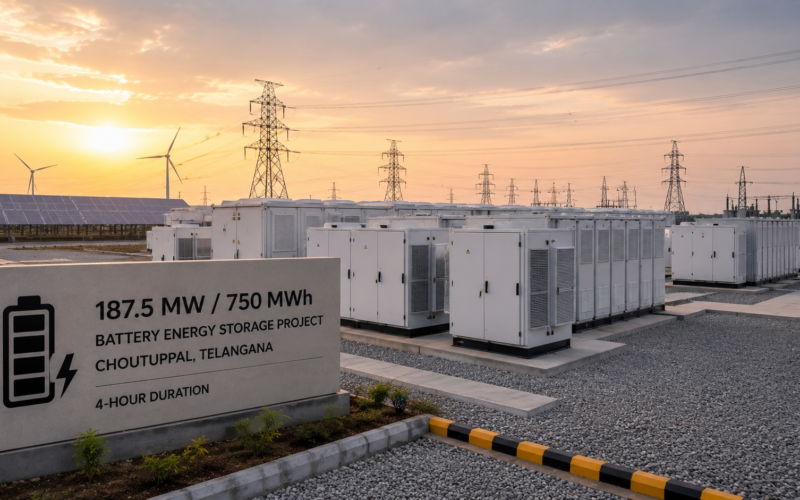
Coal India Limited (NSE: COALINDIA) has moved its planned 187.5 MW/750 MWh battery energy storage system at Choutuppal in Telangana into EPC procurement, marking the next execution step for a project carrying an estimated cost of ₹1,057.09 crore. Coal India had received the project Letter of Award from Telangana Power Generation Corporation Limited in March at a tariff of ₹3.14 lakh per MW per month, with the underlying award specifying 750 MWh of storage capable of delivering 187.5 MW for four hours.
The company subsequently invited bids for complete engineering, procurement and construction of the system, including design, equipment supply, civil works, installation, commissioning, grid evacuation infrastructure and 15 years of comprehensive operations and maintenance. Bid submission closed on August 19 and techno-commercial opening was scheduled for August 20, meaning the procurement has progressed beyond the bid-submission stage but an EPC winner should not be assumed until Coal India formally declares one.
What exactly will Coal India build at Choutuppal?
The project is designed as a 187.5 MW battery installation with 750 MWh of usable energy-storage capacity. Dividing energy capacity by power capacity gives a four-hour duration, consistent with Coal India’s original Letter of Award, meaning the plant is designed to discharge at its rated 187.5 MW output for approximately four hours under the contracted configuration.
The EPC package goes well beyond delivering battery containers. It covers design and engineering, manufacturing and supply, transportation, installation, associated civil works, performance testing and commissioning, together with 220 kV switchyard evacuation facilities at the Choutuppal site. The successful contractor will also be responsible for comprehensive operations and maintenance over 15 years, tying long-term system performance to the procurement rather than separating construction from post-commissioning service.
Coal India’s tender specifies an 11-month EPC construction period from the Letter of Award or handover of land, whichever occurs later. The customer-facing project award from Telangana Power Generation Corporation envisaged execution within 18 months from signing of the Battery Energy Storage Purchase Agreement, leaving Coal India with a schedule that has to accommodate contractor mobilisation, commissioning and its own contractual obligations.
How does the ₹1,057 crore project economics work?
Coal India disclosed an estimated project cost of ₹1,057.09 crore when it announced the Telangana Power Generation Corporation award. The tariff is ₹3.14 lakh per MW per month for 187.5 MW of contracted capacity, creating a recurring capacity-payment structure rather than revenue being determined simply by multiplying discharged electricity by a conventional per-kWh tariff.
At the disclosed tariff, 187.5 MW would correspond to approximately ₹5.89 crore of monthly capacity revenue before considering contractual adjustments, availability requirements or other commercial provisions. Annualised mechanically, that is about ₹70.65 crore. This simplified calculation does not represent guaranteed accounting revenue because actual receipts depend on the battery storage agreement and performance obligations, but it gives a sense of the relationship between the disclosed tariff and project scale.
The ₹1,057.09 crore estimated cost works out to roughly ₹1.41 crore per MWh of installed storage capacity, or about ₹5.64 crore per MW of discharge power. Those metrics are useful for comparing storage projects with different durations because quoting only the MW rating would understate the size of a four-hour system.

Why is a coal producer investing in grid-scale battery storage?
Coal India remains the dominant domestic coal producer, but its strategy increasingly includes renewable power and adjacent energy businesses. Battery storage gives the company exposure to an infrastructure category expected to grow as more solar and wind generation enters India’s power system, creating greater need to shift electricity from periods of high renewable output into evening or peak-demand hours.
The Choutuppal project is particularly notable because it is not simply a demonstration battery attached to a Coal India facility. Telangana Power Generation Corporation awarded the project through a commercial arrangement, creating an external customer and a defined storage service. That gives Coal India an opportunity to develop execution and operating experience in a grid-scale energy-storage asset with a 15-year service requirement.
Coal India has also been expanding its renewable portfolio. Government disclosures have pointed to a longer-term objective of around 9.5 GW of renewable-energy capacity by FY2029-30, while the company continues investing in solar alongside its traditional coal operations. Storage can become complementary to that strategy because renewable generation and dispatchable battery capacity solve different parts of the electricity-supply problem.
What should investors watch as the Telangana BESS moves toward construction?
The first milestone is the EPC award. Coal India’s tender was published on July 31, with bids closing August 19 and opening scheduled for August 20, but the tender process itself does not establish that a contractor has already been selected. The eventual winning price will be important because EPC economics influence how much of the disclosed ₹1,057.09 crore project estimate is consumed by construction and long-term maintenance obligations.
Battery technology and degradation are equally important. A 15-year comprehensive O&M period spans a substantial portion of the operating life of lithium-based storage equipment, making warranties, augmentation strategy, usable capacity and performance guarantees central to project economics. The tender’s long service horizon effectively transfers a meaningful amount of lifecycle responsibility to the contractor.
Grid integration will be another execution test. The project is planned around the 400/220 kV Choutuppal substation and includes new 220 kV evacuation infrastructure, so commissioning depends not only on battery installation but also on completing the electrical interface required to charge and discharge the system into Telangana’s network.
How is Coal India stock performing as it broadens beyond coal?
Coal India shares closed at ₹405.20 on August 21, up 0.67% for the session but down roughly 0.5% over the preceding week and around 6% over one month. The stock remained below its 52-week high of ₹491.25 and above its 52-week low of ₹368.65, with market capitalisation around ₹2.5 lakh crore.
At Coal India’s scale, the ₹1,057 crore battery project is not large enough to redefine group earnings by itself. Its importance lies instead in establishing whether the company can convert its balance sheet, project-management capabilities and power-sector relationships into commercially viable businesses outside coal.
Choutuppal therefore carries strategic weight disproportionate to its immediate contribution to revenue. If Coal India executes the project within cost and performance requirements, it gains a reference asset in one of the fastest-growing segments of the power infrastructure market. If the model proves repeatable, the company’s transition strategy could increasingly include storage alongside solar and other generation investments rather than treating renewable energy as a standalone diversification exercise.
Discover more from Business-News-Today.com
Subscribe to get the latest posts sent to your email.


