

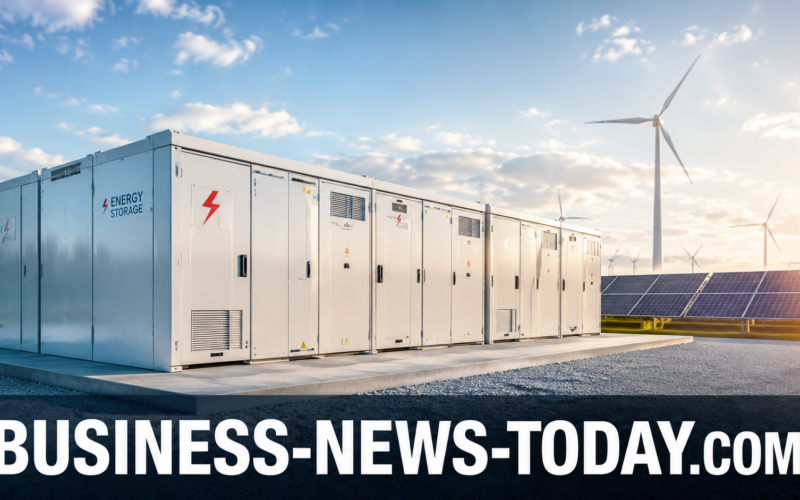
GIGA Storage has reached financial close and launched construction preparation for the 700MW/2,800MWh Green Turtle battery energy storage project in Dilsen-Stokkem, Belgium, backed by €450 million of debt from ten international banks and equity from InfraVia Capital Partners. Tesla, Inc. (NASDAQ:TSLA) has been selected as engineering, procurement and construction partner and technology supplier for the project, using its Megablock energy storage system, while Belgian transmission operator Elia will connect the project directly to the 380kV high-voltage grid through a dedicated substation. The confirmed July 9 financial close turns Green Turtle from a large European storage ambition into a financed project with a September construction start and a 2028 operational target. Tesla shares closed at $407.76 on July 10, within a 52-week range of $297.82 to $498.83, but the sharper equity signal belongs to Europe’s battery finance market rather than to Tesla’s already vast valuation.
Why does GIGA Storage’s Green Turtle financial close matter for Belgium’s grid-scale battery market?
GIGA Storage’s Green Turtle financial close matters because it moves one of Europe’s largest planned battery energy storage systems out of development risk and into funded execution. Battery projects are easy to announce when market volatility, renewable curtailment and grid congestion make the strategic case obvious. They are much harder to finance when lenders have to underwrite merchant revenue exposure, technology performance, grid access, construction risk and long-term operating assumptions. Green Turtle has now crossed that financing threshold.
The project’s scale makes the milestone especially relevant. At 700MW and 2,800MWh, Green Turtle is a four-hour battery designed to operate at grid-infrastructure scale rather than as a small ancillary-service asset. That gives it the potential to support multiple system functions, including storing excess wind and solar output, discharging during periods of higher demand, supporting grid balancing and reducing congestion around a strategic industrial location near the Netherlands, Germany and Belgium.
For Belgium, the timing is important. The country’s power system is being pulled by nuclear-phase policy debates, offshore wind expansion, industrial electrification, cross-border flows and rising flexibility needs. Green Turtle does not solve those challenges alone, but it gives the system a large flexible asset directly connected to high-voltage infrastructure. That distinction matters because the next stage of the European energy transition will be judged less by renewable capacity announcements and more by whether electricity systems can absorb, shift and deliver that power without becoming an expensive traffic jam.
How does the €450 million bank debt package change the investment case for European BESS projects?
The €450 million debt package is important because it shows that bank lenders are becoming more comfortable financing very large battery storage projects when key project conditions are de-risked. The ten-bank consortium includes ABN AMRO, ING, Rabobank, Triodos Bank, Triodos Investment Management, asr, Belfius, HCOB, Santander and SMBC. That breadth matters because storage finance is moving from specialist clean-energy capital into mainstream infrastructure lending.
Before financial close, GIGA Storage had already completed key project conditions, including permits, land contracts, supplier contracts and grid connection arrangements. That sequence is exactly what lenders want to see. Battery storage revenue may still carry market exposure, but construction and connection risk can be narrowed when the project has site control, technology selection, grid certainty and bankable counterparties. In short, the financing was not handed to a dream. It was handed to a project that had done its paperwork, which in energy infrastructure is almost a personality trait.
The financing also creates a useful benchmark for other European battery developers. As projects move from 50MW or 100MW assets into multi-gigawatt-hour systems, lenders will demand stronger evidence on revenue stacking, degradation management, availability, safety, warranties and market-access strategy. Green Turtle’s close suggests that large batteries can attract conventional project finance, but only when the risk allocation is mature enough for banks that prefer spreadsheets to slogans.
Why is Tesla’s Megablock role strategically important but not a full TSLA valuation event?
Tesla, Inc.’s role matters because Green Turtle will use the Megablock energy storage system and because Tesla, Inc. will handle engineering, construction and long-term maintenance responsibilities. That is strategically relevant for the project because utility-scale batteries are no longer just about cell procurement. They require integrated hardware, power conversion, thermal management, controls, commissioning discipline, software, safety systems and long-term service support.
For Tesla, Inc., the project strengthens its position in the European grid-scale battery market at a time when its energy storage business is increasingly important to the company’s broader narrative. Tesla, Inc.’s latest official update confirmed that production progress at the new Houston Megafactory remains tied to Megapack 3 and Megablock, making Green Turtle relevant to a current product roadmap rather than an outdated legacy system. The Belgian project also gives Tesla, Inc. another large European reference customer in a market where batteries are becoming central to grid flexibility.
The stock-market implication should be kept in perspective. Tesla, Inc. closed at $407.76 on July 10, and its share price remains shaped far more by electric vehicles, artificial intelligence, robotaxi expectations, margins and investor sentiment than by one Belgian storage project. Green Turtle is a meaningful validation for Tesla, Inc.’s energy storage platform, but it is not large enough to reprice a company with a market capitalisation above $1 trillion. The better read is strategic: Tesla, Inc.’s storage business is gaining infrastructure relevance while its equity story remains dominated by far bigger debates.
How does Elia’s 380kV grid connection make Green Turtle more than a standalone battery?
Elia’s role is central because Green Turtle will connect directly to Belgium’s 380kV high-voltage grid through a new substation being built specifically for the project. That turns Green Turtle into a grid-integrated asset rather than a battery sitting near the system hoping for useful market access. Direct high-voltage connection improves the project’s ability to participate meaningfully in system balancing, congestion relief and large-scale flexibility.
The connection also highlights a broader European bottleneck. Storage capacity is valuable only when it can interact with the grid at the right location and voltage level. Many battery developers across Europe face long connection queues, uncertain reinforcement timelines and local congestion limits. Green Turtle’s financial close is therefore notable not only because the battery is large, but because its connection architecture is already part of the funded project design.
For Belgium’s power system, the location at Dilsen-Stokkem is also strategically useful. The project sits near cross-border power corridors and industrial demand zones, giving it relevance beyond local balancing alone. If Green Turtle operates effectively, it can help demonstrate how large batteries connected at transmission level can become infrastructure assets that support renewable integration, flexibility and security of supply. If performance disappoints, it will also remind policymakers that battery scale alone is not enough; the grid interface has to work just as hard as the battery cells.
What does InfraVia Capital Partners’ equity role reveal about battery storage as an infrastructure asset class?
InfraVia Capital Partners’ equity role is important because it shows how financial sponsors are becoming more active in battery storage as the sector matures. Infrastructure investors prefer assets with long operating lives, visible demand drivers and manageable technical risk. Battery storage historically looked too merchant, too fast-changing and too dependent on evolving market rules for some conservative capital pools. That perception is changing as larger projects secure grid connections, long-term service arrangements and increasingly bankable operating models.
InfraVia Capital Partners invested in GIGA Storage in 2024, and Green Turtle now gives that investment platform a major Belgian project alongside earlier Dutch activity. The logic is portfolio scale. A single battery can be exposed to market volatility, but a multi-project platform across the Netherlands, Belgium and Germany can diversify grid locations, revenue pools, counterparties and regulatory settings. That is one reason platform investors like storage developers that can repeat the model rather than chase one heroic asset at a time.
The risk is that storage remains a more active infrastructure class than traditional regulated utilities. Revenues depend on market participation, optimisation, volatility, ancillary services and grid needs. Degradation, augmentation and software performance also matter. That makes the asset class attractive but demanding. Green Turtle’s financing suggests institutional capital believes the risk can be managed, but the operating period will decide whether that confidence was disciplined or merely fashionable.
Why does Green Turtle matter for renewable integration and fossil-fuel dependence in Belgium?
Green Turtle matters for renewable integration because Belgium and its neighbours are adding more variable generation while also facing tighter flexibility requirements. Wind and solar output do not always match demand, and the value of renewable energy falls when grids cannot absorb surplus generation. A four-hour battery can charge during surplus periods and discharge when demand is stronger, helping improve renewable utilisation and reduce curtailment risk.
The project also has a security-of-supply angle. Large batteries cannot replace every function of thermal power plants, but they can reduce reliance on gas-fired flexibility during certain periods and provide fast-response services that conventional units cannot match. That is especially relevant in a European context where gas dependence has become both an energy-security issue and a price-risk issue. A battery does not import fuel, which is a rather useful feature when geopolitics is in one of its dramatic moods.
The limitation is that Green Turtle is not seasonal storage. A 2.8GWh battery can shift electricity across hours, not months. Belgium will still need firm capacity, interconnection, demand flexibility, market reform and careful grid planning. The project is important because it addresses short-duration flexibility at scale, not because it magically eliminates all system risk. The sensible energy-transition story is not batteries versus everything else. It is batteries as one of the assets that make everything else work better.
How does GIGA Storage’s wider pipeline change the strategic meaning of Green Turtle?
Green Turtle is not an isolated project inside GIGA Storage’s development strategy. The company has already reached financial close on GIGA Leopard, a 300MW/1,200MWh battery storage project in Delfzijl in the Netherlands, and is working toward financial completion of Project Albatross, a 350MW/1,400MWh energy storage project in Germany. GIGA Storage is also developing additional projects across the Netherlands, Belgium and Germany.
That portfolio context matters because the battery storage market is becoming increasingly scale-driven. Developers with multiple projects can build stronger bank relationships, negotiate more effectively with suppliers, develop operating expertise and improve route-to-market strategies across different markets. They can also learn from one project and apply those lessons to the next, which is especially valuable in a sector where technology, regulation and revenue models are still evolving quickly.
The strategic risk is execution stretch. Managing one giant battery project is difficult enough. Managing several across multiple countries introduces complexity around grid codes, market rules, tax treatment, permitting, construction standards, optimisation strategy and supply-chain coordination. GIGA Storage’s ambition to have more than 2GW of storage capacity operational by 2030 is credible only if the company can convert financial closes into reliable operations. Green Turtle is the largest credibility test so far.
What execution risks could still affect Green Turtle before its expected 2028 operation?
The first execution risk is construction delivery. Green Turtle is scheduled to start construction in September and become operational in 2028. Between those two points sit civil works, substation delivery, battery installation, grid integration, commissioning, safety testing, software integration and maintenance readiness. A project of this scale has multiple critical paths, and delay in one package can ripple through the wider schedule.
The second risk is technology performance. Tesla, Inc.’s Megablock system may help reduce installation complexity and support modular deployment, but the project still has to prove availability, thermal performance, safety reliability and degradation assumptions under real grid conditions. Long-term maintenance responsibility helps align incentives, but it does not eliminate operational risk. Batteries are wonderfully fast until one component decides to become the slowest part of the business plan.
The third risk is market design. Green Turtle will make capacity available to Elia and market parties that help balance the grid and reduce congestion. The financial outcome will depend on how Belgian and wider European power markets reward flexibility by 2028 and beyond. If volatility, ancillary service demand and congestion value remain strong, the project could perform well. If market reforms dilute revenues or too much storage enters the same revenue pools too quickly, returns could face pressure.
How could Green Turtle influence competitors across Europe’s battery storage market?
Green Turtle could influence competitors by raising the bar for project scale, financing maturity and grid integration. Developers across Europe are increasingly announcing gigawatt-hour-scale pipelines, but the market is beginning to separate projects that are truly financeable from those still waiting for permits, connection certainty or revenue structure. Green Turtle’s close gives rivals a benchmark: large batteries need bankable details, not just big numbers.
For technology suppliers, the project reinforces the importance of integrated systems. Tesla, Inc. is not merely supplying battery equipment; it is tied to EPC and long-term maintenance responsibilities. That integrated role may pressure competitors such as Fluence Energy, Sungrow, Wärtsilä, BYD and other storage system providers to offer stronger combinations of hardware, software, service and delivery assurance. In utility-scale storage, the supplier’s job increasingly continues long after the containers arrive.
For utilities and transmission operators, the project may also become a reference case for how large batteries can sit directly within grid planning. If Green Turtle delivers measurable congestion relief and balancing value, more transmission-connected storage projects could move forward across Europe. If the project faces delays or market underperformance, it could make lenders and regulators more cautious. Either way, Green Turtle will be watched because large batteries are no longer a side dish in the power system. They are becoming part of the main course.
What are the key takeaways from GIGA Storage’s Green Turtle battery project financing?
- GIGA Storage has reached confirmed financial close for the 700MW/2,800MWh Green Turtle battery energy storage project in Belgium.
- The project is backed by €450 million of debt from a ten-bank consortium, with equity funding from InfraVia Capital Partners.
- Tesla, Inc. has been selected as EPC partner, technology supplier and long-term maintenance provider using its Megablock energy storage system.
- Green Turtle will connect directly to Elia’s 380kV high-voltage grid through a dedicated substation, making grid integration central to the investment case.
- Construction is scheduled to start in September, with the project expected to become operational in 2028.
- The project strengthens Belgium’s ability to store excess wind and solar power, balance demand and reduce grid congestion.
- For Tesla, Inc., Green Turtle adds a major European reference project for its energy storage platform, although it is not a standalone valuation catalyst for TSLA.
- The financing gives European BESS developers a new benchmark for bankability, especially around permits, land, grid connection and supplier contracts.
- Main risks include construction delivery, grid integration, battery performance, market revenue uncertainty and long-term degradation management.
- The main industry read is that Europe’s storage market is shifting from pilot-scale excitement to infrastructure-scale execution discipline.
Discover more from Business-News-Today.com
Subscribe to get the latest posts sent to your email.