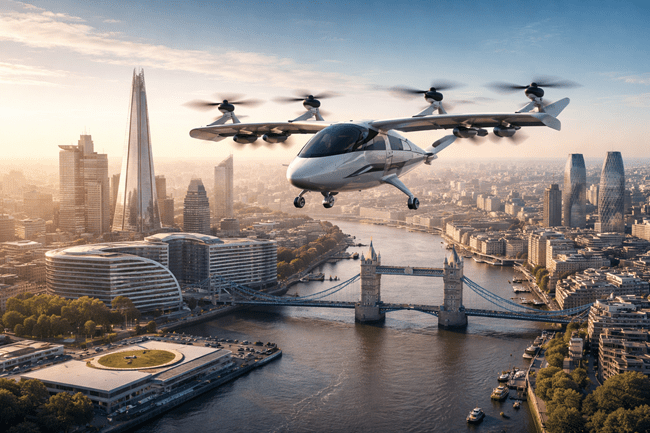




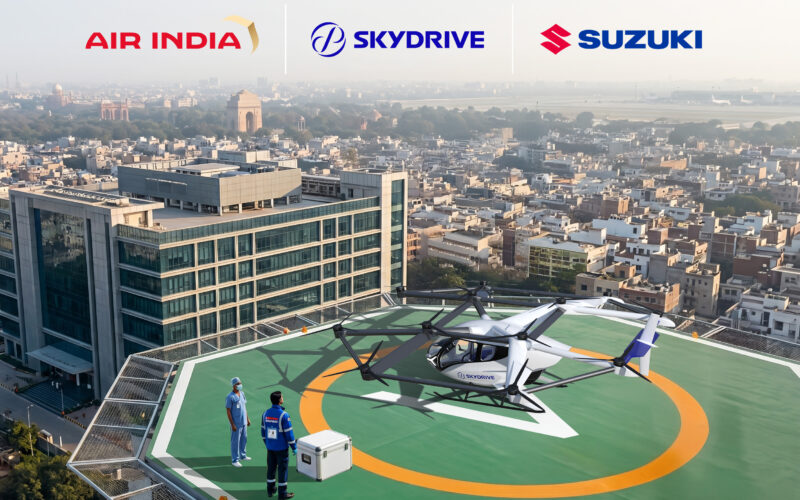
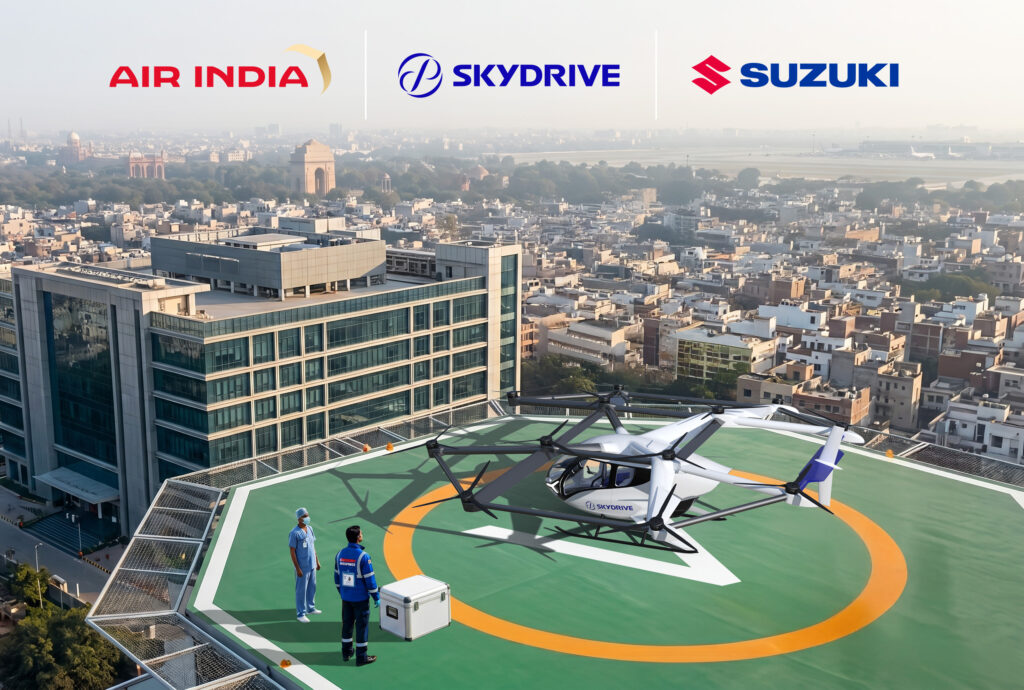
Air India Limited, SkyDrive Inc. and Suzuki Motor Corporation (Tokyo Stock Exchange: 7269) have signed a memorandum of understanding to study the use of electric vertical take-off and landing aircraft for medical air logistics in India. The partnership combines Air India’s aviation and pharmaceutical cargo capabilities, SkyDrive’s SD-05 aircraft programme and Suzuki’s manufacturing experience and extensive knowledge of the Indian mobility market. The companies are initially exploring a last-mile logistics model intended to reduce transit times for high-value and time-sensitive medical supplies in congested urban areas. However, the agreement remains a feasibility study, with no disclosed aircraft order, investment amount, launch city or commercial service date.
That distinction matters because the announcement is strategically interesting without yet being financially material. Medical logistics could provide advanced air mobility developers with a more defensible early use case than premium passenger air taxis, particularly when delays affect medicines, laboratory samples, vaccines or other critical supplies. Yet the partners must still demonstrate that an eVTOL can carry a commercially useful payload, operate reliably in India’s climate, connect approved landing locations and deliver meaningful time savings after loading, unloading and regulatory procedures are included.
Why are Air India, SkyDrive and Suzuki starting with medical logistics rather than passenger air taxis?
Medical cargo offers a clearer problem to solve than the broad promise of faster urban commuting. In India’s largest cities, road congestion can make the duration of even relatively short journeys unpredictable. A medical consignment that must move between an airport, hospital, laboratory, blood bank or distribution centre may therefore have a higher economic value per minute saved than an ordinary passenger journey.
This does not mean every pharmaceutical shipment would justify an eVTOL flight. Routine medicines can continue travelling through established road and air-freight networks at considerably lower costs. The strongest potential use cases are likely to involve shipments where delay creates clinical, financial or inventory risk, including small quantities of urgent drugs, diagnostic materials, blood products, organs or temperature-sensitive supplies. These are possible applications rather than routes confirmed under the memorandum.
The cargo-first approach could also reduce some of the consumer-adoption challenges surrounding urban air mobility. Passenger services must persuade customers that the aircraft are safe, affordable and convenient while building booking, terminal and ground-transfer systems. Medical logistics can initially be evaluated through controlled business-to-business operations involving trained cargo handlers, healthcare institutions and aviation partners.
The partners will nevertheless have to establish whether the medical value of faster transport is high enough to cover aircraft ownership, pilot costs, charging, maintenance, insurance, vertiport access and specialised cargo handling. Saving 30 minutes sounds attractive, but aviation economics has a habit of making simple journeys complicated before making them fast.
How could Air India’s pharmaceutical cargo network support an eVTOL last-mile operating model?
Air India provides more than a familiar aviation brand. Its cargo business already handles pharmaceuticals, vaccines, plasma, live human organs and other time-sensitive medical consignments. The airline operates pharmaceutical handling infrastructure across major Indian centres including Delhi, Mumbai, Bengaluru, Hyderabad, Chennai and Ahmedabad, giving the feasibility study access to existing cargo processes and potential airport-based starting points.
Air India has also obtained Good Distribution Practices certification for its pharmaceutical cargo operations. The airline transported more than 4,000 tonnes of pharmaceutical products during the 2024-25 financial year and has developed active and passive temperature-control solutions, priority loading processes and trained handling teams. These capabilities are important because an eVTOL flight would represent only one stage of the logistics chain. The shipment must remain compliant and traceable while moving from storage to aircraft, between transport modes and ultimately to the consignee.
The commercial opportunity may therefore lie in connecting Air India’s conventional passenger-aircraft cargo network with a much shorter aerial distribution layer. A shipment arriving at a major airport could theoretically be transferred to an eVTOL for delivery to a healthcare cluster or approved urban site, avoiding part of the road journey. Conversely, urgent material originating at a hospital or laboratory could reach an airport cargo terminal more quickly for onward transportation.
Air India’s airport relationships and operational knowledge should help the partners identify where such connections are physically and procedurally possible. The important measurement will not be the eVTOL’s flight time alone. The study must calculate total door-to-door performance, including cargo acceptance, security checks, temperature-control procedures, aircraft turnaround, charging, weather delays and final ground delivery.
What does Suzuki Motor Corporation contribute beyond funding and manufacturing support?
Suzuki Motor Corporation brings industrial credibility to a sector in which many developers have aircraft concepts but limited experience in repeatable, quality-controlled production. SkyDrive began producing SD-05 aircraft at a Suzuki Group plant in Iwata City, Japan, in March 2024 through its manufacturing subsidiary, Sky Works Inc. The plant has been positioned to support annual capacity of up to 100 aircraft, although actual commercial output will depend on certification and customer demand.
The relationship extends beyond contract manufacturing. Suzuki has invested in SkyDrive, supports its business development in India and has placed senior manufacturing expertise within the aircraft company. This creates a more integrated partnership than a typical automotive supplier arrangement, with Suzuki contributing production systems, quality-control knowledge and market access.
India is particularly important to Suzuki’s wider strategy. Its automotive, motorcycle, research and manufacturing operations have given the Japanese group decades of experience with Indian infrastructure, customers, suppliers and government stakeholders. Suzuki can therefore help SkyDrive assess local operating conditions and identify potential industrial partners without requiring the aircraft developer to build every relationship from scratch.
SkyDrive has already started forming an Indian aerospace supply chain. In July 2026, it appointed Kineco Limited to develop and manufacture composite aerostructures for the SD-05, following an earlier agreement with Bengaluru-based SASMOS HET Technologies Limited covering electrical wiring systems. These arrangements do not establish that the aircraft will be assembled in India, but they show that the country is becoming part of SkyDrive’s production and supplier strategy as well as its potential operating market.
Is the SKYDRIVE SD-05 technically suited to urgent medical deliveries across Indian cities?
SkyDrive describes the SD-05 as a compact, battery-powered multicopter with 12 independently controlled rotors. The current design has a maximum take-off weight of 1,400 kilograms, a maximum cruising speed of 110 kilometres per hour and a stated flight range of approximately 15 to 40 kilometres. It is configured for a maximum of three occupants, consisting of one pilot and two passengers.
For medical logistics, the passenger seats could potentially be replaced or adapted for cargo, although the companies have not disclosed a dedicated medical configuration or payload specification. That missing number is critical. A 40-kilometre nominal range does not automatically create a 40-kilometre commercial route because operators need reserves for weather, diversions, battery degradation and safe landing options.
The aircraft’s compact footprint may make it suitable for short connections involving rooftops, airports or relatively small landing sites. SkyDrive says the SD-05 produces around 65 decibels at street level while flying at an altitude of 150 metres, potentially reducing the noise problem associated with helicopter operations near hospitals and urban communities. The company has also designed separate rotor, battery and flight-control redundancies, although those systems remain subject to regulatory testing and certification.
Medical operations will place particular emphasis on reliability and dispatch availability. An aircraft that saves time on a clear day but cannot operate during heavy rain, high winds or extreme temperatures may have limited value for emergency logistics. Battery-charging duration, usable payload under hot-weather conditions and maintenance requirements will therefore be as important as headline speed.
Which regulatory and infrastructure hurdles must be cleared before operations can begin?
The memorandum does not constitute approval to operate the SD-05 in India. Any commercial network would require aircraft certification, an approved operating structure, licensed personnel, airspace coordination, maintenance arrangements and authorised take-off and landing locations. The Directorate General of Civil Aviation would be central to determining how the aircraft and service fit within India’s civil aviation framework.
SkyDrive has made progress in Japan but has not yet completed type certification. In March 2026, the company reached agreement with the Japan Civil Aviation Bureau on its General Certification Plan, defining how it intends to demonstrate compliance with aircraft safety requirements. SkyDrive is targeting commercial introduction in 2028, subject to completing certification work and the remaining development programme.
Indian certification may draw upon work completed with Japanese regulators, but it should not be treated as automatic recognition. Local authorities will need to assess operating conditions, pilot requirements, battery safety, emergency procedures, noise, vertiport standards and integration with existing air traffic.
Ground infrastructure could be an equally significant constraint. A medical logistics network needs secure landing areas close enough to hospitals, laboratories or distribution centres to preserve the time advantage. Those sites require charging equipment, fire and rescue procedures, cargo-handling facilities and reliable road connections for the final few kilometres. The last mile does not disappear simply because part of it moves into the sky.
Could medical cargo provide a more credible first revenue case than passenger eVTOL services?
Medical logistics may offer one of the stronger early commercial cases for eVTOL technology because the customer is purchasing time and reliability rather than merely a novel travel experience. Hospitals, diagnostic companies, pharmaceutical manufacturers and logistics providers may accept a higher transport cost when the consignment is urgent, valuable or clinically sensitive.
A successful service would still require sufficient shipment frequency. An aircraft operated only during rare emergencies may struggle to recover fixed costs, while a high-frequency network would require dependable cargo demand in both directions. The partners may therefore need a mixed model combining scheduled medical distribution with on-demand urgent flights.
Air India could potentially aggregate demand across its pharmaceutical customers, while Suzuki could support local partnerships and SkyDrive could tailor the aircraft and maintenance model. The commercial test is whether these capabilities can be converted into repeatable routes with high aircraft utilisation rather than isolated demonstration flights.
The feasibility study should consequently identify specific corridors and compare them with road couriers, motorcycles, helicopters and smaller unmanned drones. Larger eVTOL aircraft may carry more than conventional drones, but they are also likely to face higher certification, pilot and infrastructure costs. A credible result would quantify when the aircraft is faster, what payload it can carry and what customers are willing to pay.
What does the India eVTOL study mean for Suzuki Motor Corporation shareholders?
The agreement expands Suzuki Motor Corporation’s exposure to advanced mobility but is unlikely to have a measurable near-term effect on group earnings. Suzuki reported record revenue of ¥6.293 trillion for the financial year ended March 2026, an increase of 8%, while operating profit declined 3.1% to ¥622.9 billion as raw-material costs and growth investments affected profitability. Management forecasts revenue of ¥6.8 trillion and operating profit of ¥570 billion for the current financial year.
Against that financial scale, an early feasibility study is strategically useful but economically small. It provides Suzuki with an option on a new mobility category while leveraging manufacturing and market capabilities already developed for its core businesses. The shareholder value will emerge only if SkyDrive secures certification, attracts orders and demonstrates that aircraft production can generate acceptable returns without disproportionate capital requirements.
Suzuki shares closed at ¥2,086 on July 31, 2026, down 3.13% during the session. The stock remained approximately 6% above its July 24 close and around 6.6% above its June reference level, while trading within a 52-week range of ¥1,655 to ¥2,473. Its market capitalisation stood at about ¥4.10 trillion. The daily decline should not be attributed solely to the Air India agreement because no evidence establishes that the memorandum caused the market movement.
Investor sentiment around Suzuki’s SkyDrive involvement is therefore best described as strategically constructive but financially unproven. The programme aligns with Suzuki’s push into new mobility businesses, yet the investment case continues to be dominated by automobile volumes, India demand, raw-material costs, currency movements and profit margins.
Which milestones would show that the India medical logistics study is moving beyond an MoU?
The first meaningful milestone would be the identification of defined medical logistics corridors with named healthcare, airport or logistics participants. The partners would then need to disclose expected flight distances, usable payload, operating frequency, charging requirements and comparative door-to-door transit times.
A second proof point would be regulatory engagement that establishes a credible pathway for certifying and operating the aircraft in India. Demonstration flights would attract attention, but they would be more significant if conducted with realistic cargo weights, ground-handling procedures and representative weather conditions.
The final commercial test would be a paid pilot programme involving repeat shipments. Such a programme could demonstrate whether customers value the time savings sufficiently to support the cost structure. Until those milestones are reached, the agreement should be viewed as an intelligently structured market study rather than the launch of an Indian eVTOL medical delivery network.
The partnership has improved SkyDrive’s access to operational expertise and strengthened Air India’s position in next-generation logistics, while giving Suzuki another route to apply its manufacturing and India-market capabilities. What remains unresolved is whether the SD-05 can deliver the necessary payload, reliability and economics within India’s regulatory framework. The clearest validation would be a certified demonstration corridor that produces measurable door-to-door savings and leads to a contracted commercial trial.
What are the key takeaways from the Air India, SkyDrive and Suzuki eVTOL study?
- Air India Limited, SkyDrive Inc. and Suzuki Motor Corporation will study eVTOL-based medical logistics in India.
- The memorandum does not include a disclosed aircraft order, investment commitment, launch city or service date.
- The proposed model targets urgent, high-value and time-sensitive medical supplies affected by urban road congestion.
- Air India contributes pharmaceutical cargo experience, airport knowledge and temperature-controlled logistics capabilities.
- Suzuki Motor Corporation provides manufacturing expertise, investment support and extensive India-market knowledge.
- SkyDrive’s SD-05 has a stated range of 15 to 40 kilometres and a maximum speed of 110 kilometres per hour.
- The aircraft remains in development and is targeting commercial introduction in 2028, subject to certification.
- Payload, charging, weather reliability and total door-to-door transit time will determine commercial viability.
- The agreement is strategically relevant to Suzuki Motor Corporation but not financially material at group level today.
- A contracted pilot route with measurable time savings would provide the strongest evidence of commercial progress.
Discover more from Business-News-Today.com
Subscribe to get the latest posts sent to your email.