

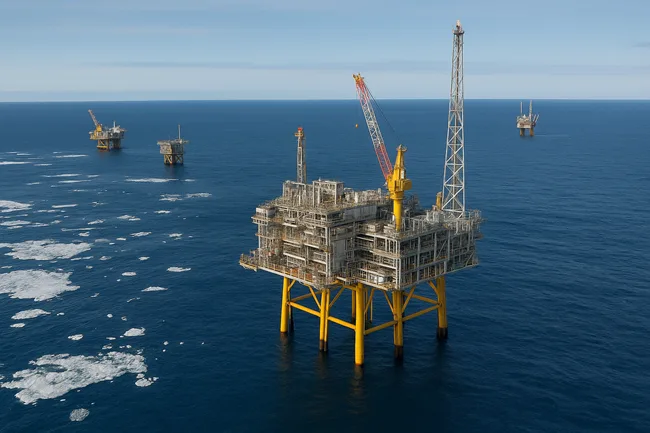
Equinor ASA, Aker BP ASA and Vår Energi ASA are pooling exploration expertise, technology, data and prospect inventories in an unusually coordinated attempt to find the next generation of large oil and gas discoveries on the Norwegian Continental Shelf, where years of near-field drilling have increasingly produced resources suited to tiebacks rather than the standalone developments needed to sustain activity deep into the next decade. The three companies said their new strategic exploration collaboration will mature and test approximately 20–25 high-impact opportunities over the next four to five years, with an ambition to drill around five such wells annually.
The scale of the programme matters because the companies are not merely combining acreage around existing platforms. Their stated objective is to increase the probability of finding discoveries sufficiently large to underpin new standalone developments, potentially creating infrastructure hubs around which smaller future discoveries could subsequently be commercialised. That makes the collaboration as much a response to Norway’s long-term resource replacement challenge as an exploration partnership.
Why are Equinor, Aker BP and Vår Energi sharing exploration risk in Norway?
Norwegian offshore exploration has increasingly gravitated toward infrastructure-led opportunities because smaller discoveries close to operating platforms can often be developed more cheaply and rapidly through subsea tiebacks. Equinor, Aker BP and Vår Energi explicitly acknowledged that this model remains important, but argued that larger discoveries are also needed to create the resource base for new standalone field developments and sustain value creation beyond 2035.
Pooling selected prospects gives the companies another lever. High-impact exploration can involve materially larger geological uncertainty and potentially expensive wells, while a dry hole produces little economic value beyond geological information. Sharing risk across a broader portfolio can therefore allow the companies to pursue prospects that may be difficult to justify individually while combining seismic interpretation, subsurface models and operating experience across some of the Norwegian Continental Shelf’s most experienced exploration organisations.
The structure does not mean the three companies are abandoning competition. Equinor, Aker BP and Vår Energi retain substantial independent portfolios and will continue conventional exploration programmes alongside the collaboration. What changes is that a defined group of higher-impact prospects can now be screened through a common technical lens before capital is committed.
Could five high-impact wells a year materially change Norway’s resource outlook?
Five wells annually would translate into roughly 20–25 drilling attempts over four to five years if the companies deliver the programme at the stated pace. Exploration success is inherently uncertain, so the number of wells alone says little about the volume ultimately discovered. Nevertheless, the portfolio approach increases the number of shots at finding something materially larger than the increasingly common satellite discovery.
A recent example illustrates the difference in scale the companies are trying to overcome. Equinor and Aker BP disclosed the Linga gas discovery near the Balder field on August 24, with preliminary recoverable volumes estimated at only around 0.1 million to 2.1 million standard cubic metres of oil equivalent. Such discoveries can still carry value when infrastructure is nearby, but they are not the kind of giant resource capable of resetting the development map of an offshore basin.
The alliance is therefore effectively searching for future hubs rather than merely additional molecules. A large discovery could justify a new production installation that later becomes infrastructure for surrounding prospects, potentially transforming the economics of resources that would otherwise remain stranded.
What does the alliance mean for Equinor, Aker BP and Vår Energi investors?
The arrangement potentially improves exploration capital efficiency, but it does not remove geological risk. Investors should distinguish between the size of a prospect inventory and commercially recoverable discoveries. The important milestones will be the identities and pre-drill resource ranges of individual prospects, ownership percentages, well costs, drilling results and whether successful discoveries can clear development hurdles under future oil and gas price assumptions.
The market has not treated the August 24 alliance as a standalone catalyst. Equinor shares on Oslo closed at NOK384 on August 27, down from NOK399.10 on August 21, while Aker BP finished at NOK347.40 against NOK354.80 over the same period. Vår Energi closed around NOK48.83 on August 27 compared with NOK49.69 on August 21. The simultaneous pullback across all three suggests broader oil-sector and commodity sentiment was dominating short-term trading rather than investors assigning an immediate premium to a programme whose economic results may take years to emerge.
The longer-term logic is easier to see. Equinor brings unparalleled knowledge of the Norwegian shelf, Aker BP has built its strategy around high-efficiency development and Vår Energi has made exploration a central component of its production growth plans. Putting those capabilities behind a shared portfolio does not guarantee another Johan Sverdrup-sized discovery, but it increases the industry’s willingness to continue taking large geological bets at a time when incremental tiebacks alone may not sustain Norway’s current offshore footprint indefinitely.
What could the next exploration wells mean for investors?
The most consequential disclosure will be the first prospect list. Investors will want to know whether the alliance is concentrating on frontier plays, deeper targets inside established basins or new geological concepts that have previously been underexplored because of technical or commercial risk.
Success would have consequences beyond the three companies. A new standalone development could extend demand for offshore drilling, subsea equipment, engineering, floating production systems and supply-chain capacity while preserving future throughput for Norway’s broader petroleum ecosystem. Failure across several expensive wells would produce the opposite lesson, reinforcing the argument that the Norwegian Continental Shelf has become primarily an infrastructure-led mature basin.
For now, the alliance represents a deliberate shift in exploration philosophy. Equinor, Aker BP and Vår Energi are effectively accepting that Norway cannot rely solely on extracting more value from yesterday’s infrastructure. If the country wants another generation of major offshore developments, somebody still has to drill for them.
Discover more from Business-News-Today.com
Subscribe to get the latest posts sent to your email.