

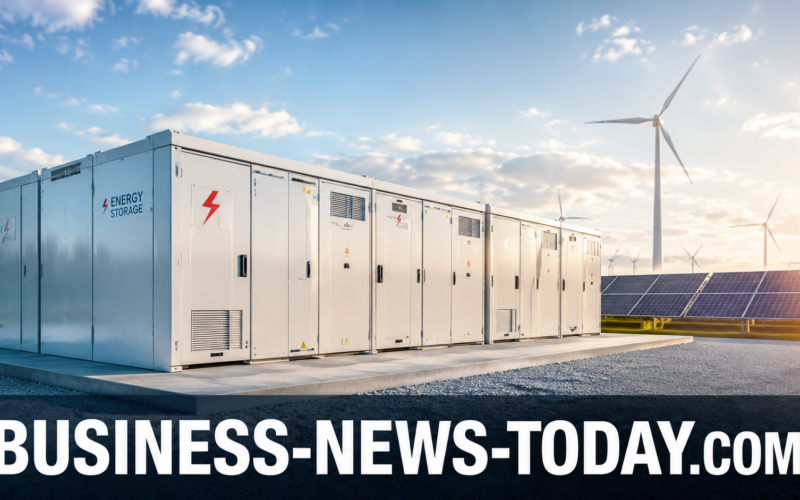
Avantus has secured a US$300 million tax-equity commitment from Truist Bank for its Aratina 2 solar and battery storage project in Kern County, California, completing the principal financing package needed to move the project through construction and into Avantus’ operating portfolio. Aratina 2 combines 150 MW of solar generation with 452 MWh of battery storage and is scheduled to enter operation before the end of 2026 under 15-year power purchase agreements with Southern California Edison.
The transaction follows more than US$525 million of construction financing arranged in July with BBVA, Canadian Imperial Bank of Commerce and Banco Santander. The apparent total of more than US$825 million should not, however, be interpreted as Aratina 2’s disclosed construction cost. The earlier financing package included construction funding, letters of credit and a tax-equity bridge loan, meaning the new Truist commitment completes and ultimately refinances part of the capital structure rather than simply adding another US$300 million of permanent project cost.
Why does a solar and battery project need such a complicated financing structure?
Large US renewable projects are commonly financed through several overlapping pools of capital rather than one conventional project loan. Construction lenders fund expenditures while assets are being built, bridge facilities can advance cash against tax benefits expected later, and tax-equity investors monetise federal incentives once eligibility requirements are satisfied.
Battery storage makes the economics more sophisticated because project value increasingly depends not only on how many megawatt-hours of renewable electricity are generated, but when that electricity can be delivered. Aratina 2’s 452 MWh battery can shift solar generation from periods of abundant daytime supply toward hours when California’s electricity system requires more dispatchable capacity.
That flexibility helps explain why Avantus describes itself increasingly as an independent power producer rather than simply a solar developer. The company intends to operate Aratina 2 and retain a controlling ownership interest instead of developing the project solely for sale, allowing it to capture contracted operating cash flows after construction.
How large is Avantus’ Aratina solar-storage platform becoming?
Aratina 2 is the second phase of the Aratina Solar Center. Together with Aratina 1, which reached commercial operation in July, the two projects will provide approximately 350 MW of solar capacity and 952 MWh of battery storage. Avantus said it expects to bring 788 MW of solar and storage online during 2026 and has another 800 MW under construction, against a development pipeline exceeding 24 GW.
That progression is strategically important. Developers can create value by originating projects, obtaining interconnection positions and securing permits, but owning operating assets creates a different business model based on long-duration contracted revenue and recurring cash generation. Retaining controlling interests also increases capital requirements, making access to banks, tax-equity investors and corporate credit facilities increasingly important as the portfolio scales.
Avantus recently increased its corporate credit facility to US$1.05 billion, providing another source of liquidity for a development portfolio spanning California and the Desert Southwest. The company is backed by investors including KKR and EIG, giving it access to institutional capital while it builds a larger operating fleet.
Why is battery storage becoming central to California solar economics?
California already has substantial solar penetration, creating periods when electricity production can be abundant during daylight hours. The challenge is increasingly shifting those electrons into evening demand periods rather than simply building additional midday generation.
Aratina 2’s configuration illustrates that change. Its 452 MWh battery capacity is approximately three times the project’s 150 MW solar nameplate capacity when expressed as megawatt-hours versus megawatts, although the measures describe different characteristics and should not be treated as directly interchangeable. The storage component nevertheless shows that this is no longer a conventional solar farm with a small battery attached for marketing purposes.
Long-term agreements with Southern California Edison also reduce merchant-power exposure. Contracted revenue improves bankability, while storage gives the utility access to electricity that can be scheduled more flexibly than raw solar output.
What should investors and the renewable sector watch next?
The immediate execution test is straightforward: Avantus must complete Aratina 2 and achieve commercial operation before the end of 2026. Construction delays could affect financing costs and contracted delivery obligations, while battery commissioning remains an increasingly important technical stage for large hybrid projects.
Beyond Aratina 2, the more consequential question is whether Avantus can repeat the financing model across its 24 GW-plus development pipeline without allowing capital requirements to constrain growth. Moving from development into long-term ownership can create more durable enterprise value, but it also turns financing discipline into a core operating capability.
Aratina 2 therefore provides a useful snapshot of where US utility-scale renewables are heading. Solar modules and megawatts remain important, but the competitive edge increasingly lies in combining solar with storage, contracted offtake and a capital stack sophisticated enough to carry a project from development into decades of operation.
Discover more from Business-News-Today.com
Subscribe to get the latest posts sent to your email.