


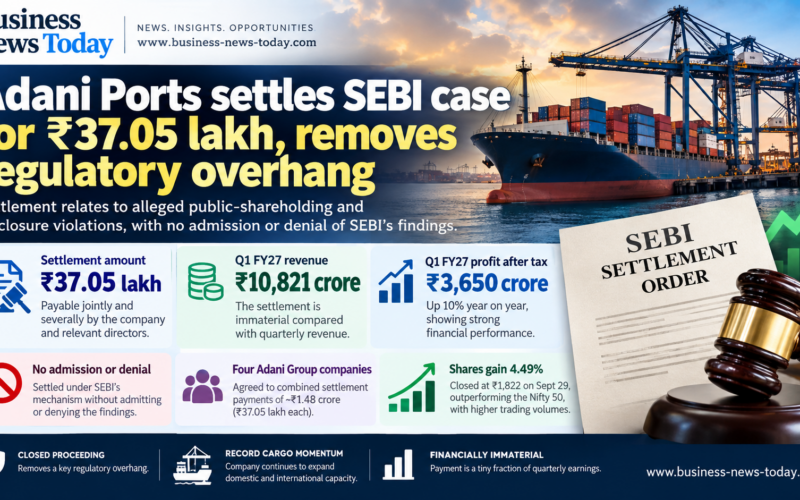
Adani Ports and Special Economic Zone Limited (NSE: ADANIPORTS), India’s largest private port operator and integrated transport infrastructure company, has disclosed a settlement order from the Securities and Exchange Board of India resolving proceedings linked to alleged violations of minimum public-shareholding and disclosure requirements. The settlement covers Adani Ports and Special Economic Zone Limited, current directors Gautam S. Adani and Rajesh S. Adani, and former directors Malay Mahadevia, Rajeeva Ranjan Sinha and Sudipta Bhattacharya, with an aggregate settlement amount of ₹37.05 lakh payable jointly and severally by the company and the relevant directors. The proceedings have been settled without admission or denial of SEBI’s findings of fact and conclusions of law, meaning the settlement should not be characterised as an admission that the alleged violations occurred. Financially, the payment is immaterial for a company generating more than ₹10,800 crore of quarterly revenue, but closure of the proceeding removes another regulatory overhang at a time when Adani Ports is reporting record cargo volumes and expanding domestic and international capacity.
Adani Ports shares closed at ₹1,822 on September 29, up 4.49% from ₹1,743.70 in the previous session and substantially outperforming a Nifty 50 index that fell 0.28% during the day. Trading volume climbed to about 4.21 million shares from roughly 1.26 million on September 28. The price movement coincided with dissemination of the settlement disclosure and broader strength in Adani Group shares, although the rise should not be attributed exclusively to the settlement because multiple market and company-specific factors can influence a single trading session.
What exactly did Adani Ports settle with SEBI under the September 28 settlement order?
SEBI’s settlement order relates to proceedings alleging violations of India’s minimum public-shareholding and associated disclosure framework. The regulations cited in Adani Ports’ exchange disclosure include Rule 19A of the Securities Contracts Regulation Rules, provisions of the former listing agreement and Regulations 31 and 38 of the SEBI Listing Obligations and Disclosure Requirements framework.
Indian listed companies are generally required to maintain at least 25% public shareholding, subject to applicable exceptions and transition arrangements. The SEBI proceedings arose from allegations concerning whether certain holdings had been appropriately classified for the purpose of calculating public shareholding and whether the relevant disclosures complied with securities-market requirements.
Adani Ports and the directors involved chose to resolve the proceedings through SEBI’s settlement mechanism. Under that framework, a matter can be concluded through agreed settlement terms without the applicants admitting or denying the underlying findings or legal conclusions.
The distinction is important for the final characterization of the case. The ₹37.05 lakh payment closes the proceeding covered by the settlement order, but it does not constitute an admission of the allegations by Adani Ports, Gautam Adani, Rajesh Adani or the former directors named in the disclosure.
How large is the Rs 37.05 lakh Adani Ports settlement compared with the company’s financial scale?
The financial impact is negligible relative to Adani Ports and Special Economic Zone Limited’s operating scale. The company generated consolidated revenue of ₹10,821 crore in Q1 FY27, meaning the ₹37.05 lakh settlement represents only a tiny fraction of one quarter’s revenue.
Q1 EBITDA reached ₹6,541 crore, increasing 19% year on year, while profit after tax rose 10% to approximately ₹3,650 crore. The settlement amount is therefore immaterial in relation to both operating earnings and net profit.
Adani Ports itself said the settlement order would have no material financial impact on the company. The more relevant consequence is regulatory rather than monetary because the order disposes of a proceeding that had remained open following SEBI’s investigation.
At the Adani Group level, four companies and their associated directors agreed to combined settlement payments of approximately ₹1.48 crore in the minimum public-shareholding proceeding. The companies included Adani Enterprises Limited, Adani Power Limited, Adani Ports and Special Economic Zone Limited and Adani Energy Solutions Limited, formerly known as Adani Transmission Limited.
Each company group agreed to a settlement amount of ₹37.05 lakh. The applicants paid the settlement amounts in August before SEBI issued the final settlement order in September.
Why does closing the SEBI proceeding matter even when the settlement payment is financially immaterial?
Large listed infrastructure companies operate with continual interaction across capital markets, lenders, regulators, concession authorities, bond investors and global institutional shareholders. Regulatory proceedings that do not threaten operations can nevertheless remain part of the governance and risk assessment surrounding a listed company.
Settlement removes uncertainty surrounding the specific allegations covered by this proceeding. It does not erase other regulatory or legal matters that may exist independently, but it closes this particular enforcement pathway subject to the conditions contained in the settlement framework.
For investors, that distinction helps separate two different analytical questions. The first concerns the economic effect of the settlement, which is negligible. The second concerns whether an unresolved regulatory issue has been converted into a concluded process, which carries greater relevance for governance visibility.
The settlement also arrives when Adani Ports’ valuation is increasingly being driven by operating expansion rather than recovery from earlier regulatory uncertainty alone. Cargo growth, international ports, marine services, logistics expansion and capacity additions are now producing measurable financial contributions, giving investors a much larger set of operating indicators against which to assess the company.
How strong was Adani Ports’ Q1 FY27 performance before the latest settlement disclosure?
Adani Ports began fiscal 2027 with another quarter of double-digit growth. Consolidated revenue increased 19% year on year to ₹10,821 crore from ₹9,126 crore, while EBITDA increased at the same rate to ₹6,541 crore.
Profit after tax rose approximately 10% to ₹3,650 crore. The slower profit growth relative to EBITDA reflected factors below the operating line, but the core port, logistics and marine businesses continued to increase scale.
Total cargo volume grew approximately 14% year on year to 138.1 million metric tonnes during Q1. Domestic cargo represented roughly 115.3 million tonnes, giving the Indian port network more than four-fifths of consolidated cargo volume while international operations continued scaling.
International Ports became a particularly strong incremental contributor. Management reported a 256% increase in international ports EBITDA during Q1, indicating that assets outside India were beginning to contribute meaningfully rather than remaining primarily expansion investments.
That diversification is strategically important because Adani Ports is gradually evolving from an Indian port operator into a wider transport and logistics platform. Domestic ports remain the foundation of cash generation, but international terminals, marine services, logistics parks, rail operations and associated services are becoming more significant components of growth.
What does the record 50 MMT August cargo month say about Adani Ports’ FY27 trajectory?
Operating momentum accelerated further after the June quarter. Adani Ports handled 50 million metric tonnes of cargo during August 2026, its highest-ever monthly volume and a 19% increase from the corresponding period a year earlier.
Dry cargo increased approximately 25% year on year during August, while container volumes grew roughly 15%. For the five months through August, total cargo reached about 234.4 million tonnes, representing growth of approximately 16%.
Those numbers imply that Adani Ports entered the September quarter with cargo growth running ahead of the 14% increase recorded during Q1. Maintaining that pace through the remainder of the financial year would provide strong operating support for revenue and EBITDA growth, although mix and tariffs will influence the amount of earnings generated from each tonne.
The network is already unusually large. Adani Ports operated a domestic portfolio with approximately 653 million tonnes of capacity before its latest Paradip expansion win, alongside international port assets in markets including Israel, Tanzania, Sri Lanka and Australia.
The scale gives the company an opportunity to move cargo between an increasingly broad set of terminals while integrating marine services, rail connectivity, logistics facilities and warehousing. The economic value of that network depends increasingly on utilisation and end-to-end customer penetration rather than capacity additions alone.
How does the new Paradip Port win strengthen Adani Ports’ eastern India strategy?
In September, Adani Ports received a Letter of Award to develop and operate CQ-I and CQ-II dry-bulk berths at Paradip Port in Odisha. The project will add approximately 18 million metric tonnes of mechanised dry-bulk capacity under a 30-year concession.
The new capacity takes Adani Ports into one of India’s most important major-port locations while strengthening an eastern network that already includes Dhamra, Gopalpur, Gangavaram and Haldia-linked operations. Before the Paradip award, those eastern assets represented roughly 140 million tonnes of capacity.
Paradip also provides access to the mineral and industrial hinterland of eastern and central India. That makes the project relevant for commodities including coal, iron ore and other dry-bulk cargo linked to steel, power, mining and industrial customers.
The award raises Adani Ports’ domestic capacity portfolio from approximately 653 million tonnes to around 671 million tonnes once the project is included. Management has a longer-term ambition to move toward one billion tonnes of cargo throughput, meaning the company needs both new capacity and higher utilisation across existing assets.
Paradip therefore matters more than its 18 million tonnes in isolation. It fills a geographic gap in the network and gives Adani Ports another long-duration concession from which to capture freight flows across eastern India.
Why is Dhamra Port’s move to renewable electricity strategically relevant for Adani Ports?
Dhamra Port in Odisha has also become the first large private multi-cargo port in India to operate entirely using renewable electricity. The port consumes more than 90 lakh units of electricity each month, with power supplied through renewable-energy arrangements that include generation linked to Adani’s Khavda hybrid project and green-grid supply in Odisha.
Moving the port to renewable electricity eliminates operational Scope 2 emissions associated with purchased conventional electricity. It can also help Adani Ports respond to customers whose own supply-chain decarbonisation targets increasingly include emissions from ports and logistics providers.
Environmental improvements do not automatically translate into higher earnings, but energy efficiency and renewable sourcing can reduce exposure to conventional electricity costs while supporting access to customers and financing frameworks that incorporate carbon performance.
The transition at Dhamra also has symbolic significance because eastern India is becoming an increasingly important part of Adani Ports’ capacity expansion strategy. Dhamra, Gopalpur and the new Paradip project collectively strengthen the company’s exposure to industrial cargo flows along the eastern coastline.
How did Adani Ports shares react after the SEBI settlement disclosure?
Adani Ports shares closed at ₹1,822 on September 29, gaining ₹78.30 or 4.49%. The stock reached an intraday high of ₹1,822 after opening at ₹1,755.20, while the session low was ₹1,738.40.
The rebound followed a 2.48% decline on September 28, when Adani Ports closed at ₹1,743.70 amid a much broader selloff in Indian equities. The September 29 gain therefore recovered the previous session’s fall and pushed the stock to its highest closing level of the recent period.
At ₹1,822, Adani Ports stood only around 3.7% below its 52-week high near ₹1,891.10. The stock was also approximately 41% above its 52-week low near ₹1,292.
The latest close implies an equity-market capitalisation of approximately ₹4.11 lakh crore. Against that valuation, the ₹37.05 lakh settlement payment is economically negligible, reinforcing the conclusion that investors are likely to place far more weight on cargo growth, EBITDA, capacity expansion, international execution and future cash generation.
The stronger share-price performance on September 29 coincided with closure of the SEBI proceeding and occurred despite weakness in the broader Indian market. The movement indicates increased investor attention around the regulatory development and Adani Group stocks more broadly, but a single session cannot establish the settlement as the sole cause.
What are the biggest financial tests for Adani Ports after the SEBI settlement?
The first test is whether cargo momentum remains above the growth rate achieved in Q1. August’s record 50 million tonnes provides a strong starting point, but September and subsequent monthly updates will show whether the pace can be sustained.
International profitability is the second variable. Q1’s 256% increase in international ports EBITDA was unusually strong, and continued growth would strengthen the argument that overseas assets are evolving into meaningful earnings contributors rather than simply increasing geographic scale.
The third test is capital discipline. Adani Ports continues adding capacity domestically and internationally while investing in logistics, marine services, technology and associated infrastructure. High EBITDA growth needs to translate into cash generation sufficient to support expansion without allowing leverage to rise disproportionately.
Paradip provides another measurable milestone. The company has a 30-year concession and 18 million tonnes of planned dry-bulk capacity, but the economic contribution will depend on construction, commissioning, customer contracting and eventual utilisation.
The SEBI settlement removes uncertainty around one historic regulatory proceeding at a time when the company’s operating trajectory remains strong. With Q1 revenue above ₹10,800 crore, record monthly cargo in August and the domestic portfolio expanding toward 671 million tonnes of capacity, the much larger question for Adani Ports shareholders is now whether its growing network can continue compounding EBITDA and cash flow at a rate that supports a market capitalisation above ₹4 lakh crore.
Key takeaways from Adani Ports’ September 29 SEBI settlement disclosure
- Adani Ports and Special Economic Zone Limited has received a SEBI settlement order covering alleged minimum public-shareholding and disclosure violations.
- The settlement covers the company, Gautam S. Adani, Rajesh S. Adani and former directors Malay Mahadevia, Rajeeva Ranjan Sinha and Sudipta Bhattacharya.
- The aggregate settlement amount for the Adani Ports group of applicants is ₹37.05 lakh.
- The proceedings were resolved without admission or denial of SEBI’s findings of fact and conclusions of law.
- Adani Ports said the settlement would have no material financial impact on the company.
- Q1 FY27 consolidated revenue increased 19% to ₹10,821 crore and EBITDA rose 19% to ₹6,541 crore.
- Q1 profit after tax increased approximately 10% to ₹3,650 crore.
- Adani Ports handled a record 50 million tonnes of cargo in August, up 19% year on year.
- The company has won a 30-year concession for two Paradip dry-bulk berths adding 18 million tonnes of capacity.
- Adani Ports shares jumped 4.49% to ₹1,822 on September 29, leaving the stock less than 4% below its 52-week high.
Discover more from Business-News-Today.com
Subscribe to get the latest posts sent to your email.