




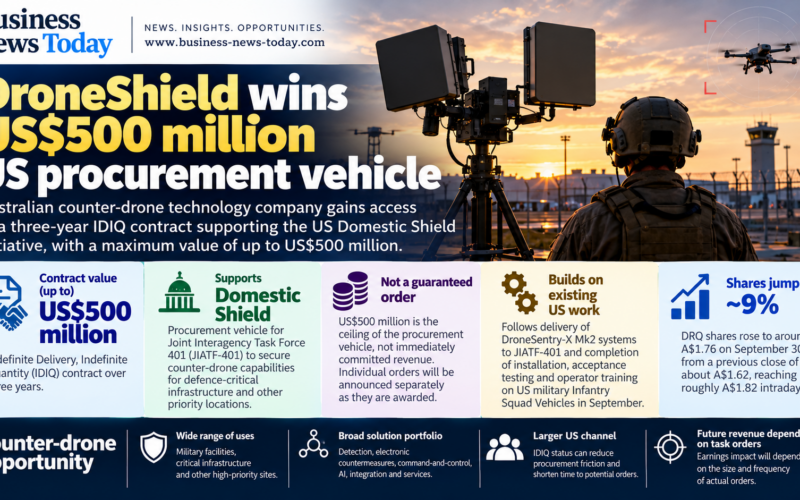
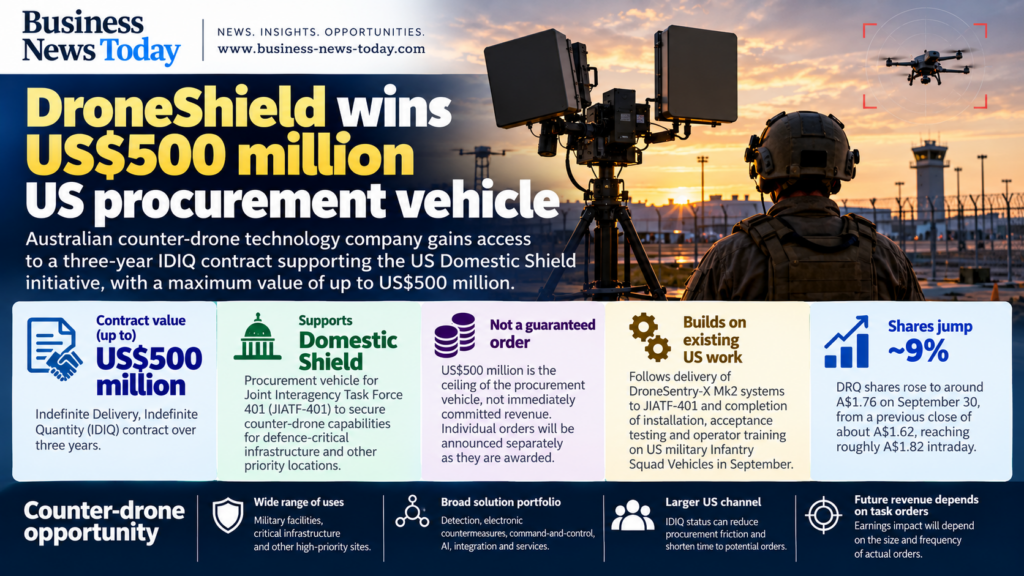
DroneShield Limited (ASX: DRO) has been awarded an Indefinite Delivery, Indefinite Quantity contract supporting Joint Interagency Task Force 401’s Domestic Shield initiative, giving the Australian counter-drone technology company access to a procurement vehicle carrying a maximum value of up to US$500 million over three years. The September 30 award creates a streamlined route through which US authorities can procure DroneShield counter-uncrewed aircraft system capabilities for defence-critical infrastructure and other priority locations. Crucially, however, the US$500 million figure is the ceiling of the contracting vehicle rather than a guaranteed DroneShield order or immediately committed revenue.
That distinction makes the announcement strategically significant without turning it into an instant half-billion-dollar backlog event. DroneShield said material orders subsequently awarded under the IDIQ would be announced separately, meaning investors will need to watch the size, frequency and product mix of individual task orders to determine how much commercial value ultimately flows through the contract. The structure nevertheless places DroneShield inside a potentially substantial procurement channel at a time when counter-drone systems are becoming a more established defence spending category rather than a niche technology purchase.
Why does DroneShield’s US$500m Domestic Shield contract matter if the full amount is not guaranteed?
An IDIQ contract is valuable because it can reduce the procurement friction between an approved supplier and a government customer. Instead of beginning a lengthy contracting process every time a requirement emerges, authorised buyers can potentially place individual orders through the established framework, subject to the relevant terms and funding. For DroneShield Limited, that could shorten the distance between operational demand and booked revenue, particularly if counter-UAS deployments broaden across military facilities and other high-priority sites.
The September 30 award also comes with more substance than a first introduction to the customer. DroneShield had already delivered DroneSentry-X Mk2 systems supporting Joint Interagency Task Force 401 requirements and announced on September 15 that installation, acceptance testing and operator training had been completed on US military Infantry Squad Vehicles. The company said that milestone was reached roughly 80 days after the underlying contract award, while additional systems were planned under a modification to the programme.
That previous execution matters because the new Domestic Shield procurement vehicle is being layered onto an existing operational relationship rather than built entirely from a sales presentation. DroneShield’s equipment is also represented on the JIATF-401 Counter-UAS Marketplace, which has been established to accelerate access to vetted technologies. The combination of prior delivery, operational acceptance and an expanded contracting pathway potentially gives DroneShield a stronger foundation from which to compete for follow-on requirements.
How large could the US counter-drone opportunity become for DroneShield Limited?
The commercial attraction is not simply the headline contract ceiling. DroneShield Limited sells a broader counter-UAS architecture spanning radio-frequency detection, electronic countermeasures, command-and-control, artificial intelligence, sensor integration and systems designed for dismounted, vehicle-mounted and fixed-site use. A procurement programme covering multiple locations and operating environments could therefore support a mix of hardware, software, subscriptions, warranties, integration work and lifecycle services rather than one-off equipment shipments alone.
DroneShield’s earlier JIATF-401 award illustrates that possible revenue mix. The company announced in June that it had secured a US$24.9 million contract, comprising an initial US$19.3 million component and US$5.6 million of customer options, covering mobile and fixed-site counter-drone solutions together with subscriptions, warranties and services. Deliveries were scheduled across 2026 and 2027, providing an early example of how US programmes can translate into multi-period revenue rather than a single shipment.
The new US$500 million ceiling is therefore best viewed as an expansion in accessible opportunity. It gives DroneShield a potentially much larger channel through which future requirements can be competed for and placed, but the economic outcome will depend on actual task-order conversion. That conversion rate is likely to matter far more to earnings than the maximum theoretical value printed at the top of the contract.
Why did DroneShield shares react strongly to the September 30 announcement?
DroneShield shares traded sharply higher after the announcement, rising about 9% to around A$1.76 during the September 30 session after closing around A$1.62 previously, with the stock reaching roughly A$1.82 intraday. Even after that rally, the shares remained substantially below levels seen over the preceding 12 months, reflecting the sharp valuation reset that has accompanied changing investor expectations around the company’s growth, execution and profitability.
The positive reaction makes sense because the announcement addresses one of the most important questions surrounding DroneShield Limited: whether rapid growth in counter-drone demand can translate into increasingly institutionalised procurement channels. Winning individual contracts demonstrates product demand, but gaining access to a large multi-year procurement vehicle can improve visibility over the opportunity pipeline and potentially reduce the friction attached to future awards.
Investors are nevertheless separating opportunity from recognised revenue more carefully than they might have during earlier phases of the counter-drone boom. The market increasingly wants evidence that large pipelines turn into booked contracts, production turns into deliveries, and strong revenue growth eventually produces durable earnings and cash generation. That makes each future Domestic Shield task order potentially more important than the US$500 million ceiling itself.
What does DroneShield’s latest US award mean for its growth strategy?
DroneShield has been expanding its US presence while simultaneously increasing technology investment and manufacturing capability. The company’s strategy depends partly on being able to respond to defence customers quickly enough that production constraints do not become the bottleneck when procurement accelerates. The fact that previously contracted DroneSentry-X Mk2 units moved through installation and acceptance within roughly 80 days provides useful evidence that DroneShield can execute against urgent programmes, although scaling that performance across much larger order volumes would be a more demanding test.
The United States is particularly important because successful deployment with major defence customers can produce reference value beyond the immediate contract economics. Counter-UAS procurement is increasingly concerned with interoperability, rapid software adaptation and layered defence rather than isolated devices. DroneShield’s modular approach, which allows its own systems to operate independently or alongside third-party sensors and effectors, appears designed for that architecture-led procurement environment.
There is also a recurring-revenue angle. Counter-drone technology changes rapidly as unmanned systems, communications protocols and operating tactics evolve, creating continuing demand for software updates, threat libraries, support, maintenance and system upgrades. If DroneShield can deepen those lifecycle relationships, the value of a deployed installed base could extend well beyond the initial hardware sale.
What are the biggest risks behind DroneShield’s US$500m opportunity?
The first risk is straightforward: a contract ceiling is not an order book. DroneShield could receive a substantial stream of task orders under Domestic Shield, but there is no basis for treating US$500 million as guaranteed revenue. Individual requirements will still depend on programme priorities, budgets, competitive selections, technical needs and the pace at which authorities deploy counter-UAS protection. DroneShield has explicitly said material orders under the vehicle will be disclosed separately.
Execution is the second major risk. A larger US opportunity can require more inventory, working capital, manufacturing capacity, specialist personnel and customer support infrastructure. Growth that is too fast can pressure margins if production or procurement costs increase faster than anticipated. Investors will therefore need to examine not just revenue growth but gross margins, operating expenses, cash conversion and the balance between internally manufactured technology and third-party equipment integrated into solutions.
Competitive intensity is another factor. The US counter-drone market includes large defence contractors, specialist electronic-warfare groups, radar companies, directed-energy developers and other emerging technology suppliers. DroneShield’s challenge is to turn its relatively agile product development model and existing customer references into repeated contract wins as larger programmes mature.
What should investors watch next from DroneShield Limited?
The next decisive data point is not another theoretical procurement ceiling. It is the first material Domestic Shield task order, followed by the pace at which additional orders accumulate. Investors should watch whether awards broaden across fixed installations, mobile platforms and integrated solutions, whether recurring software and service revenue expands alongside hardware, and whether DroneShield can convert demand into stronger operating profitability.
The September 30 award nonetheless represents an important commercial step because it embeds DroneShield Limited more deeply within a US procurement structure linked to an existing operational customer. The US$500 million maximum value gives the company room to pursue much larger volumes than its previous JIATF-401 award, while earlier deliveries demonstrate that the relationship has already moved beyond evaluation.
For DroneShield, the opportunity is therefore large but measurable. The headline gets attention, while the individual task orders will determine whether Domestic Shield becomes one of the company’s defining revenue channels.
Discover more from Business-News-Today.com
Subscribe to get the latest posts sent to your email.

