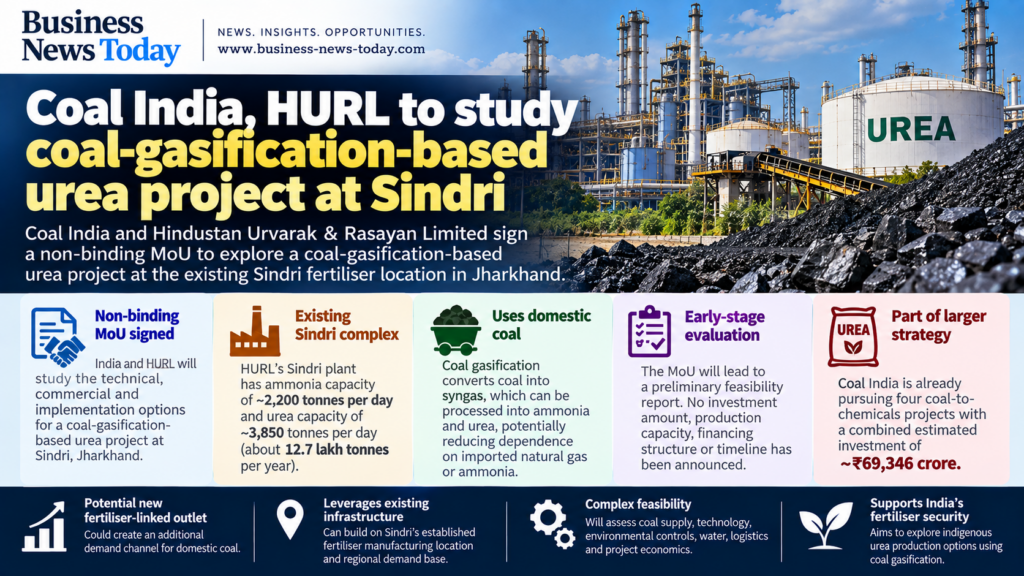
Coal India Limited (NSE: COALINDIA), the state-controlled mining major responsible for the majority of India’s domestic coal output, has signed a non-binding memorandum of understanding with Hindustan Urvarak & Rasayan Limited (HURL) to explore development of coal-gasification-based urea production at Sindri in Jharkhand. The September 29 agreement will initially focus on technical, commercial and implementation options and facilitate preparation of a preliminary feasibility report to assess whether the proposed project is viable. No investment amount, production capacity, financing structure, ownership model or commissioning timeline has yet been announced, meaning the proposal remains at an early evaluation stage rather than representing an approved capital project. The strategic significance lies in Coal India potentially adding another fertiliser-linked outlet for domestic coal while it is already pursuing four coal-to-chemicals programmes carrying combined estimated investment of approximately ₹69,346 crore.
The proposal also creates an unusual industrial fit because Coal India is already one of the lead promoters of Hindustan Urvarak & Rasayan Limited alongside NTPC Limited and Indian Oil Corporation Limited. HURL operates fertiliser plants at Gorakhpur, Barauni and Sindri, with the existing Sindri complex capable of producing approximately 12.7 lakh tonnes of urea annually. Any new coal-gasification-based urea project could therefore build on an established fertiliser manufacturing location, although the memorandum does not yet specify whether the proposed facility would integrate with existing infrastructure, add new capacity or use an entirely separate production configuration.
What exactly have Coal India and HURL agreed to study at the existing Sindri fertiliser location?
The memorandum establishes a framework for Coal India Limited and Hindustan Urvarak & Rasayan Limited to examine the technical and commercial feasibility of producing urea through coal gasification at Sindri. The immediate output is expected to be a preliminary feasibility report rather than construction activity, equipment procurement or commitment of project capital.
Coal gasification converts coal into synthesis gas, commonly known as syngas, containing gases that can subsequently be processed into products including hydrogen, ammonia, urea, methanol and synthetic natural gas. In a fertiliser project, the value proposition is the ability to use domestic coal as part of the feedstock chain for ammonia and ultimately urea rather than depending entirely on imported natural gas or imported ammonia.
The commercial challenge is considerably more complex than simply placing a gasifier beside an existing fertiliser plant. The feasibility work will need to consider coal quality, gasification technology, syngas purification, ammonia integration, water availability, ash management, environmental controls, utilities, logistics and the economics of the resulting urea against alternative feedstock routes.
Coal India has not disclosed how much coal would be required, where that coal would originate or whether a particular subsidiary would supply it. Those decisions are likely to emerge only after technical configuration and proposed plant capacity have been evaluated.
Why is Sindri strategically useful for a potential coal-gasification-based urea project?
Hindustan Urvarak & Rasayan Limited already operates a substantial fertiliser complex at Sindri in Jharkhand. The facility has installed ammonia capacity of approximately 2,200 tonnes per day and urea capacity of roughly 3,850 tonnes per day, translating into annual urea production capability of about 12.7 lakh tonnes.
The existing plant was developed as part of the revival of historic fertiliser manufacturing locations at Sindri, Gorakhpur and Barauni. HURL’s three operating units collectively provide around 3.8 million tonnes of annual urea-production capacity, giving the joint venture a large established operating platform across northern and eastern India.
Locating a prospective gasification project around Sindri could offer access to existing fertiliser expertise, infrastructure and a major regional demand base. Jharkhand’s proximity to important coal-producing areas may also create logistical advantages, although the feasibility study still needs to demonstrate whether those advantages outweigh the capital and operating complexity associated with coal gasification.
The latest memorandum should therefore not be interpreted as confirmation that HURL’s existing natural-gas-based Sindri plant will simply switch feedstocks. Coal India has disclosed only that the companies will explore development of coal-gasification-based urea production at Sindri, leaving the exact relationship with existing assets unresolved.
How does the HURL proposal fit into Coal India’s Rs 69,346 crore coal-to-chemicals strategy?
Coal India’s diversification programme already contains four major coal-to-chemicals projects with combined estimated costs of approximately ₹69,346 crore. The portfolio is large enough to show that coal conversion is no longer being treated as a small research programme, although several projects remain at different stages of engineering and execution.
Talcher Fertilizers Limited represents the largest fertiliser-linked example, with planned annual urea capacity of approximately 1.27 million tonnes and an estimated project cost of ₹19,062.22 crore. The project is intended to use coal gasification in the urea-production chain and provides Coal India with an existing reference point for assessing the technical and economic challenges of coal-to-fertiliser development.
Bharat Coal Gasification & Chemicals Limited, a Coal India and Bharat Heavy Electricals Limited joint venture, is developing a 0.66 million-tonne-per-year ammonium nitrate project with an estimated cost of approximately ₹25,015.89 crore. Bharat Heavy Electricals Limited secured the coal gasification and raw syngas cleaning package for the project during January 2026, marking commercial deployment of its indigenous pressurised fluidised-bed gasification technology.
Coal Gas India Limited, created with GAIL (India) Limited, is pursuing synthetic natural gas production with planned capacity of about 633.6 million normal cubic metres annually and an estimated project cost of ₹13,052.81 crore. Coal India is also working with Bharat Petroleum Corporation Limited on another synthetic-natural-gas initiative at Chandrapur with similar planned output and estimated investment of approximately ₹12,214.86 crore.
The proposed HURL project would therefore broaden an already diverse product mix spanning urea, ammonium nitrate and synthetic natural gas. Its eventual addition to the investment pipeline, however, would depend on the feasibility study producing acceptable economics and the partners subsequently approving a detailed project.
Why is India spending heavily to make coal gasification commercially viable?
India’s current policy push extends well beyond Coal India. In May 2026, the Union Cabinet approved a ₹37,500 crore scheme to promote surface coal and lignite gasification projects, significantly strengthening the policy framework supporting investments in the technology.
The scheme aims to stimulate production of products including synthetic natural gas, ammonia, methanol, urea, synthetic fuels and other chemicals. Government estimates indicate the programme could catalyse approximately ₹2.5 lakh crore to ₹3 lakh crore of investment and support utilisation of around 75 million tonnes of coal annually if projects proceed at the expected scale.
Import substitution sits at the centre of the policy rationale. India remains dependent on imports for substantial quantities of natural gas, ammonia, methanol and urea, exposing domestic industries and the fertiliser subsidy system to international prices, freight costs and currency movements. Converting domestic coal into chemical feedstocks offers one potential way of reducing some of that exposure.
The policy also lengthened coal-linkage tenure for qualifying gasification projects to as much as 30 years, providing developers with greater visibility over feedstock availability. Long-term coal security matters because gasification facilities require large upfront investment and need high utilisation over many years to generate competitive returns.
Government support improves project economics, but it does not remove technology risk. Coal India itself has identified adaptation to high-ash Indian coal, water consumption, ash handling, emissions management, equipment localisation and process reliability as major technical priorities that must be demonstrated before replication at scale.
Could the Sindri project help Coal India create more value from each tonne of coal?
Coal India remains overwhelmingly dependent on producing and selling thermal coal, particularly to India’s electricity sector. That business remains strategically important because coal is expected to supply a large portion of Indian electricity for many years even as renewable capacity expands.
Coal-to-chemicals creates a different value chain. Instead of selling coal primarily as a fuel, Coal India can participate in converting part of its resource base into ammonia, urea, ammonium nitrate, synthetic gas and other industrial products. Successful downstream projects could therefore diversify revenue away from simple mining volumes and regulated or market-linked coal pricing.
The economic opportunity is particularly relevant over a long horizon. India’s electricity system is gradually adding solar, wind, energy storage, nuclear power and other sources, creating uncertainty over the eventual trajectory of thermal-coal demand. Coal India is attempting to prepare for that transition while maintaining its dominant mining business.
Its diversification portfolio now extends beyond gasification into thermal generation, solar power, battery energy storage, critical minerals, graphite, rare-earth opportunities and other mineral assets. Around 550 MW of solar capacity has already been commissioned, while a 2×800 MW ultra-supercritical expansion is being pursued with Damodar Valley Corporation at Chandrapura.
Coal India is therefore not abandoning coal but attempting to create additional demand pathways around its resource position. The HURL memorandum fits that strategy because fertiliser production could create a long-duration industrial use for coal that is independent of power generation.
What financial hurdle must Coal India clear before another large gasification investment makes sense?
Coal gasification projects require exceptionally large upfront expenditure, making capital discipline central to the strategy. The four projects already identified by Coal India carry estimated combined costs approaching ₹70,000 crore before any potential Sindri investment is added.
Coal India has substantial financial capacity compared with most industrial companies. Consolidated Q1 FY27 revenue from operations rose 7.8% year on year to approximately ₹46,254.8 crore, while profit attributable to shareholders increased marginally to about ₹8,852.1 crore.
The more cautionary number was operating profitability. Operating margins declined to approximately 26.1% from 29.3% a year earlier as costs increased, while coal production during Q1 fell by around 7.5% to 169.6 million tonnes. The business remains highly profitable, but higher revenue did not produce comparable earnings growth.
Large diversification commitments therefore need to generate returns that justify moving capital outside Coal India’s historically lucrative mining franchise. Government policy objectives and energy-security considerations are important for a state-controlled enterprise, but commercial sustainability remains necessary if the projects are to create lasting shareholder value.
The preliminary feasibility report for Sindri becomes important for precisely that reason. It should provide the basis for estimating capital intensity, operating costs, coal consumption, urea economics and potential government support before Coal India commits material funds.
What could make coal-to-urea economics attractive or difficult at Sindri?
Feedstock security represents one potential advantage. Coal India controls an enormous domestic resource base and can potentially provide long-term coal supply to a gasification facility without the same exposure to international natural-gas prices that affects conventional fertiliser economics.
Existing HURL infrastructure and operating expertise could provide another advantage if the feasibility study determines that material integration is possible. Sindri already possesses ammonia and urea production infrastructure, utilities, workforce capabilities and logistics arrangements associated with a large fertiliser complex.
Capital intensity works in the opposite direction. Coal gasification and syngas-cleaning systems require substantial equipment and engineering, while high-ash Indian coal can increase the complexity of gasifier design and waste management. Water consumption and carbon emissions also require careful assessment.
The project’s economics may therefore depend heavily on scale, government incentives, coal prices, alternative gas prices and the ability to operate continuously at high utilisation. An attractive feasibility study would need to demonstrate competitiveness across a range of feedstock and fertiliser-price scenarios rather than only under unusually favourable market conditions.
Environmental performance will also influence the long-term case. Coal gasification creates a route to chemical production rather than direct combustion, but the process can remain carbon intensive unless emissions are effectively managed. Future engineering decisions around efficiency, carbon capture, water recycling and ash utilisation could materially influence both compliance costs and project economics.
How is Coal India stock positioned as the company accelerates diversification?
Coal India shares closed at ₹425 on the National Stock Exchange of India on September 29, up 0.59% for the session. The stock traded between ₹420.55 and ₹426, with approximately 7.46 million shares changing hands.
At ₹425, Coal India had a market capitalisation of approximately ₹2.62 lakh crore. The stock was around 13.5% below its 52-week high of ₹491.25 but roughly 15% above the annual low of ₹369.60.
Coal India shares had gained about 6% over the preceding month and approximately 9% over one year. The September 29 MoU was announced during market hours, although the modest daily gain cannot reliably be attributed solely to the HURL agreement because coal-market conditions, broader equity movements and investor positioning also influence the stock.
The immediate earnings case remains dominated by coal production, offtake, realisations, employee costs and power-sector demand. The gasification portfolio is more relevant to Coal India’s medium- and long-term strategic value because most projects require years of investment before contributing material earnings.
What should investors watch after Coal India and HURL signed the Sindri MoU?
The preliminary feasibility report is the first meaningful milestone. It should determine whether the proposed coal-to-urea configuration is technically workable and commercially competitive and may establish an initial capacity, investment requirement and implementation structure.
A formal project approval would represent the next major threshold. Until the boards or relevant government authorities approve capital expenditure, the Sindri initiative should not be included as committed investment alongside Coal India’s four existing coal-to-chemicals projects.
The eventual ownership structure will also matter. Coal India is already a promoter of HURL, but the MoU does not say whether any future project would sit inside HURL, a new joint venture or another special-purpose entity.
Government incentive eligibility could materially influence economics given the ₹37,500 crore national gasification-support programme. Any allocation of financial assistance, long-term coal linkage or other policy support would reduce uncertainty around the business case.
Coal India’s September 29 agreement with Hindustan Urvarak & Rasayan Limited therefore represents an early but strategically coherent extension of one of the company’s largest diversification themes. The company already has approximately ₹69,346 crore of coal-to-chemicals projects under development, and Sindri could add another route linking domestic coal resources with India’s fertiliser requirements. The decisive evidence will come from the feasibility study, because only a project that demonstrates credible technology, manageable environmental performance and competitive urea economics should progress from memorandum to major capital commitment.
Key takeaways from Coal India and HURL’s proposed Sindri coal-to-urea project
- Coal India Limited and Hindustan Urvarak & Rasayan Limited signed a non-binding memorandum of understanding on September 29.
- The companies will explore development of coal-gasification-based urea production at Sindri in Jharkhand.
- The initial work will focus on technical, commercial and implementation options and preparation of a preliminary feasibility report.
- No project investment, capacity, financing structure or commissioning timetable has yet been disclosed.
- HURL’s existing Sindri facility has annual urea capacity of approximately 12.7 lakh tonnes.
- Coal India already has four major coal-to-chemicals initiatives with combined estimated investment of roughly ₹69,346 crore.
- Those projects include urea, ammonium nitrate and synthetic-natural-gas production.
- India approved a ₹37,500 crore gasification incentive programme in May 2026 to support large-scale investment in coal and lignite conversion.
- Coal India’s Q1 FY27 revenue increased about 7.8% to ₹46,254.8 crore, while net profit rose only marginally to approximately ₹8,852.1 crore.
- Coal India shares closed at ₹425 on September 29, valuing the company at approximately ₹2.62 lakh crore.
- The preliminary feasibility report and any subsequent final investment decision will determine whether Sindri becomes Coal India’s next major coal-to-chemicals project.
Discover more from Business-News-Today.com
Subscribe to get the latest posts sent to your email.