


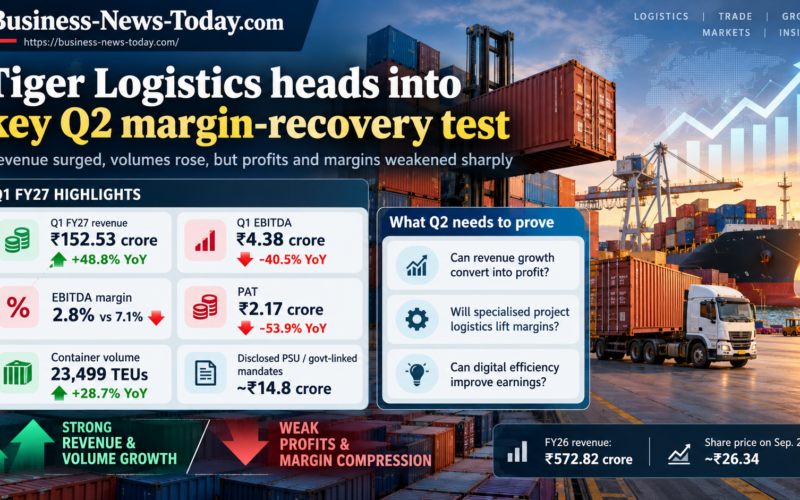
Tiger Logistics (India) Limited (NSE: TIGERLOGS), a New Delhi-based international logistics company providing freight forwarding, customs clearance, transportation and specialised project-cargo services, has announced closure of its trading window from October 1 ahead of financial results for the quarter and half-year ending September 30, 2026. The filing is procedural, but the coming results carry greater significance after Q1 FY27 revenue from operations jumped 48.8% year on year to ₹152.53 crore while profit after tax fell 53.9% to just ₹2.17 crore. Container volumes grew strongly and the company added new public-sector logistics work from Bharat Heavy Electricals Limited and Hindustan Petroleum Corporation Limited, yet freight-rate volatility, transportation expenses and competitive pricing compressed margins sharply. Q2 will therefore test whether Tiger Logistics can turn rapid shipment growth and its expanding PSU customer base into stronger earnings rather than simply higher revenue.
The September-quarter reporting cycle follows a year in which Tiger Logistics generated ₹572.82 crore of fiscal 2026 revenue but saw annual profit after tax decline to approximately ₹21.52 crore from ₹27.01 crore. Management has increasingly emphasised digitalisation, specialised project logistics and government-linked customers as avenues for growth. The financial priority, however, has shifted toward restoring margin conversion after two quarters in which revenue scale has not translated proportionately into operating profit.
Why are Tiger Logistics Q2 FY27 results more important after Q1 revenue jumped almost 49%?
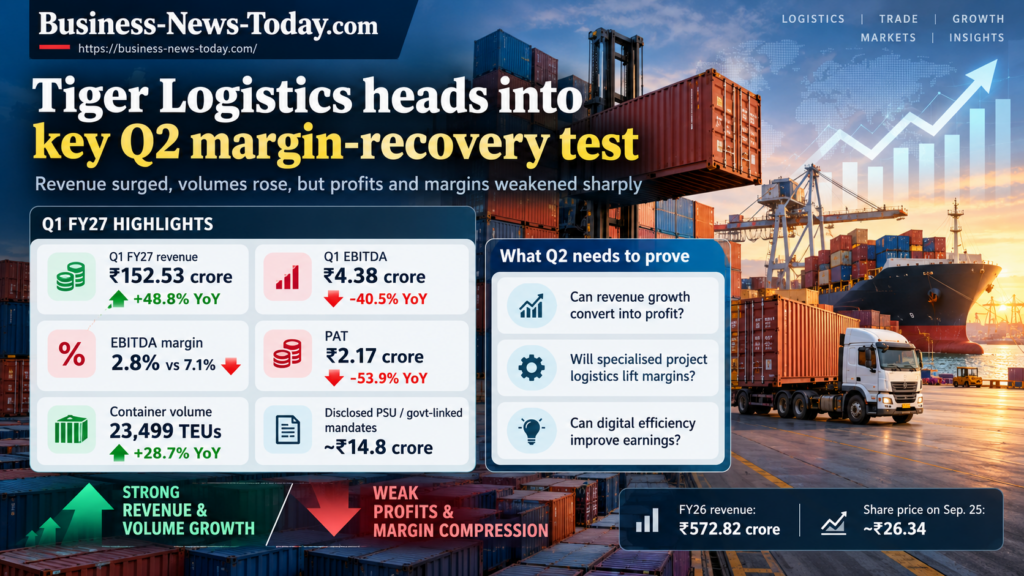
Tiger Logistics began fiscal 2027 with impressive top-line growth. Revenue from operations increased to ₹152.53 crore from approximately ₹102.52 crore in Q1 FY26, while total income reached ₹154.13 crore. Container volumes increased 28.7% year on year to 23,499 twenty-foot equivalent units from 18,256 units, indicating that the revenue improvement was supported by substantially higher shipment activity rather than being driven solely by pricing.
Profitability moved in the opposite direction. EBITDA declined approximately 40.5% to ₹4.38 crore from ₹7.37 crore and EBITDA margin fell to around 2.8% from 7.1%. Profit after tax dropped to ₹2.17 crore from ₹4.71 crore, reducing the PAT margin to roughly 1.4% from around 4.5%.
The divergence means Tiger Logistics generated approximately ₹50 crore more quarterly revenue while earning about ₹2.5 crore less profit. Such a relationship can occur in freight forwarding when freight costs, fuel, insurance, transportation charges and competitive customer pricing rise faster than the revenue generated from additional volumes.
Q2 therefore needs to show more than continued shipment growth. Tiger Logistics must demonstrate that pricing discipline, cost management and business mix can improve enough to prevent incremental revenue from producing disproportionately small incremental earnings.
What caused Tiger Logistics margins to collapse despite a 28.7% increase in container volumes?
Management identified freight-rate volatility, elevated transportation expenses and competitive pricing pressure as important reasons for the Q1 margin contraction. Global logistics markets remain exposed to changing shipping routes, geopolitical disruptions, tariffs and fluctuations in ocean and air freight capacity, all of which can alter procurement costs faster than contractual customer rates can be adjusted.
Tiger Logistics operates largely as an asset-light logistics provider, coordinating shipping, customs clearance, inland transportation and other services through a network of carriers and partners. The model limits the need for substantial ownership of ships, aircraft or large transport fleets, but margins depend heavily on the spread between freight procured from service providers and the rate charged to customers.
Q1 also showed contrasting trends across modes. Containerised freight volume increased substantially, while air-transport volume declined approximately 29% year on year to about 51,065 kilograms from 72,091 kilograms. Changes in the mix of ocean freight, air cargo, project cargo and other services can influence consolidated margins because each activity carries different revenue and profitability characteristics.
A healthier Q2 would therefore combine continued container growth with stronger EBITDA conversion. Revenue expansion accompanied by another quarter near a 2.8% EBITDA margin would suggest that Tiger Logistics is still prioritising volume and customer acquisition ahead of profitability, while margin recovery would indicate that the additional scale is beginning to produce operating leverage.
How important are Tiger Logistics’ new HPCL, BHEL and Bank Note Paper Mill contracts?
Tiger Logistics has been strengthening its public-sector and government-linked customer portfolio through several specialised mandates during fiscal 2027. In August, the company secured two air-import contracts from Hindustan Petroleum Corporation Limited valued at approximately ₹8.8 crore for movement of around 310 metric tonnes of specialised project cargo to Visakhapatnam.
The assignments involve three chartered flights carrying cargo from France and Saudi Arabia, with Tiger Logistics responsible for air freight, customs clearance and inland transportation. The contracts have an execution period of approximately one year and expand the company’s exposure to complex air-import project logistics rather than conventional container freight alone.
Earlier, Tiger Logistics won an approximately ₹4 crore break-bulk logistics order from Bharat Heavy Electricals Limited. The assignment involves transporting 13 over-dimensional cargo units, each weighing approximately 89 metric tonnes, from Italy to India. Tiger Logistics had already been executing other Bharat Heavy Electricals assignments and had delivered 28 machine components under earlier projects.
Bank Note Paper Mill India Private Limited also renewed Tiger Logistics for a one-year import logistics mandate valued at approximately ₹2 crore. The work covers freight forwarding by air and sea, customs clearance and inland transportation for imported consignments destined for the enterprise’s Mysuru facility.
Taken together, the disclosed Hindustan Petroleum Corporation Limited, Bharat Heavy Electricals Limited and Bank Note Paper Mill India mandates represent around ₹14.8 crore of contract value. That is modest relative to annual revenue above ₹570 crore, but the strategic relevance lies in building credentials for specialised government and PSU logistics work where execution history can support future tender participation.
Can project logistics improve Tiger Logistics margins compared with conventional freight forwarding?
Specialised cargo offers Tiger Logistics a potential avenue to improve business mix. Moving an 89-tonne machine component or arranging charter flights for hundreds of tonnes of refinery-related equipment requires planning, customs expertise, route management and coordination that differ substantially from conventional container booking.
More complex assignments can create opportunities for stronger margins because customers are paying for technical execution and risk management in addition to basic transportation. Whether that opportunity translates into higher reported EBITDA will depend on tender pricing, subcontracting costs, insurance, foreign-exchange exposure and operational execution.
Tiger Logistics already markets project and defence logistics as a distinct capability covering heavy-weight and over-dimensional cargo. The Bharat Heavy Electricals and Hindustan Petroleum Corporation Limited mandates provide measurable commercial evidence that the company is winning work in this segment rather than merely describing it as a future opportunity.
The next step is scale. A handful of ₹2 crore to ₹9 crore contracts will not independently transform a business generating more than ₹500 crore in annual revenue. A recurring portfolio of larger project-logistics and government contracts could, however, alter the revenue mix if the company maintains adequate margins.
What role can FreightJar play in Tiger Logistics’ push for higher efficiency and margins?
Tiger Logistics has also been investing in FreightJar, its digital freight booking and management platform. FreightJar allows customers to search freight rates across shipping lines, obtain quotes, book shipments, automate documentation and track cargo movement through a digital interface.
The strategic logic is to make portions of the freight-forwarding process more scalable. Traditional freight forwarding often relies on manual communication between customers, agents, carriers, customs teams and internal operations staff. Automating quotations, documentation and shipment visibility can potentially reduce administrative workload and allow a logistics company to process larger transaction volumes without proportionately increasing employee costs.
Tiger Logistics has presented FreightJar alongside other technology initiatives such as TiGreen and Cubox as part of its digital transformation strategy. The platform also offers the potential to reach small and medium-sized exporters that may not generate enough individual volume to justify high-touch traditional account management.
The financial evidence remains the crucial test. Q1’s 48.8% revenue growth accompanied by a 40.5% EBITDA decline shows that digitalisation has not yet produced sufficient group-level efficiency to overcome broader cost pressure. Future quarters will need to demonstrate whether increasing FreightJar adoption changes customer acquisition costs, transaction productivity or gross margins in a measurable way.
Why did Tiger Logistics FY26 revenue grow while annual profit still declined?
Tiger Logistics generated fiscal 2026 revenue of approximately ₹572.82 crore, up about 6.8% from ₹536.31 crore in fiscal 2025. EBITDA was approximately ₹26.33 crore, while profit after tax stood at around ₹21.52 crore compared with ₹27.01 crore in the previous year.
The annual numbers already showed the margin problem that became more visible in Q1 FY27. Tiger Logistics expanded the top line, but additional revenue did not produce comparable growth in earnings. The March quarter was particularly weak, with revenue reaching ₹162.55 crore while EBITDA margin fell to around 1%.
Q1 improved EBITDA margin from that March-quarter trough to approximately 2.8%, but profitability remained far below the 7.1% EBITDA margin recorded a year earlier. That makes Q2 an important second data point in determining whether the March quarter represented the low point of the current margin cycle.
The company does not necessarily need to return immediately to earlier peak margins to demonstrate progress. Even a moderate recovery in EBITDA margin alongside sustained revenue above ₹150 crore per quarter could materially improve quarterly earnings because of the current low profit base.
How does Tiger Logistics’ asset-light model affect its earnings and balance-sheet risk?
The asset-light model limits Tiger Logistics’ need for heavy investment in vessels, aircraft and large trucking fleets. Instead, the company focuses on freight procurement, customer relationships, customs expertise, project execution and coordination across transport networks.
That structure can support relatively rapid revenue expansion without the capital expenditure required by asset-heavy logistics operators. It also exposes earnings to freight-rate spreads because purchased transportation represents a large component of operating cost.
When freight markets are stable and customer pricing is disciplined, the company can benefit from rising shipment volumes without deploying large amounts of fixed capital. When transportation costs move abruptly or competition pushes customer rates lower, margins can contract quickly even if reported revenue remains strong.
The Q1 experience illustrates both sides of the model. Tiger Logistics moved 28.7% more container volume and generated nearly 49% more revenue, demonstrating scalability, but EBITDA declined because the economics retained from each unit of activity weakened materially.
Where does Tiger Logistics’ share price stand before the September-quarter results?
Tiger Logistics shares closed at approximately ₹26.34 on the National Stock Exchange of India on September 25, little changed during the session. The stock traded between roughly ₹26 and ₹26.64 and remained near the lower end of its 52-week trading range.
The 52-week range stands at approximately ₹22.87 to ₹54.40, leaving the September 25 close more than 50% below the annual high and around 15% above the 52-week low. The decline indicates that investors have substantially reduced the valuation attached to the business despite the company’s revenue and volume growth.
Based on roughly 10.5 crore outstanding shares, the latest closing price implies an equity-market value of around ₹275 crore to ₹280 crore. That compares with fiscal 2026 revenue of ₹572.82 crore and profit after tax of ₹21.52 crore.
Revenue exceeding market capitalisation does not by itself indicate that a stock is inexpensive because logistics is a high-throughput, comparatively low-margin activity. The more useful valuation question is how much sustainable profit and cash flow Tiger Logistics can generate from each rupee of freight volume.
What would make Tiger Logistics’ Q2 FY27 result substantially stronger than Q1?
The most important measure will be EBITDA margin rather than revenue growth alone. Q1 demonstrated that adding almost 49% to revenue can still coincide with a severe earnings decline when freight and transportation costs absorb most of the incremental sales.
A recovery from the 2.8% Q1 EBITDA margin would therefore carry considerable significance. If revenue remains near or above ₹150 crore while margins move meaningfully higher, Tiger Logistics could generate substantially better profit even without another exceptional increase in volumes.
PSU contract execution will provide another signal. Revenue contribution from the Hindustan Petroleum Corporation Limited charter operations, Bharat Heavy Electricals project cargo and Bank Note Paper Mill India mandate would demonstrate whether specialised logistics is becoming large enough to influence business mix.
Container volumes remain relevant, but they need to be evaluated alongside yield and profitability. Another quarter of strong TEU growth with falling earnings would reinforce concerns that volume is being won at insufficient margins.
FreightJar adoption and digital operating efficiency form the longer-term test. Tiger Logistics has established a technology platform capable of supporting a larger customer base, but Q2 and subsequent quarters must show whether digitalisation helps reduce the cost of serving that growth.
The September 27 trading-window notice therefore contains little new information by itself, but it precedes an unusually important earnings period for Tiger Logistics. The company has already demonstrated that it can grow shipment volumes rapidly and win work from major government-linked customers. Q2 now needs to demonstrate the second half of the equation: converting that expanding logistics activity into stronger operating profit.
Key takeaways as Tiger Logistics approaches its Q2 FY27 margin-recovery test
- Tiger Logistics (India) Limited has announced closure of its trading window from October 1 ahead of Q2 FY27 results.
- The trading-window filing is procedural and does not provide a new results date or financial guidance.
- Q1 FY27 revenue from operations increased 48.8% year on year to ₹152.53 crore.
- Q1 EBITDA fell approximately 40.5% to ₹4.38 crore and EBITDA margin contracted to about 2.8% from 7.1%.
- Profit after tax declined 53.9% to ₹2.17 crore despite the strong revenue increase.
- Container volumes increased 28.7% to 23,499 TEUs, while air-cargo volume declined year on year.
- Tiger Logistics secured approximately ₹8.8 crore of air-import logistics work from Hindustan Petroleum Corporation Limited during August.
- The company also has an approximately ₹4 crore specialised break-bulk mandate from Bharat Heavy Electricals Limited and a ₹2 crore Bank Note Paper Mill India contract.
- Fiscal 2026 revenue reached ₹572.82 crore, while annual profit after tax declined to around ₹21.52 crore.
- Tiger Logistics shares closed near ₹26.34 on September 25, more than 50% below the upper end of their 52-week range.
- Q2 EBITDA margin, specialised project-logistics revenue and the conversion of higher shipment volumes into profit will be the most important operating indicators.
Discover more from Business-News-Today.com
Subscribe to get the latest posts sent to your email.