Mattel, Inc. (NASDAQ: MAT) has attracted reported takeover interest from Authentic Brands Group in a potential transaction that could value the owner of Barbie and Hot Wheels at around $6 billion or more, setting up a striking valuation debate just as Mattel enters an unexpected leadership transition.
The Wall Street Journal first reported that Authentic Brands Group had discussed a potential offer above $20 per Mattel share. Reuters subsequently reported, citing a person familiar with the matter, that Mattel had been approached and that the potential valuation could be around $6 billion or more. Neither company had publicly confirmed a transaction, and there was no formal sale process disclosed when the reports emerged.
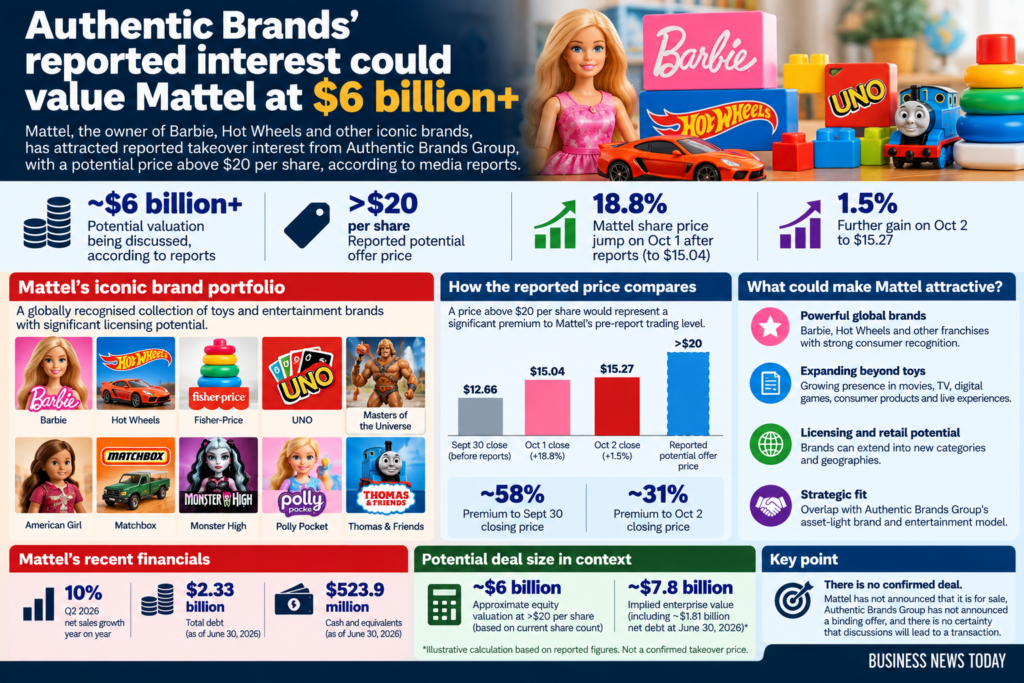
That distinction matters. Mattel has not announced that it is for sale, Authentic Brands Group has not announced a binding offer, and there is no certainty that discussions will lead to a negotiated acquisition. Yet investors reacted dramatically: Mattel shares closed 18.8% higher at $15.04 on October 1 and advanced another 1.5% to $15.27 on October 2.
The reported price also exposes how sharply investor perceptions can differ from the valuation a strategic buyer might place on intellectual property. A $20 share price would be roughly 58% above Mattel’s $12.66 closing price on September 30, immediately before the takeover report emerged. Even after the two-day rally, $20 would still represent roughly a 31% premium to the October 2 close, with any offer above $20 implying a still larger premium.
Why could Mattel be worth substantially more to Authentic Brands Group?
The obvious attraction is not simply Mattel’s toy factories. It is a collection of globally recognised intellectual property that includes Barbie, Hot Wheels, Fisher-Price, American Girl, UNO, Masters of the Universe, Matchbox, Monster High, Polly Pocket and Thomas & Friends.
Mattel has spent much of the Ynon Kreiz era trying to reposition itself from a conventional toy manufacturer into what the company describes as an intellectual-property-driven play and family entertainment business. Its strategy now extends across toys, consumer products, movies and television, digital games and live experiences rather than relying solely on selling physical products through retailers.
Authentic Brands Group approaches intellectual property from a different starting point. The privately held company describes itself as an asset-light brand and entertainment platform that owns or invests in intellectual property and then works through large networks of licensing, operating and distribution partners.
Authentic says its portfolio now includes more than 50 brands supported by more than 1,700 partners in over 150 countries, generating more than $38 billion in annual systemwide retail sales. Its portfolio spans businesses and personalities including Reebok, Champion, Sports Illustrated, Brooks Brothers, Nautica, Dockers, Guess, Elvis Presley and Muhammad Ali.
Mattel would represent a different level of complexity because it is an operating company with manufacturing relationships, inventory, employees, retail exposure and substantial existing toy operations. Nevertheless, the overlap in strategic philosophy is difficult to ignore: both companies increasingly view brands as assets that can extend far beyond their original product categories.
What would an offer above $20 a share actually mean for Mattel’s valuation?
Mattel closed at $12.66 on September 30, giving the company a market capitalisation of approximately $3.6 billion before reports of Authentic Brands Group’s interest became public.
A price of more than $20 per share would therefore imply an equity valuation approaching or exceeding $6 billion, depending on the final price and share count. The difference is significant because the market had been valuing Mattel much more conservatively after a difficult year for the stock.
Mattel also carried approximately $2.33 billion of total debt at June 30, 2026, against $523.9 million of cash and equivalents. That leaves roughly $1.81 billion of net debt based on those balance-sheet figures.
Using a reported equity valuation around $6 billion and that June net-debt position provides a simplified enterprise-value indication of roughly $7.8 billion before considering leases, transaction adjustments, subsequent cash movements or any other negotiated items. This is not a reported takeover price and should not be treated as definitive deal economics; it simply illustrates that acquiring Mattel would require an economic commitment meaningfully larger than the headline equity value.
That raises the central question for a potential buyer. Is Mattel worth close to $8 billion as an operating business because its brands can generate substantially more long-term licensing, entertainment and consumer-product revenue than current public-market expectations imply?
Why did Mattel’s stock become vulnerable to takeover speculation?
Mattel was producing revenue growth before the takeover report, but the financial picture remained mixed enough to leave investors unconvinced.
Second-quarter 2026 net sales rose 10% year over year to approximately $1.13 billion. However, reported gross margin fell to 48.2% from 50.9%, while operating income declined to $11 million from $79 million and the company recorded an $18 million quarterly net loss compared with $53 million of net income a year earlier.
Mattel attributed the gross-margin pressure primarily to incremental tariff costs, inflation, higher royalties and unfavorable foreign-exchange movements, partly offset by tariff-mitigation actions, cost savings and other factors. The company maintained that consumer demand remained positive and reiterated its full-year outlook.
The brand mix was also uneven. Barbie worldwide gross billings fell 16% in the second quarter to $169 million, while Fisher-Price declined 7%. Hot Wheels moved in the opposite direction, rising 14% to approximately $409 million, while the broader action figures, building sets, games and other category increased 35%.
Those figures help explain the valuation debate. Mattel owns brands with enormous global recognition, but investors must still price the volatility of individual franchises, tariffs, retail demand, marketing spending and the economics of producing physical toys.
A private owner willing to focus more aggressively on royalty streams, licensing partnerships and brand extensions could potentially view that intellectual property differently, although there has been no public indication of how Authentic Brands Group would operate Mattel if an acquisition occurred.
Why does Authentic Brands Group’s business model make the reported interest unusual?
Authentic Brands Group has built its growth around owning intellectual property while allowing specialised partners to handle much of the operating work.
The company explicitly describes itself as digital-first and asset-light. Its brand-management model relies on licensing partners, retailers and operators to manufacture, distribute and sell products while Authentic concentrates on intellectual-property ownership, marketing, partnerships and expansion into new categories.
Its acquisition of brands can therefore be followed by significant changes in operating structure. When Authentic announced its agreement to acquire Lee earlier in 2026, for example, it said it planned to convert the business into a licensing model and use external brand operators alongside its existing network of partners.
That precedent does not prove Authentic would follow the same strategy with Mattel. Mattel’s business is considerably larger and its operating model, toy-development expertise and retail relationships are integral to the value of its franchises.
It does, however, create an important analytical question. Authentic may see intellectual property such as Barbie, Hot Wheels and UNO not merely as toy franchises but as licensing platforms capable of supporting apparel, games, entertainment, consumer goods, hospitality, experiences and other categories globally.
Mattel itself has been moving toward that same destination, which makes the reported takeover interest especially intriguing. A potential buyer would not necessarily be purchasing a failing strategy; it could be attempting to accelerate or monetise a transformation that Mattel has already spent years building.
How important is the leadership change after Ynon Kreiz’s departure?
The takeover interest surfaced almost simultaneously with one of Mattel’s most consequential management changes in years.
Mattel announced on September 30 that Ynon Kreiz would step down as chairman and chief executive officer effective October 2. Reuters subsequently reported that Kreiz is joining Paramount Skydance as co-chief executive as the media group prepares to complete its acquisition of Warner Bros. Discovery.
Mattel named long-serving board member Roger Lynch as chairman effective October 2 and chief executive officer effective on or before November 2. Lynch has been a Mattel director since 2018 and has served as chief executive of Condé Nast since 2019, giving him experience across media, technology and consumer-facing brands.
The timing creates both continuity and uncertainty. Lynch already knows Mattel through his board role, but he is taking over just as takeover speculation potentially forces the company to evaluate strategic alternatives, defend its standalone valuation or negotiate with a prospective buyer.
Kreiz had been closely associated with Mattel’s transformation from a toy-focused company toward an entertainment and intellectual-property platform. The success of the Barbie film demonstrated the potential of that strategy, even if subsequent projects have produced a more mixed commercial record.
A prospective acquirer now has to assess whether Mattel’s brands can create more value inside Authentic Brands Group’s platform than under a new Mattel management team trying to continue the strategy independently.
Are Mattel shareholders already signaling that the company should consider a sale?
The reported Authentic Brands interest did not emerge in a vacuum. Mattel had already faced shareholder pressure over its valuation and strategic direction.
In May, Mattel publicly responded to a letter from Southeastern Asset Management, confirming that its board and management had been engaging with the shareholder and would continue reviewing opportunities to enhance long-term value.
Reuters reported that Southeastern had called for strategic measures that could include private-equity involvement or a sale. Mattel did not commit publicly to such a transaction and instead said its board regularly reviews strategy, performance and opportunities to enhance shareholder value.
The stock’s reaction to the takeover report provides another signal. Mattel shares surged 18.8% on October 1 on trading volume of more than 35 million shares, compared with roughly 11.7 million shares the previous session. They then gained another 1.5% on October 2 with approximately 19 million shares changing hands.
That does not establish that investors expect a transaction to happen. It does indicate that the market rapidly incorporated a higher probability of strategic action into Mattel’s valuation.
Even after the rally, however, the shares remained below the reported potential offer level. That discount reflects uncertainty around whether Authentic Brands Group will submit a formal proposal, whether Mattel will engage, what financing would be required and whether another buyer could emerge.
Could Mattel’s brands be worth more separately than the company is worth together?
This is one of the most important questions raised by the takeover interest.
Mattel’s reported market capitalisation before the takeover story was only about $3.6 billion, despite controlling brands recognised by consumers across generations and geographies. Barbie alone has demonstrated its ability to extend from toys into film, fashion, licensing and experiences, while Hot Wheels continues to produce strong toy growth and has its own entertainment potential.
That gap between corporate valuation and brand recognition can attract companies specialising in intellectual property. An acquirer can ask whether individual brands could produce higher royalty revenue through expanded licensing, whether underused franchises could be revived, or whether corporate costs could be reduced.
Yet separating brand value from the operating system behind it is difficult. Mattel’s design capabilities, retail relationships, marketing organisation, supply chain and decades of toy-development expertise help keep those franchises culturally relevant. Stripping too much operating infrastructure away could theoretically weaken the brands an acquirer is trying to monetise.
Authentic Brands Group would therefore face a more complicated integration decision than it does when buying a relatively straightforward fashion label. The strategic value of Mattel may lie precisely in combining the intellectual property with the product-development machinery already surrounding it.
That makes the potential transaction less obviously suited to a pure licensing conversion and more likely to require a hybrid model if a deal ultimately proceeds.
What do Mattel’s balance sheet and buybacks say about the takeover equation?
Mattel entered the second half of 2026 with approximately $523.9 million of cash and $2.33 billion of total debt. The company had no borrowings outstanding under its $1.4 billion revolving credit facility at June 30.
Mattel had also spent $300 million repurchasing shares during the first half of the year and said it continued to expect approximately $400 million of total share repurchases during 2026.
Those repurchases matter to the takeover discussion because Mattel itself had been allocating substantial capital toward buying its stock at valuations below the reported Authentic Brands indication. They also reduce the number of shares outstanding over time, which can affect the eventual equity cost of any per-share acquisition.
For an acquirer, however, Mattel’s existing debt would remain part of the economic equation even if shareholders focus primarily on the headline per-share price. Any serious buyer would need to determine how existing notes, working-capital requirements and seasonal funding needs fit with the acquisition financing.
Authentic Brands Group is privately held, so the financing structure of any potential Mattel transaction is not yet visible. No binding financing package has been announced, and speculation about debt, equity partners or asset sales would therefore be premature.
Why are investors watching the $20-per-share level so closely?
The reported threshold provides a simple benchmark because it sits far above where Mattel traded immediately before the takeover report.
At $12.66 on September 30, Mattel shareholders were valuing the business after a year marked by margin pressure, tariffs, declining Barbie billings and uncertainty over leadership. A potential buyer contemplating more than $20 per share would effectively be arguing that those near-term issues obscure materially greater strategic value.
After the report, Mattel closed at $15.04 on October 1 and $15.27 on October 2. The stock therefore retained a sizeable gap to $20, indicating that the market was not pricing a $20-plus transaction as certain.
That gap can narrow if a formal bid emerges or widen if Authentic Brands Group walks away, Mattel rejects discussions or financing proves difficult. Without an announced offer, it remains a probability-weighted takeover premium rather than evidence that shareholders will receive more than $20.
The immediate 18.8% rally should also not be interpreted as a fundamental reassessment based solely on Mattel’s operating performance. The timing strongly links the move to published takeover reports, although broader market factors can always influence a stock during a trading session.
What should investors watch next in the Mattel takeover story?
The most important milestone is straightforward: whether reported interest becomes a formal proposal.
A confirmed price would resolve much of the current valuation uncertainty. Investors would then need to examine whether the figure represents equity value or includes other considerations, what financing conditions apply, whether Mattel’s board recommends the transaction and what regulatory approvals would be required.
Mattel’s leadership transition is the second variable. Roger Lynch is taking control of a company whose standalone strategy is already evolving toward entertainment, digital experiences and intellectual-property monetisation. If Mattel remains independent, he will inherit the task of convincing investors that those brands can create more value than the market was recognising before takeover speculation emerged.
The third variable is operating performance. Hot Wheels is growing strongly, but Barbie and Fisher-Price weakened in the second quarter while tariffs and inflation compressed margins. Strong holiday-season execution could strengthen Mattel’s negotiating position or support the argument for remaining independent, while weaker results could make a premium offer more difficult to dismiss.
For Authentic Brands Group, the strategic logic is potentially powerful but far from simple. Mattel would add some of the world’s best-known consumer franchises to a platform already built around licensing and brand extension, yet it would also bring a large operating company whose value cannot easily be separated from its product-development and retail capabilities.
That tension is what makes the story more consequential than another takeover rumor. Mattel has spent years arguing that Barbie, Hot Wheels and its other franchises should be valued as intellectual property extending far beyond toys. The reported interest from Authentic Brands Group now raises a much sharper question: if the public market will not fully recognise that value, could a private brand owner be willing to pay for it instead?
Discover more from Business-News-Today.com
Subscribe to get the latest posts sent to your email.