



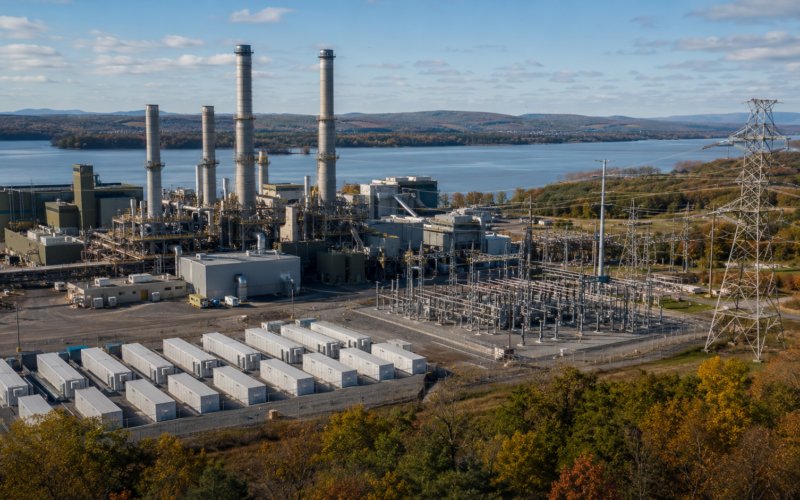
PowerTransitions has completed its acquisition of five operating natural gas-fired power plants in New York with combined capacity of 323 megawatts, marking the privately held power producer’s first completed entry into the New York Independent System Operator market. The portfolio includes the Hillburn, Shoemaker, Massena, Batavia and Sterling facilities, and lifts PowerTransitions’ operating fleet to approximately 550 megawatts across seven power stations in the New York Independent System Operator, PJM Interconnection and ISO New England markets. The transaction is strategically important because PowerTransitions is not simply purchasing generation output; it is acquiring industrial sites with existing grid connections and potential for storage, replacement generation and other energy infrastructure. If its pending acquisition of the 1,242-megawatt Roseton Generating Station closes, the platform would exceed 1.8 gigawatts across eight power stations. The central question is whether PowerTransitions can convert this rapid accumulation of legacy assets into higher-value energy campuses without allowing integration costs, permitting delays or New York’s decarbonisation timetable to weaken the economics.
The five-plant transaction was originally signed on January 30, 2026, and publicly announced in April. PowerTransitions acquired the portfolio from affiliates of Alliance Energy Group, although the financial terms were not disclosed. The original agreement also covered associated pipeline infrastructure, while the final closing announcement concentrated on the power-generating facilities and did not provide a detailed breakdown of the completed asset perimeter.
PowerTransitions said the plants have supplied electricity into the New York market for decades. Their immediate value lies in their operating status, existing workforces and physical connections to the grid, while their longer-term potential lies in what could be developed around them.
That distinction matters. Acquiring an operating power station is fundamentally different from buying an undeveloped site and beginning a multiyear permitting and interconnection process. PowerTransitions gains an established operating footprint from which it can potentially add storage, modernised generation or powered industrial infrastructure. However, an existing grid connection does not automatically provide approval to connect unlimited new capacity, and every redevelopment proposal will still require asset-specific engineering, permitting and commercial validation.
Why does owning five New York power plants give PowerTransitions more strategic value than the headline 323 megawatts?
The most important assets in the PowerTransitions New York power plant acquisition may not be the generating units themselves. The company has also gained control of five established energy locations spread across multiple parts of New York, each with electricity infrastructure, industrial land and a history of operating within the state’s wholesale market.
Those characteristics can shorten parts of the development process compared with a greenfield energy project. Suitable land near transmission infrastructure is limited, local opposition can delay new projects, and interconnection queues have become a major obstacle for generation developers and large electricity consumers. A brownfield power site can therefore carry strategic value even when the existing generating equipment is relatively old.
PowerTransitions’ business model is designed around that scarcity. The company acquires operating or retired power and industrial facilities and seeks to redevelop them into mixed-use energy campuses. Depending on the site, that could involve battery storage, newer generation, renewable capacity or land supplied with electricity for manufacturing and digital infrastructure.
The five New York plants create several possible redevelopment platforms rather than one concentrated project. That gives PowerTransitions optionality because each location can be evaluated against local electricity prices, transmission constraints, land availability, community requirements and potential customer demand.
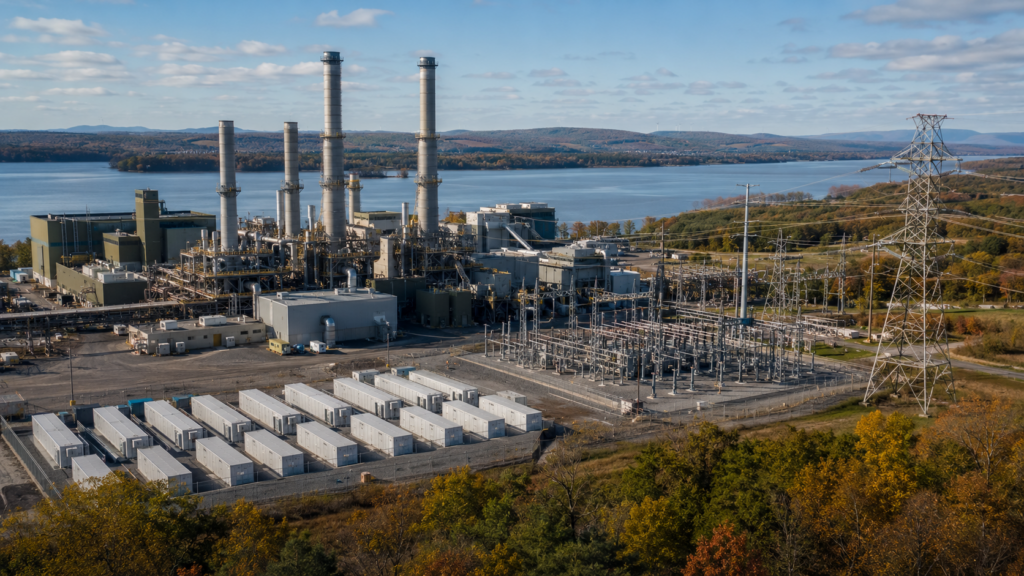
Geographic diversity also reduces reliance on a single development timetable. A storage project at one location could move forward while another site remains in permitting or commercial negotiations. However, diversity does not guarantee attractive returns. The value of each site will depend on its particular market zone, interconnection rights, fuel arrangements, environmental obligations and development costs.
The acquisition should therefore be evaluated as a portfolio of potential projects, not as one uniform 323-megawatt asset. Some sites may prove more valuable as operating generators, while others could eventually produce stronger economics through redevelopment.
How does the acquisition strengthen PowerTransitions before the 1,242-megawatt Roseton deal closes?
The five-plant closing establishes a functioning New York platform before PowerTransitions attempts to absorb the substantially larger Roseton Generating Station in Newburgh. Roseton alone has 1,242 megawatts of dual-fuel generation capacity and has operated in the Hudson Valley since 1974.
If that transaction closes, PowerTransitions would move from a relatively small regional operator into the owner of more than 1.8 gigawatts across three major northeastern electricity markets. Most of the increase would come from New York, making the state central to the company’s operating and redevelopment strategy.
Completing the smaller Alliance Energy Group portfolio first gives PowerTransitions time to develop local operating knowledge, relationships and market capabilities before Roseton enters the group. The company can begin working with New York plant employees, communities, regulators and market institutions while preparing for the integration of a much larger facility.
This sequencing may reduce some execution risk, but it also creates a rapid scaling challenge. PowerTransitions operated a 226-megawatt seed portfolio after completing its initial acquisition in September 2025. The latest transaction lifts the operating base to approximately 550 megawatts, and Roseton could more than triple that figure.
Such expansion requires more than acquisition financing. It demands experienced plant management, maintenance planning, fuel procurement, regulatory compliance, risk controls and disciplined capital allocation across assets with different operating characteristics.
Partners Group’s ownership provides an important financial foundation. When it agreed to acquire PowerTransitions in 2025, the private markets firm said it intended to invest more than $450 million to accelerate the company’s growth. That support helps explain how PowerTransitions can pursue multiple acquisitions and redevelopment opportunities within a relatively short period.
Nevertheless, the amount of capital already deployed, the acquisition financing structure and the remaining funding available for redevelopment have not been disclosed. The ability to buy assets is only the first stage. Long-term value creation will depend on how much additional capital each site requires and whether the resulting cash flows justify that investment.
Why are grid-connected legacy sites becoming increasingly valuable across the New York electricity market?
New York’s electricity system is being pulled in several directions simultaneously. Electricity demand is expected to increase as transportation, buildings and industrial processes become more electrified. Large data centres, semiconductor projects, manufacturing facilities and other energy-intensive developments are also seeking access to the grid.
At the same time, older generators are retiring and replacement resources have not always entered service at the same pace. The New York Independent System Operator has warned that reliability margins have declined and that the interconnection queue includes more than 6,000 megawatts of proposed large electricity loads.
This creates a commercial opportunity for owners of established generation and transmission-connected sites. A developer with land and an existing electrical connection may be better positioned to respond to new demand than one attempting to assemble an entirely new location.
PowerTransitions is effectively buying time as well as physical infrastructure. The company is acquiring sites that have already passed through decades of industrial development, transmission investment and operating history. Recreating those conditions elsewhere could require years of planning and approvals.
However, the advantage must not be overstated. Existing interconnection infrastructure may require upgrades before additional generation, storage or large electricity loads can be accommodated. New facilities may also need separate studies, permits and market approvals. Control of a power site creates a stronger starting position, but it does not eliminate grid constraints.
The economics will also vary widely across New York. Electricity congestion, capacity requirements and development demand are highly location-specific. A megawatt located near a constrained load centre can have different commercial value from a megawatt in an area with weaker demand or limited transmission access.
PowerTransitions’ multi-zone footprint could help it identify those differences and allocate capital selectively. The strongest evidence of strategic discipline would be a site-by-site development plan that explains why each property is suited to a particular combination of operating generation, storage or powered land.
Can natural gas power plants support reliability without conflicting with New York’s clean-energy targets?
The acquisition sits directly within New York’s central electricity-policy tension. The state is targeting 70% renewable electricity by 2030 and a zero-emissions electricity sector by 2040, while the grid operator continues to emphasise the need for sufficient dependable capacity during the transition.
PowerTransitions is buying natural gas-fired plants rather than zero-emission generation. That could appear inconsistent with the state’s long-term policy direction if the transaction were interpreted simply as an effort to extend conventional fossil-fuel generation indefinitely.
The company’s stated strategy is more nuanced. It intends to use existing power sites as foundations for new energy infrastructure, including battery storage. New York is targeting six gigawatts of energy storage by 2030, creating a potentially supportive policy environment for qualified projects.
Storage located at established generation sites could use existing land and electrical infrastructure while helping the grid manage variations in renewable output and peak demand. It could also allow PowerTransitions to layer new capacity onto sites that already serve regional reliability needs.
The important word is “could.” PowerTransitions has not disclosed project-specific storage capacities, capital budgets, construction schedules, permit applications or commercial arrangements for the five acquired plants. The energy-campus opportunity remains a development proposition rather than an operating result.
The existing gas plants may continue to play a reliability role while cleaner resources and transmission infrastructure are added. Their economic life will depend on market revenues, operating costs, environmental compliance and state policy. As New York moves closer to its 2040 objective, the strategic value of the sites may increasingly shift from the original generating equipment to the grid connections and redevelopment potential around them.
PowerTransitions will therefore need to demonstrate that its transition strategy is based on actual project execution. Simply describing legacy sites as future energy campuses will not be enough. Measurable progress would include submitted interconnection requests, storage procurement awards, local permits, financing commitments and construction activity.
What financial information is still missing from the PowerTransitions New York acquisition?
The absence of disclosed transaction terms prevents an external assessment of the acquisition price, financing structure or expected return. PowerTransitions has not provided the purchase consideration, assumed liabilities, debt contribution or projected earnings from the portfolio.
That limits the ability to judge whether the company acquired the assets at an attractive price. Legacy power plants can produce operating cash flow and capacity-market revenue, but they may also require substantial maintenance, environmental investment and modernisation spending.
The five plants could provide interim revenue while redevelopment plans advance, depending on their availability, dispatch levels and participation in New York’s energy and capacity markets. Yet the acquisition announcement did not disclose historical generation, utilisation, earnings or capital-expenditure requirements.
The same information gap applies to the redevelopment strategy. Battery storage and replacement generation can create new revenue opportunities, but these projects require development capital before they produce cash. The return profile will depend on construction costs, incentive eligibility, market revenues, contracted payments and the extent of required grid upgrades.
The pending Roseton transaction makes capital discipline even more important. Acquiring a 1,242-megawatt facility could materially increase operating scale, but it may also introduce additional maintenance, working-capital and development requirements.
PowerTransitions’ sponsor support improves its ability to pursue the strategy, although private capital is not free capital. Partners Group and its clients will ultimately require infrastructure returns that reflect the risk, duration and scale of the investment.
The strongest version of the strategy would combine near-term cash generation from operating plants with carefully phased redevelopment expenditure. The weaker version would involve acquiring numerous sites faster than engineering, permitting and commercial teams can advance them.
Which milestones will show whether the five-plant portfolio is becoming a valuable New York energy platform?
The first milestone will be operational stability. PowerTransitions must integrate the five facilities without weakening plant availability, workforce retention or compliance. Existing operations are the foundation upon which the redevelopment strategy rests.
The second will be clarity on the Roseton acquisition. Closing that transaction would lift PowerTransitions above 1.8 gigawatts and establish a much larger presence in the Hudson Valley. A delay, revised transaction structure or failure to close would materially change the company’s projected scale.
The third milestone will be project-specific redevelopment disclosures. Investors in Partners Group’s infrastructure vehicles and other industry observers will need evidence that at least some of the acquired sites can support commercially viable storage, modern generation or powered-land projects.
The fourth will be capital discipline. PowerTransitions will need to show that development spending is being directed toward sites with the best combination of grid value, customer demand and achievable permitting.
The acquisition has clearly improved PowerTransitions’ strategic position. It now controls five New York power sites and has moved closer to establishing a multi-gigawatt northeastern generation and redevelopment platform.
What remains unresolved is the economic conversion of that footprint. The company has disclosed substantial capacity and broad development potential, but not the acquisition price, asset-level earnings, redevelopment budgets or project schedules.
The next measurable proof point is therefore not another statement about energy-campus potential. It is the announcement of a financed, permitted and commercially supported project at one of the acquired sites, combined with successful completion of the Roseton transaction. That evidence would demonstrate that PowerTransitions is building an integrated infrastructure platform rather than merely assembling a larger collection of legacy power plants.
What are the key takeaways from PowerTransitions’ five-plant New York acquisition?
- PowerTransitions completed the acquisition of five New York natural gas-fired power plants with combined capacity of 323 megawatts.
- The acquired portfolio includes the Hillburn, Shoemaker, Massena, Batavia and Sterling power facilities.
- The transaction increases PowerTransitions’ operating portfolio to approximately 550 megawatts across seven stations in three northeastern electricity markets.
- The sites provide existing grid connections and industrial land that could support battery storage, new generation or powered infrastructure developments.
- No purchase price, financing structure, asset-level earnings or redevelopment budget was disclosed.
- PowerTransitions has not announced site-specific storage capacities, construction schedules, permits or commercial agreements for the five plants.
- The pending 1,242-megawatt Roseton Generating Station acquisition could increase the company’s portfolio beyond 1.8 gigawatts.
- Partners Group’s financial backing supports the expansion strategy, but long-term returns will depend on disciplined deployment of development capital.
- The central strategic test is whether PowerTransitions can transform legacy generation sites into commercially viable energy campuses while New York pursues its 2030 and 2040 clean-energy targets.
Discover more from Business-News-Today.com
Subscribe to get the latest posts sent to your email.