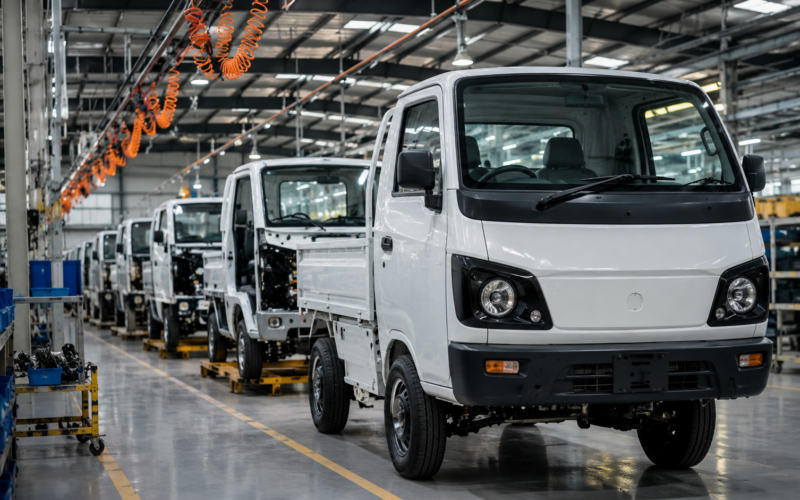
Euler Motors has expanded its Palwal manufacturing operation in Haryana with a dedicated four-wheeler electric commercial vehicle facility carrying a stated investment overlay of ₹100 crore and annual production capacity of up to 24,000 vehicles. The new line will manufacture the Turbo EV 1000 one-tonne electric truck and Storm EV, giving the privately held commercial EV manufacturer substantially greater capacity to pursue a four-wheeler cargo segment that has become an increasingly important part of its growth strategy.
The expansion arrives against a striking financial backdrop. Euler Motors more than doubled FY26 revenue to ₹402 crore, but its net loss widened to ₹308 crore as rising material and component costs accompanied rapid growth. The ₹100 crore manufacturing commitment is therefore equivalent to roughly one-quarter of FY26 revenue, making utilisation of the new four-wheeler line commercially important as Euler attempts to move from rapid volume growth toward eventual breakeven.
How much four-wheeler capacity does Euler Motors gain from the ₹100 crore Palwal expansion?
Euler says the new dedicated four-wheeler operation can manufacture up to 24,000 vehicles annually. At theoretical full utilisation, that is equivalent to an average of 2,000 vehicles a month, although production is unlikely to follow a perfectly even schedule and actual output will depend on demand, component supply and the pace at which the new line ramps.
At full production, the facility is expected to operate two shifts supplemented by a third hybrid shift. Manufacturing infrastructure includes an automated four-wheeler assembly conveyor, dedicated assembly stations, a body shop and an integrated battery-pack assembly line, while testing and validation processes have been embedded across the production system.
The battery-pack line is strategically important because the battery remains one of the largest cost components in a commercial EV. Pack integration gives Euler more direct control over vehicle packaging, thermal performance, battery management and manufacturing quality, although it does not mean the company is manufacturing lithium-ion cells itself.
Euler is also emphasising a localised supply chain for the Turbo EV 1000 and Storm EV. Higher localisation can reduce foreign-exchange exposure and shorten component lead times, but commercial-vehicle manufacturing still remains exposed to global prices for cells, semiconductors and metals.

Is the latest ₹100 crore expansion separate from Euler Motors’ earlier Palwal factory investment?
The Palwal numbers require careful interpretation because Euler Motors had already unveiled a ₹100 crore manufacturing and research facility at the same location in August 2024. That earlier plant covered about 500,000 square feet and had stated annual capacity of 36,000 vehicles, primarily supporting the company’s three-wheeler HiLoad EV operation.
The 2026 announcement describes the four-wheeler facility as a ₹100 crore investment overlay and says Euler’s wider manufacturing footprint now spans about 40 acres. It is therefore more accurate to treat the latest development as a dedicated four-wheeler expansion of the Palwal manufacturing platform rather than automatically adding the two ₹100 crore figures and asserting a ₹200 crore current plant value without a complete company reconciliation of cumulative investment.
That distinction also helps explain why the capacity figures differ. The 36,000-unit number associated with the 2024 facility related principally to the three-wheeler manufacturing hub, while the latest 24,000-unit figure describes the dedicated four-wheeler operation. They address different product lines and should not be casually combined into a single capacity number unless Euler provides a consolidated plant rating.
The larger strategic point remains unchanged: Euler has moved from being primarily a three-wheeler commercial EV manufacturer into a company with dedicated industrial capacity for electric four-wheel cargo vehicles.
Why is Euler Motors committing new capacity while FY26 losses remain ₹308 crore?
Euler’s FY26 revenue increased 110% to ₹402 crore from ₹191 crore, supported by higher vehicle volumes and accelerating adoption of electric commercial vehicles. Vehicle sales rose to 7,576 units from 4,172 a year earlier, indicating that the company has moved meaningfully beyond pilot-scale deployment.
Profitability remains the harder part of the story. Net loss stood at ₹308 crore, while the EBITDA margin remained negative at 62.9%, although that was a substantial improvement from negative 119% in FY25. Management has said positive unit economics have been achieved and expects the company to reach breakeven over the next two to three years, but the latest manufacturing expansion means fixed costs and working-capital requirements will continue rising before the platform reaches maturity.
Input costs have also been volatile. Founder and chief executive Saurav Kumar pointed to increases in lithium, memory chips, aluminium, copper and plastics during FY26, with some costs absorbed and others passed to customers. That illustrates why higher manufacturing scale does not automatically eliminate losses: pricing and component economics must improve alongside vehicle volumes.
The ₹100 crore four-wheeler expansion is therefore a bet that volume will rise quickly enough to spread engineering, manufacturing and distribution costs across a much larger base. If utilisation lags, the factory can increase depreciation and fixed overhead before generating enough gross profit to absorb them.
How important has the Turbo EV 1000 become to Euler Motors’ four-wheeler strategy?
The Turbo EV 1000 gives Euler direct exposure to the one-tonne electric cargo-truck category, moving the company beyond its established three-wheeler operations into a segment where logistics fleets can replace small diesel and compressed-natural-gas trucks. The Storm EV broadens the four-wheeler portfolio further, including technology such as advanced driver-assistance capabilities.
Industry reporting based on company data indicates that Euler estimates its share of its targeted four-wheel cargo EV segment at roughly 28%, while penetration of electric vehicles in the relevant cargo category has risen sharply since the Turbo EV 1000 entered the market. Those figures remain company-linked estimates rather than independently audited industry market shares, but they help explain why management is adding dedicated capacity only months after launching deeper into four-wheelers.
Commercial fleets are particularly sensitive to total cost of ownership because vehicles can operate for many hours each day. If electric models provide lower energy and maintenance costs without sacrificing payload, range or uptime, the economics can be more compelling than in some private passenger-vehicle applications.
The challenge is that fleet buyers are equally unforgiving about reliability. A commercial vehicle that saves energy but spends too much time off the road can destroy the economics of electrification, placing service networks, battery life and parts availability alongside purchase price as important competitive factors.
Can the 24,000-unit Palwal plant move Euler Motors closer to breakeven?
Euler expects FY27 volumes to grow by at least 40% and has been expanding its distribution and service footprint toward more than 200 touchpoints. If those ambitions translate into sustained vehicle deliveries, the new factory could produce operating leverage as manufacturing costs are distributed over higher output.
The gap to breakeven nevertheless remains large. A ₹308 crore net loss against ₹402 crore of FY26 revenue means Euler cannot depend on modest incremental growth alone; contribution margins, procurement economics and fixed-cost absorption need to continue improving materially.
That is why the 24,000-unit number is both opportunity and risk. It gives Euler the physical ability to expand rapidly if electric cargo demand strengthens, but capacity itself has no economic value unless enough vehicles can be sold at sustainable margins.
Palwal therefore represents a transition in Euler Motors’ story. The company has already demonstrated that it can more than double revenue and gain traction in four-wheeler cargo EVs. The new question is whether a larger manufacturing footprint can turn that commercial momentum into a business capable of funding its own growth rather than requiring continuing capital to absorb losses.
Discover more from Business-News-Today.com
Subscribe to get the latest posts sent to your email.