


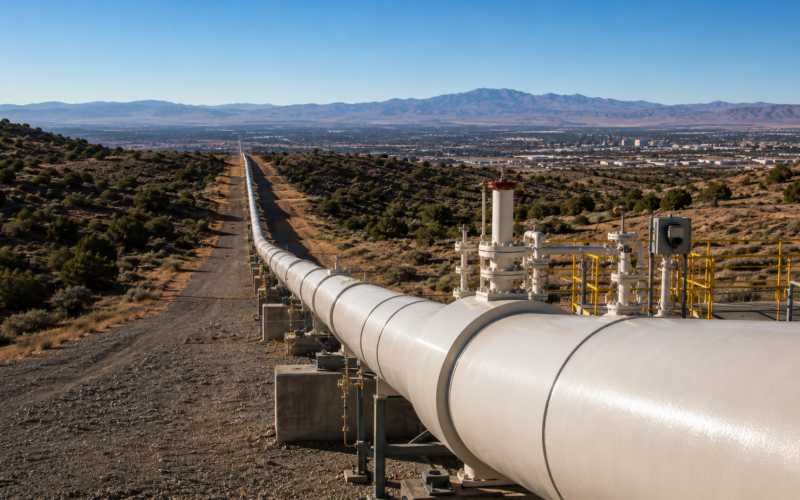
Devon Energy Corporation (NYSE: DVN) has taken a positive final investment decision on the Solitude Pipeline System, joining WhiteWater, MPLX LP, Diamondback Energy and Western Midstream Partners in a major new natural gas corridor from the Permian Basin to Katy, Texas. Solitude will comprise two 48-inch pipelines, with approximately 2.25 Bcf/d of initial capacity targeted for the second half of 2029 and another 2.25 Bcf/d expected in 2030, creating roughly 4.5 Bcf/d of planned capacity before any subsequent expansion. Devon will own 25% of the WhiteWater-operated joint venture and has also secured firm transportation capacity, although neither Devon nor the consortium has disclosed the project’s construction cost or Devon’s exact contracted transportation volume. The investment comes after Devon’s second-quarter natural gas realization fell to just $1.05 per Mcf, with the company explicitly attributing depressed pricing partly to Waha infrastructure constraints in the Delaware Basin. Solitude therefore represents more than another Permian pipeline investment: Devon is attempting to turn associated gas that has historically suffered basin discounts into a longer-duration Gulf Coast supply business linked increasingly to LNG exports and power generation.
How will the 4.5 Bcf/d Solitude Pipeline System change Permian Basin gas takeaway?
The Solitude system will be developed in two large phases rather than arriving as 4.5 Bcf/d of capacity at once. The first 48-inch line is designed to provide approximately 2.25 Bcf/d in late 2029, followed by a similarly sized second phase during 2030. The project partners have retained flexibility to accelerate or defer capacity commissioning depending on market conditions and say the system can ultimately be expanded beyond the initial 4.5 Bcf/d if shipper demand supports additional capacity.
That scale is significant even within a Permian market already undergoing a major pipeline build-out. Matterhorn Express added approximately 2.5 Bcf/d of Permian-to-Katy capacity, while Blackcomb is designed for 2.5 Bcf/d and Eiger Express for as much as 3.7 Bcf/d. The U.S. Energy Information Administration said in May that Blackcomb and other projects were being developed specifically to relieve Waha constraints and supply LNG terminals, power generators, residential customers and industrial demand.
Solitude therefore does not solve a static bottleneck. It is part of an ongoing race between growing associated gas production and infrastructure developers attempting to keep enough spare takeaway capacity available before congestion returns. Western Midstream has explicitly said it expects rising gas-to-oil ratios as the Permian develops, which could make residue-gas takeaway increasingly critical even if crude production growth eventually moderates.
The project is also commercially de-risked to a degree before construction begins. WhiteWater said FID is supported by substantial long-term firm transportation agreements predominantly with investment-grade shippers. Exact contracted volumes, tariff rates and contract durations were not disclosed, so the proportion of the 4.5 Bcf/d already commercially committed cannot yet be calculated.
Why is Devon trying to move the majority of its Delaware gas away from Waha pricing?
Waha has repeatedly demonstrated how a prolific oil basin can create a gas-pricing problem. Natural gas produced alongside Permian crude needs somewhere to go regardless of whether local infrastructure is ready for it, and when regional gas production exceeds available pipeline capacity, producers can face severe basis discounts or even negative spot prices.
The historical evidence is unusually stark. The U.S. Energy Information Administration reported that Waha prices were below zero on 46% of trading days during the first eight months of 2024, with the hub reaching as low as negative $6.41 per MMBtu. Additional pipelines subsequently eased portions of the constraint, but Devon’s latest results show the commercial issue has not disappeared.
In the second quarter of 2026, Devon realised $1.05 per Mcf for natural gas including hedges, compared with much stronger economics in its oil portfolio. Management specifically identified regional Waha pricing caused by Delaware infrastructure constraints as a drag on gas realisations. The issue is therefore visible in current reported financial results rather than being merely a historical concern.
Devon says the long-haul transportation portfolio it is assembling will eventually move the majority of its Delaware gas away from Waha and toward markets connected to expanding Gulf Coast LNG exports and power generation. The strategy does not eliminate commodity-price exposure, but it can change which benchmark and which demand centres determine the value of a much larger portion of Devon’s gas.
How does Solitude fit with Devon’s Blackcomb, Eiger and former Matterhorn investments?
Solitude is best understood as the latest layer of an infrastructure strategy Devon has been building for several years. The company was a founding equity owner in Matterhorn Express, which runs from Waha to Katy and can transport approximately 2.5 Bcf/d. Devon sold its Matterhorn investment in 2025 for $409 million and recognised a $342 million pre-tax gain while retaining its transportation rights.
That transaction demonstrates why Devon is willing to own midstream infrastructure without necessarily retaining it permanently. Early equity participation can help secure pipeline development, provide visibility over project economics and potentially create an asset that can later be monetised once construction and commercial risks have fallen. The transportation rights can remain valuable to the upstream business even after the ownership stake is sold.
Devon has also secured another 550 MMcf/d of firm transportation capacity across Blackcomb and Eiger. Blackcomb is scheduled to move Permian gas toward the Agua Dulce market, while Eiger is another large Permian-to-Katy system being developed by WhiteWater and partners. Solitude adds a still longer-dated outlet extending into 2029 and 2030.
The combined approach gives Devon multiple pathways instead of relying on one pipeline and one Gulf Coast pricing point. That optionality matters because pipeline outages, maintenance, regional demand changes or unexpected production growth can quickly alter basis economics. Diversified firm takeaway can become an operating advantage when competitors remain more exposed to distressed basin pricing.
Why could LNG-linked pricing matter more to Devon than simply adding pipeline capacity?
Moving gas out of the Permian solves only the physical portion of the problem. Devon is also trying to improve where and how portions of that gas are priced.
The company has begun securing international LNG-linked exposure, including 100 MMcf/d beginning in 2027 and another 150 MMcf/d beginning in 2028. Devon has not disclosed the counterparties or full pricing formulas in its Solitude announcement, but the combined 250 MMcf/d represents an early attempt to connect upstream production economics with international gas markets rather than relying solely on domestic basin benchmarks.
The timing aligns with a major expansion of North American liquefaction capacity. The U.S. Energy Information Administration estimated that North American LNG export capacity could increase from 11.4 Bcf/d at the beginning of 2024 to 28.7 Bcf/d by 2029 if projects under construction enter service as planned. U.S. LNG exports alone are forecast to average around 17 Bcf/d in 2026 before increasing again in 2027 as new facilities ramp up.
Solitude’s first phase is scheduled for late 2029, meaning its capacity arrives as a substantially larger LNG market should already be operating along the Gulf Coast. That alignment creates the possibility that additional Permian gas can move into a market where liquefaction terminals are competing for feedgas rather than remaining trapped behind Waha constraints.
International pricing is not automatically superior. LNG margins, global prices, shipping constraints and contract structures can all change. The strategic advantage is greater market choice. Devon is trying to create the ability to direct gas toward the demand centre offering the best netback instead of accepting whichever price emerges at an overcrowded basin hub.
How much of Devon’s strategy now extends beyond simply drilling oil and gas wells?
Solitude fits into a much broader attempt to control infrastructure around Devon’s core Delaware Basin acreage. The company says the Delaware now accounts for more than half of its production and free cash flow, making infrastructure performance around the basin economically material at group level.
In gas processing, Devon owns 50% of Catalyst Midstream Partners with Howard Energy Partners, providing more than 600 MMcf/d of processing capacity for its Stateline development. In gathering and compression, Devon owns Cotton Draw Midstream outright and operates Stateline and Triple Crown systems, giving it approximately 3.4 Bcf/d of compression capacity.
The company has also built approximately 1,200 miles of electrical distribution infrastructure and four microgrids with about 75MW of installed capacity. Its produced-water network includes nearly 1,000 miles of pipeline with about 2.2 million barrels per day of system capacity, while Devon retains approximately 13% of listed WaterBridge Infrastructure following the latter’s 2025 IPO.
On the liquids side, Devon holds firm crude transportation to the Gulf Coast, exports crude through five to seven monthly loading windows and has equity exposure at Pin Oak. Its LPG programme is also scaling toward three to five export loading windows each month, providing another route to international benchmarks.
Taken together, Devon increasingly resembles an upstream producer surrounded by strategically selected infrastructure ownership and contracts rather than a producer that simply sells hydrocarbons at the lease boundary. The objective is to capture value that would otherwise accrue to midstream operators, traders or customers and to reduce the operational cost imposed by regional bottlenecks.
Could Texas power demand become another major outlet for Devon’s Permian natural gas?
LNG is not the only demand source Devon is targeting. Power generation is increasingly becoming part of the company’s gas-marketing strategy, particularly as Texas electricity consumption expands.
Devon has agreed to supply 115 MMcf/d of natural gas for seven years to Competitive Power Ventures’ planned 1,350MW Basin Ranch Energy Center in Ward County, Texas, beginning in 2028. The pricing will be indexed to ERCOT West, giving Devon direct exposure to a local power-market benchmark rather than Waha.
That contract is strategically interesting because it monetises gas before it ever needs to reach an LNG terminal. New gas-fired plants serving population growth, industrial expansion, data centres and other large loads can create additional in-basin or Texas demand capable of competing with Gulf Coast exports for Permian molecules.
The combination of LNG-linked pricing, power-market pricing and multiple long-haul pipelines therefore matters more than any one contract. Devon is gradually building several different demand destinations around the same underlying production base.
This diversification could become increasingly valuable when one end market weakens. LNG demand may fluctuate with international gas spreads, while Texas power demand can respond to weather, renewable generation and load growth. Maintaining multiple outlets gives Devon more commercial flexibility than concentrating production behind a single benchmark.
Why does the Coterra merger make infrastructure strategy more important for the enlarged Devon Energy?
Devon completed its all-stock merger with Coterra Energy on May 7, creating a much larger multi-basin producer while retaining the Devon Energy name and DVN ticker. The combined portfolio spans the Delaware Basin, Anadarko Basin, Eagle Ford, Marcellus Shale, Powder River Basin and Williston Basin, but management continues to describe the Delaware as the anchor of the business.
Second-quarter production averaged 1.359 million barrels of oil equivalent per day, including 503,000 barrels of oil per day. Those figures include only the portion of Coterra operations following the May 7 merger close, while Devon expects third-quarter production of 1.66 million to 1.69 million Boe/d as the first full quarter of the combined business is reflected.
The enlarged company also generated $3.7 billion of operating cash flow and $1.7 billion of adjusted free cash flow in the second quarter, although those results were affected by the partial-quarter merger timing. Devon ended June with $1 billion in cash, $3 billion of undrawn credit capacity and $11.4 billion of debt, then retired the remaining $750 million of a term loan in July.
Solitude is therefore being sanctioned by a materially larger Devon than the company that originally invested in Matterhorn. The greater production base increases the value of reliable infrastructure access, but it also raises the capital-allocation hurdle. Pipeline equity must compete with drilling, acquisitions, debt reduction, dividends and an $8 billion share-repurchase authorisation for corporate capital.
What remains unknown about Solitude’s cost and Devon’s investment return?
The largest missing number in the August 17 announcement is the project cost. WhiteWater, Devon and the other owners disclosed capacity, ownership and commercial support but did not state estimated construction expenditure for either phase. Devon also did not disclose its expected equity contribution, targeted return or exact volume commitment.
That prevents a reliable calculation of Devon’s prospective return on invested capital. A 25% ownership interest in a 4.5 Bcf/d pipeline sounds substantial, but the economics depend on construction cost, tariffs, contract duration, financing structure, operating expenses and the amount of capacity already contracted.
There are nevertheless useful indicators of risk reduction. The FID is supported by long-term transportation agreements predominantly with investment-grade shippers, and commissioning can be phased according to market conditions. Those features reduce the risk of building the entire 4.5 Bcf/d before demand is ready.
Regulatory and construction execution remain important. The project still requires customary approvals, and first service is more than three years away. Large-diameter pipeline projects can face permitting, materials, labour and right-of-way risks, while cost inflation would reduce returns unless commercial agreements allow sufficient recovery.
The correct investor test is therefore not to assume a return simply because FID has been reached. Devon will need eventually to demonstrate either attractive recurring equity income from Solitude, improved gas realisations through its transportation position, or a combination of both.
What does Devon Energy’s August 17 share-price move tell investors about the Solitude announcement?
Devon shares closed August 17 at $47.57, up $1.72 or 3.75% for the session, on volume of roughly 14.8 million shares. The closing price valued the company at approximately $52.3 billion. The stock finished about 9.8% below its 52-week high of $52.71 but remained substantially above its $31.47 52-week low.
The move coincided with the Solitude announcement, but it should not be attributed entirely to the pipeline decision. Devon shares also traded within a broader oil and gas market affected by commodity-price movements, and other producers including EOG Resources, Occidental Petroleum and Diamondback Energy advanced during the same session. Devon nevertheless outperformed those three peers on August 17.
The more durable market question is whether infrastructure integration can improve the quality of Devon’s free cash flow rather than simply add another asset to the balance sheet. The company’s Q2 natural gas realisation of $1.05 per Mcf provides a visible baseline against which future improvements can eventually be measured.
Because Solitude will not begin service until 2029, investors will have several earlier proof points. Blackcomb, Eiger, Devon’s LNG-linked arrangements and the Basin Ranch supply contract all begin contributing before Solitude reaches full operation, allowing management to demonstrate whether its broader gas-marketing architecture is actually narrowing basis exposure.
What are the key takeaways from Devon Energy’s Solitude Pipeline investment?
- Solitude will consist of two 48-inch natural gas pipelines connecting the Permian Basin with Katy, Texas.
- Phase 1 is designed for approximately 2.25 Bcf/d in late 2029, while Phase 2 is expected to add another 2.25 Bcf/d during 2030.
- The initial 4.5 Bcf/d system can be expanded further, and commissioning can be accelerated or deferred according to market conditions.
- WhiteWater will own 50% of Solitude, Devon Energy 25%, MPLX 10%, Diamondback Energy 7.5% and Western Midstream Partners 7.5%.
- The consortium has secured substantial long-term firm transportation agreements predominantly with investment-grade shippers.
- Devon has taken firm capacity on Solitude, although its exact contracted volume and the project’s construction cost have not been disclosed.
- Devon already has another 550 MMcf/d of firm transportation capacity on Blackcomb and Eiger and retains transportation rights on Matterhorn after selling its former equity stake.
- The company has secured 100 MMcf/d of LNG-linked pricing beginning in 2027 and another 150 MMcf/d beginning in 2028.
- Devon’s Q2 2026 natural gas realisation was only $1.05 per Mcf, with management citing Waha infrastructure constraints as a contributing factor.
- Devon shares closed August 17 at $47.57, up 3.75%, leaving the stock approximately 9.8% below its 52-week high.
Can Devon turn Permian gas from a basin constraint into a durable source of margin?
The strongest part of Devon’s Solitude thesis is that it does not depend on one pipeline solving every problem. Matterhorn established a path from Waha to Katy, Blackcomb and Eiger add further Gulf Coast access, LNG-linked pricing introduces exposure to international markets, Basin Ranch creates a direct power-demand outlet, and Solitude extends the takeaway portfolio toward the end of the decade. Devon is surrounding its Delaware production with infrastructure and commercial options rather than relying on the basin price available on any given day.
That strategy has already produced one measurable capital-allocation success. Devon sold its Matterhorn equity investment for $409 million in 2025, booked a $342 million pre-tax gain and retained the transportation rights that mattered to the upstream business. Solitude creates the possibility of a similar dual return, combining midstream ownership economics with improved market access, although there is no basis yet to assume the eventual outcome will match Matterhorn.
What remains unresolved is the cost of creating that optionality. Solitude’s project budget, Devon’s equity contribution and its transportation commitment remain undisclosed, while construction and regulatory approvals still separate FID from first gas in 2029. The project must also arrive into a market where Matterhorn, Blackcomb, Eiger and other pipelines will already have added billions of cubic feet per day of competing Permian takeaway.
The most important evidence will therefore emerge before Solitude itself starts operating. If Devon’s gas realisations improve as Blackcomb and Eiger enter service, LNG-linked volumes begin in 2027 and 2028, and the Basin Ranch contract provides an ERCOT-linked outlet, management will have demonstrated that infrastructure control is converting physical constraints into measurable margin. Solitude would then represent the long-duration extension of an already working strategy. If those additions fail to materially improve netbacks, investors will have stronger reason to question whether owning more infrastructure is creating value or merely moving capital further downstream.
Discover more from Business-News-Today.com
Subscribe to get the latest posts sent to your email.