


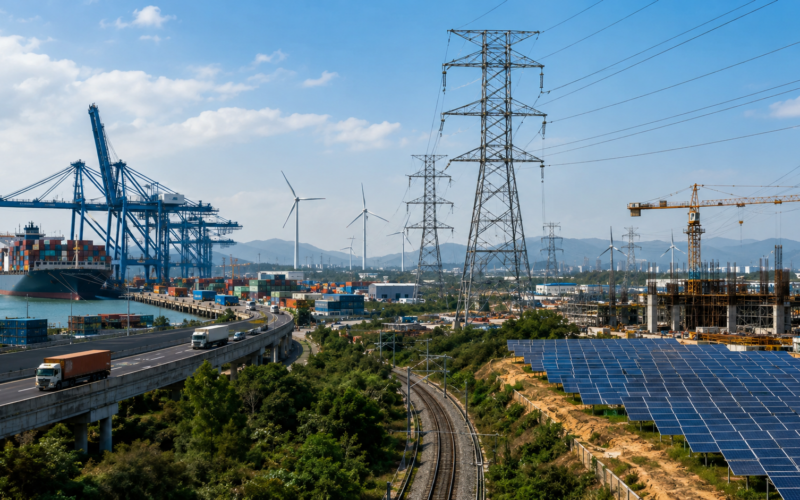
Eleven Power Private Limited has proposed investing approximately ₹4,717 crore to construct a parallel electricity distribution network across the Gurugram and Nuh revenue districts of Haryana. The privately held company said on July 20 that the capital required for the first phase had been secured, with equity infused and the planned mix of debt and equity in place. Eleven Power is seeking a 25-year distribution licence from the Haryana Electricity Regulatory Commission, but approval has not yet been granted and the regulator has reserved its decision pending an independent expert assessment. The project would introduce a second electricity network alongside Dakshin Haryana Bijli Vitran Nigam Limited and could give eligible consumers a choice of supplier. The central tension is whether private competition and renewable-led procurement can improve reliability without weakening cross-subsidies, duplicating infrastructure or allowing the applicant to focus disproportionately on profitable urban and industrial customers.
Why does Eleven Power’s ₹4,717 crore plan represent a major test of electricity competition in Haryana?
Electricity distribution in most Indian markets remains a regulated monopoly. Consumers generally receive power from the distribution company licensed for their geographic area, even when generation and power trading involve multiple public and private participants.
Sections 14 and 15 of the Electricity Act, 2003 allow more than one distribution licensee to operate in the same area, subject to regulatory approval and compliance with capital, technical and service requirements. The provision creates the legal basis for competition, but parallel distribution has remained unusual because a new entrant may need to build a separate physical network while also meeting obligations normally imposed on an established utility.
Eleven Power is not seeking to acquire Dakshin Haryana Bijli Vitran Nigam Limited or replace its network. The state-owned company would continue serving existing consumers, while Eleven Power would construct its own substations, feeders, transformers, metering systems and customer-service infrastructure.
Consumers would therefore not automatically move to the private supplier. Migration would depend on customer choice, network availability and the rules eventually approved by the Haryana Electricity Regulatory Commission.
The proposed licence covers the full Gurugram and Nuh revenue districts, including Gurugram, Manesar, Sohna, Pataudi Mandi, Farrukh Nagar, Nuh, Punhana, Firozepur Jhirka and Tauru. The broad territory is important because it combines high-value commercial and industrial loads with residential, rural and agricultural consumers whose supply economics may be less attractive.
This geographic diversity is also why the application has become a wider policy test. A successful model could demonstrate that parallel licensing can improve supply quality without dismantling the social obligations embedded in regulated electricity distribution. A weak model could leave duplicated urban assets, underused infrastructure and additional financial pressure on the incumbent utility.
How extensive is the physical network Eleven Power proposes to construct over five years?
Eleven Power’s application envisages far more than a limited supply arrangement for business parks or premium residential areas. The company has proposed a five-year rollout from the 2026-27 financial year through 2030-31 covering high-voltage connections, distribution substations, local feeders and low-tension infrastructure.
The planned architecture includes six 220/33 kV bay extensions connected to Haryana Vidyut Prasaran Nigam Limited substations, 17 bay extensions at 66/33 kV and 14 at 66/11 kV. Eleven Power also proposes 36 distribution substations equipped with 105 transformers, approximately 205 kilometres of 33 kV sub-transmission lines and around 1,020 kilometres of 11 kV feeders.
At the local distribution level, the plan includes approximately 4,080 kilometres of low-tension infrastructure and 13,600 distribution transformer centres. Underground cabling is proposed across Gurugram, while Nuh would use a combination of underground and overhead systems.
The network design presented by the company is based on ring-main configurations, N-1 reliability, maximum asset loading of 80%, smart prepaid metering, supervisory control and data acquisition systems and distribution-management software. These measures are intended to create redundancy, improve fault detection and shorten restoration times when equipment fails.
Approximately ₹4,650 crore of the proposed capital spending relates to the wires business. A further ₹66 crore is allocated to the supply business, including smart meters, customer centres, automation and billing infrastructure.
The scale shows why regulatory approval cannot rest solely on the company’s ability to procure electricity. Eleven Power must demonstrate that it can design, finance, construct and maintain thousands of kilometres of infrastructure across areas with very different demand densities.
Gurugram offers large commercial loads and relatively concentrated revenue potential. Nuh presents a different operating challenge, with lower load density, agricultural demand and a greater need for geographically dispersed infrastructure. A rollout that performs well in one district may not produce the same economics in the other.
Can the proposed 80% renewable procurement mix provide reliable round-the-clock electricity?
Eleven Power’s business plan proposes sourcing 80% of its electricity from renewable sources and 20% from thermal generation. Renewable procurement would combine the Green Day Ahead Market with firm and dispatchable renewable energy contracts, while thermal power would support baseload requirements.
This structure is intended to distinguish the company from a conventional distribution utility whose power portfolio may contain a larger thermal component. It could be commercially relevant to multinational companies, exporters, data centres, manufacturers and office campuses seeking lower-emissions electricity for internal climate targets or supply-chain reporting.
However, an 80% renewable portfolio does not automatically guarantee uninterrupted green power. Solar and wind output varies with weather and time of day. Firm and dispatchable renewable contracts can combine generation, storage and balancing arrangements, but they are generally more expensive and more operationally complex than purchasing variable renewable electricity alone.
The Green Day Ahead Market can allow Eleven Power to purchase renewable electricity closer to delivery, potentially taking advantage of periods of abundant supply. It can also expose the company to price volatility and availability risk if demand forecasts, renewable output and market liquidity diverge.
The company’s assumptions include renewable and thermal procurement prices, escalation rates and an increasing shift from short-term purchasing toward bilateral contracts. These remain planning assumptions rather than approved costs or completed power purchase agreements.
The independent committee appointed by the Haryana Electricity Regulatory Commission has specifically been asked to consider whether long-term power purchase agreements must be finalised before the licence is granted or whether they can be completed afterward.
That sequence matters. Requiring contracts before approval could increase the applicant’s financial commitments before it knows whether it can operate. Allowing procurement to be arranged after licensing could reduce upfront exposure but leave questions about price certainty and supply readiness.
The strongest commercial version of the proposal would combine competitively priced renewable power with sufficient firm capacity, storage and market access to maintain reliability during evening peaks and low-generation periods. The model would weaken if Eleven Power became heavily dependent on volatile short-term purchases or required expensive backup procurement to fulfil its supply commitments.
Does Eleven Power’s first-phase funding claim resolve the regulator’s capital adequacy concerns?
Eleven Power said on July 20 that first-phase capital had been fully locked in, with the required equity infused and the debt-equity funding mix arranged. During the July 8 public hearing, the company reportedly stated that ₹91 crore of equity had been infused for the initial phase.
That is a meaningful development, but it does not establish that all ₹4,717 crore needed for the complete five-year programme is immediately available.
The application proposes financing the total investment through approximately ₹1,415 crore of equity and ₹3,302 crore of debt. Eleven Power is 99.99% owned by S A S Fininvest LLP, which the company has presented as the source of promoter financial support.
Eleven Power’s petition states that S A S Fininvest LLP had a certified market-value net worth of ₹4,085.60 crore as of October 30, 2025. The applicant also cited solvency certificates of ₹1,000 crore each from 360 One Prime Limited and IndusInd Bank.
The Haryana Electricity Regulatory Commission had previously questioned the use of the holding company’s market-value net worth rather than its much lower book-value net worth. It also noted that Eleven Power was incorporated in 2025, had authorised share capital of ₹100 crore and initially reported paid-up capital of ₹1 crore, despite proposing a ₹1,415 crore equity contribution.
These questions do not amount to a finding that the company lacks funding. They explain why the regulator wants evidence that promoter resources and lender commitments are legally enforceable, sufficient and available when required.
A solvency certificate is not the same as a completed loan agreement or a disbursed facility. Similarly, the valuation of investments held by a promoter may provide financial capacity but could fluctuate or require asset sales before capital can be transferred into the project.
The expert committee has therefore been directed to assess the debt-equity structure, financing commitments, projected cash flows, debt-servicing capability and long-term sustainability of the proposed utility.
The funding case would become considerably stronger if Eleven Power provides named financing institutions, binding facility terms, an equity infusion schedule and clear evidence that subsequent phases are not dependent on optimistic customer migration assumptions.
Why is consumer migration the most important commercial assumption in Eleven Power’s business plan?
Eleven Power’s proposed licence area contained approximately 836,000 consumers, more than 7,488 MW of connected load and around 12,220 million units of billed electricity during the 2024-25 financial year. Total electricity sales in the area are projected by the applicant to increase to approximately 18,224 million units by 2030-31.
The company does not expect to capture the entire market. It projects sales of approximately 558 million units in 2027-28, rising to about 2,772 million units by 2030-31.
That would increase Eleven Power’s share of total area sales from approximately 3.75% to 15.2%. Demand served through its network is projected to rise from around 212 MW to 1,067 MW over the same period.
These projections assume Eleven Power will capture an increasing share of new demand and persuade some existing Dakshin Haryana Bijli Vitran Nigam Limited customers to switch. The company expects its share of incremental new sales to rise from 25% to 50%, while the proportion of existing sales migrating from the incumbent is projected to increase from 2.5% to 5%.
This is where operational performance and financial viability become inseparable. Eleven Power needs enough customers to support infrastructure investment and debt repayment. Consumers, however, may hesitate to migrate until the new network demonstrates reliability, price competitiveness and responsive service.
The first customers are likely to be those located close to receiving stations and network corridors. This can improve construction economics, but it also creates the risk that the rollout appears concentrated around high-load industrial or commercial clusters.
The Haryana Electricity Regulatory Commission has therefore placed universal service obligations at the centre of the review. Eleven Power must show that phased development will not become a mechanism for serving profitable customers while deferring investment in lower-return areas.
A regulator-approved migration framework will also need to address security deposits, arrears, disputed bills, metering, customer contracts, complaint resolution and continuity of supply. Consumer choice is commercially attractive, but the transition cannot create uncertainty over who is responsible when supply fails or accounts remain disputed.
Could parallel distribution weaken DHBVN’s cross-subsidy structure even if consumers benefit?
Indian electricity tariffs frequently include cross-subsidies. Commercial and industrial users may pay tariffs above the average cost of supply, helping contain charges for agricultural, rural or lower-consumption users.
A competing distributor may attract customers who currently contribute disproportionately to that support structure. If high-paying consumers migrate while lower-revenue consumers remain with Dakshin Haryana Bijli Vitran Nigam Limited, the incumbent could face a weaker sales mix and higher per-unit fixed costs.
This is the regulatory concern commonly described as cherry-picking. The Haryana Electricity Regulatory Commission has not concluded that Eleven Power will engage in such conduct. It has directed the expert committee to assess whether the network plan, consumer strategy and licence conditions can prevent it.
The committee must also evaluate the impact on retail tariffs, cross-subsidy levels, fuel adjustments, existing power purchase agreements, stranded costs and future infrastructure investment by the incumbent and the state transmission utility.
Duplicated networks can improve resilience and choice, but they can also create underused assets. If two distributors build capacity for the same customers, the total system may carry more fixed infrastructure than actual demand requires.
The economic case is strongest where new investment addresses genuine load growth or persistent reliability gaps. It is weaker where the new network merely shifts existing high-value demand from one provider to another without increasing system efficiency.
Regulatory safeguards could include minimum geographic rollout obligations, universal connection requirements, phased capital milestones, network-utilisation reporting and penalties for failing to serve less profitable areas. The commission may also need mechanisms to allocate stranded costs fairly when consumers migrate.
Can Eleven Power offer cheaper electricity, or will reliability remain the stronger selling point?
Eleven Power projects an average cost of supply ranging from ₹7.72 per unit to ₹8.16 per unit between 2027-28 and 2030-31. It compares this with projected Dakshin Haryana Bijli Vitran Nigam Limited costs of ₹7.77 to ₹8.49 per unit.
The difference suggests the applicant expects to operate at a modest cost advantage. These figures are company projections, not approved retail tariffs or guaranteed consumer savings.
Actual bills will depend on power purchase costs, transmission charges, distribution losses, financing costs, depreciation, return on equity, consumer mix and regulatory tariff decisions. An underground urban network may improve reliability but can require higher initial capital expenditure than overhead infrastructure.
Eleven Power may therefore compete more effectively on service quality than on headline tariff discounts. Gurugram businesses frequently maintain diesel generators, uninterruptible power systems and other backup arrangements because even short outages can disrupt operations.
A utility that reduces interruptions could create savings even when its electricity tariff is similar to the incumbent’s. Lower diesel consumption, reduced equipment downtime and more predictable operations may be more valuable to industrial and commercial users than a small reduction in the regulated per-unit charge.
For residential customers, billing transparency, restoration times, complaint handling and service accessibility may be equally important.
The company’s smart-grid proposal could improve outage detection and meter accuracy. It could also introduce concerns around prepaid metering, data management and disconnection procedures that will require strong consumer-protection rules.
What happens next before Eleven Power can begin constructing and operating the network?
The Haryana Electricity Regulatory Commission held a public hearing on July 8 and issued an interim order on July 9. It concluded that the proposal required an independent assessment because of its scale and its potential impact on consumers, the incumbent distributor, the transmission system and Haryana’s regulatory framework.
A three-member expert committee was formed to examine the legal, financial, technical, commercial and regulatory issues. The panel began work on July 13 and was instructed to submit its report within 15 days, although it may seek additional time if required. Eleven Power was directed to deposit ₹30 lakh toward the committee’s expenses.
The committee’s terms of reference include capital adequacy, grid integration, power procurement, universal supply obligations, consumer migration, tariffs, cross-subsidies, public interest and appropriate licence safeguards.
Its recommendations will be advisory rather than binding. The Haryana Electricity Regulatory Commission retains authority to grant the licence, reject the application or impose additional conditions.
Even a favourable licence decision would not mean the entire ₹4,717 crore network can begin operating immediately. Eleven Power would still need transmission access, land, equipment procurement, construction permits, power contracts, metering systems, staffing and customer migration procedures.
The project has moved beyond an early concept because the application is under formal regulatory review and the company says first-phase funding has been arranged. What remains unresolved is whether the financing, universal-service plan and projected customer base can support a second full-scale distribution network.
The proposal would strengthen if the expert report validates the financing structure, recommends workable consumer-protection rules and confirms that the network can serve both Gurugram and Nuh without selective rollout. It would weaken if capital commitments remain conditional, cross-subsidy impacts appear unmanageable or the rollout depends too heavily on capturing a narrow group of profitable consumers.
The next decisive proof point is the expert committee report and the Haryana Electricity Regulatory Commission’s final order, not the ₹4,717 crore investment headline alone.
What are the key takeaways from Eleven Power’s proposed Gurugram and Nuh distribution network?
- Eleven Power has proposed investing approximately ₹4,717 crore in a parallel electricity network across Gurugram and Nuh.
- The company said the first-phase equity and debt funding mix had been secured, but complete project financing remains subject to regulatory scrutiny.
- Eleven Power is seeking a 25-year distribution licence from the Haryana Electricity Regulatory Commission.
- The licence has not yet been approved, and the commission has reserved its order pending an expert committee review.
- The proposed network includes substations, more than 1,200 kilometres of higher-voltage lines and approximately 4,080 kilometres of low-tension infrastructure.
- Eleven Power plans to procure 80% renewable electricity and 20% thermal power, using firm renewable contracts and the Green Day Ahead Market.
- The company projects its share of electricity sales in the licence area could reach 15.2% by 2030-31.
- Regulatory concerns include capital adequacy, consumer migration, universal service obligations and possible disruption to DHBVN’s cross-subsidy framework.
- A competing supplier could improve reliability and consumer service, but duplicating infrastructure may also increase system costs.
- The expert committee report and final HERC decision are the next measurable milestones.
Share this:
Discover more from Business-News-Today.com
Subscribe to get the latest posts sent to your email.