




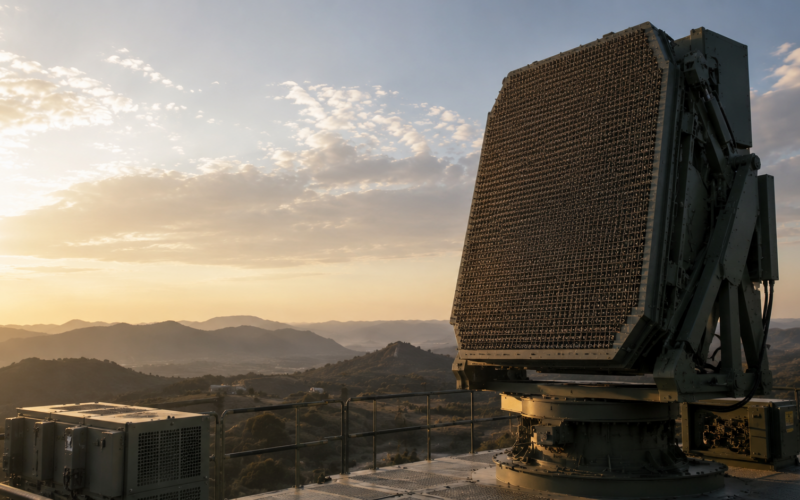
Astra Microwave Products Limited (NSE: ASTRAMICRO) has secured a ₹2,205.23 crore order from Hindustan Aeronautics Limited for equipment supporting the indigenous Uttam Radar programme, giving the Hyderabad-based defence electronics manufacturer a contract worth almost twice its entire FY26 consolidated revenue. The domestic order covers procurement of 122 Active Antenna Array Units, or AAAUs, and 121 interface frames, with execution scheduled over five years. The scale marks a major commercial conversion for a radar programme in which Astra Microwave has spent years developing indigenous active-array capabilities.
The contract is particularly significant because Astra Microwave generated consolidated FY26 revenue of ₹1,163 crore and ended March 2026 with a consolidated order book of ₹2,610 crore. The HAL award alone is therefore approximately 1.9 times FY26 revenue and equivalent to roughly 84% of the March-end backlog before allowing for subsequent order execution or other bookings. That makes the Uttam Radar programme potentially one of the most important revenue drivers in Astra Microwave’s medium-term history rather than another incremental defence-electronics order.
How large is Astra Microwave’s ₹2,205 crore HAL order against its existing revenue base?
The ₹2,205.23 crore contract is unusually large relative to Astra Microwave’s current operating scale. Spread evenly across five years for illustration, it would represent about ₹441 crore of gross annual contract value, although actual revenue recognition will depend on HAL’s delivery schedules, manufacturing milestones, acceptance testing and the timing of individual equipment deliveries. An even annual split should therefore not be treated as company guidance, but it demonstrates why the award can materially alter revenue visibility.
Astra Microwave’s FY26 standalone revenue from operations was ₹1,156 crore, while consolidated revenue was ₹1,163 crore. Consolidated EBITDA reached ₹334 crore and profit after tax ₹193 crore, while the consolidated order book stood at ₹2,610 crore at March 31. Adding a contract equivalent to almost an entire existing backlog provides a very different starting point for future programme execution, although the company will continue delivering older defence, space, electronic-warfare and radar orders alongside Uttam.
The absolute order value also changes the execution risk. A project of this scale requires sustained procurement of electronic components, RF systems, specialised manufacturing inputs and testing capacity over several years. Working-capital management becomes more important as production expands because defence contracts can require substantial inventory and work-in-progress before milestone collections are received.

What will Astra Microwave supply for HAL’s Uttam AESA Radar programme?
Astra Microwave will supply 122 AAAUs and 121 interface frames for the Uttam Radar programme. The AAAU is a critical part of an active electronically scanned array radar, containing the antenna and associated active electronics used to electronically steer radar beams rather than mechanically repositioning an antenna. HAL’s order therefore places Astra Microwave inside a strategically important subsystem rather than assigning it routine fabrication work.
The company has been working on indigenous AESA radar technology for years. In earlier investor discussions, management described Astra Microwave as the major private-sector supplier of the AAAU portion of Uttam and said it was, at that stage, the only player for the particular AAAU requirement. Earlier development orders had covered prototype quantities, with management repeatedly pointing to future production orders as the major commercial opportunity if the radar progressed into serial induction.
The ₹2,205 crore award therefore represents the commercialisation of technology development rather than entry into an unfamiliar product category. That is important in defence electronics because successful qualification on one platform can create opportunities for variants, upgrades and related radar programmes, although future orders remain dependent on procurement decisions and should not be assumed from the current contract alone.
Why does the five-year HAL contract change Astra Microwave’s defence visibility?
Large defence orders can provide unusually long revenue visibility because deliveries are spread over several years and programme quantities are linked to aircraft or system production. Astra Microwave’s five-year schedule consequently gives management a more predictable production base from which to plan component procurement, manufacturing capacity and specialised technical manpower.
The order can also increase the proportion of revenue derived from products where Astra Microwave contributes substantial design and engineering content. Higher-value radar and electronic-warfare subsystems have historically supported stronger margins than commodity electronic manufacturing, although programme mix can change sharply between quarters.
The strategic benefit extends beyond revenue. Supplying a large production batch for an indigenous fighter radar gives Astra Microwave an operating reference that could strengthen its position when Defence Research and Development Organisation laboratories, Hindustan Aeronautics Limited and other defence customers procure additional AESA radar systems or upgrades.
The qualification barrier remains high, which is precisely why the contract matters. Radar electronics require long development cycles, extensive testing and platform integration before production orders arrive. Once a supplier clears those barriers, however, replacement, production and variant requirements can create a multi-year opportunity that is difficult for an unqualified competitor to replicate quickly.
Can Astra Microwave absorb its mega order while Q1 FY27 revenue and profit decline?
The latest quarterly numbers introduce an important counterpoint to the order-book optimism. Astra Microwave’s consolidated Q1 FY27 revenue declined 11.6% year on year to ₹176.66 crore, while net profit fell 24.1% to ₹12.35 crore. Operating margin also softened, with the quarter showing that defence-electronics revenue remains uneven despite a large forward pipeline.
Those numbers do not necessarily contradict the stronger order outlook because the HAL contract was awarded only after the June quarter and will be executed over years. Defence programmes frequently produce lumpy quarterly performance depending on customer inspection, shipment and milestone schedules.
The scale of the new order nevertheless increases the importance of production planning. Against Q1 revenue of ₹176.66 crore, the HAL contract is more than 12 times one quarter’s sales. Astra Microwave must expand execution without allowing procurement bottlenecks, receivable growth or inventory requirements to absorb too much cash.
This creates the central tension for FY27 and beyond. The company has secured exceptional revenue visibility, but shareholders still need evidence that the record contract converts into timely sales, sustainable margins and operating cash flow rather than merely creating a very large backlog.
Why has Astra Microwave stock surrendered part of its post-HAL rally?
Investors initially responded aggressively to the HAL award. Astra Microwave shares jumped nearly 14% intraday on July 31 to a then-record ₹1,960 after the order was disclosed, compared with the previous session’s close around ₹1,725. The market reaction reflected both the exceptional size of the contract and its association with the indigenous Uttam Radar programme.
By August 21, however, the stock had retreated to ₹1,668.50, down 0.93% for the session after closing at ₹1,684.20 a day earlier. The decline from the post-order peak suggests the market has moved beyond simply celebrating the award and is beginning to weigh execution, quarterly earnings and the valuation already attached to Astra Microwave’s defence growth.
The Q1 profit decline likely reinforces that scrutiny. A ₹2,205 crore contract materially strengthens visibility, but its economic value will only become evident through delivery schedules and margins over the next five years.
For Astra Microwave, Uttam Radar has therefore crossed an important line from development opportunity into large-scale commercial production. The next phase is less about proving that indigenous radar electronics can win a major order and more about demonstrating that Astra Microwave can manufacture them at a scale approaching twice its previous annual revenue without compromising profitability or cash conversion.
Discover more from Business-News-Today.com
Subscribe to get the latest posts sent to your email.


