

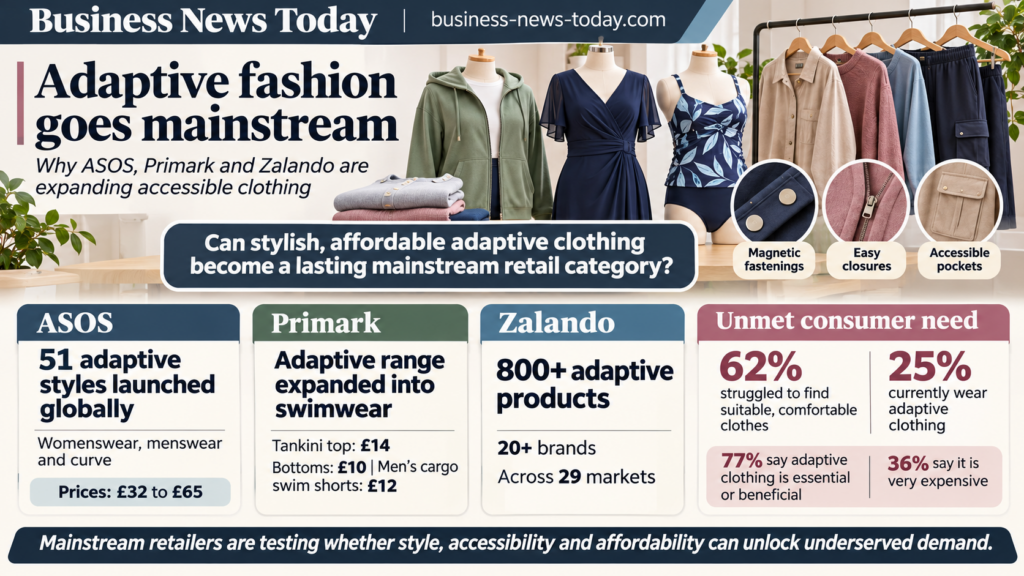
ASOS plc (LSE: ASC), Primark and Zalando SE (XETRA: ZAL) are expanding adaptive clothing into mainstream fashion assortments, responding to consumer needs that have historically received limited attention from major apparel retailers. ASOS introduced a 51-option adaptive collection globally in September 2026, Primark has expanded its accessible clothing range into swimwear and seasonal fashion, while Zalando offers more than 800 adaptive products from over 20 brands across its European retail platform. Independent research by the Research Institute for Disabled Consumers found that 62% of surveyed disabled shoppers struggled to find clothing they felt comfortable wearing, while only 25% reported currently using adaptive clothing. These developments reveal a gap between consumer requirements and conventional fashion availability, creating opportunities for retailers, designers and specialist manufacturers. The central commercial question is whether affordable, stylish and easier-to-use clothing can become a sustainable part of mainstream retail, generating additional customer spending and loyalty without creating inventory, fit and operating costs that undermine profitability.
The shift is not about the sudden discovery of adaptive clothing, which specialist manufacturers have produced for years. It concerns established fashion businesses beginning to integrate accessibility into ordinary purchasing occasions, including work, social events, holidays and everyday dressing. The emerging opportunity is particularly interesting because consumers requiring adaptive features may also value style, brand identity and choice in much the same way as other shoppers. Retailers that recognise those overlapping preferences could reach underserved customers while improving the design and usability of products across their wider assortments.
Why are mainstream fashion retailers recognising a longstanding gap in accessible clothing?
The commercial foundation for adaptive fashion comes from a longstanding mismatch between what consumers need and what conventional fashion retail provides. Clothing designed around standard body proportions, fastening systems and dressing movements can present difficulties for shoppers with mobility limitations, limb differences, sensory requirements or medical devices. Some consumers need garments that can be worn comfortably while seated, while others require simpler fastenings, discreet access points or fabrics that reduce discomfort. These requirements influence purchasing decisions but have not consistently been accommodated within mainstream fashion collections.
Research commissioned by Primark and conducted by the Research Institute for Disabled Consumers provides an unusually direct measure of the problem. The organisation surveyed more than 800 members of its consumer panel and reported in January 2024 that 62% struggled to find suitable, comfortable clothing because of a disability or health condition. Although 77% considered adaptive clothing essential or significantly beneficial to their quality of life, only 25% said they currently wore it. Another 36% regarded adaptive clothing as very expensive, while 24% purchased conventional garments and altered them to meet their needs.
The findings come from a targeted consumer panel rather than a representative survey of every disabled person, and they measure unmet requirements rather than the current value of the adaptive clothing market. Nevertheless, they identify barriers that retailers can potentially address through better product availability, more accessible prices and improved shopping experiences. The difference between the proportion identifying adaptive clothing as valuable and the proportion actually wearing it is particularly relevant. It suggests that limited adoption may partly reflect constraints on choice and affordability rather than a lack of interest in accessible garments.
For mainstream retailers, the opportunity is to serve customers whose spending has often been directed towards specialist suppliers, alterations or conventional products that do not fully meet their needs. However, expanding availability does not automatically create additional expenditure, particularly when shoppers already face financial constraints. The strongest commercial proposition would combine useful design improvements with styles and prices customers are willing to purchase repeatedly. That requires retailers to understand specific consumer requirements rather than treating adaptive fashion as a single, uniform category.
How is ASOS moving adaptive clothing beyond functional basics into occasionwear?
ASOS introduced its first adaptive fashion collection on September 24, 2026, launching 51 options across womenswear, menswear and curve categories. Developed with disability inclusion consultancy Tilting the Lens and disabled consumers, the range focuses on occasionwear, contemporary tailoring and everyday clothing with integrated accessibility features. Products include dresses, blazers, trousers, shirts and other garments designed to accommodate different dressing requirements without abandoning the retailer’s fashion-led positioning. The collection was launched globally through ASOS’s own website, with announced prices ranging from £32 to £65.
The emphasis on occasionwear is commercially significant because specialist adaptive ranges have frequently concentrated on practical everyday garments rather than clothing for celebrations, professional settings and social occasions. ASOS is attempting to address customers seeking fashionable outfits that also accommodate physical or sensory requirements. Its collection includes draped dresses with concealed access points, tailoring with adjusted proportions for seated wearers and clothing incorporating alternative fastenings. These features are intended to become part of the garment’s overall design rather than being treated as visibly separate medical adaptations.
The development process also differs from conventional fashion launches. Tilting the Lens worked with ASOS over approximately two years, involving almost 150 individuals through research, consultation, fitting sessions and product testing. The collaboration examined clothing design alongside barriers involving online shopping, customer support, product information, delivery and returns. In research undertaken during development, 86% of participants identified comfort and fit as leading purchasing considerations, while fashionable occasionwear emerged as a particular area of unmet demand.
For ASOS, the strategy could support customer acquisition in an underserved segment while strengthening its broader position in inclusive fashion. The company already offers clothing across different sizes, fits and style categories, meaning adaptive design can potentially become an additional dimension of its existing assortment strategy. However, the retailer must establish whether customers purchase the range consistently and whether suitable products remain available across sizes and seasons. A well-received initial collection may improve brand perception, but lasting commercial relevance requires more than positive responses to the launch.
Can Primark make adaptive fashion affordable enough for everyday high-street shopping?
Primark is pursuing a different approach by bringing accessible clothing into a value-oriented physical retail environment. The retailer began its broader adaptive clothing range in January 2025, following an earlier adaptive lingerie initiative, and has subsequently expanded into additional everyday and seasonal categories. On March 26, 2026, Primark introduced adaptive swimwear developed with designer Victoria Jenkins, adding another type of clothing that can present practical difficulties for consumers with specific mobility or medical requirements. The products were made available through selected stores and Click & Collect rather than through every Primark location.
The initial swimwear offering included a women’s tankini top priced at £14, matching bottoms at £10 and men’s cargo swim shorts at £12. The tankini incorporates features such as tube access and internal waistband pulls, while the men’s shorts include accessible openings, larger pockets and design adjustments intended to support easier dressing. Primark also introduced a £5 adaptive stoma brief alongside refreshed underwear and seasonal clothing. These prices demonstrate an attempt to place functional design within mainstream value-fashion purchasing expectations.
An illustrative comparison highlights the relevance of affordability. A customer purchasing Primark’s £14 adaptive tankini top and £10 bottoms would spend £24 for the two-piece combination at the announced prices. ASOS’s adaptive occasionwear collection occupies a different purchasing category, with garments priced between £32 and £65, so the two ranges should not be treated as directly comparable products. Nevertheless, the different price positions demonstrate that mainstream retailers can approach accessibility through distinct consumer segments and purchasing occasions.
Primark has also moved towards making adaptive clothing an ongoing part of its assortment rather than relying solely on temporary launches. Its corporate accessibility programme describes adaptive clothing as an always-on line, building on the original collection developed with Victoria Jenkins. The retailer’s July 2026 progress update highlighted continued work on clothing design, store accessibility and sensory-friendly products. These commitments provide stronger evidence of continued organisational investment than a single limited-edition launch, although they do not establish the range’s sales or profitability.
The commercial challenge for Primark is particularly demanding because its business model is closely associated with affordable pricing and high-volume retail operations. Adaptive garments may require additional design work, specialised components and more detailed product testing than conventional alternatives. Maintaining low prices while providing suitable fit and functionality could therefore place pressure on sourcing and merchandising decisions. The opportunity will depend on whether Primark can achieve sufficient sales volumes and production efficiency to support the range over time.
Why is Zalando developing a multi-brand adaptive fashion destination across Europe?
Zalando is approaching adaptive clothing through a marketplace-style assortment rather than concentrating exclusively on products developed under one retailer-owned brand. On August 10, 2026, the company announced the renewal of its collaboration with Ottobock, a mobility-solutions specialist, as part of its ongoing adaptive fashion development programme. Zalando reported offering more than 800 adaptive items from over 20 brands through a dedicated shopping hub, accessible within its platform operating across 29 markets. The company has been developing adaptive collections since 2022, making the latest initiative part of a longer-term programme rather than its first entry into the category.
The multi-brand approach addresses a different consumer problem from the creation of individual clothing collections. Shoppers with specific accessibility requirements may struggle to identify suitable products scattered across numerous retailers, particularly when descriptions do not clearly explain garment features. A dedicated assortment can make comparison easier by bringing together products designed for different mobility, sensory and dressing needs. This potentially creates value through product discovery as well as the physical characteristics of the garments themselves.
Zalando’s work with Ottobock has also influenced product development through direct consumer involvement. The companies have organised workshops, interviews and prototype testing with people who use prosthetic and orthotic devices, drawing on the experiences of Ottobock’s Movao community. One example involved modifying adaptive sportswear after participants identified potential compatibility problems with magnetic closures and connected prosthetic devices. Zalando reported replacing certain magnetic fastening systems with alternative solutions in response to that feedback.
This demonstrates why adaptive design cannot rely on a single supposedly universal feature. Magnetic fastenings can make some garments easier to use, but they may be unsuitable for customers with certain implanted or connected medical devices. Similarly, an adjustment that improves comfort for someone who spends extended periods seated may not address another shopper’s requirements. Retailers developing adaptive collections must therefore balance functional variation with clear product information and manageable inventory.
Zalando’s scale provides a potential distribution advantage because its platform already serves a large European customer base. However, access to millions of existing shoppers does not mean that millions are purchasing adaptive clothing. The company has not separately disclosed adaptive fashion revenue, transaction volumes or customer retention. Its commercial opportunity lies in helping appropriate customers discover suitable products efficiently, while the financial significance remains to be demonstrated through measurable sales performance.
Why does adaptive clothing require a better shopping experience, not just different garments?
The consumer opportunity extends beyond product design because purchasing clothing can involve accessibility barriers at several stages. Customers may need detailed measurements, photographs showing how garments function while seated, accurate descriptions of fastening systems or information about compatibility with medical devices. Conventional fashion websites may not provide enough detail for shoppers to assess whether a garment meets their requirements. This can increase uncertainty before purchasing and create dissatisfaction when products arrive.
The Research Institute for Disabled Consumers previously found that 55% of surveyed disabled consumers regularly avoided shopping in clothing stores because they found the experience difficult or challenging. Physical retail environments can create barriers through inaccessible fitting rooms, crowded layouts, unsuitable changing facilities or insufficient product information. Improving accessibility therefore requires operational adjustments alongside clothing innovation. Retailers that remove those barriers could potentially attract customers who previously relied heavily on online or specialist shopping.
A separate investigation by Which? and the Research Institute for Disabled Consumers identified additional problems involving online delivery and returns. Published in 2026, the investigation involved 18 mystery-shopping exercises across six major British fashion retailers, including Next, H&M, John Lewis, JD Sports, Sports Direct and Zara. Participants reported difficulties involving delivery instructions, collection arrangements and return procedures, with experiences varying considerably between companies. The small study was designed to identify practical problems rather than estimate the frequency of those issues across the entire retail industry.
The findings are commercially relevant because online shopping is especially important for consumers who encounter difficulties visiting physical stores. An adaptive garment may be carefully designed, but an inaccessible delivery or returns process can still undermine the overall purchasing experience. Repeated difficulties could discourage future orders even when customers like the products themselves. This creates an opportunity for retailers to differentiate through reliable service rather than focusing exclusively on assortment expansion.
ASOS’s collaboration with Tilting the Lens included staff training and improvements to digital shopping processes, while Primark has introduced accessible store information, seated mannequins and sensory-friendly shopping initiatives. These changes can make adaptive products easier to discover and purchase, but their effectiveness will depend on consistent implementation across retail channels. The commercial value of accessibility may therefore emerge from the combination of appropriate products and easier customer journeys.
What are the economic challenges of developing adaptive fashion at mainstream prices?
Adaptive fashion introduces product-development and inventory considerations that can differ from conventional apparel. Garments may require adjusted patterns, accessible openings, alternative closures, reinforced access points or specialist fitting procedures. These features can influence manufacturing complexity, component sourcing and quality control. Retailers must ensure that additional functionality is durable and comfortable while maintaining the design appeal expected from ordinary fashion products.
The diversity of consumer requirements creates another operational challenge. A retailer may need different adaptive features across garment categories, sizes and intended uses, potentially increasing the number of product variations. This can make demand forecasting more complicated, particularly when there is limited historical sales information for comparable products. Small production runs may carry higher unit costs, while larger commitments increase the risk of unsold inventory if demand concentrates in particular sizes or styles.
Returns are an especially important consideration for online retailers. Clothing that appears suitable in photographs may not provide the expected comfort or functionality when worn, creating potential differences between customer expectations and actual fit. More detailed product descriptions and user testing could reduce uncertainty, but the cost of returns and customer support remains relevant. Retailers will need to assess whether better product design can improve customer satisfaction sufficiently to justify the investment.
The opportunity is not necessarily restricted to specialised garments. Certain accessible design features, including easier fastenings, softer fabrics and more comfortable waistbands, may appeal to customers who do not identify as requiring adaptive clothing. That creates possibilities for incorporating some improvements into mainstream product ranges. However, features should not be generalised without testing because accessibility requirements can differ significantly between individuals.
For manufacturers, the business case depends on balancing specialist design expertise with efficient production. Retailers may benefit from working with experienced adaptive designers and component suppliers, particularly during the early stages of product development. Over time, stronger demand and more standardised manufacturing capabilities could reduce some costs, but that outcome remains conditional on sustained purchasing volumes. The key economic test is whether inclusive product development can support attractive margins at prices customers can afford.
Which fashion manufacturers and specialist suppliers could benefit from adaptive clothing?
The expansion of adaptive fashion could create opportunities for companies supplying garment components, textile technologies and specialised manufacturing services. Products incorporating alternative fastening systems, adjustable waistbands, concealed access points and sensory-friendly fabrics may require expertise not consistently used across traditional apparel collections. Suppliers capable of producing reliable components at commercial scale could become important partners for retailers developing accessible assortments. However, the current launches do not establish measurable demand growth for any individual supplier.
Independent adaptive designers and accessibility consultancies also occupy an important position in the emerging value chain. Victoria Jenkins’s collaboration with Primark and Tilting the Lens’s work with ASOS demonstrate how specialist knowledge can influence mainstream product development. Their contribution extends beyond suggesting features to include customer consultation, fitting sessions and evaluation of how garments function in everyday use. Such expertise may help retailers avoid expensive redesigns and improve the suitability of products before commercial launch.
There may also be opportunities for manufacturers already supplying conventional apparel to integrate accessibility into selected production processes. If retailers repeatedly order adaptive products, suppliers could justify developing specialised tooling, sourcing arrangements or technical capabilities. The commercial outcome would depend on order consistency, contract terms and whether the additional production requirements command appropriate pricing. Retailer commitments to permanent ranges would provide stronger evidence of supplier opportunity than isolated capsule collections.
The broader business implication is that accessibility could become another dimension of competition in product quality. Fashion retailers already differentiate products through materials, fit, sustainability claims and design. Adaptive functionality introduces additional criteria that may influence purchasing decisions among underserved consumers. Companies able to deliver the right combination of appearance, comfort, functionality and affordability could strengthen their position without competing exclusively through discounts.
What do the latest financial results reveal about ASOS, Primark and Zalando?
The adaptive fashion opportunity is developing within three businesses facing very different financial conditions. ASOS reported in its September 24, 2026, trading update that gross merchandise value had returned to growth during the fourth quarter of fiscal 2026, following a decline across the full financial year. The company expected adjusted gross margin to exceed 50% and adjusted EBITDA to finish above the midpoint of its £150 million to £180 million guidance range. Management also reported improvements in sourcing, full-price selling and return rates, reflecting its broader restructuring and operational priorities.
These developments provide context for ASOS’s decision to introduce a new adaptive collection. The retailer is seeking to strengthen its fashion relevance and customer experience while maintaining tighter control over inventory and profitability. Adaptive occasionwear could support product differentiation and attract customers whose needs have not been consistently served. However, the collection launched near the end of the company’s financial year, and ASOS has not identified a separate revenue or earnings contribution from the range. Its preliminary fiscal 2026 results are scheduled for November 5, making future disclosures relevant to the wider business rather than an immediate measure of adaptive fashion performance.
Primark operates within Associated British Foods plc (LSE: ABF), which reported in September that Primark’s full-year fiscal 2026 like-for-like sales were expected to decline approximately 2.6%, despite estimated total sales growth of around 2%. Continental European trading remained challenging, while management continued investing in pricing, product quality and the customer proposition. The company expected Primark’s adjusted operating margin to remain around 10%, with full-year results scheduled for November 3. These figures illustrate why new product initiatives must compete for investment within a business managing broader sales and profitability pressures.
Primark’s adaptive range is therefore strategically interesting but financially unquantified. Its value proposition depends on whether accessibility can be integrated into the retailer’s established low-price model without generating excessive sourcing or inventory costs. The programme could strengthen customer loyalty and expand purchasing opportunities, particularly if customers find products unavailable from competitors at comparable prices. Nevertheless, the company’s broader trading performance cannot be attributed to the adaptive collection.
Zalando reported second-quarter 2026 group gross merchandise value of approximately €4.9 billion, up 20.7% on a reported basis, while revenue reached €3.4 billion. Adjusted earnings before interest and taxes increased to approximately €205 million, and the company reported 62.5 million active customers across its wider group. These figures reflect the broader fashion platform, including the effects of its ABOUT YOU acquisition, rather than performance within adaptive clothing specifically. The next quarterly results are scheduled for November 3, with the company’s wider marketplace and profitability trends remaining the principal financial indicators.
For investors, adaptive fashion should currently be treated as a potential differentiation and customer-access opportunity rather than a separately established earnings catalyst. The companies have disclosed meaningful product and distribution initiatives, but none has provided comparable adaptive-range sales, margins or repeat-purchase figures. Future evidence of sustained customer acquisition, efficient inventory turnover and profitable product expansion would be more useful than attributing daily share-price movements to the launches. The financial importance of adaptive fashion will become clearer only when product commitments are accompanied by measurable commercial results.
Could adaptive fashion remain a collection of specialist ranges rather than become mainstream?
The largest uncertainty is whether mainstream retailers will continue investing in adaptive clothing after the initial wave of product launches. Developing a collection can demonstrate commitment and attract consumer attention, but maintaining suitable products across seasons requires recurring design, manufacturing and merchandising resources. Customers may be disappointed if successful products disappear without replacements or if essential sizes and features remain unavailable. Long-term trust depends on predictable access to appropriate clothing rather than occasional promotional collections.
A second challenge involves the diversity of consumer requirements. Adaptive fashion cannot be treated as a uniform product category with a single set of design solutions. Consumers who use wheelchairs, prosthetic devices or medical equipment may have different needs from those experiencing sensory sensitivities, limited dexterity or temporary mobility restrictions. Retailers must decide how to address those differences without creating assortments too fragmented to manage efficiently.
Affordability presents another important limitation. The Research Institute for Disabled Consumers found that more than one-third of surveyed participants considered adaptive clothing very expensive, indicating that better design alone may not remove purchasing barriers. Mainstream retailers can potentially improve availability and pricing, but specialised manufacturing requirements may constrain how far costs can fall. Consumers also need confidence that garments will remain comfortable and functional after repeated use, making product durability part of the value proposition.
There is also a risk that retailers focus more heavily on the visibility of adaptive collections than on removing practical shopping barriers. Limited store availability, difficult online returns and inadequate product information could undermine the customer experience even where clothing designs are well considered. The strongest commercial programmes will need to address accessibility throughout the purchasing process rather than presenting it solely as a product feature. That distinction may determine whether consumers regard mainstream retailers as dependable destinations for adaptive clothing.
What evidence would prove adaptive fashion is becoming a lasting mainstream retail category?
The next 6 to 24 months should provide clearer evidence through assortment continuity, distribution expansion and customer purchasing behaviour. ASOS maintaining and refreshing its adaptive collection across additional fashion seasons would demonstrate a deeper commitment than a single global launch. Primark expanding permanent availability beyond selected stores and introducing further accessible categories could indicate that the retailer sees a sustainable role for adaptive products within its value-fashion model. Zalando increasing its multi-brand assortment while improving product discovery would provide another measure of continued investment.
The strongest commercial evidence would involve repeat purchasing, customer retention and product performance rather than the number of launches alone. Retailers reporting meaningful sales from adaptive assortments, stable or improving product availability and acceptable inventory turnover would strengthen the case for mainstream adoption. Returns data, customer satisfaction and evidence that shoppers can consistently find suitable clothing would also be important, particularly given the complexity of fit and functionality. Product expansion across additional categories and geographies would provide greater confidence if supported by demonstrated demand.
Contrary evidence would include collections being discontinued after one season, persistent stock shortages, high returns linked to unsuitable fit or pricing that remains inaccessible to intended customers. Retailers reducing dedicated assortments despite favourable publicity would raise questions about their willingness to sustain investment. Similarly, the absence of repeat orders for specialist components could indicate that manufacturing demand remains concentrated in isolated projects rather than developing into a durable supplier opportunity.
The emerging change is not simply that major fashion retailers are beginning to acknowledge consumers with different clothing requirements. It is that ASOS, Primark and Zalando are experimenting with ways to make accessible clothing part of ordinary fashion choices, supported by research identifying substantial unmet needs. Their strategies differ in price, assortment breadth and distribution, but all confront the same commercial challenge: combining personal style, functional design and affordability at a scale that supports continuing product availability. If retailers can demonstrate sustained sales, reliable product performance and stronger customer loyalty, adaptive fashion could become an established component of mainstream apparel retail. If those conditions remain difficult to achieve, the market may continue depending heavily on specialist suppliers and limited collections, leaving a significant consumer requirement insufficiently served.
Discover more from Business-News-Today.com
Subscribe to get the latest posts sent to your email.