


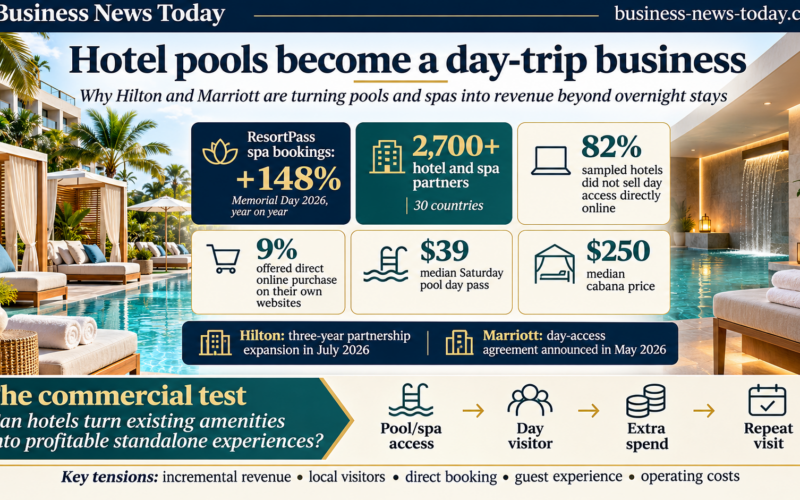
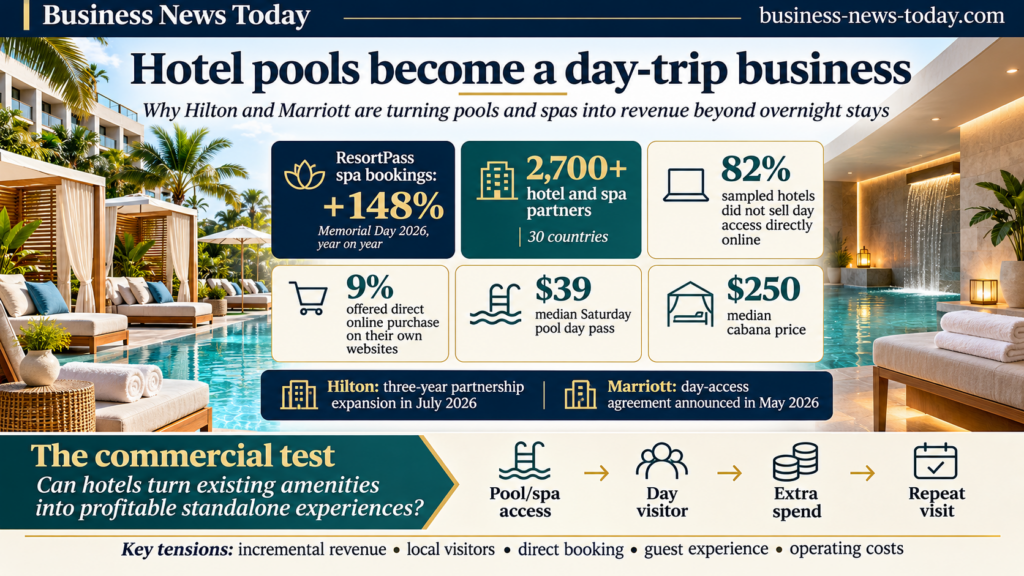
Hilton Worldwide Holdings Inc. (NYSE: HLT) and Marriott International Inc. (NASDAQ: MAR) are expanding access to hotel swimming pools, spas and resort amenities without requiring customers to book an overnight stay, signalling a potentially important change in how hospitality experiences are purchased. Hilton announced a three-year expansion of its partnership with ResortPass in July 2026, while Marriott signed a separate agreement in May to extend day-access distribution across participating properties. ResortPass reported a 148% year-on-year increase in spa bookings over the Memorial Day holiday period, providing an indication of consumer activity beyond the partnership announcements. Meanwhile, an October 2026 study of 280 US hotels found that 82% did not sell day access directly through their own websites, exposing a potential gap between hotels offering experiences and controlling the customer relationship. The central commercial opportunity is to generate additional revenue from existing hotel amenities without selling another room, but success depends on whether day visitors deliver incremental profit without undermining overnight guest satisfaction or creating excessive operating and distribution costs.
The development is particularly relevant because hotels have traditionally concentrated their commercial strategies on occupancy, room rates and related services purchased by overnight guests. Pools, spas, fitness centres and private cabanas are frequently operated as supporting amenities, even though some have the potential to attract paying customers independently. Day-access marketplaces are making it easier to package those facilities into standalone experiences, creating new purchasing occasions for residents, families and travellers who do not need accommodation. The emerging shift is not that hotels have suddenly begun selling pool passes, but that major hospitality groups are increasingly treating access to their facilities as a distinct commercial product.
Why are consumers purchasing hotel experiences without booking overnight stays?
The attraction of a hotel day pass lies in separating the leisure experience from the wider cost and commitment of accommodation. A customer may want access to a resort swimming pool, a private cabana, a spa or a family-friendly leisure facility without needing a room for the night. This can create a more accessible way to enjoy premium hospitality, particularly for people living within travelling distance of established hotels. It also introduces new occasions for spending, including short wellness breaks, family outings, celebrations and daytime social experiences.
The behaviour is especially relevant to hotels in urban and resort markets where local customers may already be familiar with the property but have little reason to book accommodation. Someone living near a luxury hotel could be willing to purchase an afternoon at its pool without considering an overnight stay at the same property. Similarly, families may prefer a day at a hotel with a lazy river or children’s swimming facilities instead of arranging a longer holiday. These purchasing decisions create opportunities that conventional room-focused marketing may overlook.
ResortPass has developed a business around connecting these consumers with hotels willing to sell unused or selectively available amenity capacity. The privately held platform reported working with more than 2,700 hotel and spa partners across 30 countries in 2026, offering access to pools, spas, cabanas and other daytime experiences. The number of participating properties indicates substantial supply-side adoption, although partnerships alone do not establish transaction frequency or profitability. More persuasive evidence comes from actual bookings and the types of customers purchasing these experiences.
How is Hilton expanding hotel day access through its ResortPass partnership?
Hilton announced a three-year expansion of its ResortPass partnership on July 14, 2026, building on an existing relationship between the two companies. The agreement is intended to expand access to participating Hilton properties across the Americas, allowing local residents and travellers to purchase qualifying experiences without an overnight reservation. Available offerings can include swimming pools, spas, fitness centres, private cabanas and selected wellness programmes, depending on the property. Hilton positioned the initiative as part of its wider strategy to make hospitality experiences more accessible while developing stronger connections with surrounding communities.
The expansion also introduced Off Hours, a ticketed event series designed to transform hotel pool areas into social and leisure destinations. Events may include music, local vendors, food and beverage offerings and curated activities, with initial programmes announced at selected Florida properties. Participating locations included Hilton Orlando, Hilton West Palm Beach, Hilton Tampa Downtown and other resorts within the Hilton network. The initiative represents a different proposition from ordinary pool access because consumers are purchasing a programmed experience rather than simply admission to an existing facility.
For participating properties, this creates the possibility of monetising quieter periods and introducing spending opportunities that do not depend on room occupancy. A hotel pool that attracts relatively few users during a particular afternoon could potentially accommodate additional customers, while an evening event might generate revenue from admission, food, drinks and optional upgrades. However, the available capacity must be assessed carefully, especially when an event requires additional employees, security, entertainment or extended operating hours. The financial attractiveness depends on the incremental contribution after those costs rather than gross ticket revenue alone.
Hilton has also highlighted wellness-focused properties offering spa access and specialised treatments. Waldorf Astoria Atlanta Buckhead, for example, has promoted day experiences involving its indoor saline pool, sauna, steam facilities and additional wellness services through ResortPass. Such offerings allow customers to experience selected premium amenities without purchasing accommodation, potentially introducing the property to consumers who would otherwise have limited interaction with the brand. Whether those customers eventually become overnight guests or repeat wellness visitors remains an important commercial question.
Why did Marriott International sign a separate ResortPass agreement?
Marriott International’s agreement with ResortPass, announced on May 27, 2026, reflects a similar interest in developing revenue opportunities beyond hotel rooms. The arrangement allows participating Marriott properties to distribute access to selected pools, spas, fitness facilities and other experiences through the marketplace. The agreement is designed to simplify participation for hotels within Marriott’s portfolio, rather than automatically making every property available for day bookings. Individual hotels remain subject to operational considerations and decisions about which amenities can be offered to non-overnight customers.
The distinction matters because Marriott operates an extensive portfolio of brands serving different customer segments. A destination resort with several swimming pools and private cabanas may have a very different day-access proposition from an urban business hotel with a small fitness centre. Some properties may generate meaningful demand for spa treatments or leisure facilities, while others have limited amenities suitable for outside visitors. The commercial model must therefore be adapted to each location rather than applied uniformly across the network.
Marriott’s partnership also illustrates how hospitality groups can use specialist distribution platforms to develop new business without building every booking function internally. A marketplace can help customers discover participating hotels, compare available experiences and complete transactions. For hotels, this reduces some of the work involved in establishing a standalone sales channel while potentially introducing customers beyond the existing room-booking audience. The trade-off involves platform fees, control over customer relationships and the extent to which the hotel can encourage repeat purchases through its own channels.
Individual Marriott properties are already demonstrating how day passes can support broader leisure programming. Sandbourne Santa Monica, Autograph Collection, promoted its Summer Pour Series during 2026, allowing local visitors with eligible day passes to attend selected poolside events and purchase additional refreshments. The hotel’s participation shows how daytime access can be combined with food and beverage activity rather than sold exclusively as swimming-pool admission. However, an individual property programme should not be interpreted as evidence that the same format would succeed across every Marriott brand or market.
Does ResortPass booking activity demonstrate genuine consumer demand?
ResortPass’s booking disclosures provide more useful evidence of consumer participation than partnership announcements alone. During the 2026 Memorial Day holiday period, the company reported that spa bookings increased 148% compared with the corresponding period a year earlier. The increase suggests stronger activity in wellness-related day experiences on the platform, although the company did not publish the underlying booking totals or a full-year comparable growth rate. The figure therefore describes a specific seasonal period within one distribution business rather than overall demand across the hospitality industry.
The company’s June 2026 summer travel announcement offered another indication of who uses hotel day passes. ResortPass reported that more than 70% of its Independence Day reservations came from local customers, reinforcing the importance of residents rather than exclusively conventional tourists. The statistic is particularly relevant because hotels traditionally compete for travellers visiting from other locations, whereas the day-access model can attract people who already live nearby. This creates a potentially different customer-acquisition opportunity from ordinary accommodation marketing.
The distinction between local leisure spending and overnight travel is commercially significant. Local customers may return to the same hotel for several occasions, including family outings, wellness visits or celebrations, whereas a conventional traveller may only visit the destination occasionally. That could support recurring relationships if the property delivers a consistently attractive experience. However, holiday booking patterns should not be assumed to represent the year-round customer mix, and the evidence does not yet establish typical repeat-purchase rates.
A more mature assessment would compare bookings across weekdays, weekends and seasons, while separating first-time visitors from returning customers. Growth in total reservations could reflect additional hotels joining the platform, increased usage at existing properties or both. The underlying composition matters because increasing distribution does not necessarily mean each participating hotel is generating stronger sales. For the business model to become structurally important, demand must be sufficiently durable at the individual-property level.
What does the October 2026 hotel day-pass study reveal about distribution?
One of the more distinctive commercial findings comes from DestinationCommerce’s Hotel Day Pass Report 2026, published in October. The company examined the official websites of 280 US hotels across 39 states, selected from properties already offering day-access experiences through marketplaces such as ResortPass. The study found that only 9% allowed customers to select and purchase day access online through the hotel’s own website or a brand-operated booking channel. Another 9% advertised direct purchasing through telephone, email or the front desk without providing online checkout.
Among the remaining hotels, 25% directed prospective customers to third-party booking websites, while 53% did not mention day-access availability on their official websites. Another 4% displayed restrictions indicating that the relevant amenities were reserved for registered guests. Taken together, 82% of the sampled properties did not offer direct online purchasing or another clearly advertised direct sales route under the study’s classification. This is a meaningful distribution finding because customers searching for a particular hotel’s amenities may be unable to complete the purchase through the property itself.
The research also revealed differences between hotel categories. Resorts were more likely to support direct sales than urban, suburban or airport hotels, consistent with their greater availability of leisure amenities and established experience-based offerings. The findings suggest that direct selling remains comparatively underdeveloped among properties that may have less extensive leisure operations. However, the study examined hotels already listed on day-access marketplaces rather than a representative sample of all US hotels, and website availability was measured during a specific period in October.
DestinationCommerce provides commercial services related to hotel experience distribution, making the research relevant but also requiring its business interest to be considered. Its website audits provide observable evidence of how participating hotels present day access, while the underlying dataset was not published in full. The findings are best interpreted as a snapshot of distribution practices rather than proof that hotels are losing a particular amount of revenue. Even so, they identify an important commercial question: why are many hotels selling experiences through external platforms without making those products easy to discover and purchase through their own websites?
Can hotels capture more revenue by selling day passes directly?
Direct distribution could provide hotels with greater control over how they price experiences, communicate availability and maintain relationships with local customers. A property that allows consumers to purchase pool access through its own website may also be able to promote spa services, restaurant reservations or future events. The customer relationship could potentially extend beyond a single transaction, especially when the hotel can communicate directly with visitors about upcoming offerings. However, direct sales require effective discovery, payment processing, customer support and booking technology, all of which involve costs.
Third-party platforms offer an alternative advantage by bringing together customers searching across multiple hotels and destinations. ResortPass can introduce consumers who may not know which properties offer day access, reducing the need for every hotel to generate all demand independently. Hotels therefore have an incentive to use marketplaces for discovery while developing direct relationships where repeat purchasing makes that economically attractive. The most effective strategy may involve combining channels rather than abandoning specialist platforms.
The cost of distribution is particularly important because the value of a day pass may be relatively modest compared with an overnight reservation. Marketplace commissions can reduce the amount retained by the hotel, while direct bookings still carry payment, marketing and technology expenses. The publicly available partnership disclosures do not establish a standard commission rate that can reliably be applied across participating properties. Any comparison between the channels must therefore consider actual contractual terms rather than assume that direct sales are automatically more profitable.
Hotels could also benefit from a clearer understanding of local demand. Booking data might reveal whether customers prefer weekday wellness visits, weekend pool access or private cabanas for celebrations. That information could support more targeted pricing and programming, potentially improving utilisation during periods when facilities are less crowded. The commercial benefit depends on whether hotels can convert those insights into incremental spending without compromising existing guests’ experiences.
What do $39 pool passes and $250 cabanas reveal about hotel revenue potential?
DestinationCommerce’s October 2026 pricing audit offers a useful starting point for evaluating the opportunity. Among the sampled US properties with available prices, the median Saturday hotel day pass cost $39, while the median listed cabana price was $250. Resort properties carried a higher median day-pass price of $50, compared with $40 at urban hotels and $32 at suburban properties. These were observed prices for a particular Saturday and should not be treated as permanent industry averages or typical weekday rates.
The figures illustrate how hotels can offer several tiers of daytime hospitality. A basic pool pass may attract consumers seeking an affordable leisure outing, while private cabanas can appeal to groups willing to spend more on comfort, privacy or additional amenities. Spa treatments, dining and event packages introduce further purchasing options, depending on the facilities and the terms of each reservation. These different products could allow hotels to serve customers with varying budgets without relying exclusively on room bookings.
A simple illustrative calculation shows the potential scale of a small day-pass operation. If a property sold ten passes at the study’s $39 median Saturday price, it would generate $390 in gross admission revenue for that day before platform fees, taxes and operating expenses. A separate $250 cabana booking could represent a higher-priced transaction, although any included guest admissions would need to be considered before combining revenue figures. These are pricing scenarios based on the observed rates, not estimates of actual hotel bookings or profitability.
The calculation also demonstrates the limitations of focusing on gross revenue. A hotel may need additional lifeguards, attendants, cleaning staff or security personnel to accommodate outside visitors, while premium cabanas can require service and equipment maintenance. Food and beverage sales can improve the commercial result, but they also carry their own staffing and product costs. The relevant measure is how much additional profit the hotel retains after accounting for the resources required to serve those customers.
Why might an unused hotel pool chair not represent pure incremental profit?
The appeal of day access is strongest when a hotel has facilities that are already operating but not fully utilised. A swimming pool requires maintenance and may already have staff present regardless of whether outside customers are admitted. Filling some unused capacity could therefore generate additional contribution without the investment required to construct a new amenity. However, that reasoning depends on the facility having genuinely available capacity at the time the day passes are sold.
Hotels must also account for the experience promised to overnight guests. A luxury resort may justify its room rates partly through exclusive or comfortable access to pools, spas and relaxation areas. Increasing the number of day visitors could reduce the availability of lounge chairs, create longer service queues or change the atmosphere of facilities that overnight guests expected to enjoy. The resulting dissatisfaction could affect reviews, repeat accommodation bookings and the property’s pricing power.
Capacity management becomes particularly important during weekends, public holidays and peak travel periods. These may be the times when day-pass demand is strongest, but they can also coincide with high hotel occupancy and greater use of amenities by registered guests. A property selling too many passes during those periods could damage its core business while collecting relatively modest additional revenue. Effective inventory controls must therefore balance expected demand against the value of protecting the overnight experience.
The economics are likely to vary considerably between properties. A large destination resort with multiple pools, restaurants and dedicated cabanas may be able to accommodate outside visitors more easily than a small urban hotel with limited facilities. Weather, seasonality, local competition and staffing requirements can also affect profitability. A successful model will depend on matching the offering to the property’s operational characteristics rather than assuming every hotel has unused leisure capacity worth selling.
Can wellness and ticketed experiences create a more profitable day-access business?
Pools are only one part of the emerging opportunity. Spas, saunas, fitness facilities and guided wellness programmes can provide additional reasons for consumers to visit a hotel without accommodation. Certain wellness experiences may also be less dependent on warm weather than outdoor pool access, potentially creating more consistent demand across the year. Hotels offering specialist treatments can combine amenity access with services that have their own pricing and customer relationships.
Hilton’s Off Hours initiative introduces another approach by turning facilities into programmed experiences. A ticketed poolside event can incorporate entertainment, food, beverages and optional upgrades, creating a broader spending occasion than an ordinary pool pass. The format may also attract groups celebrating birthdays, social occasions or seasonal events. However, event programming introduces additional operating requirements, and profitability will depend on attendance, spending per customer and the cost of delivering the experience.
Hospitality businesses could eventually develop more sophisticated product combinations around local customers. A daytime wellness package might include spa access and a treatment, while a family offering could combine pool admission with dining or selected recreational activities. Such packages could support higher transaction values and differentiate hotels from ordinary leisure facilities. Their commercial value would depend on sustained demand at prices consumers regard as reasonable.
The opportunity also extends to independent spa operators and service providers working within hotels. Additional daytime visitors could create demand for treatments, hospitality services and event programming that existing overnight occupancy does not fully support. Revenue-sharing arrangements and operating responsibilities would determine how those benefits are divided. As a result, the growth of day-access hospitality could influence several businesses beyond hotel brands and booking platforms.
What does hotel day-access growth mean for Hilton and Marriott investors?
For Hilton Worldwide Holdings, day access is a potential ancillary revenue opportunity within a much larger hospitality business. The company reported third-quarter 2026 net income of $536 million and adjusted EBITDA of approximately $1.06 billion, while system-wide comparable revenue per available room increased 5.8% on a currency-neutral basis. Management and franchise fee revenues also increased 9.5%, supported by the company’s wider operating and development performance. These results establish the scale of Hilton’s existing business, but the company has not separately disclosed day-pass revenue or profitability.
The distinction between brand-level strategy and property-level economics is especially important because major hotel groups operate extensively through management and franchise arrangements. Participating hotel owners or operators may receive the direct economic benefit of admission fees and additional spending, subject to their contractual arrangements. Hilton could benefit indirectly through stronger property performance, brand exposure and associated fee opportunities, but those benefits cannot be quantified from the available disclosures. The partnership is therefore best interpreted as an innovation initiative with potential commercial relevance rather than a demonstrated material earnings driver.
Marriott International has a comparable strategic opportunity. In its second-quarter 2026 results, the company reported worldwide revenue per available room growth of 3.4%, adjusted EBITDA of approximately $1.59 billion and a global portfolio exceeding 10,000 properties. Its asset-light business model means that financial benefits from day-access programmes would depend on the economics of participating hotels and the contractual arrangements connecting property operators with Marriott. The ResortPass agreement could help improve the attractiveness of selected properties, but Marriott has not identified a separate financial contribution from the partnership.
For investors, the relevant indicators will be evidence of incremental property-level revenue, guest satisfaction and sustainable margins rather than isolated partnership announcements. The investment case for both companies continues to be driven primarily by room demand, hotel development, management and franchise fees, and wider operating performance. Day-access innovation could become a useful additional source of value if adoption broadens and hotels demonstrate attractive economics. Until that evidence emerges, it remains a developing component of hospitality strategy rather than a reason to attribute share-price movements to the trend.
Could hotel day passes become a new form of local consumer loyalty?
One of the more interesting possibilities is that hotels could build customer relationships extending beyond overnight travel. Local residents may visit a property repeatedly for wellness treatments, dining, leisure activities or social events, even when they have little reason to book a room. This creates opportunities for hotels to understand preferences and develop offerings around recurring occasions rather than one-time accommodation transactions. A hotel could become part of a customer’s local leisure choices instead of being considered only when travel is necessary.
The opportunity is different from conventional hotel loyalty programmes, which have historically emphasised room stays and associated spending. Day-access visitors may generate frequent but smaller transactions, making customer lifetime value dependent on repeat participation and the contribution from additional services. Hotels would need suitable customer communication, booking and loyalty arrangements to encourage those relationships. They must also ensure that the benefits offered to day visitors do not weaken the value proposition for registered guests.
For ResortPass, recurring consumer participation could strengthen the marketplace’s competitive position. A customer discovering several attractive hotels through the platform may return for different occasions, creating opportunities for additional transactions across the network. This supports a marketplace model based on both variety and convenience, although profitability and customer retention figures remain privately held. The question for hotels is how much of that recurring relationship they can build themselves while continuing to benefit from third-party discovery.
What would confirm that hotel day access is becoming a sustainable hospitality business?
The next 6 to 24 months should provide clearer evidence through booking growth, property participation and financial disclosure. Continued expansion of Hilton and Marriott day-access offerings would indicate that participating hotels see sufficient commercial value to maintain or broaden the programmes. More important would be growth in bookings per established property, repeat visits by local consumers and evidence that demand extends beyond peak holiday periods. Strong performance across pools, spas and ticketed experiences would support a broader hospitality shift rather than a narrowly seasonal pool-pass business.
Property-level economics will provide the decisive evidence. Hotels reporting meaningful incremental profit after staffing, maintenance, distribution and service costs would offer stronger confirmation than gross booking growth alone. Stable overnight guest satisfaction, carefully managed amenity capacity and higher food and beverage spending would further strengthen the business case. Conversely, overcrowding complaints, repeated programme closures, weak weekday demand or heavy reliance on promotional discounts would challenge expectations of a durable opportunity.
Distribution will be another measurable area to watch. The October 2026 hotel website audit suggests considerable room for improvement in making day experiences visible and directly bookable. An increasing proportion of participating hotels offering transparent prices, real-time availability and direct checkout could indicate that day access is becoming a more established commercial product. However, hotels will still need to assess whether direct booking generates better customer economics than relying on marketplaces for discovery and transactions.
The emerging consumer shift is not simply that hotels are selling access to swimming pools or spas. It is that more consumers may be willing to purchase hospitality experiences independently of accommodation, creating an opportunity for hotels to serve local customers and monetise amenities in new ways. Hilton, Marriott International and ResortPass are helping organise that market, while booking activity and distribution research reveal both commercial potential and unresolved execution challenges. If participating properties can convert unused capacity into profitable repeat business without weakening the overnight guest experience, day-access hospitality could become a more important component of hotel revenue strategies. If those conditions prove difficult to achieve, the model may remain attractive primarily to selected resorts, wellness properties and seasonal leisure destinations.
Discover more from Business-News-Today.com
Subscribe to get the latest posts sent to your email.