

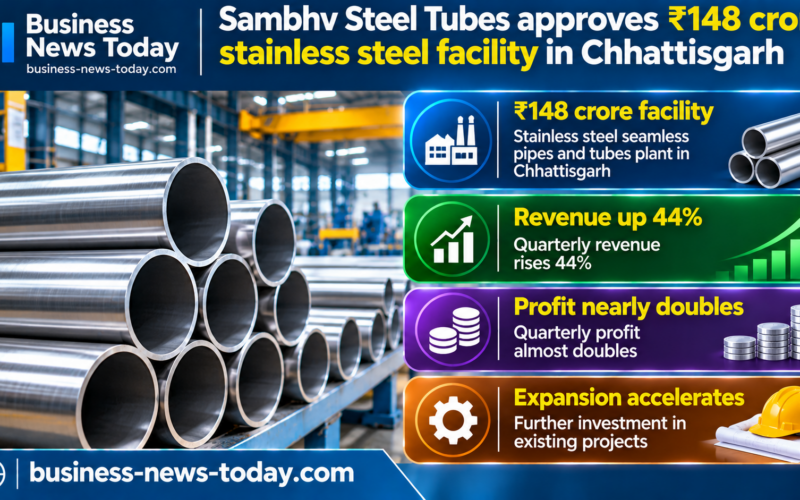
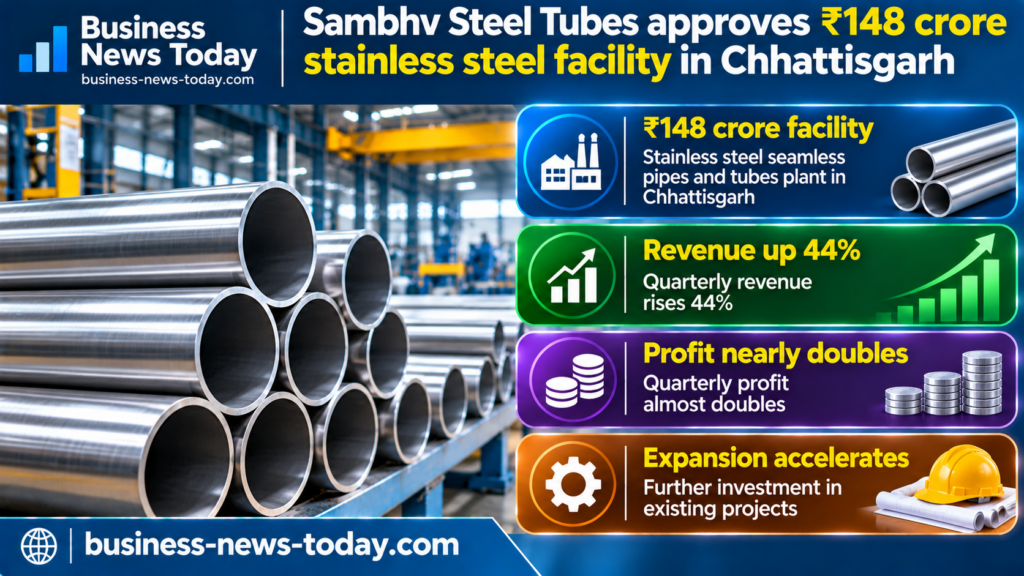
Sambhv Steel Tubes Limited (NSE: SAMBHV, BSE: 544430) has approved a ₹148 crore greenfield manufacturing project in Chhattisgarh to produce stainless steel seamless pipes and tubes, marking its entry into a specialised industrial product category. Announced on 29 October 2026, the investment will be undertaken through its wholly owned subsidiary, Sambhv Tubes Limited, with an initial annual production capacity of 14,400 tonnes targeted for completion by March 2028. The decision coincided with second-quarter FY27 results showing consolidated revenue growth of 44.1% to ₹836 crore and profit after tax growth of approximately 99% to ₹60.95 crore. The company intends to finance ₹100 crore of the project through debt and the remaining ₹48 crore through internal accruals, adding another capital commitment to its existing manufacturing expansion programme. However, Sambhv shares declined 4.44% on 30 October to ₹152.26, highlighting the gap between improving reported earnings and the market’s near-term assessment of the business.
The latest project forms part of Sambhv’s wider ambition to increase finished steel product capacity from approximately 0.6 million tonnes annually to more than 2 million tonnes by 2030. The strategy combines expanded stainless steel processing, structural pipes, coated steel products and captive power generation with an entry into stainless steel seamless pipes. The proposed diversification could broaden the company’s access to industrial customers, although the expansion will also require greater capital deployment, manufacturing expertise and commercial qualification in markets where established competitors already operate.
What does Sambhv Steel Tubes’ ₹148 crore stainless steel seamless pipe project involve?
The new manufacturing facility will be developed by Sambhv Tubes Limited, formerly known as Sambhv Tubes Private Limited, in Chhattisgarh. The wholly owned subsidiary currently has no installed capacity in stainless steel seamless pipes and tubes, making the project an entry into a new manufacturing category rather than the expansion of an existing seamless-pipe production line. The initial investment is expected to create 14,400 tonnes of annual manufacturing capacity.
The company has disclosed a proposed funding structure comprising ₹100 crore of debt and ₹48 crore from internal accruals. Borrowings would therefore account for approximately 67.6% of the estimated project cost, while internally generated funds would represent the remaining 32.4%. The financing structure indicates a substantial reliance on debt, although the actual timing of borrowings and expenditure will depend on project implementation.
The announced investment translates into approximately ₹1.03 lakh of capital expenditure per tonne of planned annual capacity. This provides an indication of the project’s capital intensity, but it does not establish manufacturing cost per tonne, revenue potential or expected profitability. Those outcomes depend on production volumes, product specifications, selling prices, input costs and utilisation following commissioning.
Sambhv has targeted March 2028 for completion, corresponding to the fourth quarter of FY28. The project remains at the board-approved development stage, with the company’s latest disclosure establishing its intended capacity, investment, location at state level and financing plan. The announcement does not establish that construction has commenced or that the required manufacturing equipment has already been installed.
The initial project represents the first phase of a larger proposed seamless-pipe business. Sambhv’s October 2026 investor presentation outlines an ambition to increase seamless manufacturing capacity to 50,000 tonnes annually over approximately five years, with greater backward integration in subsequent phases. That larger target remains a strategic objective and should not be confused with the currently approved ₹148 crore investment or its initial 14,400-tonne capacity.
Why is Sambhv Steel Tubes entering stainless steel seamless pipes when it already manufactures welded tubes and coils?
Sambhv’s existing business includes electric resistance welded structural pipes and tubes, stainless steel coils, galvanised products and intermediate steel materials. Seamless pipes represent a different manufacturing process and address applications where product specifications, pressure resistance, corrosion performance and manufacturing consistency can be particularly demanding. The move would extend Sambhv’s product portfolio beyond its established welded-pipe and coil manufacturing activities.
Unlike welded pipes, which are produced through the forming and joining of steel material, seamless pipes are manufactured without a longitudinal weld. Manufacturing methods can include piercing, hot finishing and cold drawing, depending on product requirements. These capabilities can support industrial applications involving complex operating conditions, although the suitability of individual products depends on material grades, specifications and certification requirements.
Sambhv’s investor presentation identifies oil and gas, chemical processing, power generation, pharmaceuticals, water infrastructure, fertilisers, boilers and food processing among its intended end-user markets. These industries use different grades and dimensions of stainless steel piping, creating opportunities across multiple customer categories rather than a single end market. However, inclusion in the company’s target-market strategy does not establish approved supplier status or contracted business in each sector.
The initial manufacturing plan involves piercing and pilgering capabilities, with production focused on austenitic stainless steel grades. Sambhv intends to manufacture a range extending from small precision tubes to larger industrial pipes, using hot-finished and cold-drawn processes. The proposed operating model will initially depend on sourcing suitable raw material from external suppliers, with additional backward integration contemplated in later phases.
That sequencing creates a commercially important distinction. Sambhv’s established upstream steel manufacturing capabilities may provide useful technical experience, but the first phase of seamless production should not be treated as completely backward-integrated manufacturing from the outset. The eventual economics will depend on raw material procurement, process efficiency, product rejection rates and the technical qualifications required by industrial customers.
The diversification could become strategically attractive if Sambhv secures orders for specialised products carrying favourable realisations and acceptable operating margins. Its success cannot be measured solely by adding 14,400 tonnes of nominal capacity, because the commercial value of seamless products depends heavily on the grade, dimensions and applications ultimately manufactured.
How could import substitution and export demand support Sambhv’s stainless steel seamless pipe investment?
Sambhv has identified domestic import substitution and export opportunities as major commercial objectives behind the project. Its investor presentation describes stainless steel seamless pipes as a market supported by demand from established industrial applications alongside emerging requirements in energy, advanced manufacturing and infrastructure. The company also sees opportunities to participate in international supply chains where qualified Indian manufacturers can compete on product quality, delivery and pricing.
The opportunity is not uniform across all seamless-pipe categories. Common stainless steel grades compete in markets where price and availability can influence purchasing decisions, while specialised alloys and precision tubing typically require more demanding manufacturing capabilities. Customer approval procedures, testing requirements and product certifications can affect how quickly new production facilities gain access to higher-value applications.
Sambhv’s presentation identifies different competitive strengths among manufacturers in Japan, Europe, China, India and the United States. It positions Indian producers as potential beneficiaries of competitive manufacturing costs and growing export participation, but international competition also includes established producers with extensive technical qualifications and customer relationships.
The company has outlined a phased approach to developing its seamless business, beginning with manufacturing capability and gradually increasing integration and product sophistication. That approach could allow management to build commercial experience before committing to the full proposed 50,000-tonne capacity.
For import substitution to produce measurable financial benefits, Sambhv must demonstrate that its products meet customer requirements at competitive delivered costs. Export opportunities would additionally depend on market access, product approval, logistics and prevailing trade conditions. A domestic manufacturing plant does not automatically secure either import replacement volumes or export orders.
The strongest commercial evidence would therefore be customer qualifications, purchase orders and sustained sales of manufactured seamless products following commissioning. These indicators would provide a clearer assessment of market acceptance than broad industry demand projections alone.
What do Sambhv Steel Tubes’ Q2 FY27 results reveal about the strength of its existing business?
Sambhv reported consolidated revenue from operations of ₹835.99 crore for the quarter ended 30 September 2026, compared with ₹580.17 crore in the corresponding period of FY26. The 44.1% increase was accompanied by consolidated profit after tax of ₹60.95 crore, up from ₹30.60 crore a year earlier. Profit growth of approximately 99.2% indicates substantially stronger earnings generation from the existing business before the new seamless-pipe facility begins contributing.
The company’s standalone investor presentation reported operating EBITDA of approximately ₹101 crore, an increase of nearly 68% from ₹60.3 crore in Q2 FY26. The standalone operating EBITDA margin improved from 10.39% to 12.08%, indicating that operating earnings expanded faster than revenue during the year-on-year comparison.
The sequential performance provides a more measured picture. Standalone revenue increased from ₹732.17 crore in Q1 FY27 to ₹835.99 crore in Q2, while operating EBITDA increased from approximately ₹95.2 crore to ₹101 crore. However, the operating EBITDA margin declined from 13% in the June quarter to 12.08% in September.
The decline suggests that the stronger quarterly revenue did not produce proportionate incremental operating earnings. Changes in product mix, realisations, input costs and operating expenditure can influence quarterly manufacturing margins, although the disclosed figures do not isolate a single factor responsible for the sequential movement.
Gross profit also illustrates the distinction between sales growth and manufacturing profitability. Standalone gross profit increased from approximately ₹161.7 crore in Q2 FY26 to ₹214.9 crore in Q2 FY27, but the gross margin declined from 27.87% to 25.17%. Sambhv consequently generated higher absolute gross profit despite a lower gross margin, while the reported operating EBITDA margin improved year on year.
For the first half of FY27, standalone revenue increased approximately 37.7% to ₹1,568.16 crore, while operating EBITDA rose about 47.5% to ₹196.2 crore. Standalone profit after tax increased from ₹63.36 crore to ₹117.90 crore, representing growth of approximately 86%.
These results provide financial support for the company’s expansion ambitions, particularly because earnings growth has exceeded revenue growth over the first half. However, the sequential margin moderation shows that operating profitability can fluctuate even during periods of strong sales expansion. Maintaining product-level margins as new capacity enters production will therefore be essential to sustaining the earnings trajectory.
How does the proposed seamless pipe facility fit into Sambhv Steel Tubes’ wider ₹810 crore stainless steel expansion?
The ₹148 crore seamless-pipe project is only one component of Sambhv’s broader manufacturing investment programme. The company is developing a greenfield expansion at Kesda in Chhattisgarh, with the first phase planned to add 360,000 tonnes of annual stainless steel coil production capacity. The disclosed estimated capital expenditure for that phase is ₹810 crore, with commissioning targeted for the fourth quarter of FY27.
The Kesda investment is substantially larger than the newly approved seamless-pipe facility and is intended to strengthen Sambhv’s existing stainless steel manufacturing value chain. It will involve upstream manufacturing and processing capabilities that can support the company’s wider product portfolio. The facility was still under development at the time of the October investor presentation, with management reporting progress on civil construction and equipment installation.
Sambhv is separately undertaking a brownfield expansion of structural pipes and tubes at Sarora, adding 150,000 tonnes of annual capacity through direct forming technology. The estimated investment is ₹50 crore, with commissioning targeted for the second quarter of FY28. This project would increase structural pipe manufacturing capability within an established product category rather than introduce a new market segment.
The three identified investments represent approximately ₹1,008 crore of planned capital expenditure when their disclosed project estimates are combined. That calculation provides a measure of the scale of the manufacturing programme but does not represent expenditure already incurred, nor does it capture every other project and supporting infrastructure initiative in Sambhv’s development pipeline.
The wider strategy includes captive power investments intended to reduce dependence on externally purchased electricity and improve manufacturing cost control. Planned developments include additional power generation at Kesda and Sarora, alongside solar capacity at Kuthrel. The commissioning schedules and financial returns of these projects remain separate from those of the seamless-pipe facility.
Management’s Vision 2030 objective is to increase finished-product capacity from approximately 0.6 million tonnes to more than 2 million tonnes annually. Achieving that target would involve multiple expansion phases, substantial capital deployment and stronger demand absorption across different steel products.
The near-term operational priority is consequently not limited to constructing the new seamless-pipe plant. Sambhv must also bring existing investments into productive use, integrate new production lines into its manufacturing network and sell additional output at returns that justify the associated expenditure.
Can Sambhv Steel Tubes finance another ₹148 crore project while capital expenditure and borrowings are already rising?
Sambhv’s September 2026 balance sheet shows that its investment cycle is already accelerating. Consolidated capital work-in-progress increased to approximately ₹446.91 crore from ₹191.81 crore at the end of March 2026. The increase reflects substantial expenditure on assets that had not yet entered regular commercial operation.
At the standalone level, non-current borrowings increased from ₹225.89 crore in March to ₹442.96 crore in September. Current borrowings, meanwhile, declined from approximately ₹145.42 crore to ₹113.03 crore. Combined standalone borrowings therefore rose from roughly ₹371.31 crore to ₹555.99 crore over six months.
The approximately ₹184.7 crore increase in total borrowings indicates that debt financing is already playing an important role in funding the manufacturing programme. The newly approved seamless-pipe facility proposes a further ₹100 crore debt component, although this represents future project financing rather than an amount already drawn at September.
Sambhv’s cash-flow performance provides a more favourable operating counterbalance. Standalone net cash generated from operating activities increased to approximately ₹305.39 crore during H1 FY27, compared with ₹16.51 crore during the corresponding period of FY26. The substantial improvement reflected stronger operating earnings and favourable movements in several working capital categories, including inventories and receivables.
Operating cash generation was considerably higher than reported first-half standalone profit after tax of ₹117.9 crore. However, part of the cash-flow improvement arose from working capital releases, meaning the full amount should not automatically be treated as a recurring run rate.
Capital expenditure remained substantial. Standalone payments for property, plant and equipment, including capital work-in-progress and capital advances, reached approximately ₹457.41 crore during the first half. Those payments exceeded operating cash generation by about ₹152 crore, before considering other investing and financing activities.
The company’s investor presentation reported net debt to annualised operating EBITDA of approximately 1.04 times at 30 September. The metric suggests that earnings generation provided some coverage against existing leverage, but the ratio may change as additional borrowings are drawn and newly commissioned assets begin contributing to operating earnings.
The funding strategy also includes an equity warrant issue. In October 2026, Sambhv allotted 86,95,400 fully convertible warrants at ₹115 each, receiving approximately ₹25 crore as the initial 25% subscription payment. The remaining consideration is payable upon conversion, which may take place within 18 months of allotment.
The warrants represent potential future equity issuance rather than ordinary shares already issued through conversion. Full conversion would create additional shares and provide further funds, subject to the applicable terms and payment requirements. The warrant proceeds should not be confused with the ₹100 crore debt financing proposed specifically for the seamless-pipe facility.
Sambhv has demonstrated stronger operating cash generation, but its simultaneous investments require continued financial discipline. The important test will be whether cash generated by existing operations and subsequently commissioned projects can support additional expenditure while keeping leverage and financing costs manageable.
What role could captive power, customer approvals and product certifications play in the new seamless-pipe business?
Manufacturing costs are particularly relevant to Sambhv’s proposed transition into specialised stainless steel products. Seamless-pipe production involves multiple processing stages, including heating, forming, finishing, testing and quality control. Energy consumption, raw material yields and production efficiency can therefore influence the cost of finished products.
Sambhv’s wider plan to increase captive power capacity is intended to strengthen energy availability and reduce costs associated with external electricity procurement. The company has also outlined longer-term initiatives involving captive industrial gases and recycling of certain processing chemicals. These initiatives could improve manufacturing economics if implemented successfully, although their projected benefits should not be treated as savings already achieved.
Customer qualification represents another consideration. Sambhv’s October investor presentation reported product approvals from organisations including Mazagon Dock Shipbuilders Limited and Goa Shipyard Limited. These approvals are relevant to the company’s established manufacturing credentials, but they should not automatically be interpreted as certification of products from the proposed seamless facility, which has not yet been commissioned.
Industrial customers frequently require product-specific testing, technical documentation and approval processes before incorporating new suppliers into demanding applications. Sambhv has identified established testing infrastructure and its technical capabilities as potential advantages when entering the seamless-pipe market. Whether those capabilities shorten qualification periods will depend on the products and customers involved.
The company has also reported a memorandum of understanding under the Production Linked Incentive Scheme 1.2 for Specialty Steel. That development may support aspects of its manufacturing strategy, but eligibility arrangements and an agreement under the scheme should not be interpreted as proof that specific incentives have already been earned or received.
The combined significance of these initiatives lies in their potential to reduce operating costs and improve market access. The new seamless-pipe business will require commercially accepted products, efficient manufacturing and reliable delivery before these advantages can be reflected in financial performance.
What does Sambhv Steel Tubes’ share-price decline reveal about investor expectations after its strong Q2 earnings?
Sambhv shares declined 4.44% to close at ₹152.26 on the National Stock Exchange of India on 30 October 2026, compared with ₹159.33 in the previous session. The decline followed a 3.69% fall on 29 October, producing a combined two-session decrease of approximately 8% from the 28 October close of ₹165.43.
The stock had reached a 52-week high of approximately ₹175.50 on 16 October, placing the 30 October closing price about 13.2% below that level. It remained substantially above its 52-week low of approximately ₹81.42, illustrating the wider range of valuations experienced during the year.
The share price also declined approximately 7.7% from its 30 September close of ₹164.90. Trading activity was particularly elevated on 29 October, when approximately 62 lakh shares changed hands, compared with about 23 lakh shares on 30 October.
The market movement coincided with the company’s financial results, expansion announcement and broader corporate developments, but it cannot be attributed conclusively to any single disclosure. The sharp near-term decline occurred despite stronger revenue, higher operating earnings and significantly improved first-half cash generation.
At the 30 October close, Sambhv’s equity market capitalisation was approximately ₹4,487 crore. The valuation reflects expectations for both its existing steel manufacturing business and the returns anticipated from capacity additions that remain under development.
One relevant issue is the timing mismatch between investment and earnings. Construction expenditure is being incurred ahead of commissioning, while the new seamless-pipe facility is not expected to be completed until March 2028. Investors evaluating the business must therefore consider an expanding asset base and financing commitments before receiving evidence of the new project’s eventual revenue contribution.
The company’s earnings growth provides support for its underlying operations, but the market reaction indicates that strong quarterly financial performance has not prevented a near-term decline in its shares. Sustained valuation improvement would be more convincingly supported by successful commissioning, profitable capacity utilisation and operating cash generation that remains strong after the current investment cycle.
How does Sambhv Steel Tubes’ new five-year Sachin Tendulkar agreement fit into its manufacturing-led expansion?
Alongside its industrial investment programme, Sambhv announced a separate corporate development on 30 October 2026 involving Sachin Ramesh Tendulkar. The company entered into a five-year services agreement with Tendulkar and SRT Sports Management Private Limited for endorsement, promotion and marketing of its steel, stainless steel and alloy steel products under the Sambhv brand.
The arrangement is scheduled to take effect from 7 December 2026, subject to its contractual terms. The exchange disclosure did not specify the financial consideration associated with the endorsement agreement. Its cost or expected contribution to revenue therefore cannot be quantified from the available announcement.
The agreement complements Sambhv’s broader distribution and brand-building activities, which include expanding its co-branding network with stainless steel pipe manufacturers. The company reported 30 memorandum-of-understanding partners within that network in its October presentation.
Brand recognition can support dealer engagement and customer awareness, particularly in construction-related steel products distributed through commercial networks. However, specialised seamless pipes are also sold through technical procurement processes where material specifications, manufacturing quality, certification and delivery performance can outweigh consumer-style brand promotion.
The endorsement agreement should therefore be assessed separately from the seamless-pipe investment’s manufacturing economics. It may strengthen Sambhv’s commercial visibility, but it does not establish additional factory output, product approvals or contracted industrial sales.
Which milestones will show whether Sambhv Steel Tubes’ seamless-pipe expansion creates shareholder value?
Sambhv’s next phase of growth will depend on several overlapping project milestones rather than the seamless-pipe announcement alone. The immediate priority is progress towards commissioning the first phase of the Kesda stainless steel manufacturing expansion, which management has targeted for Q4 FY27. That project represents a substantially larger capital commitment and could influence the company’s earnings and balance sheet before the proposed seamless facility becomes operational.
The Sarora structural pipe expansion, targeted for Q2 FY28, provides another measurable test of project delivery. Successful commissioning would add capacity in an established product category and create an opportunity to assess how effectively Sambhv converts new manufacturing assets into revenue and operating earnings.
For the seamless-pipe project, construction progress, equipment procurement, financing drawdowns and commissioning readiness will become more relevant as March 2028 approaches. The first financial evidence of commercial success would follow production stabilisation and customer qualification, rather than completion of civil construction alone.
Sambhv’s growing borrowings and capital work-in-progress make cash generation an important parallel indicator. The company produced more than ₹305 crore of operating cash during H1 FY27, but its capital expenditure exceeded that amount. Future reporting periods will show whether this cash generation can be sustained while additional manufacturing assets are completed and commercialised.
The operating results provide a constructive starting point. Revenue increased 44% in Q2 FY27, profit nearly doubled at the consolidated level and first-half operating earnings strengthened. Nevertheless, the sequential decline in operating margins and the scale of capital spending demonstrate why the returns from expansion cannot be assumed.
The ₹148 crore seamless-pipe project offers Sambhv a route into specialised industrial products serving a different mix of applications from its existing welded-pipe and coil businesses. Its planned 14,400-tonne first phase is financially smaller than the Kesda investment but strategically more distinctive because it introduces a new manufacturing capability.
A stronger long-term investment case would emerge if Sambhv commissions its existing projects on schedule, maintains operating margins and secures commercially attractive seamless-pipe orders without allowing leverage to rise disproportionately. Delays, weaker product realisations or slower customer qualification could postpone those returns while financing and operating commitments continue.
The most immediate proof point will be progress towards commissioning the Kesda stainless steel capacity during FY27, followed by the Sarora expansion and the March 2028 seamless-pipe target. Together, these milestones will determine whether Sambhv’s transition towards a larger, more diversified steel manufacturing business produces sustainable earnings and capital efficiency.
Key takeaways from Sambhv Steel Tubes’ ₹148 crore seamless pipe investment and Q2 FY27 results
- Sambhv Steel Tubes Limited approved a ₹148 crore greenfield stainless steel seamless pipes and tubes manufacturing project in Chhattisgarh on 29 October 2026.
- The project will be developed through wholly owned subsidiary Sambhv Tubes Limited, with initial annual capacity of 14,400 tonnes and completion targeted by March 2028.
- The proposed financing comprises ₹100 crore of debt and ₹48 crore from internal accruals, with borrowings accounting for approximately 67.6% of project cost.
- Management has outlined a longer-term ambition to expand seamless-pipe capacity to 50,000 tonnes annually, although the currently approved project covers only the initial phase.
- Consolidated Q2 FY27 revenue increased 44.1% to ₹835.99 crore, while profit after tax rose approximately 99% to ₹60.95 crore.
- Standalone operating EBITDA increased nearly 68% year on year, although its margin moderated sequentially from 13% to 12.08%.
- The company’s wider expansion programme includes a ₹810 crore stainless steel capacity project at Kesda and a ₹50 crore structural pipe expansion at Sarora.
- Standalone net operating cash flow reached approximately ₹305.4 crore during H1 FY27, while payments towards property, plant and equipment and related capital expenditure totalled approximately ₹457.4 crore.
- Sambhv shares closed 4.44% lower at ₹152.26 on 30 October, bringing the two-session decline to approximately 8% despite stronger quarterly earnings.
- Future project commissioning, customer qualification, operating margins and debt management will determine whether the manufacturing expansion translates into durable shareholder returns.
Discover more from Business-News-Today.com
Subscribe to get the latest posts sent to your email.