




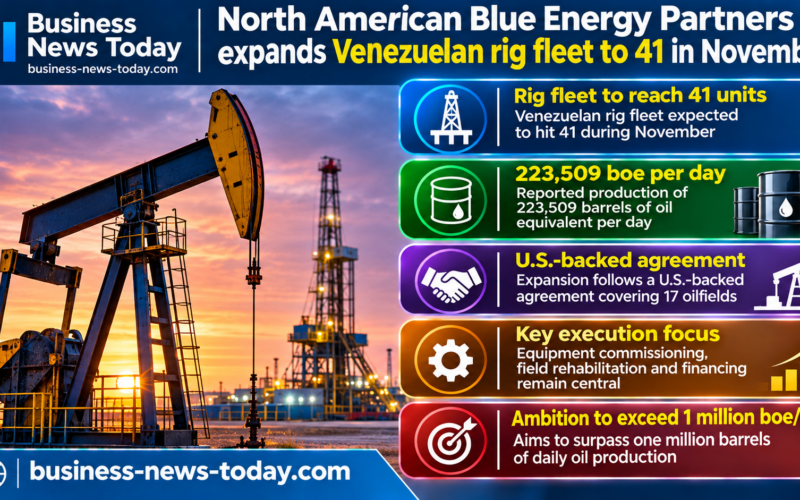
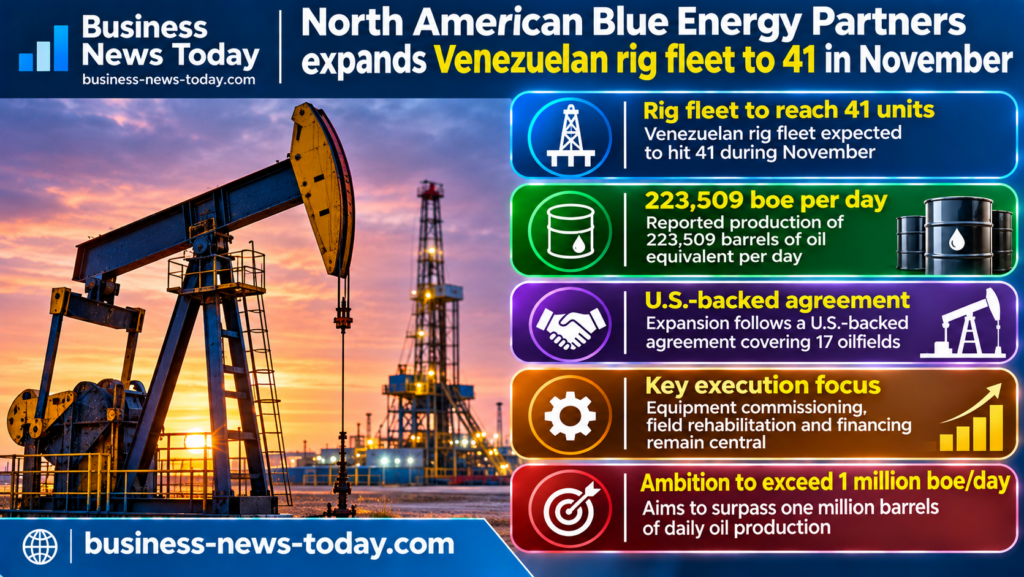
North American Blue Energy Partners (NABEP), the privately held oil exploration and production company operating in Venezuela, expects its in-country rig fleet to reach 41 units during November 2026 as it accelerates development across the Orinoco Oil Belt and Lake Maracaibo. The company reported production of 223,509 barrels of oil equivalent per day on October 19, approximately 11.8% above the 200,000-barrel-equivalent daily level it cited for August. Announced on October 31, the equipment expansion forms part of a wider programme involving 60 rigs and a proposed investment of nearly $100 billion to develop Venezuelan oil resources under an agreement with the United States government. The immediate commercial opportunity lies in restoring output from existing fields while expanding new drilling, although the gap between equipment deployment and sustained production growth remains substantial.
The latest announcement identifies nine drilling rigs and 20 workover rigs already in Venezuela, with additional equipment being transported or refurbished. Three drilling rigs are active at the Junín 10 block in the Orinoco Belt, while the remaining rigs are at different stages of preparation and deployment.
NABEP is seeking to increase production to more than one million barrels of oil per day over the longer development programme. Its immediate activities are concentrated on restoring underperforming wells, improving existing infrastructure and expanding drilling capacity across a portfolio of 17 fields.
The company says approximately $1 billion has already been reinvested in operations over the past two years. However, North American Blue Energy Partners has not published comprehensive audited financial statements alongside the latest announcement, limiting independent assessment of operating cash generation and the funding available for its much larger investment programme.
How will NABEP’s planned 41-rig fleet change drilling and well-rehabilitation capacity in Venezuela?
NABEP’s October 31 update identifies nine drilling rigs already within Venezuela. Three are operating at Junín 10, three are expected to begin work there, and another three are being refurbished or moved into position. Four additional drilling rigs are being shipped from Houston, Brazil and Colombia, potentially increasing the identified drilling fleet to 13 units after their arrival.
The company also reports 20 workover rigs in Venezuela, including three in Lake Maracaibo, 12 serving the Lagunillas and Bachaquero fields and five operating within the Orinoco Belt. Another 15 workover units are undergoing refurbishment in Houston for eventual deployment in western Venezuela. NABEP says the 35 workover rigs covered by these arrangements are being recertified to Category 4 inspection standards before entering service.
The disclosed equipment breakdown identifies 29 rigs already in Venezuela, comprising nine drilling rigs and 20 workover units. The company’s projection of 41 rigs during November therefore involves a further increase of 12 units, although the announcement does not specify precisely which combination of additional rigs will arrive and complete preparation during that month.
The broader inventory described in the release covers 48 drilling and workover rigs when equipment currently in Venezuela, in shipment and undergoing refurbishment is combined. The remaining portion of the previously announced 60-rig programme is not itemized in equivalent detail. Investors and contractors should distinguish the number of rigs planned, delivered, refurbished and actively operating.
NABEP’s previous October update included the addition of 11 workover rigs rated at 550 horsepower and two drilling rigs rated at 1,500 horsepower. The company has identified equipment models associated with U.S. manufacturers Helmerich & Payne and NOV, although it has not disclosed the value of the underlying equipment transactions.
Why are workover rigs potentially more important than new drilling for NABEP’s near-term production growth?
The composition of NABEP’s fleet indicates that restoring production from existing wells is a major part of its immediate strategy. Workover rigs are used to maintain, repair or modify wells that have become inactive or are producing below their potential. This activity can sometimes restore output without the expense and longer development cycle associated with drilling entirely new wells.
In mature Venezuelan oilfields, production may be constrained by worn equipment, inadequate artificial lift, accumulated well problems and unreliable supporting infrastructure. Restoring individual wells can improve output relatively quickly where reservoirs remain productive and surface facilities are capable of handling the additional fluids.
NABEP’s concentration of workover equipment in Lagunillas, Bachaquero and Lake Maracaibo reflects the importance of established western Venezuelan production areas. The company is also deploying workover equipment within the Orinoco Belt, where recovery conditions differ because of the characteristics of the heavy oil resources.
The economics of well rehabilitation depend on the additional recoverable output, repair expenditure and operating life of each well. A successful intervention may generate attractive returns where substantial production infrastructure already exists, but other wells can require repeated maintenance or more extensive upgrades.
Reuters reported on October 30 that approximately 80% of around 4,000 inactive wells in the wider Maracaibo basin require repairs, citing comments from a senior official at state-owned Petróleos de Venezuela. This indicates a substantial potential rehabilitation market, but those wells should not all be treated as belonging to NABEP or as economically viable restoration candidates.
The commercial advantage of the expanding workover fleet will be established through completed interventions, incremental production and sustained well performance. Equipment deliveries alone cannot demonstrate how many additional barrels will ultimately be recovered.
What does NABEP’s reported production increase to 223,509 boe/d reveal about operating progress?
NABEP reported production of 223,509 barrels of oil equivalent per day as of October 19, compared with approximately 200,000 in August. The increase of 23,509 boe/d represents growth of approximately 11.8% over the company’s stated reference level.
The company says production has increased from approximately 18,000 barrels per day two years earlier, reflecting expansion through infrastructure repairs, operational improvements and additional field activity. The October figure represents approximately 12.4 times the historical starting volume, although the differing production descriptions should be considered when comparing oil-only volumes with total hydrocarbon output.
According to Bloomberg reporting in October, much of NABEP’s production comes from its western Venezuelan operations, with additional volumes from Petrocedeño and Junín 10 in the Orinoco Belt. The company assumed operating control of 14 additional Venezuelan fields on October 1, expanding a portfolio that previously included three projects.
The latest production figure is a reported operating measure rather than an independently audited production statement. Bloomberg previously attributed the October 19 figure to a person familiar with company operations and internal data associated with Petróleos de Venezuela, providing additional reporting context but not a published field-by-field reconciliation.
The distinction between crude oil output and barrels of oil equivalent is particularly relevant when assessing the company’s million-barrel objective. Barrels of oil equivalent can include natural gas converted into oil-equivalent energy units, while the stated long-term target refers to barrels of oil production.
Consistent reporting of crude oil, condensate and natural gas volumes would allow more precise measurement of progress. Production sustained over several reporting periods would also provide stronger evidence than a single-day operating figure, particularly where recently restored wells may experience changes in output.
How does the U.S. government’s 35% stake and preferential oil access change NABEP’s commercial position?
NABEP’s expansion follows an agreement announced by the White House on August 31, 2026, involving the company’s parent structure, Venezuelan oilfield development and U.S. access to future production. The arrangement gives the U.S. government’s Office of Strategic Capital a 35% equity stake in NABEP’s corporate parent.
The U.S. Department of State also secured rights to purchase 20% of the company’s relevant production at production cost, together with a right of first refusal over the remaining 80%. The arrangements are subject to the agreement’s terms and the allocation of production under the Venezuelan operating framework.
The White House described the agreement as providing a basis for developing 17 Venezuelan fields associated with approximately 65 billion barrels of stated proven oil reserves. The figure represents the resource base attributed to the relevant concessions, not the amount of oil already produced or a guarantee that the full quantity can be recovered commercially.
The U.S. agreement creates an unusual relationship between a private oil producer and a national government. Preferential offtake rights may provide a defined commercial channel for part of production, while the governance provisions give the U.S. government influence over important corporate decisions.
However, preferential access at production cost is different from a conventional market-price oil sales contract. The company’s financial return depends on its overall production allocation, pricing, operating expenses and the obligations associated with the arrangements.
NABEP has said that it did not receive U.S. government funding as part of the equity agreement and that its expansion plan currently relies on reinvesting operating cash rather than raising outside capital. The existence of a government ownership interest therefore should not be interpreted as a $100 billion public financing commitment.
Why does the first million-barrel shipment to Texas matter for NABEP’s oil commercialization strategy?
On October 27, NABEP announced the arrival of two tankers carrying approximately one million barrels of Venezuelan crude at Corpus Christi, Texas. The shipment was associated with the new U.S. agreement and represented an initial physical delivery under the expanded commercial relationship.
NABEP said the first cargo was provided without charge to U.S. taxpayers. Reuters separately reported that the crude would be sold to refineries operated by ExxonMobil and Citgo Petroleum, establishing a specific downstream destination for the shipment.
The delivery demonstrates that NABEP has access to a functioning export route linking Venezuelan production with the U.S. Gulf Coast refining market. This is commercially relevant because producing crude oil does not guarantee that a company can transport, market and sell it efficiently.
Gulf Coast refineries have experience processing a range of crude grades, including heavy oil. However, the economics of individual shipments depend on crude quality, refinery requirements, transport costs and the terms of purchase agreements.
The first shipment should not be treated as evidence that NABEP is already delivering one million barrels regularly under the new arrangement. The cargo represents a specific completed shipment, while the volume and frequency of subsequent exports will depend on sustained production, shipping availability and commercial scheduling.
For NABEP, the more consequential milestone will be establishing repeatable export flows. Consistent deliveries at commercially sustainable margins would strengthen the company’s ability to fund the planned drilling and infrastructure programme from operating cash.
Can NABEP finance a nearly $100 billion development programme through oil production and internal reinvestment?
NABEP says it has invested approximately $1 billion of its own resources over the past two years to increase production. Management intends to continue funding expansion through proceeds from existing operations, with additional spending directed towards drilling equipment, well rehabilitation and supporting infrastructure.
The proposed investment programme of nearly $100 billion is substantially larger than the capital deployed so far. It represents a long-term development ambition rather than spending already committed through completed projects or cash held on the company’s balance sheet.
The economics of self-funded growth depend on the cash generated after production expenses, royalties, taxes, commercial obligations and sustaining capital expenditure. Higher output can expand available cash flow, but new drilling, field maintenance and infrastructure restoration may also increase expenditure.
Heavy oil operations can face particularly demanding capital and operating requirements. Some fields need artificial lift, thermal recovery or other techniques to maintain production, while surface infrastructure must be capable of transporting and processing the additional output.
NABEP has also announced plans involving 30 steam boilers and 70 pieces of heavy construction equipment. These assets could support expanded field activity, but their operation requires fuel, maintenance, trained personnel and reliable supporting services.
The company has not published audited cash-flow statements, field-level operating costs, a detailed capital expenditure schedule or independent financing commitments sufficient to evaluate the full $100 billion proposal. Without those disclosures, calculating a reliable payback period or project-level return would involve unsupported assumptions.
NABEP has said its business plan does not currently contemplate additional debt or external equity financing, although it may pursue commercial arrangements with vendors. This approach preserves ownership flexibility but makes the rate of development closely dependent on operating cash generation and the timing of equipment and infrastructure expenditure.
How serious are the infrastructure, contractor and workforce challenges facing NABEP’s Venezuelan oil expansion?
Venezuela’s mature oil industry contains substantial established infrastructure, but many facilities have experienced prolonged underinvestment and maintenance difficulties. Restoring production across multiple fields requires coordinated work involving electrical supply, pumping systems, pipelines, fluid handling and access to skilled technical personnel.
The scale of NABEP’s programme means that equipment procurement is only one part of the challenge. Rigs need qualified crews, maintenance support, spare parts and suitable locations before they can perform productive work. Additional well output also requires the wider field infrastructure to accommodate the extra volumes.
Reuters reported on October 30 that interviews with workers, contractors, financiers and industry specialists identified concerns about infrastructure conditions, hiring requirements and payments to some suppliers. The report cited people familiar with operations who said that certain contractors were owed money, while acknowledging that the total amount could not be established.
NABEP disputed that characterization in a detailed response published the same day. The company said its supplier base was expanding, invoices were being paid and any temporary payment-system disruption would be addressed. It also stated that its operations were progressing and that it had provided journalists with visual material showing field activity.
The competing accounts should not be treated as an established finding of financial misconduct or as proof that the company lacks the resources to continue its programme. The commercially relevant uncertainty concerns the capacity to maintain contractor relationships and complete a rapidly expanding schedule of field work.
NABEP says it currently employs approximately 5,000 people and supports another 10,000 contract workers in Venezuela. It also reported receiving more than 12,000 job applications and registrations from over 1,800 prospective suppliers and contractors during the second half of October. These figures suggest substantial recruitment interest, although applications and supplier registrations are not equivalent to qualified personnel already employed or contracted.
How realistic is NABEP’s target of 500,000 barrels per day by 2028 and more than one million over the longer term?
NABEP has identified a target of reaching approximately 500,000 barrels per day by the end of 2028, while its broader strategy envisages production exceeding one million barrels per day. The two targets describe different stages of expansion and should not be treated as having the same deadline.
Relative to the October 19 figure of 223,509 boe/d, reaching 500,000 daily barrels would require an increase of approximately 276,500 units of daily output before adjusting for differences between oil-only and oil-equivalent production measures. The company must therefore add substantial production while maintaining output from existing wells.
An increase to one million barrels of oil per day would represent a much larger development requirement. New wells, restored production capacity and reliable gathering and processing infrastructure would all need to contribute.
The maturity of some Venezuelan fields creates an additional challenge because production gains from rehabilitation may diminish without ongoing maintenance or investment. Expansion must therefore offset any decline in existing output while adding incremental volumes.
A senior official at Petróleos de Venezuela reportedly suggested that reaching one million barrels per day could require six to seven years. That timetable differs from the impression of near-term expansion conveyed by NABEP’s broader goal and illustrates the uncertainty surrounding development schedules.
The most useful indicators will be sustained production volumes, completed workovers, active drilling rigs and new wells placed into service. Detailed reporting across those measures would allow the company’s progress to be assessed against its operational milestones rather than headline fleet numbers alone.
Does NABEP’s claim to more than 65 billion barrels of proven reserves establish the economic value of its Venezuelan concessions?
NABEP and the White House have described the portfolio as covering approximately 65 billion barrels of proven oil reserves across 17 Venezuelan fields. The size of that resource base is central to the strategic case for long-term redevelopment.
However, a large stated reserve figure does not establish how much oil can be produced profitably within a particular investment period. Recoverability depends on reservoir characteristics, extraction technology, capital availability, operating costs and the commercial terms governing production.
Reuters reported that Francisco Monaldi, director of the Latin America Energy Program at Rice University’s Baker Institute, considered approximately 10 billion barrels a more realistic potential development volume within the relevant 25-year planning period, and only under favorable conditions.
That assessment differs materially from treating the full 65 billion barrels as recoverable through the announced investment programme. It does not constitute a final independent reserves audit, but it identifies an important commercial distinction between the reported resource base and economically achievable production.
NABEP has maintained that improvements in extraction technology and continued capital investment can increase recovery opportunities. The company has also argued that evaluations relying heavily on historical performance may understate the potential for field rehabilitation.
The economic case would be strengthened by independently assessed field-level reserves, recovery assumptions and development plans. Those disclosures would provide a more useful basis for valuing production rights than multiplying the headline reserves figure by an assumed oil price.
What does NABEP’s expansion mean for oilfield equipment suppliers and the wider Venezuelan energy industry?
NABEP’s equipment programme could create commercial opportunities for rig manufacturers, oilfield service companies, maintenance contractors and engineering businesses. Its announcements identify equipment associated with U.S. manufacturers and describe refurbishment and logistics activity involving several countries.
Helmerich & Payne and NOV are publicly traded businesses with exposure to drilling equipment or related technology. However, NABEP has not disclosed a material new contract award, purchase value or expected earnings contribution for either company in the October 31 release.
Consequently, the expansion should not be treated as evidence of a measurable near-term revenue increase for those listed suppliers. A confirmed order value or company-specific disclosure would be necessary to assess its materiality to shareholders.
For Venezuela, the wider commercial opportunity involves restoring existing productive capacity while creating additional demand for engineering, transport, maintenance and industrial services. That could support employment and local supplier activity if investment is sustained and payments circulate through the domestic economy.
The associated infrastructure requirements are considerable. Higher crude output may require investment in storage, pipelines, power generation, fluid processing and export logistics, meaning the effectiveness of the drilling programme depends on improvements across the wider operating system.
The U.S. commercial relationship may provide an outlet for some additional production, but Venezuela’s oil recovery will still depend on reliable project execution and economically sustainable field operations.
What evidence will determine whether NABEP’s rig expansion produces lasting production growth?
The immediate operating milestone is verification of the planned increase to 41 rigs during November, including the number actually active rather than merely present within Venezuela. Progress should also be measured through completed workovers, new wells brought into production and the performance of existing fields.
NABEP’s reported 223,509 boe/d output provides a useful starting point, but sustained production over a longer period would offer stronger evidence of operational improvement. Separate disclosure of crude oil and other hydrocarbon production would make comparison with its future targets more precise.
The company’s financing approach presents the second major test. Generating sufficient cash to maintain existing operations while undertaking major new investment will depend on production economics, commercial receipts and the timing of capital expenditure.
Greater financial transparency, including audited accounts and detailed capital commitments, would strengthen assessment of the proposed $100 billion investment programme. Independent field data and a reconciled rig inventory would also clarify the relationship between equipment procurement and actual production capacity.
The October expansion demonstrates tangible progress in mobilizing equipment and increasing reported output. However, the decisive economic milestone will be the conversion of additional operating rigs and rehabilitated wells into sustained, commercially saleable barrels that provide enough cash to fund the next stage of redevelopment.
What are the key takeaways from NABEP’s 41-rig expansion and Venezuela oil production strategy?
- North American Blue Energy Partners expects its Venezuelan rig fleet to reach 41 units during November 2026, out of a wider 60-rig programme.
- The October 31 announcement identifies nine drilling rigs and 20 workover rigs already in Venezuela, with only three drilling rigs reported active at Junín 10.
- Production reached a company-reported 223,509 boe/d on October 19, approximately 11.8% above its stated August reference of 200,000 boe/d.
- Additional drilling and well rehabilitation are concentrated in Lake Maracaibo, Lagunillas, Bachaquero and the Orinoco Oil Belt.
- The company says it has reinvested approximately $1 billion over two years and is pursuing a much larger development programme involving nearly $100 billion in planned investment.
- An August agreement gives the United States government a 35% equity interest in NABEP’s corporate parent and preferential access to a share of production.
- The first shipment of approximately one million barrels under the expanded U.S. commercial arrangement arrived in Corpus Christi on October 27.
- NABEP is targeting approximately 500,000 barrels per day by the end of 2028 and more than one million barrels per day over its broader development programme.
- Infrastructure rehabilitation, skilled personnel, contractor capacity and financing will influence how quickly additional rigs generate sustained production.
- Independent operational and financial reporting will provide the strongest evidence of whether the equipment expansion can support the company’s production and investment ambitions.
Discover more from Business-News-Today.com
Subscribe to get the latest posts sent to your email.

