

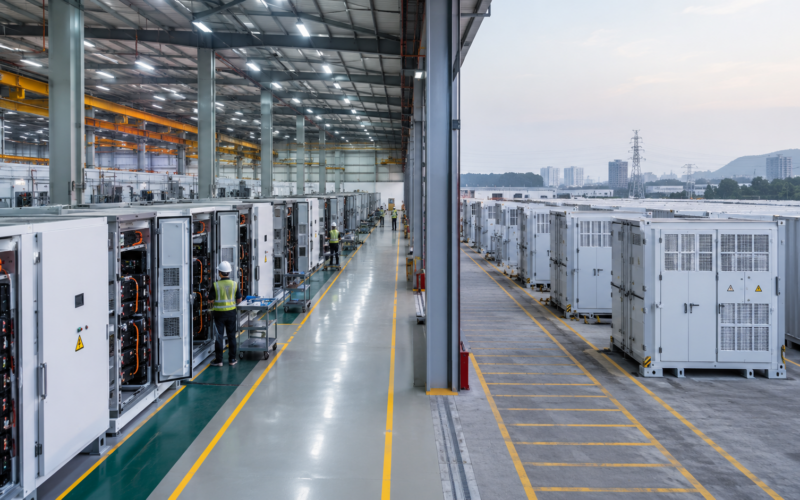
Amperehour Solar Technology Private Limited, which operates under the AmpereHour Energy brand, has inaugurated a battery energy storage system manufacturing and integration facility at Chakan in Pune with planned annual capacity of 5 GWh. The privately held company intends to manufacture and integrate cabinet-based and containerised battery DC-AC blocks for utility-scale, commercial and industrial energy storage projects. The investment represents a significant expansion from project engineering and system integration into repeatable factory production supported by AmpereHour Energy’s proprietary software and digital testing platforms. However, the strategic significance of the facility will depend less on its announced nameplate capacity than on the company’s ability to secure bankable orders, manage imported battery-cell exposure and operate the plant at commercially sustainable utilisation levels.
The Pune BESS manufacturing facility arrives as India attempts to translate a rapidly expanding energy storage project pipeline into a domestic industrial ecosystem. AmpereHour Energy is positioning itself in the middle of that value chain, between global battery-cell suppliers and the utilities, renewable developers, infrastructure investors and industrial consumers that need complete storage assets. That position can be strategically attractive because system engineering, controls, safety design, commissioning and lifecycle optimisation often determine whether a BESS project performs as expected after installation. It can also be commercially demanding because integrators remain exposed to cell-price volatility, aggressive tender pricing, warranty obligations and the risk that announced projects are delayed before reaching construction.
How does AmpereHour Energy’s 5 GWh Pune facility change its position in India’s BESS value chain?
AmpereHour Energy’s expansion marks a shift from delivering customised storage projects toward building a manufacturing platform capable of producing standardised systems at greater scale. The Chakan plant is designed to combine battery cabinets, containerised DC-AC blocks, subsystem engineering, safety architecture, software controls and factory-level testing before equipment is dispatched to project sites.
This changes the company’s operating model in several ways. Project integration is typically organised around individual contracts, engineering specifications and site conditions. Manufacturing requires a more repeatable rhythm involving procurement planning, inventory management, production scheduling, supplier quality, working capital and warranty control. A 5 GWh facility therefore creates the possibility of higher throughput, but it also increases the cost of underutilised equipment, excess inventory and delayed customer deliveries.
The scale-up is notable when viewed against AmpereHour Energy’s earlier expansion plans. Following a $5 million Series A funding round led by Avaana Capital with participation from UC Impower and existing investors in March 2025, the company said it planned to strengthen manufacturing, software, research and product development. At the time, management referred to contracted capacity supporting a planned increase toward 1 GWh over an 18-month period. The new 5 GWh platform implies a considerably larger industrial ambition, although planned factory capacity should not be confused with confirmed annual production or customer orders.
The strategic opportunity is to convert project experience into repeatable products and processes. If AmpereHour Energy can standardise design elements while retaining sufficient flexibility for different battery cells, power conversion systems and customer requirements, the company may be able to shorten engineering cycles and reduce commissioning risks. The challenge is that excessive customisation can erode the efficiencies that manufacturing scale is intended to create.
Why is the Chakan plant better understood as a system-integration factory than a battery cell gigafactory?
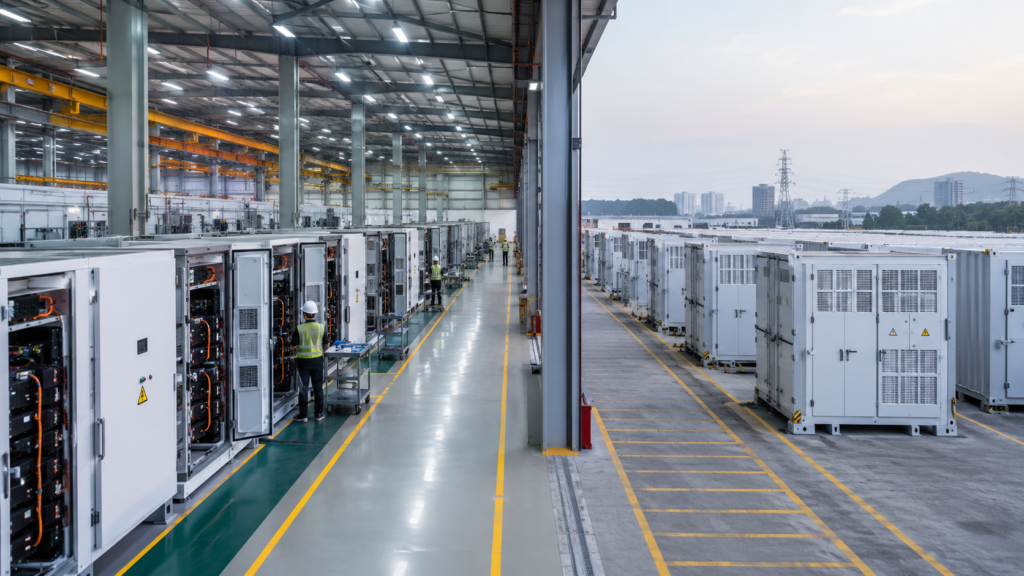
The description of the Pune facility requires precision. AmpereHour Energy has announced the integration and manufacture of battery cabinets and containerised DC-AC blocks, not a lithium-ion cell manufacturing plant. Battery cells are only one component of a complete BESS asset, although they generally represent a large share of its equipment cost and supply-chain exposure.
A complete utility-scale BESS can include cells, modules, racks, battery management systems, thermal management, fire detection and suppression equipment, power conversion systems, transformers, switchgear, enclosures, control software and grid interfaces. AmpereHour Energy’s role is to bring these components together into a system designed for a particular project’s operating duty, grid requirements, safety standards and commercial obligations.
That is still a meaningful form of domestic manufacturing. Local enclosure fabrication, electrical integration, control-system development, wiring, protection engineering, software configuration and factory acceptance testing can create employment, shorten delivery chains and retain more engineering capability in India. However, the level of genuine localisation depends on which components are produced domestically and which remain imported.
The facility announcement did not disclose the planned capital expenditure, employment numbers, expected production ramp-up, battery-cell suppliers, domestic value-addition percentage or committed customer volumes. It also did not indicate whether the 5 GWh capacity would be reached immediately or through a phased expansion. These omissions do not diminish the importance of the plant, but they establish the evidence that will be needed to evaluate its industrial impact.
India is separately supporting domestic advanced chemistry cell manufacturing through a ₹18,100 crore production-linked incentive programme targeting 50 GWh of cell capacity, including 10 GWh earmarked for grid-scale stationary storage. AmpereHour Energy’s integration platform could benefit if domestic cell availability improves, but it occupies a different part of the battery value chain from the companies producing electrochemical cells.
Can AH-Suite and ELINA turn digital quality control into a bankable BESS advantage?
AmpereHour Energy is attempting to differentiate the Pune facility through software-led manufacturing rather than hardware assembly alone. Its platform combines the ELINA Energy Management System with AH-Suite, a digital factory acceptance testing and quality-management system.
The company says AH-Suite can automate testing protocols, validate system communications, monitor charge and discharge behaviour, test safety triggers and record component-level results in a cloud-based environment. It is also intended to create traceability across cells, modules and serial numbers before systems leave the factory. ELINA operates at the asset-control level, managing energy dispatch, grid interaction and performance optimisation after deployment.
This combination addresses a genuine weakness in large BESS projects. A battery storage asset may contain thousands of interconnected components supplied by multiple vendors. A fault in communication logic, thermal control, sensor configuration or battery management can delay commissioning even when the main battery equipment is physically installed. Problems discovered at a remote project site are generally more expensive to correct than problems identified on a controlled factory floor.
Digital factory acceptance testing could therefore reduce commissioning uncertainty, improve documentation and provide developers and lenders with a clearer performance record. That matters because BESS projects are increasingly financed against long-term availability, capacity and efficiency obligations. Project owners need confidence that the integrated system can meet contractual requirements across repeated charge and discharge cycles, not merely pass an initial hardware inspection.
The commercial advantage will depend on evidence. AmpereHour Energy will need to demonstrate that its digital testing process reduces failure rates, commissioning time, warranty claims or lifecycle costs compared with conventional integration methods. Customers may value sophisticated software, but procurement decisions in India’s competitive storage market will remain heavily influenced by tariff, equipment price, guarantees and financing terms.
What does the 180 MW Gujarat project reveal about AmpereHour Energy’s execution capability?
AmpereHour Energy enters manufacturing with experience from large operating projects rather than approaching the sector solely as a factory developer. The company provided technology support for the 180 MW/360 MWh Gujarat BESS project developed by IndiGrid at a Gujarat Energy Transmission Corporation substation in the Sanand industrial area.
The standalone system was developed for Gujarat Urja Vikas Nigam Limited and structured under a long-term battery energy storage service arrangement. AmpereHour Energy’s role included technology integration supported by its ELINA Energy Management System and AH-Suite platform. The project followed an earlier 40 MWh installation in Delhi, giving the company experience across both urban distribution-level and transmission-connected storage.
The Gujarat project is relevant because it demonstrates exposure to the technical and commercial requirements of a large grid-connected BESS. Such projects must coordinate batteries, power electronics, substation infrastructure, control systems and utility dispatch requirements while meeting efficiency, availability and safety standards.
The financing structure also illustrates how storage projects are moving toward infrastructure-style investment. The International Finance Corporation committed approximately ₹4.6 billion, equivalent to about $55 million at the time of the announcement, through listed non-convertible debentures to support IndiGrid’s Gujarat project. The financing included International Finance Corporation capital and concessional support from the Clean Technology Fund.
For AmpereHour Energy, the strategic question is whether the company can convert such reference projects into a repeatable order pipeline for the Chakan plant. One large project establishes credibility, but manufacturing economics require sustained throughput across several customers, geographies and delivery periods.
Why could India’s BESS demand boom still produce difficult manufacturing economics?
India’s storage demand outlook provides a substantial addressable market. The Ministry of Power has projected a BESS requirement of 8.68 GW and 34 GWh for 2026-27, rising to 47.24 GW and 236 GWh by 2031-32. The projected investment needed for battery storage by 2031-32 is approximately ₹3.49 lakh crore. Government support includes viability gap funding for 43.8 GWh of BESS capacity, competitive bidding guidelines, infrastructure classification and measures allowing storage to participate in grid and electricity-market services.
Those figures support the case for additional domestic integration capacity. More renewable electricity increases the requirement for systems that can shift solar generation into evening demand periods, provide grid balancing, reduce peak stress and support reliable supply. Commercial and industrial consumers also represent a potential market through demand management, renewable integration and cleaner backup power.
However, strong demand forecasts do not automatically produce attractive manufacturing margins. India’s BESS tender market has experienced aggressive price competition, with developers submitting increasingly low capacity tariffs in anticipation of falling battery costs. That assumption became more difficult during 2026 as battery and metal costs increased and suppliers reconsidered earlier price commitments.
Reuters reported in July 2026 that India had around 260 GWh of energy storage projects at different stages of development, while installed battery storage had risen to approximately 8.7 GWh during the first half of the year. Industry participants warned that some previously quoted tariffs were no longer sustainable after rising lithium, copper and aluminium costs and changes affecting Chinese exports.
This creates a mixed environment for AmpereHour Energy. Higher equipment prices may increase the nominal value of systems passing through the plant, but they can delay projects, weaken developers’ returns and make lenders more cautious. A manufacturer or integrator accepting fixed-price commitments before securing its components may also absorb cost increases.
The company’s ability to preserve margins will therefore depend on procurement contracts, customer payment terms, price-adjustment mechanisms and the timing of inventory purchases. Growth without disciplined contract structures could consume working capital rapidly, particularly when battery components must be purchased well before final project payments are received.
How important are cell sourcing, local content and supplier discipline to the Pune facility’s success?
Battery-cell sourcing remains one of the most important unresolved questions around the 5 GWh platform. India is developing domestic cell production, but the grid-storage industry continues to depend heavily on international supply chains for cells and several specialised components.
A hardware-agnostic design can reduce dependence on a single supplier by allowing AmpereHour Energy to integrate different battery technologies or vendors. It may also enable the company to choose components based on project pricing, performance, safety requirements and availability. The trade-off is that each supplier combination requires technical validation, software compatibility, warranty coordination and performance testing.
Supplier diversification is useful only when the company can maintain consistent quality. Differences in cell characteristics, battery management systems, cooling equipment and communication protocols can affect efficiency, degradation and operating behaviour. AmpereHour Energy’s emphasis on factory-level digital validation appears designed to manage this complexity.
Local content will matter for policy and commercial reasons. Domestic integration can shorten lead times and improve service responsiveness, but customers and policymakers will increasingly distinguish between systems assembled in India and systems built from deeply localised component supply chains. AmpereHour Energy can strengthen its positioning by disclosing how much of each DC-AC block is locally produced, how supplier risk is distributed and whether domestic content increases over time.
Can AmpereHour Energy fill 5 GWh of annual capacity without sacrificing pricing discipline?
Factory utilisation is likely to become the clearest measure of the Pune investment’s success. A plant can be technically capable of producing 5 GWh annually while operating far below that level if project awards are delayed or customer demand arrives unevenly.
The company’s addressable market includes utility procurements, renewable-plus-storage developments, transmission-connected assets, industrial facilities, data centres, microgrids and backup-power applications. Serving multiple segments could reduce dependence on a single tender cycle, although the technical and commercial requirements differ significantly between a 5 MWh industrial installation and a multi-hundred-megawatt-hour utility project.
International expansion may provide another source of demand. During its 2025 funding announcement, AmpereHour Energy said it was working on projects in Oman and Nigeria and commissioning systems in Belgium and the United Arab Emirates. Exporting integrated systems from Pune could support higher plant utilisation, but overseas growth introduces certification, logistics, service-network and counterparty risks.
The strongest growth path would combine large utility projects with recurring commercial and industrial orders. Utility contracts can deliver scale, while smaller industrial projects can improve production continuity and diversify customers. The risk is that competitive bidding encourages the company to prioritise factory volume at the expense of margin, warranty protection or payment security.
AmpereHour Energy’s private-company status means investors and industry observers do not have the same access to revenue, cash-flow, backlog and utilisation disclosures available from listed manufacturers. Future funding announcements, customer contracts and operating updates will therefore be important indicators of whether the 5 GWh facility is being matched by financial capacity.
What milestones will show whether the Pune BESS manufacturing strategy is working?
The opening of the Chakan facility gives AmpereHour Energy a credible platform from which to pursue India’s expanding storage market. The company has moved beyond a purely conceptual manufacturing plan, has experience from operational BESS assets and has developed proprietary control and factory-testing software.
What remains unresolved is the commercial ramp. The next meaningful evidence would include disclosed customer orders, annual production volumes, factory utilisation, domestic content, cell-supply partnerships and repeat business from large infrastructure customers. Financial evidence will also matter, particularly whether the company can fund inventory and project execution without repeatedly stretching its balance sheet.
A successful ramp would validate AmpereHour Energy’s argument that Indian BESS companies can compete through engineering, software and integration rather than attempting to replicate every part of the battery supply chain immediately. It could also support India’s attempt to build a domestic storage industry alongside expanding renewable generation.
A weaker outcome would emerge if project delays leave the facility underutilised, if imported cell costs compress margins or if customers treat integration as a largely commoditised procurement category. The decisive test is therefore not whether AmpereHour Energy has built a 5 GWh facility. It is whether the company can turn that facility into a consistently utilised manufacturing platform delivering reliable systems, defensible margins and measurable lifecycle performance.
What are the key takeaways from AmpereHour Energy’s 5 GWh Pune BESS manufacturing expansion?
- AmpereHour Energy has inaugurated a BESS manufacturing and integration facility in Chakan, Pune, with planned annual capacity of 5 GWh.
- The plant will manufacture and integrate cabinet and containerised battery DC-AC blocks for utility-scale, commercial and industrial projects.
- The facility is a system-integration and equipment-manufacturing platform rather than a disclosed lithium-ion cell gigafactory.
- AmpereHour Energy is combining hardware integration with its ELINA Energy Management System and AH-Suite digital factory-testing platform.
- The company has gained utility-scale experience through its technology role in IndiGrid’s 180 MW/360 MWh Gujarat BESS project.
- India’s projected requirement of 236 GWh of BESS capacity by 2031-32 creates a substantial potential market for domestic manufacturers and integrators.
- Rising battery and raw-material costs could challenge project tariffs, customer financing and manufacturing margins.
- Cell sourcing, local content, supplier diversification and working-capital discipline will be critical to the plant’s commercial performance.
- Confirmed orders, production volumes and factory utilisation will provide stronger evidence than the facility’s announced nameplate capacity.
Discover more from Business-News-Today.com
Subscribe to get the latest posts sent to your email.