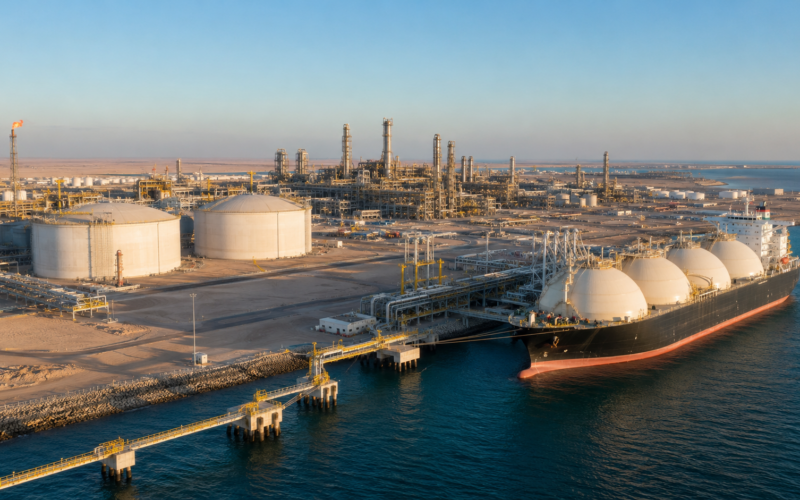
The Ruwais LNG Project is being developed in Al Ruwais Industrial City in Abu Dhabi’s Al Dhafra region, west of the UAE capital. ADNOC is leading the project, with bp, Mitsui & Co., Shell and TotalEnergies each announced as 10% equity partners and ADNOC retaining a 60% majority stake.
The project will comprise two 4.8Mtpa liquefaction trains, giving Ruwais LNG a total export capacity of 9.6 million tonnes per year. ADNOC says the facility will be the first LNG export plant in the Middle East and Africa region to operate on clean power, using electrically driven liquefaction systems rather than conventional gas turbine-driven trains.
Ruwais LNG moved through final investment decision and major EPC award in 2024, with a Technip Energies-led joint venture including JGC Corporation and NMDC Energy selected to build the plant. Commercial operations are scheduled to start in 2028, and ADNOC has already committed 90% of the project’s capacity through long-term arrangements with customers across Asia and Europe.
The project matters because ADNOC is trying to turn Abu Dhabi from a regional LNG producer into a larger global LNG supplier. Ruwais LNG will more than double ADNOC’s existing operated LNG production capacity to around 15Mtpa, while giving the UAE a lower-carbon-intensity export platform at a time when Asian and European buyers are locking in long-term gas supply.
Where is the Ruwais LNG Project located and why did ADNOC choose Al Ruwais?
The Ruwais LNG Project is located in Al Ruwais Industrial City, in Abu Dhabi’s Al Dhafra region. The site is part of one of the UAE’s most important industrial zones, already linked to ADNOC’s wider downstream, petrochemical, refining and gas infrastructure base.
The location matters because LNG projects need more than liquefaction trains. They require feed gas access, marine export facilities, storage, utilities, power supply, construction logistics, industrial land, safety corridors, skilled labour and integration with existing operations. Al Ruwais offers many of these advantages because it is already an established ADNOC industrial hub.
ADNOC had previously considered Fujairah for the LNG project before selecting Ruwais. The shift to Al Ruwais gives the project closer proximity to ADNOC’s existing operations, planned growth projects and local supplier base. That proximity can reduce execution risk and support a more integrated industrial development model.
The project’s location also reinforces Abu Dhabi’s broader downstream and gas strategy. Ruwais is already associated with refining, petrochemicals and industrial expansion. Adding LNG export capacity strengthens its role as a long-term energy and industrial platform rather than a single-sector complex.
For global buyers, the location has another advantage. The UAE is already a reliable energy exporter with established ports, shipping relationships and long-term customer relationships. Ruwais LNG builds on that reputation while adding new liquefaction capacity and a cleaner power model for plant operations.

Who owns and operates the Ruwais LNG Project?
ADNOC is the lead developer of the Ruwais LNG Project and retains the majority position. In July 2024, ADNOC announced that bp, Mitsui & Co., Shell and TotalEnergies were to be awarded 10% equity stakes each in the project, with ADNOC retaining a 60% majority stake.
The partner group gives Ruwais LNG a global commercial and technical base. bp, Shell and TotalEnergies are among the world’s most experienced LNG portfolio players, while Mitsui brings long-standing Japanese energy trading and investment experience. Their participation strengthens the project’s credibility with buyers, financiers, regulators and global gas markets.
ADNOC Gas has said it expects to acquire ADNOC’s 60% stake in Ruwais LNG at cost, estimated at around $5 billion, in 2028. That expected transfer is important because ADNOC Gas is the listed gas processing and LNG platform through which ADNOC can consolidate long-term value from the project.
This ownership structure gives Ruwais LNG three layers of strategic support. ADNOC provides the national development platform and majority control. International partners provide LNG market access, technical experience and customer credibility. ADNOC Gas provides the future operating and capital-market vehicle for the UAE’s expanded LNG footprint.
The structure also reflects a broader shift in LNG project development. Major export plants increasingly rely on a mix of national energy companies, international oil and gas partners, long-term offtakers and dedicated gas platforms. Ruwais LNG follows that model while remaining majority-controlled by ADNOC.
What is the planned capacity of the Ruwais LNG Project?
The Ruwais LNG Project will have a total LNG export capacity of 9.6 million tonnes per year. The facility will consist of two liquefaction trains, each designed for 4.8 million tonnes per year.
This capacity will more than double ADNOC’s existing operated LNG production capacity. ADNOC’s current operated LNG base is around 6 million tonnes per year from Das Island, while Ruwais is expected to lift operated capacity to around 15 million tonnes per year after completion.
The capacity figure is important because Ruwais LNG is not a small incremental expansion. It is a full new export platform that shifts the UAE’s LNG position in the global market. At 9.6Mtpa, Ruwais is large enough to support multiple long-term sales agreements across regions and customers.
The project is also being largely commercialised before start-up. ADNOC said in July 2026 that 90% of Ruwais LNG’s 9.6Mtpa production capacity had been committed to international buyers across Asia and Europe through long-term arrangements. That level of pre-commitment reduces marketing risk and shows strong buyer confidence before the plant enters commercial operations.
Capacity should still be understood as nameplate export capacity, not guaranteed annual output from the first day of operation. LNG projects typically move through commissioning, start-up, reliability testing and ramp-up before reaching stable long-term production. Ruwais LNG is scheduled to begin commercial operations in 2028, but actual output will depend on commissioning performance, feed gas availability, plant reliability, shipping logistics and customer scheduling.
How will Ruwais LNG use clean power and electric liquefaction technology?
Ruwais LNG’s defining technical feature is its clean-powered, electric-driven liquefaction model. ADNOC says the plant will be the first LNG export facility in the Middle East and Africa region to operate on clean power, making it one of the world’s lower-carbon-intensity LNG plants.
Traditional LNG plants often use gas turbines to drive large compressors in the liquefaction process. Ruwais LNG is designed to use electric-driven motors instead. Baker Hughes was awarded a contract of more than $400 million to supply all-electric compression systems, including compressors driven by 75MW electric motors.
This matters because liquefaction is energy-intensive. The power source and compressor-drive system have a major effect on the emissions intensity of LNG production. Electrified trains powered by cleaner grid electricity can reduce operational emissions compared with conventional gas turbine-driven liquefaction trains.
The clean-power model should be described carefully. Ruwais LNG will still produce LNG from natural gas, and LNG remains a fossil fuel with lifecycle emissions from production, liquefaction, shipping, regasification and end-use combustion. The lower-carbon claim relates mainly to the facility’s operational emissions intensity, not to the elimination of all LNG-related emissions.
ADNOC also says the plant will use artificial intelligence, digitalisation and advanced technologies to enhance safety, efficiency and operational performance. These systems can support predictive maintenance, energy optimisation, process reliability and plant monitoring, which are all important for a large export facility operating under long-term customer commitments.
Which companies won major contracts for the Ruwais LNG Project?
The main EPC contract for the Ruwais LNG Project was awarded to a joint venture led by Technip Energies, with JGC Corporation and NMDC Energy as partners. The contract covers engineering, procurement and construction of the lower-carbon LNG plant in Al Ruwais Industrial City.
The EPC award followed an earlier limited notice to proceed for early engineering, procurement and construction activities. This allowed preparatory work to start before full final investment decision, helping ADNOC accelerate the schedule and reduce the gap between sanction and execution.
Technip Energies brings LNG process and project execution experience, JGC brings deep LNG engineering and construction capability, and NMDC Energy adds local industrial execution capacity in the UAE. The combination is important because Ruwais LNG must deliver a technically complex plant while also supporting domestic industrial participation.
Baker Hughes has a critical equipment role. ADNOC awarded Baker Hughes, through Nuovo Pignone International, a contract valued at more than $400 million for all-electric compression systems for the liquefaction trains. The scope includes compressors driven by 75MW electric motors.
These contract awards show that Ruwais LNG is not only a commercial LNG story. It is also a major engineering and industrial project involving electrified compression, large-scale process units, utilities, controls, construction logistics, marine export requirements and local fabrication support.
How did the Ruwais LNG Project move from planning to final investment decision?
The Ruwais LNG Project moved through a staged development process before final investment decision. ADNOC first built commercial momentum by signing heads of agreement and sales arrangements with potential LNG buyers, showing that customer demand existed before the plant was fully sanctioned.
In March 2024, ADNOC issued a limited notice to proceed for early EPC activities to the Technip Energies-led joint venture. This was an important pre-FID step because it allowed engineering and procurement work to advance before the full project moved into execution.
The project reached final investment decision in June 2024. At the same time, ADNOC awarded EPC contracts worth about $5.5 billion for construction of the Ruwais LNG plant. That combination of FID and EPC award moved the project from planning and marketing into the execution phase.
In July 2024, ADNOC announced international partner participation, with bp, Mitsui & Co., Shell and TotalEnergies each set to take 10% stakes and ADNOC retaining 60%. That partner structure strengthened the project’s financial, technical and commercial base.
Since then, ADNOC has continued converting customer commitments into firmer long-term supply arrangements. The signing of long-term agreements with customers in Asia and Europe has turned Ruwais LNG into one of the more visibly de-risked LNG projects scheduled for start-up in 2028.
What are the latest Ruwais LNG Project updates in 2026?
The most important 2026 update is ADNOC’s July 2026 agreement with INPEX Corporation. ADNOC signed a 15-year sales and purchase agreement to supply 1 million tonnes per year of LNG from the Ruwais LNG Project to INPEX, Japan’s largest exploration and production company.
That agreement raised Ruwais LNG’s long-term commitments to 90% of the project’s 9.6Mtpa production capacity. It also increased the share committed to Japanese customers to nearly 23%, reinforcing the project’s importance to Asian energy-security buyers.
The INPEX agreement was also the first long-term LNG deal announced after the launch of ADNOC and XRG’s integrated global LNG marketing and trading platform. That matters because ADNOC is not only building liquefaction capacity. It is also creating a more global marketing system for LNG molecules, portfolio management and customer access.
ADNOC has said the Ruwais LNG Project is scheduled to start commercial operations in 2028. The project is therefore now in the period where execution, equipment delivery, construction productivity, commissioning readiness and commercial coordination become increasingly important.
The latest commercial position is strong. With 90% of capacity committed through long-term arrangements, Ruwais LNG has already secured most of its demand base before start-up. The execution question now shifts to whether the plant can be delivered on schedule and ramped reliably into those sales commitments.
Which customers have signed long-term LNG agreements or commitments for Ruwais LNG?
ADNOC has built a broad customer base for Ruwais LNG across Asia and Europe. Long-term agreements or commitments have been announced with buyers including INPEX, IndianOil, Osaka Gas, PETRONAS, EnBW, SEFE, Shell, Mitsui and ENN Natural Gas.
The INPEX agreement announced in July 2026 covers 1 million tonnes per year for 15 years. It reinforces the UAE-Japan energy relationship and gives Japanese customers a significant share of future Ruwais LNG production.
IndianOil also signed a 15-year sales and purchase agreement for 1 million tonnes per year sourced primarily from Ruwais LNG. That agreement reflects India’s growing role as a long-term LNG demand centre as gas use expands across industry, city gas, fertilisers, refining and power.
European buyers are also part of the portfolio. EnBW signed a 15-year agreement for 0.6 million tonnes per year, while SEFE signed a 15-year agreement for 1 million tonnes per year. These contracts align with Europe’s continuing effort to diversify gas supply after the disruption of Russian pipeline flows.
The customer mix gives Ruwais LNG strategic flexibility. Asian buyers provide long-term demand growth, while European buyers support diversification and security-of-supply goals. For ADNOC, that combination helps position Ruwais LNG as a portfolio asset rather than a plant dependent on one region or one customer group.
How does Ruwais LNG affect ADNOC’s global LNG strategy?
Ruwais LNG is central to ADNOC’s plan to expand its LNG business. ADNOC and XRG are targeting 47 million tonnes per year of combined marketable LNG by 2035, and Ruwais LNG is one of the key physical supply sources behind that ambition.
The project also changes ADNOC’s LNG scale. ADNOC’s legacy LNG position has historically been anchored by Das Island, but Ruwais gives the company a newer, larger and cleaner-powered export platform. That strengthens ADNOC’s ability to compete in long-term LNG tenders and portfolio supply arrangements.
Ruwais LNG also fits with ADNOC’s broader gas growth strategy. The company is expanding upstream gas development, processing, LNG marketing and international gas exposure. LNG is becoming a larger part of its future growth portfolio alongside oil, petrochemicals, low-carbon energy and international investments.
For ADNOC Gas, the project is especially important because the expected acquisition of ADNOC’s 60% stake in 2028 would materially expand its operated LNG platform. That could increase the company’s exposure to global LNG demand and long-term contract cash flows.
For the UAE, Ruwais LNG strengthens national energy leverage. It allows Abu Dhabi to deepen energy relationships with Japan, India, Germany, Malaysia, China and other major gas buyers while positioning itself as a lower-carbon-intensity LNG supplier.
What regulatory, environmental and market issues shape Ruwais LNG?
Ruwais LNG is shaped by three major issues: gas market demand, emissions intensity and execution risk. The project is entering a global LNG market where buyers want secure long-term supply but also face pressure to reduce emissions.
The lower-carbon-intensity design is commercially important because buyers increasingly compare LNG not only by price and reliability, but also by emissions profile. Clean-powered electric liquefaction can help ADNOC position Ruwais LNG more competitively with customers that have climate targets or policy pressure.
However, environmental scrutiny will remain. LNG can have lower combustion emissions than coal or oil in some uses, but it is still a hydrocarbon fuel. Methane management across the gas value chain, shipping emissions and end-use combustion will continue to shape how customers, regulators and investors assess LNG projects.
Market timing also matters. Ruwais LNG is scheduled to start commercial operations in 2028, a period when several other LNG projects from Qatar, the United States and elsewhere are also expected to add supply. ADNOC’s advantage is that most Ruwais capacity is already committed through long-term arrangements, but global LNG prices and portfolio dynamics will still affect long-term value.
The project also sits within a competitive Gulf LNG landscape. Qatar remains the dominant regional LNG exporter, while the UAE is positioning itself as a smaller but strategically flexible supplier with a lower-carbon-intensity production story. Ruwais LNG is the clearest expression of that positioning.
What could limit the Ruwais LNG Project’s delivery or performance?
The first limitation is construction execution. LNG plants are complex projects with long supply chains, specialised equipment, safety-critical systems and demanding commissioning requirements. Even with experienced contractors, schedule pressure can arise from equipment delivery, labour productivity, interface management and commissioning complexity.
The electric liquefaction model reduces some emissions intensity but adds its own integration requirements. Large electric motors, power supply, compressors, controls and grid reliability must work together at high availability. The plant’s clean-power claim depends on both design and dependable operation.
Feed gas availability is another critical factor. A liquefaction plant cannot run at high utilisation unless upstream gas supply, processing and pipeline systems deliver the required volumes and quality. Ruwais LNG therefore depends on ADNOC’s wider gas strategy and infrastructure readiness.
Shipping and logistics must also be aligned. LNG sales contracts require cargo scheduling, carrier availability, port operations and reliable delivery windows. ADNOC’s LNG marketing platform and shipping arrangements will need to support the plant as it ramps up.
Market risk remains present even with long-term contracts. Buyers may have destination flexibility, price formulas and portfolio rights that affect realised value. Global LNG supply additions around 2028 could also influence spot prices and contract negotiations for uncommitted volumes.
What is the future outlook for the Ruwais LNG Project?
The future outlook for the Ruwais LNG Project is strong but execution-sensitive. The project has reached FID, secured a major EPC contractor group, brought in international equity partners, awarded critical electric-compression equipment and committed 90% of capacity through long-term arrangements.
The next major test is physical delivery. ADNOC and its contractors must build, energise, commission and ramp up two 4.8Mtpa liquefaction trains while maintaining safety, schedule discipline and plant reliability. Commercial demand is largely in place, but LNG projects ultimately succeed only when they deliver cargoes consistently.
If Ruwais LNG starts commercial operations in 2028 as planned, it will materially change the UAE’s LNG position. ADNOC’s operated LNG capacity would rise to around 15Mtpa, and ADNOC Gas would gain a major new platform if the expected 60% stake transfer is completed.
The project’s long-term relevance lies in its combination of capacity, commercial backing and lower-carbon-intensity design. Ruwais LNG gives ADNOC a way to expand gas exports while offering customers a cleaner-powered liquefaction pathway than conventional LNG plants.
The main uncertainty is not whether buyers want the LNG. ADNOC has already secured most of the project’s capacity. The 2026 question is whether Ruwais LNG can turn commercial momentum into construction delivery, commissioning performance and reliable supply from 2028 onward.
Discover more from Business-News-Today.com
Subscribe to get the latest posts sent to your email.