


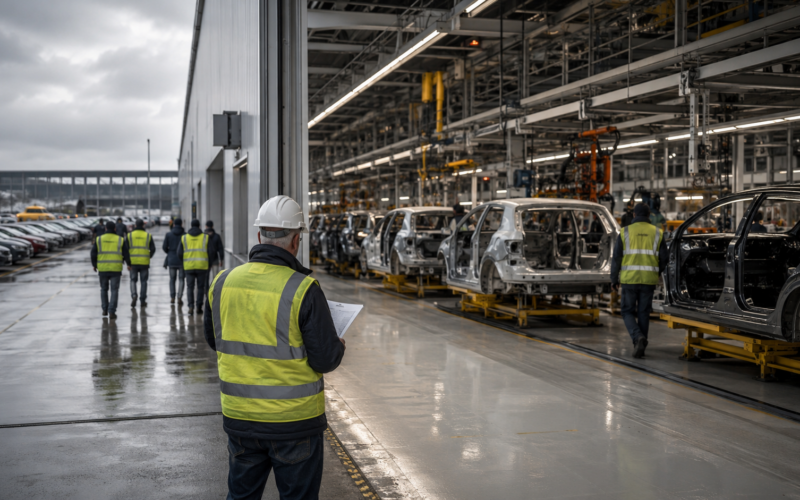
Volkswagen AG is reportedly preparing a restructuring that could eliminate up to 100,000 jobs globally, end vehicle production at four German factories and reduce planned investment by approximately 15%, creating the possibility of one of the largest workforce transformations in European industrial history.
The proposals have not been approved or formally announced by Volkswagen. The company declined to confirm the reported figures on June 26, saying the relevant matters would need to be discussed and approved by its governing bodies. Volkswagen nevertheless acknowledged that its existing business model no longer works for every brand in its current form and that the automotive group must undergo far-reaching change.
The reported plan would significantly expand the approximately 50,000 job reductions already under way across the Volkswagen Group. It could also reopen a confrontation with German labour representatives over factory closures, job guarantees and the future of several manufacturing regions.
With Volkswagen employing 602,659 people at the end of 2025, a reduction of 100,000 positions would represent approximately one-sixth of the group’s global workforce. That scale makes this more than a conventional cost-cutting programme. It would amount to a fundamental redesign of how Volkswagen develops vehicles, operates factories, organises its brands and allocates capital.
What exactly is Volkswagen reportedly considering under its latest restructuring plan?
The reported proposals are built around three interconnected changes: fewer employees, fewer operating factories and substantially lower investment.
Chief Executive Officer Oliver Blume and Chief Financial Officer Arno Antlitz are reportedly considering cutting up to 100,000 jobs over the next several years. The programme could include positions already scheduled to disappear, meaning the additional reduction may be closer to another 50,000 roles beyond the cuts currently being implemented.
Volkswagen is also reportedly examining the eventual closure of production facilities in Hanover, Zwickau and Emden, together with an Audi plant in Neckarsulm. Under the reported scenario, vehicle production would end after the current models allocated to those factories reach the end of their lifecycles.
The plan may also reorganise Volkswagen’s corporate structure by separating the Volkswagen Passenger Cars business and component-manufacturing operations into distinct legal entities. Such a change could provide greater transparency over costs, investment and performance, while potentially making future partnerships, asset sales or workforce negotiations easier to execute.
Investment over the coming five years could reportedly be reduced by approximately 15% to just over €130 billion. Volkswagen had previously outlined capital expenditure and research spending of approximately €165 billion for 2025 through 2029, reflecting the extraordinary cost of funding combustion vehicles, electric cars, batteries, software and regional product development at the same time.
The reported restructuring is expected to reach Volkswagen’s supervisory board on July 9. Until governance approvals and negotiations occur, the 100,000 figure should be treated as a strategic scenario under consideration rather than a confirmed layoff target.
Why would Volkswagen consider doubling its job-cutting ambition after its earlier union agreement?
Volkswagen already has an extensive workforce-reduction programme in progress. Under the Zukunft Volkswagen agreement reached with employee representatives in December 2024, the company committed to reducing more than 35,000 positions at its German operations by 2030.
That agreement was designed to lower annual labour costs by approximately €1.5 billion, contribute to more than €4 billion in annual savings from labour and production measures, and reduce German manufacturing capacity by around 734,000 vehicles. The broader programme was expected to deliver more than €15 billion in sustainable annual cost savings for Volkswagen AG over the medium term.

The arrangement attempted to balance competitiveness with employment security. Workforce reductions were expected to occur through retirement, voluntary departures and other socially managed measures, while Volkswagen provided job-security commitments extending to the end of 2030.
The latest reported plan suggests management may no longer believe the 2024 settlement goes far enough. Conditions have changed rapidly as Chinese carmakers expand in Europe, tariff barriers disrupt global production economics and electric vehicle development continues to consume substantial capital.
Volkswagen also operates one of the industry’s most complicated corporate structures, with brands including Volkswagen Passenger Cars, Audi, Porsche, Škoda, SEAT, Cupra, Bentley, Lamborghini and commercial vehicle businesses. Each brand requires engineering, manufacturing, sales, software and administrative resources, creating significant duplication across the group.
Blume’s apparent conclusion is that incremental efficiency measures may not resolve a structural cost problem. Volkswagen may need fewer management layers, more shared technology, sharper brand accountability and significantly lower fixed manufacturing capacity.
Why are Volkswagen’s Hanover, Zwickau, Emden and Neckarsulm plants reportedly at risk?
The four factories reportedly being examined represent different parts of Volkswagen’s manufacturing system, but they share a central challenge: future model allocation may not be sufficient to justify their existing scale.
Electric vehicles generally require fewer mechanical components and fewer production processes than combustion-engine vehicles. As manufacturers transition towards electric architectures, traditional engine, transmission and component operations face shrinking workloads.
Demand has also failed to develop exactly as many European manufacturers expected. Electric vehicle sales are growing, but pricing pressure, charging concerns, subsidy changes and competition from Chinese companies have complicated factory planning.
Zwickau became a flagship location for Volkswagen’s electric transition, producing models based on the company’s Modular Electric Drive Matrix platform. Its reported inclusion in the closure scenario is therefore especially significant. It suggests that converting a plant to electric vehicle production does not automatically guarantee high utilisation or long-term security.
Emden has also received substantial investment for electric vehicle production, while Hanover is closely connected to Volkswagen Commercial Vehicles. Neckarsulm is a major Audi production location. Closing any of these sites would demonstrate that recent investment cannot protect a factory when future products, volumes and cost structures no longer support continued operation.
The consequences would extend far beyond direct Volkswagen employees. Automotive factories support networks of component suppliers, logistics providers, maintenance contractors, catering businesses and local service companies. A production shutdown can therefore place several layers of regional employment under pressure.
Could Volkswagen legally and politically close German plants despite its previous commitments?
This may become the central governance battle surrounding the restructuring.
Volkswagen’s 2024 agreement linked significant workforce and capacity reductions with continued employment security. Labour representatives now argue that plant closures would cross a firm boundary and undermine the compromises employees previously accepted.
IG Metall and Volkswagen’s works council reacted strongly to the latest reports, saying they would oppose more aggressive savings proposals and factory closures. Labour leaders also criticised repeated media reports for creating uncertainty among employees and communities before formal proposals had been presented.
Employee representatives have substantial influence within Volkswagen’s supervisory governance system. Representatives aligned with the workforce, together with members connected to the German state of Lower Saxony, could make approval of a sweeping closure programme politically and institutionally difficult.
That does not mean the proposals are impossible. It means management would probably need to negotiate alternative product allocations, partnerships, site sales or extended transition periods before securing sufficient support.
Volkswagen has already explored unconventional solutions for underused plants. At Osnabrück, where production of the T-Roc sport utility vehicle is expected to end in 2027, possibilities have included third-party vehicle manufacturing and potential defence-related industrial work. Approximately 2,300 jobs are connected to that plant’s unresolved future.
Similar solutions could be considered for other factories. A site might cease producing Volkswagen vehicles without closing entirely if another company, joint venture or industrial sector can provide alternative work.
Why is Volkswagen considering reducing investment when software and electric vehicles require more capital?
Reducing investment appears contradictory when Volkswagen is attempting to compete with Tesla, BYD Company Limited and rapidly expanding Chinese manufacturers. The group needs new electric vehicles, more competitive batteries, advanced driver-assistance systems and significantly better software.
The problem is not simply the total amount Volkswagen spends. It is how widely that spending is distributed.
Volkswagen has historically supported numerous brands, platforms, powertrains and regional variations. That breadth provides substantial market coverage, but it also increases engineering complexity and slows decision-making.
A reduction towards approximately €130 billion could force Volkswagen to prioritise projects with the strongest commercial returns. Brands may share more vehicle architectures, electronic systems, software and purchasing operations. Marginal products or duplicated development programmes could be cancelled.
The risk is that Volkswagen cuts too deeply while competitors continue investing. Lower spending can improve near-term cash flow, but weak product development could leave the company with ageing vehicles or technological gaps later in the decade.
The quality of capital allocation will therefore matter more than the headline reduction. Volkswagen does not necessarily need to win every technological race independently. It needs to determine which capabilities must remain internal and which can be obtained through partnerships.
Its software relationship with Rivian Automotive, Inc. is one example of this changing approach. Rather than building every electronic and software capability through its own internal structures, Volkswagen is using strategic collaboration to accelerate development and share investment risk.
What does the reported restructuring reveal about Oliver Blume’s strategy for Volkswagen?
Blume appears to be moving Volkswagen away from its identity as a sprawling federation of semi-independent automotive businesses and towards a more financially controlled industrial platform.
Separating the core Volkswagen brand and component operations into distinct entities could make profitability and accountability easier to measure. It may become clearer which factories, product programmes and shared services create value and which survive largely because their costs are hidden within group structures.
The restructuring could also make future transactions easier. Volkswagen has already demonstrated greater willingness to divest operations outside its central automotive priorities. Further asset sales could generate cash while allowing management to concentrate on vehicles, software and mobility technology.
This approach carries governance risks. Volkswagen’s brands derive value from their individual identities, engineering traditions and customer relationships. Excessive centralisation could weaken differentiation and reduce local decision-making.
Blume must therefore achieve a difficult balance. Volkswagen needs less duplication, but it does not need every brand to become a different badge attached to the same vehicle and controlled by the same committee.
His leadership will be judged by whether restructuring produces faster product development and stronger margins, rather than merely smaller headcount figures.
Which Volkswagen employees and professional functions could face the greatest pressure?
Volkswagen has not released a role-by-role or country-by-country breakdown because the reported programme remains unconfirmed. However, the structure of the proposed transformation indicates where workforce pressure could emerge.
Manufacturing roles at underutilised German plants face the most visible exposure. Component operations associated with combustion engines, transmissions and conventional vehicle systems may also decline as electric vehicle production expands.
Corporate functions could face significant consolidation if Volkswagen creates more centralised or shared operations. Finance, procurement, information technology, human resources, legal services and administrative management are common targets when companies remove duplicated structures across multiple brands.
Middle management may face particular scrutiny. A simpler organisation generally requires fewer reporting layers and larger areas of responsibility for remaining executives.
Engineering will not be protected uniformly. Volkswagen still needs battery, software, electrical architecture and autonomous-driving expertise. Demand may weaken for roles tied primarily to declining mechanical technologies or duplicated vehicle programmes.
No verified salary bands or severance details have been announced for a possible 100,000-position plan. Employees and job seekers should be cautious about unofficial compensation claims until Volkswagen presents formal measures.
Where could Volkswagen continue hiring despite potentially eliminating thousands of positions?
Large restructurings rarely mean that every part of an organisation stops recruiting. Volkswagen is likely to continue competing for specialised talent even while total employment declines.
Software engineering, cybersecurity, artificial intelligence, battery management, vehicle electronics, automated manufacturing and digital sales are likely to remain strategically important. Volkswagen’s difficulty is that these roles often require different skills and may be based in different locations from the traditional manufacturing positions being removed.
Hiring may also shift towards markets where Volkswagen needs faster product development and lower costs. China-specific engineering and software have become increasingly important as Volkswagen attempts to compete with local manufacturers that develop vehicles rapidly and offer advanced digital features at aggressive prices.
The workforce transformation is therefore likely to involve substitution as well as reduction. Thousands of traditional roles could disappear while smaller numbers of highly specialised positions are created.
For job seekers, this changes the definition of an automotive career. Future opportunities may sit closer to software, data, electronics and energy systems than to traditional mechanical production.
What does Volkswagen’s recent stock performance say about investor confidence?
Volkswagen preference shares were trading around €78 during June 26, placing the stock close to the lower end of its 52-week range of approximately €76.02 to €109.15.
The shares had fallen roughly 8% over the preceding week and around 15% over one month, reflecting concern about profitability, capital requirements and the scale of the restructuring challenge.
The depressed valuation indicates that investors already expect substantial operational difficulties. Volkswagen continues to generate enormous revenue and possesses valuable brands, manufacturing capabilities and financial assets, but the market is questioning how much of that scale translates into sustainable shareholder returns.
A credible restructuring could eventually support investor sentiment by lowering fixed costs and improving capital discipline. However, factory closures, severance charges and labour disputes could create significant short-term expenses.
Investors are also likely to question whether a 15% investment reduction preserves sufficient funding for future products. Cost cutting would lose credibility if it strengthened near-term cash flow while weakening Volkswagen’s position in electric vehicles and software.
The stock therefore reflects a valuation conflict. Volkswagen appears inexpensive relative to its industrial scale, but investors remain unconvinced that management can restructure the group without damaging its competitive capabilities.
Could Volkswagen’s reported cuts trigger a wider European automotive employment crisis?
Volkswagen’s plans could influence restructuring decisions across Europe. Automakers including Mercedes-Benz Group AG, BMW AG and Stellantis N.V. face similar challenges involving high production costs, Chinese competition, regulatory pressure and expensive electric vehicle development.
If Volkswagen demonstrates that German factories once considered politically untouchable can be closed or repurposed, other manufacturers may pursue more aggressive capacity reductions.
Suppliers could experience even greater pressure. Automotive component businesses often operate with thinner margins and depend heavily on production volumes from a small number of major customers. Lower Volkswagen output could force suppliers to consolidate factories, reduce employment or seek customers outside Europe.
Governments will face difficult choices. Supporting every legacy factory may delay necessary industrial restructuring, but allowing major plants to close without replacement investment could damage entire regional economies.
Europe’s automotive challenge is therefore not merely protecting existing jobs. It is creating enough new employment in batteries, charging infrastructure, power electronics, defence, renewable energy and advanced manufacturing to offset the decline of traditional vehicle production.
What should Volkswagen employees, investors and suppliers watch next?
The July 9 supervisory board discussion will be the first major test. The central question will be whether the board treats the reported 100,000-job scenario as a negotiating position, an internal planning assumption or the foundation of an approved restructuring.
Employees should watch for details on affected brands, countries and functions. They should also monitor whether Volkswagen retains the socially managed departure mechanisms used in its previous German agreement or begins seeking compulsory redundancies.
Factory communities should focus on future product allocations. A plant’s survival depends less on its historical importance than on whether it receives vehicles, components or alternative industrial work beyond the current model cycle.
Investors should monitor the final investment budget, restructuring provisions, automotive cash flow and measurable savings. Announcing a large cost target is easy. Delivering it without product delays or manufacturing disruption is the real test.
Suppliers should examine Volkswagen’s purchasing forecasts and platform plans. A smaller product portfolio or fewer factories could rapidly alter component volumes and contract economics.
Key takeaways from Volkswagen’s reported 100,000-job restructuring scenario
- Volkswagen has not confirmed that it will eliminate 100,000 jobs. The figure comes from reports about an internal restructuring scenario that still requires discussion and approval.
- The plan would nevertheless represent a dramatic expansion of existing measures. Volkswagen is already implementing approximately 50,000 job reductions across the group, including more than 35,000 positions at German Volkswagen operations by 2030.
- The reported closure of plants in Hanover, Zwickau, Emden and Neckarsulm would challenge the assumptions behind Volkswagen’s previous labour agreement and trigger intense political and union opposition.
- Reducing five-year investment to approximately €130 billion could improve financial discipline, but it also creates the risk that Volkswagen underinvests while Chinese and electric vehicle competitors accelerate.
- For employees, the restructuring points towards fewer conventional manufacturing and administrative roles, combined with selective demand for software, battery, artificial intelligence and automation skills.
- For investors, the potential savings are significant, but the proposal also reveals how deeply management believes Volkswagen’s current operating model must change.
Discover more from Business-News-Today.com
Subscribe to get the latest posts sent to your email.