


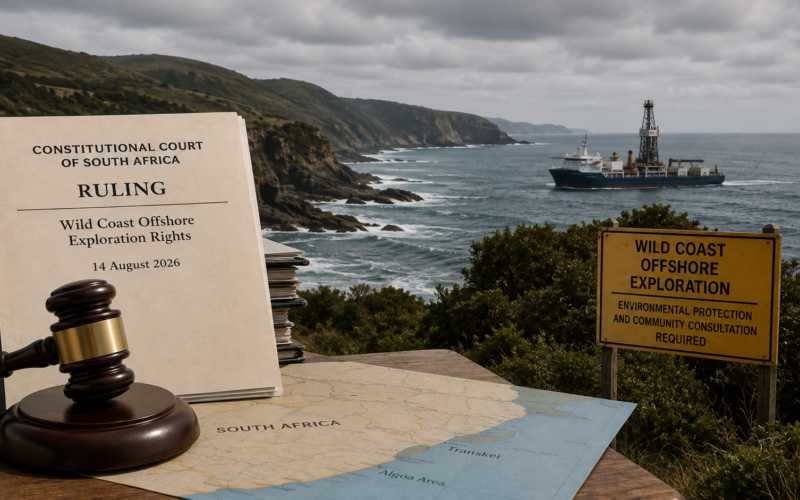
Shell plc (LSE: SHEL) has suffered a major legal setback in South Africa after the Constitutional Court blocked its long-running Wild Coast offshore exploration plans. The August 14 ruling set aside a 2024 Supreme Court of Appeal order that had kept the disputed exploration right alive while a final renewal application was considered. The immediate financial effect on Shell is small relative to its global portfolio, and its London-listed shares actually rose 0.97% on the day of the judgment. The broader significance is much larger for South Africa, where offshore oil and gas investment is already constrained by lengthy permitting processes and repeated legal challenges. The ruling raises a difficult question over whether South Africa can attract exploration capital while also meeting the consultation and environmental standards required by its courts.
The dispute concerns an exploration right originally awarded to Impact Africa Limited in 2014 for the Transkei and Algoa area off South Africa’s eastern coastline. Shell subsequently joined the project through BG International Limited and became involved in plans to conduct seismic exploration along the Wild Coast.
Years of litigation followed after coastal communities and environmental organisations challenged the approval process. Courts ultimately found serious defects in consultation with affected communities and in the consideration of relevant environmental, livelihood and cultural factors.
The 2024 Supreme Court of Appeal agreed that the original exploration right had been unlawfully granted. It nevertheless suspended the setting aside of the right, allowing the government to consider a third and final renewal application after an additional public-participation process. The Constitutional Court has now removed that remedy, closing the route that had allowed the existing right to remain alive.
Why does the Constitutional Court ruling change Shell’s Wild Coast position more than the 2024 judgment did?
The distinction between the two judgments is important.
The Supreme Court of Appeal did not reverse the finding that the exploration right had been unlawfully granted. Instead, it crafted a remedy that prevented the right from immediately disappearing. The court allowed the authorities to consider a final renewal application after further consultation designed to address deficiencies in the earlier process.
That gave Shell and Impact Africa an important procedural lifeline. They did not have to begin entirely from the start under a new application. The existing right remained relevant while the renewal process was considered.
Wild Coast communities and environmental organisations challenged that part of the ruling in the Constitutional Court. Their argument centred on whether shortcomings in the original process could effectively be repaired years later through consultation attached to a renewal application.
The Constitutional Court’s majority judgment has now set aside the Supreme Court of Appeal order that created that opportunity. The practical consequence is that Shell cannot proceed with the Wild Coast exploration programme through the route preserved by the 2024 judgment.
This is therefore more consequential than another temporary delay in seismic work. It removes the legal mechanism that had preserved the possibility of continuing under the original exploration-right framework.
The judgment does not mean South Africa has prohibited offshore oil and gas exploration generally. Nor does it establish that Shell cannot participate in different South African offshore projects operating under separate rights and approvals. The scope is the disputed Wild Coast exploration right and the legal process surrounding it.
That distinction will be crucial as the ruling is interpreted by investors and the wider energy industry.

Why did consultation with Wild Coast communities become the decisive issue for Shell’s exploration right?
The dispute has always involved more than technical environmental approval.
The original litigation focused heavily on whether affected coastal communities had been meaningfully consulted before the exploration right was granted. The Makhanda High Court found the consultation process inadequate and concluded that relevant interests had not been properly taken into account.
Those interests included fishing livelihoods and the cultural and spiritual relationship that some coastal communities have with the ocean. The litigation also raised environmental and climate-related considerations.
The Supreme Court of Appeal subsequently agreed that the exploration right had been unlawfully granted, although it chose a different remedy from the High Court. The Constitutional Court proceedings then concentrated heavily on whether later consultation could cure failures that occurred when the original right was approved.
That makes the judgment commercially relevant well beyond the Wild Coast.
Companies entering large infrastructure, mining and energy projects frequently treat public participation as one component within a larger permitting programme. The Wild Coast litigation demonstrates that consultation can instead become fundamental to the legal durability of the underlying right.
The consequence for developers is not necessarily that projects become impossible. It means consultation quality can affect whether an approval survives judicial review several years later.
For capital-intensive oil and gas exploration, that matters because expenditure often occurs long before commercial production. A company can spend heavily on geological work, seismic interpretation, technical studies and project preparation before discovering whether a prospect contains commercially recoverable hydrocarbons.
If the underlying regulatory right remains vulnerable during that period, the risk-adjusted economics become less attractive.
Could the Shell judgment make South Africa less competitive for offshore exploration capital?
South Africa is competing for exploration investment against countries that offer both geological potential and comparatively predictable development pathways.
The comparison with neighbouring Namibia has become increasingly uncomfortable.
Major offshore discoveries have transformed Namibia into one of the world’s most closely watched exploration provinces. Shell, TotalEnergies and other international companies have spent heavily evaluating discoveries and additional prospects, while Namibia has actively positioned itself as a destination for upstream capital.
South Africa shares part of the same broader geological opportunity on its west coast, including the Orange Basin. Yet commercial progress on the South African side has been considerably slower.
Legal challenges are only one reason. Offshore exploration also depends on environmental approvals, petroleum regulation, fiscal terms, infrastructure, geological evidence and corporate capital-allocation priorities. However, repeated disputes over permits and consultation increase the time between acquiring acreage and actually drilling.
That delay has an economic cost.
Exploration capital is mobile. A global oil company comparing opportunities can allocate money toward a prospect where regulatory timelines are clearer rather than waiting several years for a South African project to resolve litigation.
The challenge for South African policymakers is therefore not to weaken environmental or consultation requirements. Doing so could simply create approvals that remain vulnerable to further court action.
The more commercially durable solution is to make those processes clearer and more rigorous before expensive project commitments are made. A slower but legally robust approval can ultimately be more valuable than a fast approval that collapses after years of litigation.
Does the Wild Coast ruling threaten Shell plc financially or mainly change its South African options?
For Shell plc itself, the judgment does not appear financially material at group level.
Shell reported adjusted earnings of $9.8 billion for the second quarter of 2026 and generated more than $21 billion of cash flow from operations. Net debt fell to approximately $42 billion, while management maintained its 2026 cash capital-expenditure outlook of $24 billion to $26 billion.
The group also announced another $3 billion share-buyback programme following the results.
Against those numbers, the removal of one pre-development exploration opportunity in South Africa does not materially change Shell’s near-term earnings capacity. The Wild Coast acreage had not reached commercial production and therefore was not contributing established upstream cash flow.
The market reaction supports that interpretation.
Shell shares closed at £33.20 in London on August 14, up 0.97% for the session even though the Constitutional Court ruling had been reported earlier that day. The FTSE 100 declined 0.21%, meaning Shell outperformed the broader index during the session.
The stock remained about 11.7% below its 52-week high of £37.59 reached on June 4. Compared with the July 14 closing price of £31.47, however, the August 14 price was approximately 5.5% higher.
It would be inappropriate to interpret the August 14 gain as investor approval of the court ruling. Shell shares respond to global oil and gas prices, trading conditions, geopolitical developments, portfolio actions and broader equity-market factors.
The more defensible conclusion is that investors did not treat the Wild Coast decision as a sufficiently large financial event to overwhelm those other drivers on the day.
That distinction is useful. The judgment is potentially important for South African offshore investment policy while remaining relatively small for a company with Shell’s global asset base.
Why should Shell’s other South African offshore interests not be confused with the Wild Coast ruling?
The Wild Coast litigation applies to a specific exploration right and should not be described as a blanket prohibition on Shell exploration in South Africa.
Shell has interests connected with other offshore acreage governed by separate approvals and legal processes. Those projects must be assessed individually.
One example is Block 5/6/7 off South Africa’s southwest coast between Cape Town and Cape Agulhas. The exploration venture has involved TotalEnergies, Shell and the Petroleum Oil and Gas Corporation of South Africa.
That project has faced its own legal complications. In August 2025, the Western Cape High Court declared decisions connected with its environmental authorisation unlawful after identifying deficiencies in assessments, including consideration of oil-spill socio-economic consequences and climate effects.
Importantly, the court provided an opportunity for deficiencies to be addressed rather than permanently terminating the project. TotalEnergies had separately indicated its intention to withdraw from the licence, with Shell remaining involved in the venture.
The difference illustrates why South Africa’s offshore disputes cannot be treated as one collective case against the petroleum industry. Different exploration areas have different rights, environmental approvals, partners, procedural histories and court orders.
For Shell, the Wild Coast ruling therefore removes one exploration pathway rather than eliminating its entire South African offshore strategy.
For investors considering the broader sector, however, the accumulation of separate legal disputes still matters. Multiple projects encountering lengthy challenges can affect perceptions of jurisdictional risk even when each case has different facts.
How does Shell’s global portfolio strategy reduce the importance of losing one exploration option?
Shell enters the Wild Coast ruling while actively reshaping a global portfolio far larger than any single South African licence.
During its second-quarter results, management highlighted record production performance in Brazil, LNG Canada reaching full capacity and continued exploration activity in Namibia. Shell also said it had drilled what management described as its most promising exploration well to date in Namibia.
The company is simultaneously buying and selling assets.
Shell has agreed to acquire ARC Resources Limited, a major Canadian producer concentrated in the Montney resource region. Management expects that transaction to raise Shell’s anticipated production growth toward 2030 from around 1% annually to approximately 4%, compared with 2025.
Elsewhere, the company has been disposing of assets where management believes capital can earn stronger returns in other parts of the portfolio. Recent actions include the agreed $1.8 billion sale of Sprng Energy in India and the completed $1.3 billion disposal of Jiffy Lube International and Premium Velocity Auto in the United States.
Shell has also announced plans to reposition its South African mobility portfolio.
That capital-allocation model means an exploration project is constantly competing internally against opportunities in LNG, upstream oil and gas, trading, chemicals and other businesses.
The Wild Coast judgment therefore has an opportunity-cost dimension for South Africa. Shell does not need the project to maintain its global investment programme. It can allocate exploration and development capital elsewhere.
South Africa, by contrast, has a more concentrated interest in whether its offshore geological potential attracts drilling, discoveries and eventual domestic production.
That imbalance in negotiating position is one reason regulatory certainty matters.
Could the ruling ultimately improve South Africa’s investment framework rather than simply deter oil companies?
There is another possible interpretation of the judgment.
Repeated court defeats can deter investment if companies conclude that approvals are unpredictable. But strong judicial scrutiny can also force regulators and developers to improve procedures, eventually making future approvals harder to challenge.
The key variable is what government does next.
If policymakers respond by clarifying consultation requirements, environmental-authorisation procedures and the interaction between petroleum legislation and other environmental laws, future applicants could gain greater certainty before committing capital.
If instead each exploration project continues to produce disputes over what consultation was required, when it should have occurred and which environmental factors should have been considered, the investment penalty will persist.
This distinction matters because certainty does not necessarily mean making approvals easier.
An investor can price a demanding regulatory regime if the rules are clear. It is much harder to price a regime where the validity of a core licence can remain unresolved through several levels of court proceedings for years.
The Wild Coast case began around decisions taken more than a decade ago. The length of that process itself is commercially important because offshore exploration cycles are already long.
South Africa therefore has an opportunity to use the Constitutional Court judgment as a framework for reducing future ambiguity. The objective would be approvals that satisfy constitutional and environmental obligations from the beginning, rather than relying on courts to determine years later whether procedural shortcomings can be repaired.
What does Shell’s share-price reaction say about investor sentiment after the Wild Coast ruling?
The market reaction provides an important reality check on the scale of the event.
Shell closed August 14 at £33.20, gaining 0.97% while the FTSE 100 declined. Trading volume of approximately 4.8 million shares was also below the stock’s 50-day average of about 9 million.
There is therefore little evidence in the session itself of a material negative reassessment of Shell’s global valuation because of the Wild Coast judgment.
That is understandable.
Shell is valued primarily on global oil and gas prices, LNG performance, upstream production, refining and trading conditions, capital expenditure, balance-sheet strength and shareholder distributions. A pre-production exploration licence in South Africa is a comparatively small component of that equation.
The strategic signal is more important than the immediate earnings impact.
South Africa wants international companies to commit exploration capital and technical expertise to offshore acreage. A high-profile licence becoming unusable after more than a decade of regulatory and legal activity can influence how companies assess the timing and risk attached to future opportunities.
The market may therefore show little reaction in Shell shares while the decision still has meaningful implications for South African energy investment.
That is not a contradiction. It reflects the difference between materiality for a £200 billion-class global energy company and materiality for an emerging offshore petroleum jurisdiction.
What is the next measurable test for South Africa after Shell loses its Wild Coast legal lifeline?
The Wild Coast judgment resolves an important legal question but leaves a larger policy challenge.
Shell can absorb the loss of the opportunity within its global exploration portfolio. South Africa still needs to determine how it wants offshore petroleum development to coexist with constitutional rights, community participation and environmental regulation.
The next proof point will not be Shell’s quarterly earnings. It will be how government and regulators apply the Constitutional Court principles to future exploration applications.
A stronger regulatory framework would establish consultation requirements early, define the environmental process clearly and reduce the possibility that major rights remain vulnerable years after being awarded. That would not guarantee project approvals, but it would make both approvals and refusals more predictable.
Evidence of faster, legally durable decisions on other offshore applications would strengthen the argument that South Africa can remain investable while maintaining demanding environmental and community safeguards.
Continued litigation across multiple exploration blocks would point in the opposite direction. It would increase the probability that companies direct discretionary exploration spending toward jurisdictions where the timetable from licence award to drilling is easier to assess.
For Shell, the Wild Coast is now one lost option within a portfolio capable of shifting capital toward Canada, Brazil, Namibia, LNG and other opportunities. For South Africa, the ruling is a much larger test of whether the next generation of offshore rights can survive the legal process that this one could not.
Key takeaways from Shell’s Wild Coast ruling and South Africa’s offshore oil outlook
- South Africa’s Constitutional Court blocked Shell’s Wild Coast exploration plans on August 14 and set aside the relevant 2024 Supreme Court of Appeal order.
- The disputed exploration right was originally granted to Impact Africa Limited in 2014 and later became part of a Shell-led exploration programme.
- The Supreme Court of Appeal had agreed that the right was unlawfully granted but allowed it to remain alive while a third renewal application and additional consultation were considered.
- The Constitutional Court ruling removes that procedural lifeline and prevents the Wild Coast programme from proceeding through the preserved exploration-right route.
- The case centres heavily on meaningful consultation with affected coastal communities and the treatment of environmental, livelihood and cultural considerations.
- The ruling applies to the Wild Coast exploration right and does not constitute a general prohibition on Shell or other companies exploring elsewhere offshore South Africa.
- Shell’s global financial exposure is limited, with the company reporting $9.8 billion of second-quarter adjusted earnings and more than $21 billion of operating cash flow.
- Shell shares rose 0.97% to £33.20 on August 14, indicating that the judgment did not dominate the global company’s market valuation that day.
- The larger commercial issue is whether repeated legal and permitting delays make South African offshore exploration less competitive for internationally mobile capital.
- The next test is whether regulators can convert the Constitutional Court principles into clearer consultation and approval processes for future offshore projects.
Discover more from Business-News-Today.com
Subscribe to get the latest posts sent to your email.