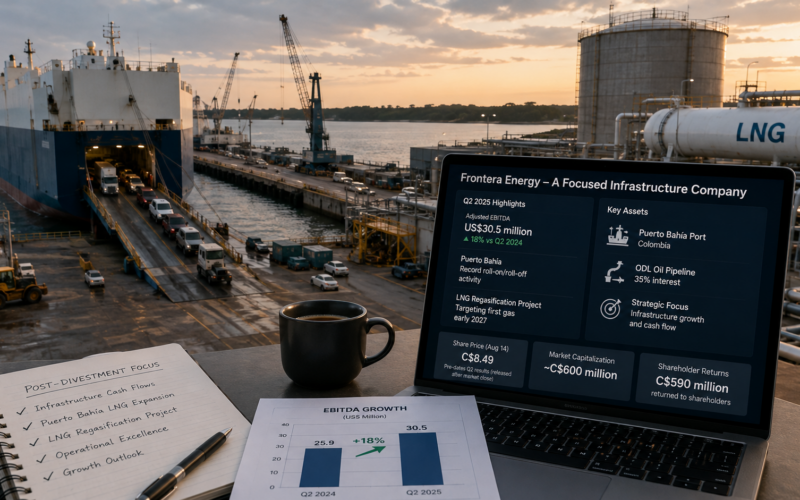
Frontera Energy Corporation (TSX: FEC) enters a new phase after completing the sale of its Colombian exploration and production assets and emerging as a focused infrastructure company built around Puerto Bahía and a 35% interest in the ODL oil pipeline. The company reported second-quarter adjusted EBITDA of US$30.5 million, up 18% year on year, while Puerto Bahía delivered record roll-on/roll-off activity and Frontera advanced an LNG regasification project targeting first gas in early 2027. FEC closed at C$8.49 on August 14, but that price predates the Q2 release because the results were issued after the Toronto market had closed. The immediate investor question is therefore whether a company now worth roughly C$600 million can turn its existing infrastructure cash flows and Puerto Bahía LNG expansion into enough growth to justify the post-divestment valuation after returning C$590 million to shareholders.
What does Frontera Energy actually own after selling its oil production business?
Frontera Energy is no longer primarily the Colombian upstream producer many investors may associate with the ticker.
On June 1, Parex Resources Inc. completed the acquisition of Frontera’s Colombian exploration and production portfolio for an aggregate transaction value of US$750 million. The transaction included US$500 million of upfront cash consideration, US$225 million of assumed net debt and a potential US$25 million contingent payment linked to an extension of the Quifa contract.
Frontera subsequently returned C$8.34 per share, approximately C$590 million in aggregate, to shareholders.
What remained is a much simpler infrastructure company.
Frontera owns 99.97% of Puerto Bahía, a multipurpose maritime terminal near Cartagena, Colombia, and a 35% equity interest in Oleoducto de Los Llanos Orientales, or ODL, one of Colombia’s principal crude-oil transportation pipelines.
ODL connects major Llanos Basin production areas with the Monterrey and Cusiana stations. Frontera says the pipeline transports approximately 30% of Colombia’s oil production and generates recurring dividends and capital distributions.
Puerto Bahía provides liquids handling, roll-on/roll-off vehicle logistics, containers and break-bulk services. The terminal is also developing liquefied petroleum gas infrastructure and, more importantly for the future investment case, an LNG import and regasification business.
The shift changes how FEC should be assessed. Oil-production volumes and drilling programmes are no longer the central metrics. Pipeline distributions, port throughput, leverage, infrastructure returns and progress toward LNG first gas now matter considerably more.

How strong were Frontera Energy’s first results as a focused infrastructure company?
Second-quarter adjusted revenue reached US$48.7 million compared with US$41.8 million a year earlier, an increase of approximately 16%. Adjusted EBITDA increased 18% to US$30.5 million, producing a 63% adjusted EBITDA margin.
First-half adjusted EBITDA reached US$59.0 million.
That number is useful because when the Parex transaction closed in June, Frontera said the standalone infrastructure company was expected to generate US$110 million to US$120 million of adjusted EBITDA during 2026.
Taking the US$115 million midpoint as an illustrative benchmark, Frontera would need approximately US$56.0 million of adjusted EBITDA during the second half.
That is about 5% below the US$59.0 million generated during H1.
Reaching the US$110 million lower end would require approximately US$51.0 million of H2 adjusted EBITDA, around 13% below the first-half contribution. Reaching US$120 million would require about US$61.0 million, only around 3% more than H1.
Those calculations suggest the earnings hurdle established at the time of the transaction does not require a dramatic second-half acceleration. The more important issue is the durability of the cash flows and how much additional capital must be invested to create the next stage of growth.
Reported net income for Q2 was US$29.0 million, but that figure included discontinued operations related to the upstream business. Continuing operations recorded a US$4.0 million net loss.
Investors should therefore avoid valuing the new Frontera simply by annualising headline Q2 net income. Adjusted EBITDA and infrastructure distributable cash flow provide more useful indicators while the financial statements continue reflecting the effects of the transformation.
Why could Puerto Bahía LNG become the most important FEC catalyst?
Puerto Bahía’s planned LNG regasification project has become the largest identifiable growth option inside the post-divestment company.
Puerto Bahía has signed a take-or-pay agreement with Ecopetrol S.A. covering a seven-year service term once operations begin. Frontera has also secured floating storage and regasification unit capacity with Excelerate Energy.
The proposed service includes receiving imported LNG, regasifying it and delivering natural gas into the Colombian market.
Management is targeting first gas in early 2027.
That timetable gives FEC a relatively near-term catalyst compared with infrastructure projects that can spend several years in construction before generating revenue. The August 18 investor call should provide an early opportunity for management to clarify the remaining milestones, spending requirements and commissioning timetable following the Q2 update.
The project also has strategic relevance beyond Frontera itself. Colombia has faced increasing attention around future natural-gas supply and the need for additional import infrastructure. A functioning LNG terminal at Puerto Bahía could therefore become part of the country’s energy-security infrastructure rather than simply another cargo business at the port.
However, the commercial structure should not be treated as equivalent to a completed project.
Frontera has said additional third-party arrangements, regulatory requirements and execution milestones remain relevant. The project also depends on infrastructure integration and successful commissioning of the regasification system.
The clearest proof point is consequently not another announcement about project potential. It is achieving first gas close to the early-2027 target with capital requirements remaining manageable.
Is Puerto Bahía already growing before LNG starts?
The existing port business produced strong second-quarter operating evidence.
Puerto Bahía generated US$14.6 million of port revenue compared with US$11.3 million a year earlier, an increase of approximately 29%.
Roll-on/roll-off activity was especially strong. The port handled 48,074 vehicles during Q2, up from 28,283 a year earlier and 38,067 during Q1.
That represents year-on-year growth of roughly 70%.
April also established a monthly record with approximately 17,200 units handled.
The strength reflects Puerto Bahía’s increasing role serving Colombia’s automotive logistics market. General-cargo revenue reached approximately US$8.1 million in Q2 compared with US$4.3 million a year earlier.
Liquids-terminal revenue was about US$6.5 million, broadly similar to the previous year’s US$6.8 million, while LPG volumes increased to 4,000 tonnes from 1,200 tonnes during Q1.
Not every port metric improved. Container volumes declined to 3,277 twenty-foot-equivalent units from 3,993 a year earlier, while break-bulk activity remained relatively small and can fluctuate significantly between periods.
The broader picture is nevertheless constructive because Puerto Bahía is generating growth before LNG begins contributing.
That reduces dependence on the regasification project being the sole source of future expansion. A stronger investment case would emerge if vehicle logistics, LPG and containers continue growing while LNG becomes an additional contracted infrastructure revenue stream.
How valuable is Frontera’s 35% ODL pipeline interest?
ODL provides the more stable side of the portfolio.
Pipeline throughput averaged approximately 239,300 barrels per day during Q2 compared with about 235,800 barrels per day a year earlier. The average transportation tariff was US$4.59 per barrel.
ODL generated US$47.5 million of net income during Q2, of which approximately US$16.6 million was attributable to Frontera’s 35% economic interest.
For 2026, ODL declared net dividends to Frontera of US$64.7 million compared with US$52.9 million during 2025. Frontera received US$26.8 million of those dividends during the first half.
The ODL interest therefore provides substantial cash generation relative to Frontera’s current size.
Last-twelve-month infrastructure distributable cash flow reached US$78.8 million at June 30. Management cautioned that changes in this measure can be affected by the timing of ODL distributions rather than changes in underlying pipeline performance.
That qualification matters because infrastructure cash flows can look unusually strong or weak in individual quarters depending on when distributions arrive.
The more useful indicators are annual ODL distributions, pipeline throughput and the sustainability of the underlying crude volumes moving through the system.
ODL and Puerto Bahía also create different risk characteristics. ODL is an established pipeline generating distributions today, while LNG at Puerto Bahía represents a higher-growth opportunity that still requires additional execution.
That combination is potentially attractive if Frontera can use predictable ODL cash flows to support growth without overleveraging the company.
Does Frontera have enough financial flexibility to fund LNG growth?
Frontera ended June with US$56.3 million of cash and cash equivalents against US$170.5 million of debt and lease liabilities.
Net debt was US$114.2 million.
The ratio of net debt to last-twelve-month adjusted EBITDA improved to 0.98 times from 1.33 times at the end of March.
That is a relatively moderate leverage level for an infrastructure business, but the LNG project means cash cannot be viewed simply as surplus capital.
Management has identified maintaining liquidity, meeting scheduled debt obligations and funding committed LNG development milestones as near-term capital-allocation priorities.
First-half capital expenditure from continuing operations was only US$2.5 million, indicating that the existing infrastructure business has not required unusually heavy capital spending during the period. LNG spending could change that profile as the project advances toward commissioning.
At the June transaction close, Frontera indicated it expected to retain approximately US$64 million of cash, including US$39 million earmarked for Puerto Bahía growth projects and US$25 million for debt and other liabilities.
The Q2 balance sheet is broadly consistent with a company beginning that new capital-allocation phase.
The key financial test is therefore not whether Frontera can show low leverage immediately after disposing of the upstream business. It is whether leverage remains controlled as LNG spending increases and whether the new project begins generating contracted cash flows on schedule.
Is FEC cheap after returning C$590m to shareholders?
Frontera closed at C$8.49 on August 14, up 0.35% for Friday’s session.
The stock had closed at C$8.10 on August 7, meaning FEC gained approximately 4.8% over the latest five completed trading sessions. Compared with C$8.97 on July 14, however, the shares remain about 5.4% lower over one month.
The 52-week range is C$4.96 to C$16.77.
With approximately 69.7 million shares outstanding, the August 14 price implies an equity market capitalisation close to C$600 million.
An unusual comparison emerges from the restructuring. The C$590 million capital return completed in June is almost equal to Frontera’s entire current equity market value.
That does not mean investors are somehow receiving the remaining infrastructure business for free. The distribution has already left the company and was reflected in the ex-distribution adjustment to the share price. The comparison instead illustrates how dramatically Frontera’s capital structure and asset base have changed.
Traditional trailing valuation ratios are also unusually difficult to interpret because historical revenue and earnings include businesses that Frontera no longer owns.
The more relevant valuation inputs are the earnings capacity of the retained infrastructure assets, the value of the ODL stake, sustainable Puerto Bahía cash flow, net debt and the future economics of the LNG project.
At the June transaction close, management expected the infrastructure company to generate US$110 million to US$120 million of 2026 adjusted EBITDA and US$80 million to US$85 million of distributable free cash flow.
Those figures are particularly important now because they provide a cleaner starting point for valuing the post-sale company than consolidated historical earnings.
Frontera Energy stock key takeaways after the Q2 infrastructure reset
- Frontera Energy has completed the sale of its Colombian upstream assets to Parex Resources and now operates primarily through Puerto Bahía and a 35% interest in the ODL pipeline.
- Q2 adjusted EBITDA increased 18% year on year to US$30.5 million, taking first-half adjusted EBITDA to approximately US$59.0 million.
- H1 adjusted EBITDA already represents slightly more than half the US$110 million to US$120 million 2026 infrastructure earnings range outlined when the Parex transaction closed.
- Puerto Bahía handled a record 48,074 roll-on/roll-off units during Q2, approximately 70% more than a year earlier.
- The LNG project has a seven-year take-or-pay agreement with Ecopetrol and secured floating regasification capacity from Excelerate Energy, with first gas targeted for early 2027.
- Frontera ended June with US$114.2 million of net debt and net leverage of 0.98 times last-twelve-month adjusted EBITDA.
- The August 18 investor call is the next immediate milestone, with LNG execution, capital requirements and post-divestment cash allocation likely to be the most important issues for shareholders.
What would strengthen or weaken the Frontera Energy investment case?
Frontera Energy is now a fundamentally different company from the one investors owned at the beginning of 2026. The upstream portfolio has been sold, C$590 million has been returned to shareholders and future value increasingly depends on two infrastructure assets with very different characteristics.
ODL provides established pipeline cash flows and meaningful annual distributions. Puerto Bahía provides an operating port business that is already expanding in automotive logistics and LPG, alongside the larger potential catalyst from LNG regasification.
The investment case would strengthen if second-half adjusted EBITDA remains near the first-half run rate, ODL continues generating stable distributions and Puerto Bahía maintains strong general-cargo growth. Most importantly, completing the remaining LNG milestones and achieving first gas in early 2027 without a material increase in leverage would give investors tangible evidence that the post-divestment company can create a new growth engine.
The thesis would weaken if LNG commissioning slips materially beyond early 2027, project spending rises significantly above current expectations or ODL distributions decline enough to reduce the stable cash flow supporting the wider portfolio.
Frontera has already completed the largest corporate event in the story by exiting Colombian oil production and returning a substantial amount of capital. The next phase is narrower and easier to measure. FEC now needs to prove that a focused Colombian infrastructure portfolio can turn a roughly US$59 million first-half EBITDA base and an emerging LNG project into sustainable cash-flow growth after the extraordinary capital return is behind it.
Discover more from Business-News-Today.com
Subscribe to get the latest posts sent to your email.