


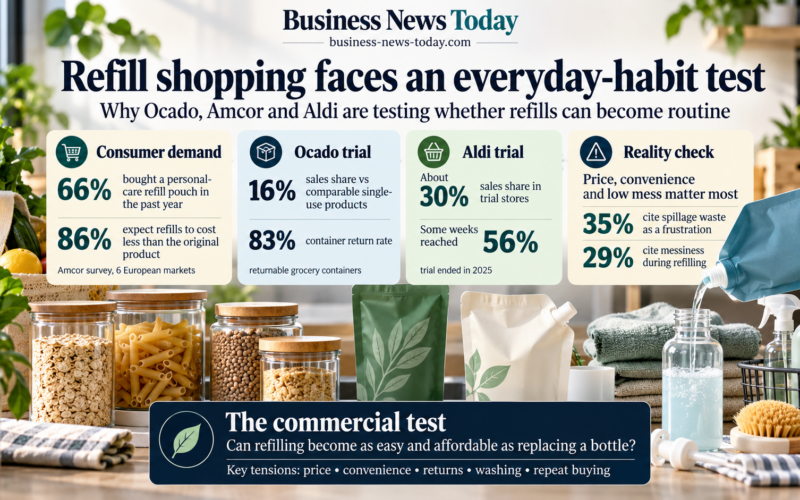
Ocado Retail is extending a reusable-container programme for British online grocery customers, while packaging manufacturer Amcor has reported substantial consumer participation in refill pouches for shampoo, shower products and hand soap across six European countries. Amcor’s April 2026 survey of 2,749 consumers found that 66% had purchased a personal-care refill pouch in the preceding year, but 86% expected refills to cost less than the original product. At Ocado, a UK trial recorded a 16% sales share for returnable containers compared with equivalent single-use products, and its partners are preparing to expand availability to more of the grocer’s customer base. Yet earlier refill programmes at Aldi, Asda and Tesco also exposed the difficulty of turning local consumer enthusiasm into repeatable retail operations. The commercial opportunity is to make replenishing a familiar product as easy and affordable as replacing it, while keeping packaging, collection, washing and handling costs low enough to support a profitable business.
Why are refill pouches gaining traction in European bathrooms?
Refill packaging is already part of purchasing routines for a meaningful share of consumers in personal care, although its prevalence differs by product and market. Amcor’s June 2026 publication covered survey respondents in France, Germany, Italy, Poland, Spain and the United Kingdom, focusing on shower and bath products, hair care and handwashing liquids. Beyond the 66% who reported buying pouches, 81% said recyclability would make them more inclined to purchase a refill and 74% favoured refill packaging using recycled plastic. These are self-reported survey findings, not independently audited sales figures, but they indicate that the purchasing proposition is familiar rather than purely theoretical.
Price appears to be the stronger lever for further adoption. The same survey found that 69% would buy more refills if they cost less, while 45% said easier discovery in stores or online would encourage additional purchases. Among respondents not buying refills, nearly half said their preferred product or brand was unavailable in that format. For manufacturers, this suggests that placing a pouch beside its corresponding bottle, and giving shoppers an obvious price advantage, could matter more than promoting an environmental message in isolation.
What do Ocado’s grocery trials reveal about actual repeatable consumer behaviour?
Ocado Retail, the British online grocery business jointly owned by Marks & Spencer Group and Ocado Group, has been testing a more demanding proposition since 2024. Customers receive selected products, including pasta, rice, laundry detergent and fabric conditioner, in prefilled reusable vessels delivered with their normal order. They can hand the empties to the delivery driver on a subsequent visit, after which the containers are cleaned and refilled for circulation. This uses an existing delivery relationship rather than requiring a shopper to visit a separate return point.
The Refill Coalition’s 2025 industry report found that the trial’s reusable products averaged a 16% sales share against their single-use packaged equivalents, with some weeks reaching 43%. Ocado’s sustainability reporting recorded an 83% vessel return rate and found that 96% of surveyed participants said they were likely to buy again. The results have different meanings: sales share shows purchasing within the tested assortment, return rate measures the recovery of containers, and stated intention measures future interest rather than confirmed repeat buying. Together, they provide more useful evidence than an announcement of product availability alone.
In May 2026, Amcor confirmed it would continue producing the specially designed 2-kilogram and 3-kilogram vessels for the project. Ocado described expansion to additional customer fulfilment centres, with an objective of making the scheme accessible to 90% of its customer base and extending the product range. That is a rollout objective, not proof that 90% of customers will use refillable containers. The commercially relevant question is whether wider availability preserves return performance while reducing the cost of collecting and preparing each container for its next use.
Why did Aldi attract refill purchases but still end its supermarket trial?
Aldi UK’s experiments reveal how a well-designed in-store system can encourage customers to refill dry groceries. In Solihull and Leamington Spa, the retailer used dispensers supplied by reusable bulk vessels rather than conventional individually wrapped products. The Refill Coalition reported that refill options regularly captured about 30% of sales against comparable packaged products in those stores, occasionally reaching 56% during individual weeks. Surveyed participants also reported favourable experiences with hygiene and ease of use.
Nevertheless, the Aldi trials concluded in February 2025 after approximately 16 months rather than becoming an announced permanent national programme. Their results establish that a meaningful proportion of customers chose refills when given a convenient local option; they do not establish that the full cost structure would work across every store. Each location must still accommodate the dispensers, weighing procedures, replenishment arrangements and staff routines needed to operate the system. Scaling those processes without creating excessive labour or space costs is a separate challenge from attracting trial purchases.
The coalition reported that redesigning the in-store system reduced staff time needed to manage fixtures by 86% relative to its model of a more manual refill approach. It also argued that larger volumes should reduce equipment, filling and transport costs per unit. Those are encouraging operational findings, but expected savings at scale still depend on investment, purchasing volumes and the way retailers integrate systems into existing operations.
What did Asda and Tesco learn from earlier refill experiments?
Other British supermarket trials show why operational friction can outweigh environmental appeal. Asda ended refill-station experiments at four stores in July 2024 after reporting weak customer uptake alongside difficulties involving cost, convenience, cleanliness and perceived product quality. The retailer had tested ways to improve visibility and previously introduced a pledge to make refills cheaper than packaged counterparts, yet concluded that its model was too challenging to operate and scale. The decision is an important counterexample to the assumption that public enthusiasm inevitably creates a workable supermarket business.
Tesco’s earlier partnership with Loop explored reusable packaging for online and in-store shopping, including a trial in ten British stores. In its own packaging reporting, Tesco said the pilots had concluded after customers bought more than 80,000 products across the programmes over two years. The retailer continued working with others to understand how reuse could expand, rather than presenting the trials as a permanent national service. Tesco’s experience demonstrates that transaction activity and operational learning can be valuable even when a trial does not progress directly into routine retail distribution.
How much do price, availability and convenience matter to refill customers?
Amcor’s research offers a practical picture of barriers after initial interest. More than one-third of surveyed consumers identified wasted product from spills as a frustration, while 29% cited messiness during refilling. Another third said they encountered no problems, showing that the experience is not uniformly inconvenient. For product designers, compatibility between spouts, bottles and dispensing pumps could have a measurable role in encouraging customers to refill repeatedly.
WRAP’s Recycle Now initiative provides a useful contrast between willingness and observed behaviour. In March 2026 it mapped 675 refill locations around the United Kingdom and pointed to earlier consumer research showing that 87% of respondents were open to online refill shopping and 89% to in-store options. Yet only 25% of surveyed adults aged 18 to 34 said they had taken their own packaging for an in-store refill during the preceding few years, compared with 8% of those aged 55 and over. These measures concern different types of interest and behaviour, but the gap illustrates why environmental attitudes alone cannot be treated as adoption rates.
Can reusable containers compete financially with single-use packaging?
Reusable packaging changes the cost equation rather than simply removing it. A durable vessel costs more to manufacture than an individual disposable pack and may need to be tracked, transported back, cleaned, inspected and refilled many times. Each successful circulation spreads its original cost over more product deliveries, whereas lost or damaged vessels interrupt that economics. Return rates, washing capacity and delivery-route density therefore matter directly to the financial proposition.
The Refill Coalition argues that standardised containers and existing logistics networks can lower costs as participation grows. Its operating analysis found reduced store labour for the redesigned Aldi system and modelled more competitive per-unit costs at higher volumes for both refill stations and Ocado’s returnable containers. However, a claim that a scheme could be competitive at scale is not the same as a disclosed contribution margin or a demonstrated profitable national rollout. Retailers must still decide who funds containers and cleaning infrastructure, and whether savings on disposable packaging and waste charges cover the incremental handling costs.
For an online operator, a return rate in the eighties is promising because most containers come back without a deposit programme, but it is not equivalent to an unlimited number of rotations. Some units will be lost, damaged or taken out of circulation over time, so the system must replenish inventory. Ocado and its suppliers will need performance evidence over longer periods to determine actual lifetime use and the resulting cost per delivery.
Is refill packaging always environmentally better than disposable alternatives?
Environmental outcomes depend on the baseline material, distance travelled, number of reuses and energy required for washing. An April 2025 lifecycle assessment prepared by Eunomia for the Refill Coalition modelled Aldi’s in-store format and Ocado’s online returnables against several conventional packaging alternatives at scale. It found potential environmental advantages across many of the compared products, especially when replacing certain plastic formats. The analysis did not establish that every reusable container outperforms every single-use alternative under real-world operating conditions.
One especially useful exception involved oats sold in an unlined paper bag. Under the study’s baseline assumptions, that single-use format performed better than the reusable option in several impact categories, including climate change, while the relative performance of other products depended on wash throughput and reuse cycles. The researchers also stressed that the primary analysis modelled scaled operations rather than measuring a completed nationwide system. This is an important safeguard against equating the presence of reusable packaging with a verified environmental saving in every application.
Refill pouches involve a different environmental comparison. A flexible refill pack may use less material than a replacement rigid bottle, but the pouch can still be single-use and its end-of-life treatment depends on local collection and recycling capability. Returnable systems may eliminate repeated disposal of the main vessel but add washing and transport impacts. Manufacturers should therefore evaluate the full system rather than relying on a generic environmental claim attached to the word refill.
Which packaging suppliers could benefit if refill shopping becomes routine?
Amcor plc (NYSE: AMCR; ASX: AMC) has positioned itself to supply both components of the refill relationship: the initial durable bottle and the pack used to replenish it. In September 2026, the company detailed rigid containers and dispensers alongside spouted AmPrima refill pouches ranging from 30 millilitres to two litres. Its continued involvement in Ocado’s reusable-container trial provides a separate example of the design and manufacturing work required for a returnable system. The opportunity spans product engineering, closures, leak resistance and compatibility across retail and household use.
Elopak offers a different approach through D-PAK cartons for personal-care and home-care liquids, including applications such as handwash and cleaning products. Its positioning illustrates that refill does not necessarily mean a flexible pouch or a store dispenser; cartons and other packages can also be designed for decanting into reusable containers. Technical performance, product protection, material use and customer convenience will determine where different formats compete successfully. None of these product offerings establishes a quantified future earnings contribution for the suppliers.
How could European packaging rules change the economics of reuse?
The European Union’s Packaging and Packaging Waste Regulation began applying in phases from August 12, 2026, creating a new regulatory context for producers and retailers operating in the bloc. The rules address packaging prevention, recyclability, recycled content and various reuse and refill requirements, with additional obligations scheduled for later years. From 2030, large retail establishments are expected to endeavour to dedicate part of their sales area to refill stations, subject to the regulation’s detailed conditions. That does not amount to an immediate requirement for every supermarket to operate a universal refill service.
Regulation can make packaging design and waste management costs more significant in commercial planning, potentially supporting investment in alternative formats. However, the United Kingdom’s schemes operate under their own regulatory and commercial arrangements, so EU rules should not be presented as the direct cause of Ocado’s or Aldi’s pilots. Even in EU markets, compliance-driven adoption does not automatically mean consumers prefer a new shopping routine. Companies still have to provide reliable products at prices and levels of convenience that shoppers accept.
What would prove that refilling can become an ordinary retail habit?
The most convincing proof over the next 6 to 24 months would be sustained product sales and repeat participation beyond controlled trials. Ocado’s expansion offers a direct test: broader product choice, consistently high return rates and demonstrated reductions in per-use container costs would indicate progress towards an economically scalable service. For refill pouches, independent sales growth across several personal-care and household categories, coupled with repeat purchasing at normal prices, would be stronger evidence than favourable survey responses. Retailers restarting or expanding in-store schemes after solving earlier operating problems would add another independent confirmation.
The contrary signals are equally clear. Low vessel recovery, rising cleaning and transport costs, customer complaints about spills, persistent discounting or the closure of further trials would weaken the business case. Product-specific lifecycle results will remain relevant, particularly where reusable packaging replaces lightweight materials that already perform efficiently. Public disclosure of refill-related profitability and customer retention would provide the most direct evidence that the model is generating commercial value instead of merely shifting environmental costs around the supply chain.
Refill packaging is already a real purchasing choice in parts of personal care, and selected grocery trials show that consumers will adopt returnable or self-dispensed formats when they fit established routines. The unresolved opportunity is not to persuade every shopper to become an environmental enthusiast, but to make refilling feel like an ordinary, economically sensible way to buy familiar products. If retailers and packaging suppliers can deliver that combination consistently, refill systems could become a lasting consumer business rather than a collection of promising but disconnected trials.
Discover more from Business-News-Today.com
Subscribe to get the latest posts sent to your email.